28 December 2010

A New Lawsuit Against JPM and HSBC for Silver Manipulation With An Interesting ETF Twist


This lawsuit specifically cites JPM and HSBC as custodians of the largest silver ETFs, SLV and SIVR, and how they used that market positioning to manipulate their knowledge and market positioning as custodians of these funds to manipulate the silver price to their benefit.

The goal of this lawsuit is to move to the discovery process, and to attach itself to the ongoing CFTC and DOJ investigations into the silver market. It will be very interesting to watch this drama unfold over the coming months.

It is always worrisome when the 'house' sits down at the same table as the players and bets against them. It ought to never be permitted except in the course of making a market in limited circumstances, because as the lawsuit also illustrates, the opportunity for private collusion is beyond the scope of the regulators, especially given the ability for the house to deal in dark pools.

And of course the root of the problem is that the Wall Street banks, which had been engaged in massive frauds in subprime debt instruments, were never reformed, and in fact became even larger and more hungry, now devouring whole markets and even small nations in their search for fees and illicit profits.

Paul Volcker's vision of a return to 'narrow banking' may very well prove to have been wisdom as compared to the current financial system of unproductive mammoths still unfolding.

Plaintiffs vs. JPM and HSBC

8. In this case, the vast majority of trading on CME/COMEX and NYSEArca was electronic. While electronic trading was intended to allow for greater efficiency and “freer” markets, it has actually provided greater opportunities to restrain trade in the markets and manipulate prices. Rather than being visible in an “open outcry” pit and subject to the scrutiny of fellow market participants, the vast majority of trading is electronic, involving traders who sit at computer-trading terminals and place orders anonymously. Thus, unlike where pit or open-outcry trading is the dominant form of placing offers and bids, nothing prevents potential manipulators in this market from signaling or outright communicating with each other to drive the market in any direction they deem fit, or from posting sham orders that are intended to drive prices in an artificial way. In other words, because of electronic trading, market participants are generally unable to police one another. Thus, defendants JP Morgan and HSBC, had an opportunity to communicate and signal to each other their market moves (i.e., conspire and
manipulate) without detection by other market participants.

11. Before the Class Period began, JPMorgan had become the custodian and an authorized participant of the largest known concentration of silver bars, the iShares Silver ETF, which holds in excess of 340 million troy ounces of silver, a sum that equals an estimated 1/3 of the total present global supply of silver bullion. As a result, it had actual knowledge of the precise whereabouts of much of the world’s known silver bar supply.

12. In approximately March 2008, JP Morgan acquired Bear Stearns, which held a very large short position in silver. With more of the total short position in silver concentrated in the hands of JP Morgan, it had a further motive to suppress prices.

13. Upon information and belief, JP Morgan works together with HSBC, the other dominant player in the silver and precious metals markets. In July 2009, HSBC became the custodian of the SIVR ETF, which meant that it had physical access to and knowledge of the silver held by that trust. Notably, it named JP Morgan as one of the sub-custodians of the SIVR ETF.

14. As a result of their participation in the silver ETFs, JP Morgan and HSBC had a direct opportunity to confer and discuss with each other the prices of silver held by each of them.

15. In addition, Defendants had a strong incentive to suppress downward the price silver as measured by the NYSE-Arca and CME/COMEX instruments. For example, Defendants could pledge their silver to the ETFs in exchange for ETF shares, sell their shares to other market participants, drive down the prices of silver through trades on NYSE-Arca and CME/COMEX, buy back their ETF shares from investors at lower prices, and return their (now lower priced) silver ETF shares in exchange for the silver bars initially pledged against those shares, the real value of which remained the same, and only notionally appears lower because of Defendants’ suppression.

There are other ETFs which have similar setups and opportunities for market manipulation by the 'custodians' and insiders. There are a few that on the surface appear to be so stacked against the buyer as to approach the level of fraud. Professional traders snigger that those who are not specifically informed enough to find this out for themselves deserve to be 'taken.' I wonder how these smart fellows would feel if the medical profession in which they and their children are customers was managed in the same way. A bull market in infant mortality and thalidomide babies?

This is not some efficient free market but a kind of hell in which no one or nothing can be trusted, a society that dissolves into mere anarchy and madness.

But in fact the common protection of the many against the more powerful, the average person against the insider, with the creation and maintenance of a public infrastructure, are the primary functions of popular government. And if you look to the governments of the developed nations against this benchmark, too many recently appear to be miserable failures.

The source of this failure and its remedy is a familiar tale to those well read in history, and is the great story of the beginning of this century.

"It is to be regretted that the rich and powerful too often bend the acts of government to their selfish purposes. Distinctions in society will always exist under every just government. Equality of talents, of education, or of wealth can not be produced by human institutions. In the full enjoyment of the gifts of Heaven and the fruits of superior industry, economy, and virtue, every man is equally entitled to protection by law.

But when the laws undertake to add to these natural and just advantages artificial distinctions, to grant titles, gratuities, and exclusive privileges, to make the rich richer and the potent more powerful, the humble members of society — the farmers, mechanics, and laborers — who have neither the time nor the means of securing like favors to themselves, have a right to complain of the injustice of their government. There are no necessary evils in government. Its evils exist only in its abuses."

Andrew Jackson

The problem is not that government is inherently bad. The triumph of evil is always when good men and women do nothing, or even worse, allow themselves to be co-opted by their selfish interests into a system of injustice. No one can control the madness, the will to power, the insatiable hunger to possess. In the end it will always come for them and what they hold most dear, and consume it.

27 December 2010

Gold Daily and Silver Weekly Charts


Groundhog Day. Every artificially created dip gets bought by stronger hands.
"In order that the deception may succeed it must be habitual and uninterrupted." William Hazlitt
But when deception fails, it unleashes the pent up power of an earthquake.


SP 500 and NDX March Futures Daily Charts


Stocks were selling off in Europe this morning, and the US opened lower as well, chilled not only by the New York winter storm, but by the interest rate increase in China.

AIG is reported to be receiving private financing, and this led the financials and the SP futures higher on very thin holiday volumes. The market closed unchanged to higher.

I got a bit of a 'kick' out of the market today watching the VIX insurance plays rise with the SP futures in an obvious paired trade. Someone does not believe in this rally. It looks like a puffball fueled by the SP futures.

Price manipulation with a purpose in my humble opinion. End badly and all that. Frauds and fees are the primary US exports.


26 December 2010

Vermont C. Royster: A Light On the Road to Damascus


Most people confuse freedom with power.

Freedom is not the ability to do whatever we wish when we wish however we wish, to serve our passions as ends unto themselves, to be rude and demeaning to those who we think are weaker at the moment.  This self indulgence is the act of small and mean spirited souls when they yearn to show that they have a little power.

True freedom is to know what is good, what is the right thing to do, and to have the will to do it, even when it goes against our selfish inclinations. It is to free ourselves from fear and all those things that hold us down, which prevent us from finding and fulfilling our part in the great renewal of creation and the triumph of life over death, of being over nothingness.

The most powerful in the eyes are the world are often the most enslaved, victims of basest passions, servants to the most undeserving and meanest of ambitions, lashing out in their insatiable misery. With obeisance they serve and nuture the willfulness that delivers them first up to slavery to themselves, and then to darker powers, and finally into the jaws of self destruction.

The paradox of life is that we hate what we fear, but we eventually become what we hate, because it occupies so much of our energy and mind. It makes a place for itself in our hearts.  When the adversary of all goodness interwines his fingers with ours, whispering sweet words of power and fame, of hatreds and passions slacked, he slowly tightens his grip and holds fast, and then we are his.

"When I despair, I remember that all through history the ways of truth and love have always won. There have been tyrants, and murderers, and for a time they can seem invincible, but in the end they always fall. Think of it. Always." Mahatma Gandhi

WSJ
In Hoc Anno Domini
By Vermont C. Royster
December 24, 1949

When Saul of Tarsus set out on his journey to Damascus the whole of the known world lay in bondage. There was one state, and it was Rome. There was one master for it all, and he was Tiberius Caesar.

Everywhere there was civil order, for the arm of the Roman law was long. Everywhere there was stability, in government and in society, for the centurions saw that it was so.

But everywhere there was something else, too. There was oppression -- for those who were not the friends of Tiberius Caesar. There was the tax gatherer to take the grain from the fields and the flax from the spindle to feed the legions or to fill the hungry treasury from which divine Caesar gave largess to the people. There was the impressor to find recruits for the circuses. There were executioners to quiet those whom the Emperor proscribed. What was a man for but to serve Caesar?

There was the persecution of men who dared think differently, who heard strange voices or read strange manuscripts. There was enslavement of men whose tribes came not from Rome, disdain for those who did not have the familiar visage. And most of all, there was everywhere a contempt for human life. What, to the strong, was one man more or less in a crowded world?

Then, of a sudden, there was a light in the world, and a man from Galilee saying, Render unto Caesar the things which are Caesar's and unto God the things that are God's.

And the voice from Galilee, which would defy Caesar, offered a new Kingdom in which each man could walk upright and bow to none but his God. Inasmuch as ye have done it unto one of the least of these my brethren, ye have done it unto me. And he sent this gospel of the Kingdom of Man into the uttermost ends of the earth.

So the light came into the world and the men who lived in darkness were afraid, and they tried to lower a curtain so that man would still believe salvation lay with the leaders.

But it came to pass for a while in divers places that the truth did set man free, although the men of darkness were offended and they tried to put out the light. The voice said, Haste ye. Walk while you have the light, lest darkness come upon you, for he that walketh in darkness knoweth not whither he goeth.

Along the road to Damascus the light shone brightly. But afterward Paul of Tarsus, too, was sore afraid. He feared that other Caesars, other prophets, might one day persuade men that man was nothing save a servant unto them, that men might yield up their birthright from God for pottage and walk no more in freedom.

Then might it come to pass that darkness would settle again over the lands and there would be a burning of books and men would think only of what they should eat and what they should wear, and would give heed only to new Caesars and to false prophets. Then might it come to pass that men would not look upward to see even a winter's star in the East, and once more, there would be no light at all in the darkness.

And so Paul, the apostle of the Son of Man, spoke to his brethren, the Galatians, the words he would have us remember afterward in each of the years of his Lord:

Stand fast therefore in the liberty wherewith Christ has made us free and be not entangled again with the yoke of bondage.

h/t to Catherine Austin Fitts for introducing me to V. Royster's writings and for being a light in her own life and writings at Solari.

24 December 2010

Joyeux Noël


"Les renards ont des tanières, et les oiseaux du ciel ont des nids: mais le Fils de l'homme n'a pas un lieu où il puisse reposer sa tête."

Foxes have holes, and the birds of the air have nests, but the Son of Man has no place to lay his head.

Except in our hearts.

"The people who walked in darkness have seen a great light; those who dwelt in a land of deep darkness, on them has light shined. " Is 9:2

Veselé Vánoce a šťastný nový rok!

Obama's Failure to Reform: A Bipartisan Crisis And A General Failure of Ethics and Stewardship


I hope everyone has the opportunity to see "Inside Job" in the months ahead.

The issue is not settled. As someone who watches the markets closely every day, often tick by tick, and speaks to market participants around the world, I see an accident waiting to happen in the US financial system. And it is surprising, almost shocking, that it receives so little attention while there is so much focus on the relatively trivial.

We have just witnessed one of the greatest financial frauds in modern history. Where are the indictments? Where is the reform?

It concerns me greatly because it is such a important economy. Such a failure would have unsettling collateral damage on the rest of the world not only because of its size, but through the transmission mechanism of the dollar reserve currency which is pervasive in trade and in most central bank holdings.

Like its cronies on Wall Street, the government in Washington thinks it is Too Big To Fail. It may very well be. But propping it up is probably too great of a task for the rest of the world to bear indefinitely. And so we may have an uneasy year or two ahead.


23 December 2010

Gold Daily and Silver Weekly Charts


There is quite an effort to keep the lid on gold and silver here. I suspect that it is part of the holiday window dressing. Those with large short positions do not want to mark their losses to market for year end at higher valuations.

Let's see how long they can comfortably stand on these markets.

I think we are in the calm ahead of the gathering storm.


The Calm


The Gathering Storm


SP 500 and NDX March Futures Daily Charts


I started building positions in gold and silver bullion on weakness yesterday and today, hedging them with short stocks positions and long volatility in the VIX.

As of today, the adults have left the building and the kids are managing the desks. So I do not expect anything profound before January unless there is some exogenous development. Volumes are thin and liquidity is plentiful.

A massive shift in fund flows has been underway among individual investors since the 'flash crash' as they flee US bond and equity funds in favor of offshore investments, gold, silver, and other commodities.

Charles Biderman, CEO of TrimTabs Investment Research, has the details and a theory that QE2 is supplying the liquidity to support US stocks at artificially high prices. Biderman says that the government is 'rigging the market.' He wonders what will happen when this monetary support falters. I myself wonder if the TBTF banks are using the Fed monies to build up assets in a pyramid scheme that will do further damage to institutional monies like 401k, insurance, and pension funds. Typically in Ponzi schemes there is a violent market correction back to a sustainable equilibrium.

Could Wall Street peddle fraudulent instruments and cause serious damage to the real economy in order to line their own pockets with fees and bonuses while the government and regulators look the other way?

Uh, how do you think you got here in the first place?  Nothing has really changed as a consequence of the failure to reform and allow the system to take its losses.   All the individual can do in such an environment of insider trading and artificial pricing is to protect themselves, which is what it appears many individual US investors are doing by shunning US funny money paper and placing their wealth in safer investments overseas, in commodities, and precious metals if Mr. Biderman has his facts straight. 

Yes, there is plenty of short term, high risk, cynical money to be made in US equities as in any pyramid scheme while it is building.  But one has to know when to get out with a profit.  It will be hard to beat the pros to the exits when the time comes.

Following the Fund Flows - Charles Biderman of TrimTabs on CNBC
Airtime: Thurs. Dec. 23 2010 | 4:13 PM ET

So let's see what happens.


22 December 2010

Stock Market Rally This Time Last Year


Gold Daily and Silver Weekly Charts


See my Handwave Forecast for 2011 for a look ahead.


Here is a brief excerpt from a book describing the Weimar hyperinflation which I came across today. It reminded me of the collapse of the Russian rouble during the dissolution of the Soviet Union. I was there when the rouble was still being used but the writing was clearly on the wall. There were terrible shortages of basic goods such as toilet paper, cigarettes, and common foodstuffs. Water and electricity were marginally reliable. Since most housing was supplied by the state there were few homeless in evidence, but plenty of quiet desperation and going through the motions of daily life.

Foreign corporations with domestic operations were sitting on huge piles of depreciating currency which they were unable to expatriate or convert. People were desperately trying to obtain hard currencies, and durable goods like diamonds, gold, and silver. Most of the popular places such as 'the world's largest McDonalds,' Lenin's Tomb, and GUM Department Store were almost deserted.

I brought home quite a few 500 and 1000 rouble notes for the children to play with, which I received on exchange with the office staff for US dollars as a courtesy to them. The unofficial exchange rate was 300 to 1 but really no one wanted to exchange, and the economy had shifted to hard currencies and barter, or nothing.

Every morning our fellows scheduled working meetings with some of the local staff at the hotel which had a breakfast buffet. We really did not have anything to discuss, but they were grateful for the opportunity to eat their fill for the start of the day. The expats were living reasonably well since they were paid in dollars, but they were impacted by the shortages and personal insecurity.

The rouble was finally reissued as the 'new rouble' in January 1998 at the rate of 1000 to 1 for the old rouble. This is probably a more realistic example to keep in mind than the example from Weimar below.
On January 2, 1924 the full implications of the Austrian currency reforms dawned upon her:

"The kronen and heller have been changed into schillings and groschen.* (Their issue in silver and copper coins rather than paper was to encourage thrift and restore confidence. The change of style was to get rid of large figures.) It is a drastic change. For 15,000 kronen we get — one schilling! Thousands of Austrians have been reduced during the last days to beggary. All who were not clever enough to hoard the forbidden stable currencies or gold have, without exception, suffered losses. An old married couple with whom I have been friendly for years had a holding of government stock amounting to 2 million pre-war kronen which brought them in interest 80,000 pre-war kronen a year [more than £3,200]. They were rich people. Today their stock brings them in 8 new schillings a year. Panic has seized the Stock Exchange. My millions have dwindled to about a thousand new schillings. We belong to the new poor. The middle class has been reduced to the proletariate.…"

Adam Fergusson, When Money Dies, p.131

SP 500 and NDX March Futures Daily Charts


New highs on thin volumes, low volatility readings, frothy PE projections, and everyone is a bull.

End of year tape painting notwithstanding, this is going to end badly, and January 2011 could be interesting.

See my Handwave Forecast for 2011 for a look ahead.


A Handwave Forecast for 2011


When I was attending classes at an engineering school in Cambridge Mass my professor used to say that a weak estimate without rigorous analytical underpinning was a 'Harvard handwave.' What they taught up the street was how to recognize that you had a problem, and then to run around waving your hands while you found someone who actually knows how to fix it. If you were in the Law School they taught you to wave with both hands, but with gravitas. Such is the bias of the engineering class towards modern professional management. As my Statistics and Probabilities prof Pandu The Formidable pithily observed, "It's all bullshit."

(By the way, a reader has been unkind enough to point out that Ben Bernanke received his Ph.D. in economics from MIT. I should like to rebut that he did his undergraduate economics degree at Harvard,  and that economics as such is certainly not an engineering discipline, and probably not even a proper science.  'Financial engineering' is like 'nuclear sociology.' In addition, MIT also has a football team. Ben played the saxophone. Would you hold that against Charley Parker?)

So here is my own handwave forecast for 2011. After all, how can one apply analytical rigor when the data is largely hidden or even worse, fictional?

The general theme for 2011 is "I can't believe this. What are they thinking? Don't they know people are watching? Are they mad? Do they think we are idiots? How far do they think they can go?"

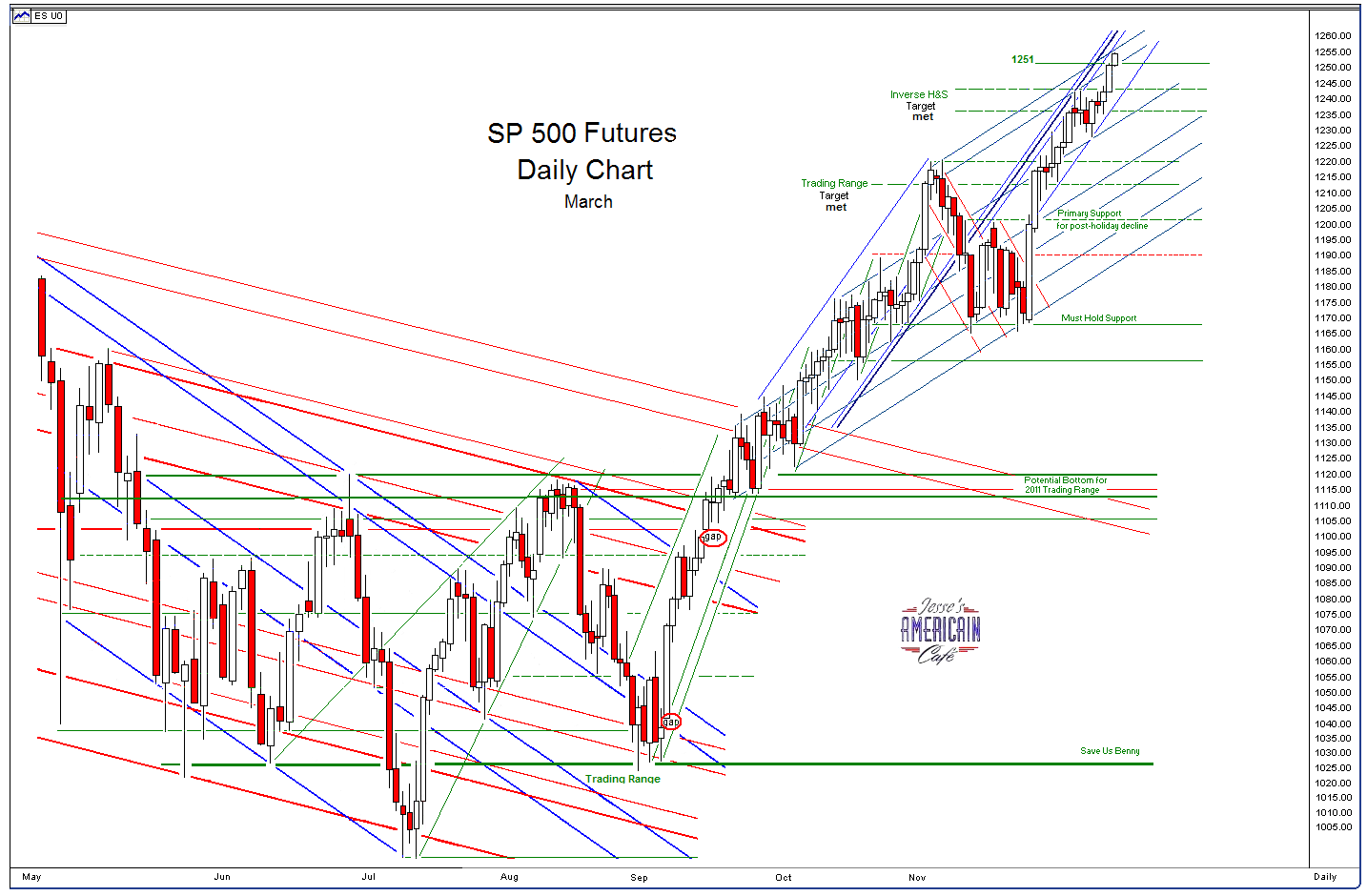
The US equity market has reached the target of 1251 futures basis, and has clearly priced in a recovery based on the most optimistic of forecasts for 2011. It is hard not to assume that this is a cynical exercise in painting the tape for year end bonuses and political spin.

I am having difficulty forecasting 2011 credibly for myself, because the normal metrics and fundamentals seem to have been left at the shore as we have set sail on the uncertain seas of quantitative easing and cargo cult economics promoted by highly mercenary think tanks and their demimonde in the mainstream media.

The great unalterable fact is that the system that delivered the financial crisis is still largely in place and insolvent, merely papered over with dollars in an unsustainable equilibrium. Frauds and fees are the major US domestic products.

For my thinking the great pivot is to what extent Ben and the US will attempt to maintain a pretense of virtue in the dollar while using it like a whore, fudging the economic results and by attacking all its competitors such as the Euro with short sales and downgrades. "They are all pigs, but ours is a little prettier" is the advertising jingle for a continuing dollar dominance. And they will attempt to continue to inflate what is going to be seen in retrospect as a new asset bubble in dollar denominated financial instruments.

As I have said in the past, the primary limiting factor on the Fed and the Treasury is the acceptability of the US bonds (and the dollar is a bond of zero maturity). They know this and are stretching it now as far as I thought they would, although the coordinated assault on the euro, gold and silver are starting to raise a few eyebrows.

Since Obama reminds one of a modern American CEO I suspect that they will take it to the limit if they can. With Larry Summers leaving though, one wonders if Timmy and Larry's replacement will be up to the task of actually pulling the right levers, or will they just keep dishing out the cash to their cronies on Wall Street and hope for the best.

As an aside, someone from the dark side of management philosophy once told me that honesty, loyalty, and enlightened self-interest in a subordinate is good, but blackmail is more reliable.  This was why I did not obtain a position for which I quickly lost interest.  It might not hurt to keep this principle in mind. After all it was the basis for Timmy, Ben, and Hank's presentation of TARP.

This could imply a higher SP 500 in 2011 than most people realize, and an earlier taste of hyperinflation lite. Gold and the euro will continue to be attacked, and the dichotomy between reality and the managed mainstream perception will continue to widen. Consider this the extension of current trends until something breaks.

Remember the shock people felt when, riding the tide of global good will and just cause,  the US diverted from its mission in Afghanistan to suddenly start making the case for an invasion of Iraq which up to that point seemed to have no connection with events, and in retrospect, did not? Expect something like that to happen once again.  Not the same, but similarly out of 'left field' as they say in the states.

And if and when the bough breaks it will be noticeable. There will be a panic liquidation and then a very interesting period of time. The limiting factor there is the Constitution, and how much people will mind it. I have not read many who really understand all that this implies.

The other primary course is to allow things to correct back to some sustainable trend, with the thought of actually rebuilding the system rather than just taking it up for another run at the stratosphere to see what happens. This will imply a weaker dollar, higher gold and commodities, and a grinding stagflation as the financial arsonists call for austerity for those on whom they have off laden their bad debts.

There are outliers naturally. The government could just 'take off the gloves' early on some pretext and declare price and currency controls and a type of martial law. I do not see Obama doing this, because I doubt the military would support him without a very solid pretext indeed, probably marked by smoking ruins. At that point December 2012 starts to play more prominently in my thinking.

I keep thinking that we will have features of both primary outcomes, a deflation and a further bubble, but the timing is difficult because it depends on the will of powerful men, and also exogenous events from other powerful men and the many who, at least for now, are sleepwalking into cattle cars.  This is why I hold tight to the concept of portfolio diversity and keeping certain options open.

So what I am doing for myself is setting up pivots and trigger points to help determine which way the course of events will break, waiting for events to unfold in their own good time, preparing for the worst but hoping for the best.  Things that are 'real' and 'lasting' offer the greatest safety now as they have done for the last ten years. Most of the time the future is just an extension of the past, the continuation of the obvious, until something happens.

The month of January will likely provide us a better window into the rest of the year, in which case the charts and forecasts will become more reliable.

If this seems gloomy it is.  This is a tough fix, and the many, most people, are in denial, reaching for all the wrong solutions, rationalizing the irrational, holding on to the past, and grasping at straws.   When they are betrayed by reality most will fall into despair, but some will be angry like the gangs of true believers that went around Berlin lynching draft dodgers while the Russians rolled their tanks across the Oder.  I am hoping that this is a metaphorical example and not literal. How many lamposts are there in lower Manhattan anyway?

And yet I cannot say that I see one person in power, a great leader, in whom I would place any confident hope. So perhaps this is when one is most likely to rise up. And this is perhaps the most potentially frightening prospect of all.  Great leaders are a very dicey affair.

Since people always want to trade some roadmap or system I have included some markers on the SP 500 Daily chart that show a likely path if we follow the second course of a correction and a serious attempt to fix things now rather than just take it to the limit and kick the can down the road for some other tomorrow. As Woody Allen might say, Our best hope is that things will be frightening and dangerous rather than desperate and horrific.

Dark humour aside, my primary forecast of a grinding stagflation remains intact. More of the same, with a twist. After all, the system has not changed with the exception of a few empty seats like Bernie Madoff and Lehman Brothers, relative bit players and outsiders. It is still highly geared towards wealth transference and fraud, merely searching for something to replace the housing bubble, and a new crop of suckers.

As I have said previously, I lost money in 2005-6 underestimating the reckless disregard for decency and the public good by the Fed and the US government in creating a massive housing bubble. I shall not make that mistake again, trying to get ahead of the market, and suggest you do not as well.

21 December 2010

On Obama's Failure To Carry Out His Elected Mandate To Reform


"First is the danger of futility; the belief there is nothing one man or one woman can do against the enormous array of the world's ills -- against misery, against ignorance, or injustice and violence. Yet many of the world's great movements, of thought and action, have flowed from the work of a single man. A young monk began the Protestant reformation, a young general extended an empire from Macedonia to the borders of the earth, and a young woman reclaimed the territory of France. It was a young Italian explorer who discovered the New /world, and 32 year old Thomas Jefferson who proclaimed that all men are created equal. "Give me a place to stand," said Archimedes, "and I will move the world."

These men moved the world, and so can we all. Few will have the greatness to bend history; but each of us can work to change a small portion of the events, and in the total of all these acts will be written the history of this generation. Thousands of Peace Corps volunteers are making a difference in the isolated villages and the city slums of dozens of countries. Thousands of unknown men and women in Europe resisted the occupation of the Nazis and many died, but all added to the ultimate strength and freedom of their countries. It is from numberless diverse acts of courage such as these that the belief that human history is thus shaped.

Each time a man stands up for an ideal, or acts to improve the lot of others, or strikes out against injustice, he sends forth a tiny ripple of hope, and crossing each other from a million different centers of energy and daring those ripples build a current which can sweep down the mightiest walls of oppression and resistance...

The second danger is that of expediency; of those who say that hopes and beliefs must bend before immediate necessities. Of course if we must act effectively we must deal with the world as it is. We must get things done.

But if there was one thing that President Kennedy stood for that touched the most profound feeling of young people across the world, it was the belief that idealism, high aspiration and deep convictions are not incompatible with the most practical and efficient of programs -- that there is no basic inconsistency between ideals and realistic possibilities -- no separation between the deepest desires of heart and of mind and the rational application of human effort to human problems.

It is not realistic to solve problems and take action unguided by ultimate moral aims and values, although we all know some who claim that it is so. In my judgement, it is thoughtless folly. For it ignores the realities of human faith and of passion and of belief; forces ultimately more powerful than all the calculations of our economists or of our generals. Of course to adhere to standards, to idealism, to vision in the face of immediate dangers takes great courage and takes self-confidence. But we also know that only those who dare to fail greatly, can ever achieve greatly.

It is this new idealism which is also, I believe, the common heritage of a generation which has learned that while efficiency can lead to the camps at Auschwitz, or the streets of Budapest; only the ideals of humanity and love can climb the hills of the Acropolis.

A third danger is timidity. Few men are willing to brave the disapproval of their fellows, the censure of their colleagues, the wrath of their society. Moral courage is a rarer commodity than bravery in battle or great intelligence. Yet it is the one essential, vital quality for those who seek to change the world which yields most painfully to change. Aristotle tells us "At the Olympic games it is not the finest or the strongest men who are crowned, but those who enter the lists. . .so too in the life of the honorable and the good it is they who act rightly who win the prize." I believe that in this generation those with the courage to enter the conflict will find themselves with companions in every corner of the world.

For the fortunate amongst us, the fourth danger is comfort; the temptation to follow the easy and familiar path of personal ambition and financial success so grandly spread before those who have the privilege of an education. But that is not the road history has marked out for us. There is a Chinese curse which says 'May he live in interesting times.' Like it or not, we live in interesting times. They are times of danger and uncertainty; but they are also the most creative of any time in the history of mankind. And everyone here will ultimately be judged -- will ultimately judge himself -- on the effort he has contributed to building a new world society and the extent to which his ideals and goals have shaped that effort."

Robert F. Kennedy, Cape Town, South Africa, 6 June 1966

Gold Daily and Silver Weekly Charts


"The law has been perverted, and the powers of the state have become perverted along with it. The law has not only been turned from its proper function, but made to follow an entirely contrary purpose. The law has become a tool for every kind of greed. Instead of preventing crime, the law itself is guilty of the abuses it is supposed to punish. If this is true, it is a serious matter, and moral duty requires me to call the attention of my fellow-citizens to it."

Frederick Bastiat, The Law, 1853


SP 500 and NDX March Futures Daily Charts


The futures hit 1251.25 intraday which is almost exactly what we suggested they would do. And of course it was done on very thin volumes.

Signs of economic recovery? Perhaps. Look around you, and decide for yourself.

Personally this seems much more like typical year end painting of the tape to optimize the bonuses of fund managers and to promote the perception management of the people by the professional politicians. All of this, of course, fueled by liquidity from the monied interests in the banking cartel.

If it is, then this will end badly, as it has done several times before.


Net Asset Value of Certain Precious Metals Trusts and Funds


Fitch Warns May Cut Greece to 'Junk'


The objective is nothing less than for the Anglo-American banking cartel to control the world's money supply. One major currency is almost as good as one world government.

Fed Extends Dollar Liquidity Swaps Until August 2011

Cry havoc and let slip the dogs of currency war.

MarketWatch
Fitch May Cut Greece Debt to 'Junk'
By Sue Chang
December 21, 2010

SAN FRANCISCO (MarketWatch) -- Fitch Ratings on Tuesday placed Greece's BBB-long-term foreign- and local-currency issuer default ratings on downgrade review, raising the possibility that Greece's sovereign rating may be cut to junk in the near future. "A Rating Watch Negative indicates that there is a heightened probability that Greece's sovereign ratings will be downgraded," said Fitch in a statement. The review is expected to be completed in January and will focus on Greece's fiscal sustainability, the country's economic outlook and the political will of the government to carry out reforms, Fitch said.

"And Caesar's spirit, ranging for revenge,
With Ate by his side come hot from hell,
Shall in these confines with a monarch's voice
Cry 'Havoc!' and let slip the dogs of war;
That this foul deed shall smell above the earth
With carrion men, groaning for burial."


William Shakespeare, Julius Caesar, Act 3 Scene 1

20 December 2010

SP 500 and NDX March Futures Daily Charts


US equities seem to be drifting higher on very low volumes, led by the SP 500 futures which are reaching up for 1251, the better to paint a bright holiday season for the Wall Street insiders and their political cronies.

The primary industry in the US is now financial engineering (less euphemistically known as fraud), and it appears that business is still brisk and quite profitable despite the recent crisis.

I have some expectation of a rather sharp decline in equities, but I will not get out ahead of it, given the Fed's willingness to keep providing fresh dollars to their banking friends who are papering their way to prosperity at the expense of the many.


Gold Daily and Silver Weekly Charts - Bloomberg Apparently Does Not Like Gold


Bloomberg TV is running an interesting special on gold today titled "The Dark Side of Gold."

As one might expect it contains the usual claims that gold is in a bubble and poses a danger to the public in a variety of dimensions.

What I thought was a bit unique is that they are now blaming the entire gold rally on the creation of the GLD ETF.

Indeed, Carol Massar said today that before the gold ETF "gold was trading at $400 and the only people buying gold were conspiracy theorists who were hiding it in their pantries."

In her defense Carol, along with a number of the talking heads on financial TV, are just news readers, and one might as well blame the weatherman for reading the Weather Service forecasts. 

But I don't suppose it might have occurred to whoever wrote this 'special report' to mention that the central banks, who had been steadily selling their gold reserves for the last twenty years, led by the US and England, had started to become net buyers of gold led by the BRIC countries, an event of tremendous significance among many others of a general change in the markets and the beginnings of a largely unreported 'currency war.' 

And it is my experience that when a writer or analyst starts reaching for ad hominem remarks of a non-satirical nature that they are just plain out of facts and faltering in a desire to win an argument that is running against them.

This reminds me of what the dean of financial letters recently said about a similar performance on Bloomberg:
"I listened to Kitco's Nadler on the Bloomberg channel this morning. He's been bearish on gold for months, and I thought he sounded like a know-nothing fool today. Why didn't Bloomberg interview someone who's been bullish and right about gold?"
Richard Russell
The big changes are almost never caught by those close to the action, or with a vested interest in some aspect of the status quo that blinds them to change.  It is the nature of the big changes, what makes them 'big.'   This reminds me so much of early November 2009 when economist Willem Buiter launched into a couple of irrational rants about gold bullion in the Financial Times, a few weeks before shed his Maverecon status to join the ranks of Citigroup.

Buiter Still Fitfully Obsessing About Gold

When 'news outlets' or 'analyst/economists' with ties to Wall Street start coming out with such outlandish statements, gold may likely be going another leg higher in the following months.

And a bit of a mystery is why there is almost never any mention of silver, which is making gold look like a bit of a slacker by comparison as an emerging store of value for wealth that fears the arbitrariness of the Wall Street dominated global financial system.


19 December 2010

Greed Is Not Good


With regards to the global financial crisis, imposing austerity is not the answer. That is like starving the slaves to improve their condition by making the plantation more profitable.   Looting the 'great house' and the barns to feed the slaves, at least temporarily, is not the answer either. The problem is obviously in the system itself.

But either expedient solution suits the external moneyed interests promoting the system who seek only to plunder and drain the assets and labor of others who are all their common prey, whether they feel their kinship or not. An unjust and unsustainable system tarnishes all participants and leaves them vulnerable to exploitation and decay.

It is the root causes of the debt and the imbalances in the system that must be addressed to make any reform sustainable. And this obviously includes addressing abuses such as the promotion of a global trade regime that is inherently unjust and imbalanced to the favor of the oligarchs of whatever political wrappings around the world who hold the greater profit to themselves and leave their people relatively impoverished and exploited.  And it also includes the waging of unfunded wars to protect and promote privileged commercial interests, and a political funding system that is little more than soft graft and an open invitation to corruption by special interests.

It begins with a debilitating system of taxation by the moneyed interests on every commercial transaction in the form of fees and commissions, and the abuse of a money system that is little more than a fraud perpetrated by private interests for the benefit of a few at the expense of the many. If you wish a simple measure of this, then look to the median wage.

Greed is not good.  Greed is a disease, an aberration of simple honest ambition and necessary provision taken to excess. 
It is a sin, a transgression against love.  This simple distinction may be lost on a people no longer able to distinguish between virtue and sin, honor and expediency, appetite and gluttony, the means and the ends.  Every great religion, every school of philosophy has cautioned throughout history on the perils of unbridled and unregulated greed.  

And yet this generation would make a god of it, although they may not understand, or care, what it is that they are doing, and whom it is they serve. And yet they will be held to account for their willfulness, foolishness, and casual disregard for others.

Greed, often in company with hubris and fear, is a handmaiden of the corrupting influence of power and triumph of the will. Greed is contagious, and attacks the very contentment of society at its heart, turning it towards oligarchy and oppression.

"Greed is a bottomless pit which exhausts the person in an endless effort to satisfy the need without ever reaching satisfaction." Erich Fromm
Any system that promotes greed, gluttony, and insatiability as its highest goods and fundamental ideals is a cult of perversion and addiction on a scale with ancient Rome, an imbalanced insult to the natural law, with a fatal attraction to overreach, failure and self-destruction. What the US has today is not market capitalism that rewards the merits and work of individuals, but rather is the product of dishonest and disordered minds, a system of fraud and plunder by privileged oligarchs masquerading as fair and honest markets of legitimate valuation and price discovery.
"Because the free market system is so weak politically, the forms of capitalism that are experienced in many countries are very far from the ideal. They are a corrupted version, in which powerful interests prevent competition from playing its natural, healthy role." Raghuram G. Rajan
The Banks must be restrained, and the financial system reformed, with balance restored to the economy, before there can be any sustained recovery.

Financial Interests Dictate Sovereign Policy
By Michael Hudson
December 18, 2010

"...The economic problem is not caused by sovereign debt but by bad bank loans, deceptive financial practice and neoliberal bank deregulation. Iceland’s Viking raiders, Ireland’s Anglo-Irish bank and other foreign banks are trying to avoid taking losses on financial claims that are largely fictitious, inasmuch as they exceed the ability of indebted economies to pay. The ‘crisis’ can be solved by making the banks write down their debt claims to realistic ‘junk’ valuations. There is no need to wreck economies by subjecting them to financial asset-stripping.

In such cases there’s a basic principle at work: Debts that can’t be paid, won’t be. The question is, just how won’t they be paid? As matters stand, countries are being told to subject themselves to massive foreclosure – not only a forfeiture of homes, but of national policy.

In this respect the sovereign crisis is a crisis of sovereignty itself: Who shall be in charge of the economy, its tax philosophy and public spending: elected officials acting in the public interest, or an intrusive financial oligarchy? The EU was wrong to tell governments to pay for following its advice – and pressure – to trust financial crooks and deregulate bank oversight. The European Central Bank should reimburse victimized governments for the bailouts that have been paid. This reimbursement can be done by levying a progressive tax policy and creating a central bank to help finance governments.

The proper aim of a national economy is to promote capital formation and rising living standards for the population as a whole. not a narrowing financial class at the top of the pyramid. So I see two major policies to lead the way out of this mess:

First, shift taxes back onto land and resource rent, and onto financial and capital gains. This will prevent another real estate bubble from being inflated by debt leveraging. By holding down housing prices, it will save labor from having to pay an equivalent amount in income tax. Low real estate taxes (under 1% until just recently) have not saved homeowners money in Latvia. Low property taxes merely have left more rental income to be pledged to banks, to capitalize into large mortgage loans.

Second, de-privatize basic utilities and natural monopolies to save Europe from rentiers turning it into a tollbooth economy. Europe needs a central bank that can do what central banks are supposed to do: create money to finance government deficits. But the European Central Bank and article 123 of the European Constitution as amended by the Lisbon Treaty prevents the central bank from lending to governments. This forces governments to levy taxes to pay interest to banks – for creating electronic credit that a real central bank could just as well create on its own computer keyboards.

Government banking is not necessarily inflationary. It finances what is necessary for economies to grow: investment in infrastructure and capital formation to raise productivity and minimize the cost of doing business.

What turns out to be inflationary is commercial bank lending. It inflates asset prices – unproductively. Banks lend mainly against real estate and other assets already in place, and stocks and bonds already issued. This is unproductive credit, not real wealth creation. The only way to keep this unproductive debt overhead solvent is to inflate asset prices more – by untaxing assets to leave more revenue to pay bankers on exponentially growing debts.

It doesn’t have to be this way. The recent 30 years of financial polarization is reversible. The alternative is to succumb to neoliberal austerity."

I think that most people know what needs to be done in their conscience, but their hearts have become so hardened over the past twenty years that the message will be ignored until after they undergo a period of suffering on the scale of the worst of the twentieth century. May God have mercy on us all.


Unless the Lord builds the house, the builders labor in vain.
Unless the Lord watches over the city, the guards stand watch in vain.
In vain you rise early and stay up late,
toiling for food to eat—
for he grants sleep only to those he loves.

Psalm 127

17 December 2010

Weekend Reading - When Money Dies: The Nightmare of the Weimar Collapse - Adam Fergusson


When Money Dies

SP 500 and NDX March Futures Daily Charts - Crony Capitalism: The Fed's Frankenstein


The mechanics of what is happening with money now is fascinating, and seems to be clarifying in my mind. It is hard to imagine a more inherently ineffective system of capital and resource allocation than crony capitalism. It is a game which is rigged to deliver the money in the system to a minority of insiders, thereby bankrupting all the customers.

It is said that in a purely competitive capitalist system, all businesses are vectored to zero profit in a process of creative destruction. As a certain class of participants clearly recognizes this they take every opportunity to corrupt and game the system through fraud. This is why markets must have regulators. At times the fraud overcomes the regulation to such a degree that the normal market balances are rendered ineffective and the system passes to a crony capitalist system, if not an outright oligarchy.

In a crony capitalist system a similar outcome can be achieved, but with the insiders and powerful interests holding most of the money which ultimately becomes worthless because the foundation of the money, the labor of the people, is destroyed.

In other words, greed compels the materially obsessed to obtain the greatest piles of chips, but in the long term renders their chips to be worthless because they are unable to stop their fraud and plundering even when it is in their best interests. They are not governed by rationality or conscience or even common sense. For periods of time oligarchies are able to survive in an uneasy equilibrium enforced by power, but ultimately these wicked wither and die on their great piles of gains.

I now give more weight to the potential for hyperinflation, and will be exploring this topic during 2011. The Congress and the Fed are reckless to the point of self-destruction.


Gold Daily and Silver Weekly Charts


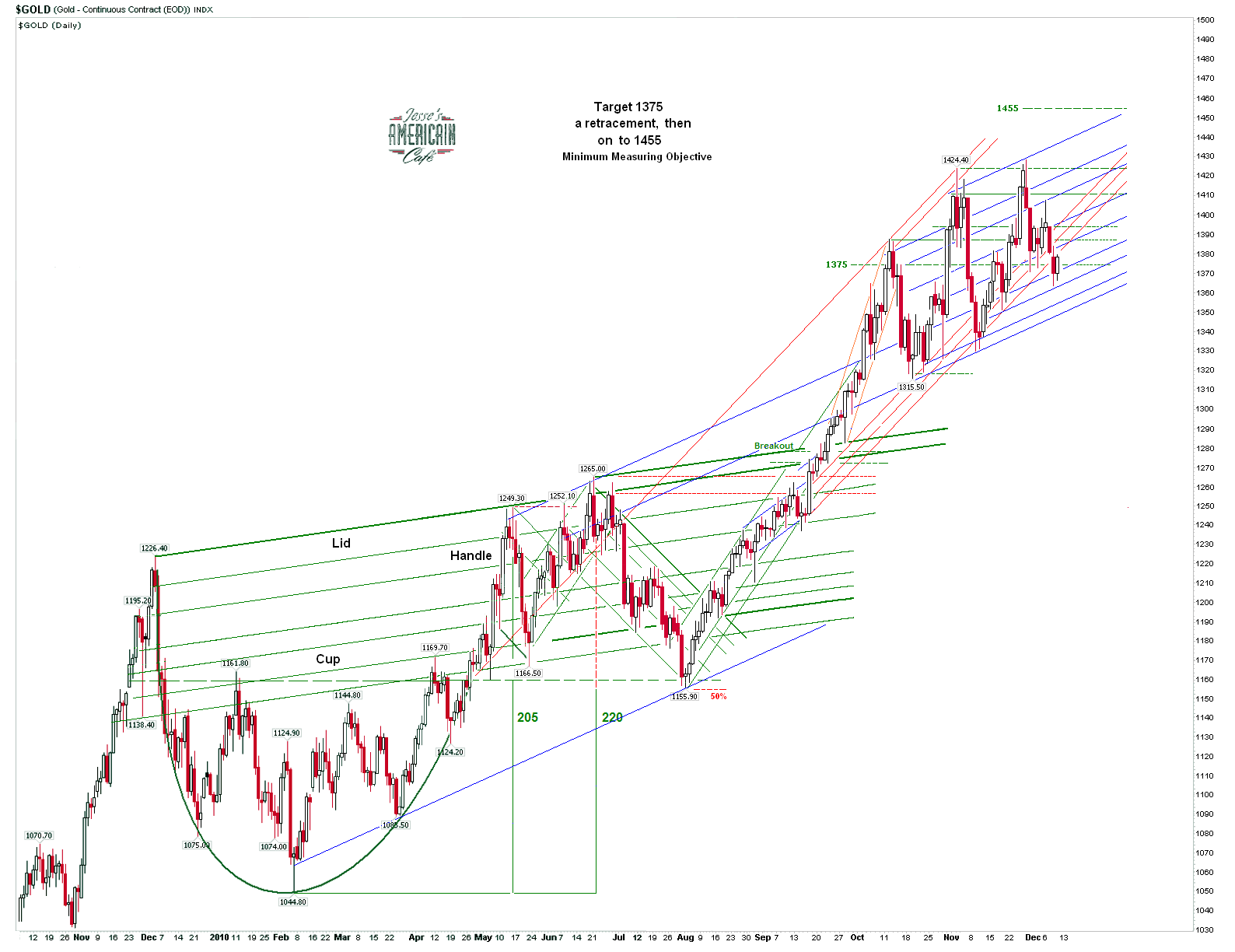
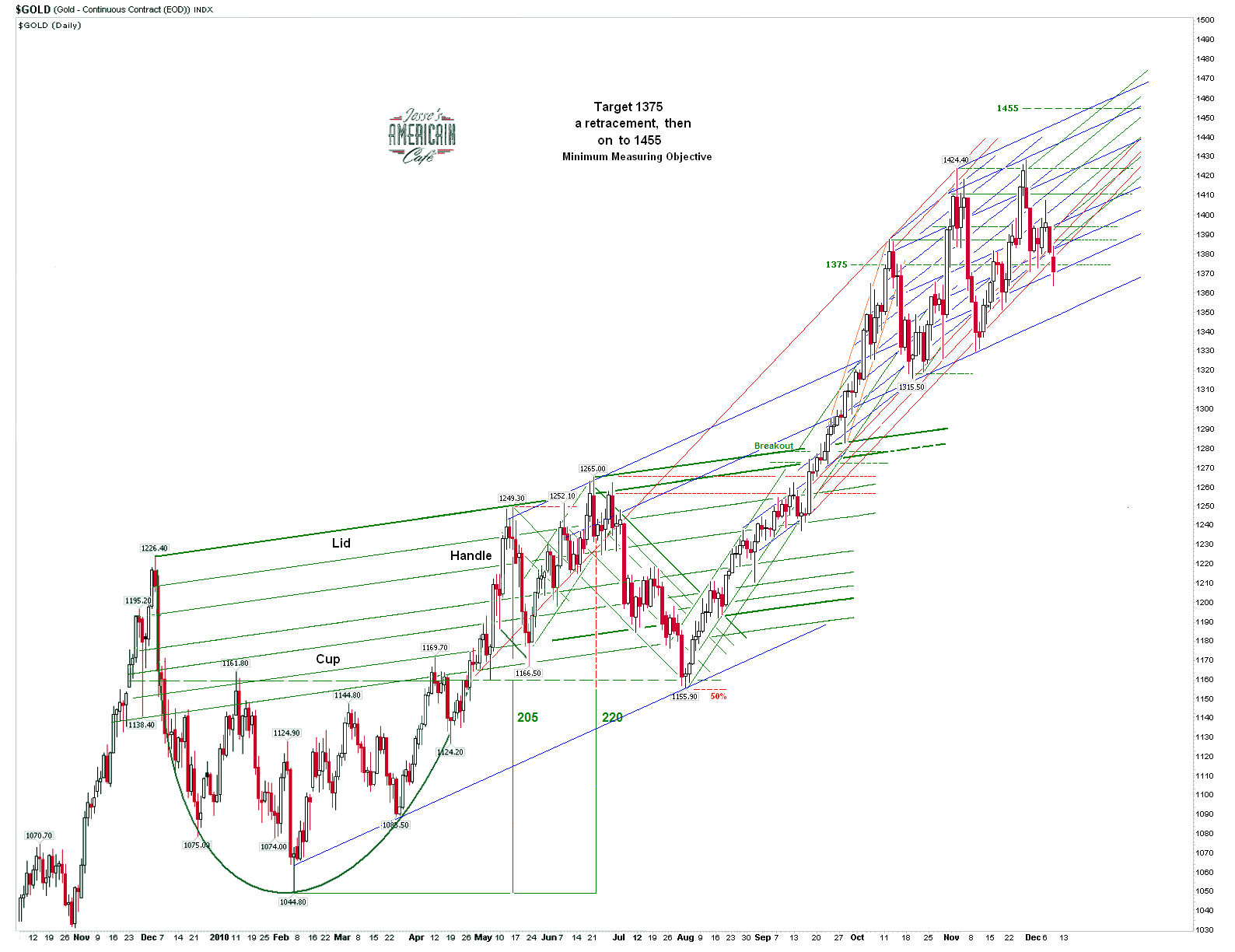
The pattern in the gold market has greatly clarified. It is now following a more gradual path higher as the banks of the world resist its upward trajectory, and the many still do not recognize the inherent value of bullion in the face of currency devaluation.

The gradual rise will take gold much higher over time than a parabolic spike higher would, although it demands more patience as things unfold.

At some point it will regain a more aggressive track higher, and then likely consolidate and resume a more gradual rise for a time.

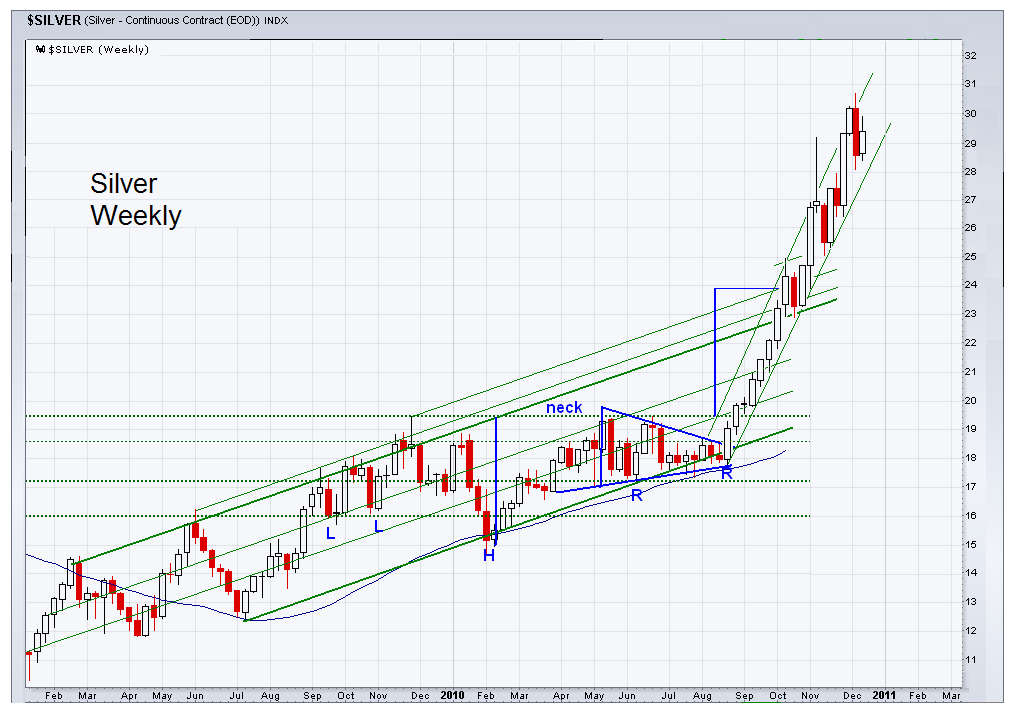
Silver is on an aggressive but sustainable rally path. The many years of suppression and the leverage in this market may call out a path and price much higher on a percentage basis than gold.

I like to buy both, but given a choice I would tend now to overweight silver for trading, and gold for the long term investment and wealth protection.


16 December 2010

Gold Daily and Silver Weekly Charts - Gold With 50 Day Moving Average


The 50 Day Moving Average once again provided support for a dip in bullion. I tended to view the bear raid today as tied to option expiration in equities moreso than in the bullion itself. Mining stocks have been hot, and the call buying may have gotten ahead of itself, setting up an incentive for players to hit the metals and take down the industry associated stocks.

Although the CFTC has enabled a position disclosure trigger at 10% at which the regulators can ask a market participant to show their net swaps, the actual position limits discussion was tabled today for a future meeting.

CFTC delays tough commodity speculation crack-down


SP 500 and NDX March Futures Daily Charts


Tomorrow is December options expiration for equities and the funds are also painting the tape to make their bonuses round up nicely into the year end.

Let's see how the markets go as they hit all our targets in the currently active chart formations. Wait for it, because Benny is in there pumping and it may take a stumble to turn this trend around, which for now is up.


15 December 2010

Gold Daily and Silver Weekly Charts


"Currency values and precious metals prices can be volatile, but the long-term weakness in the U.S. dollar and relative purchasing-power-preservation attributes of gold and silver, and the stronger currencies outside the dollar, remain in place. As with systemic risks in the United States, risks in other areas of the world — such as among the countries using the euro — likely will be addressed by the spending or creation of whatever money is needed (indications of any needed U.S. backing are in place) in order to prevent systemic failure.

Keep in mind that the U.S. remains the proverbial elephant in the bathtub in terms of pending effective sovereign bankruptcies. The various European crises remain an intermittent foil for the U.S. dollar, pulling market attention away from the unfolding solvency crisis in the United States and a likely move to massive selling against the U.S. currency.

Accordingly, high risk of the early stages of a hyperinflation beginning to unfold by mid-2011 continues. Rising inflation should become increasingly broad, reflecting an increasingly serious problem in the first-half of 2011.”

John Williams: Massive Selling of US Currency Ahead - KWN


SP 500 and NDX March Futures Daily Charts


14 December 2010

Gold Daily and Silver Weekly Charts And One Possible Unfolding of the Endgame


This seems mildly reminiscent of the setup which Soros and unnamed Swiss parties engaged in when they took down the Bank of England's defense of the British Pound and its official peg to the Euro.

Will the US ultimately feel compelled to defend some of the gold and silver shorts, both in terms of bullion and derivatives, held by its Wall Street Banks? You could allow for the possibility, if you will, that there is a corresponding web of derivatives that has a links, and a possible chokehold, on a few key European institutions, particularly in England and Germany, involving counterparty derivatives and CDS, and collateral damage to professional and political careers. Ugly stuff, rather messy really. But there are historic precedents.

How Asian Buyers Are Maneuvering the Metals Shorts

There should be no confusion that this involves not only a few large Wall Street players, but also elements, past and present, in the US Treasury and the Federal Reserve. It makes the unfolding insider trading scandal look like a neighborhood numbers racket.

Therefore we should not discount the possibility that if a default should occur there will be an emotional and political reaction put forward as a means of deflecting the disclosure of the true nature of the financial corruption.

It would be most interesting and possibly entertaining to see if Ron Paul's congressional committee could be able to mount an effective investigation into the matter, or if events will take place to pre-empt and redirect such an inquiry to manage the potential collateral damage to careers and possibly governments, both at home and abroad. 

It's never really the act itself, often minor infractions undertaken for practical purposes or what could be rationalized as such by some. Rather it is always the corruption of the policy actions to personal gain, and the subsequent cover-up, that tends to gather substance over time into a first class scandal, acts of felony and high crimes, and all the revelations that follow.
“Oh what a tangled web we weave, When first we practice to deceive." Sir Walter Scott


SP 500 and NDX March Futures Daily Charts


Non-event FOMC statement, the last of 2010, which is what had been expected. The macro retail sales picture was painted in high gloss, but the big miss by Best Buy cuts deeper to the heart of the truth.

The US is becoming two nations, one of privileged fraud and illusion, and another of harsh reality, difficult circumstances, and unnecessary hardship.


Federal Reserve Statement for December 14


The first paragraph is the only thing that has changed and that from slow to insufficient. The Fed is dour on the jobless recovery and its self-sustainability.

"Information received since the Federal Open Market Committee met in September confirms that the pace of recovery in output and employment continues to be slow. Household spending is increasing gradually, but remains constrained by high unemployment, modest income growth, lower housing wealth, and tight credit. Business spending on equipment and software is rising, though less rapidly than earlier in the year, while investment in nonresidential structures continues to be weak. Employers remain reluctant to add to payrolls. Housing starts continue to be depressed. Longer-term inflation expectations have remained stable, but measures of underlying inflation have trended lower in recent quarters."
Contrast this opening paragraph from the Fed's November 3 Statement with their latest below.
Release Date: December 14, 2010
Federal Reserve Open Market Committee Statement

Information received since the Federal Open Market Committee met in November confirms that the economic recovery is continuing, though at a rate that has been insufficient to bring down unemployment. Household spending is increasing at a moderate pace, but remains constrained by high unemployment, modest income growth, lower housing wealth, and tight credit. Business spending on equipment and software is rising, though less rapidly than earlier in the year, while investment in nonresidential structures continues to be weak. Employers remain reluctant to add to payrolls. The housing sector continues to be depressed. Longer-term inflation expectations have remained stable, but measures of underlying inflation have continued to trend downward.

Consistent with its statutory mandate, the Committee seeks to foster maximum employment and price stability. Currently, the unemployment rate is elevated, and measures of underlying inflation are somewhat low, relative to levels that the Committee judges to be consistent, over the longer run, with its dual mandate. Although the Committee anticipates a gradual return to higher levels of resource utilization in a context of price stability, progress toward its objectives has been disappointingly slow.

To promote a stronger pace of economic recovery and to help ensure that inflation, over time, is at levels consistent with its mandate, the Committee decided today to continue expanding its holdings of securities as announced in November. The Committee will maintain its existing policy of reinvesting principal payments from its securities holdings. In addition, the Committee intends to purchase $600 billion of longer-term Treasury securities by the end of the second quarter of 2011, a pace of about $75 billion per month. The Committee will regularly review the pace of its securities purchases and the overall size of the asset-purchase program in light of incoming information and will adjust the program as needed to best foster maximum employment and price stability.

The Committee will maintain the target range for the federal funds rate at 0 to 1/4 percent and continues to anticipate that economic conditions, including low rates of resource utilization, subdued inflation trends, and stable inflation expectations, are likely to warrant exceptionally low levels for the federal funds rate for an extended period.

The Committee will continue to monitor the economic outlook and financial developments and will employ its policy tools as necessary to support the economic recovery and to help ensure that inflation, over time, is at levels consistent with its mandate.

Voting for the FOMC monetary policy action were: Ben S. Bernanke, Chairman; William C. Dudley, Vice Chairman; James Bullard; Elizabeth A. Duke; Sandra Pianalto; Sarah Bloom Raskin; Eric S. Rosengren; Daniel K. Tarullo; Kevin M. Warsh; and Janet L. Yellen.

Voting against the policy was Thomas M. Hoenig. In light of the improving economy, Mr. Hoenig was concerned that a continued high level of monetary accommodation would increase the risks of future economic and financial imbalances and, over time, would cause an increase in long-term inflation expectations that could destabilize the economy.

13 December 2010

The Gold Short


Well, it could be worse. He could be short silver, too.


S - A - V - E - - -  M - E - - -  B - E - N - N - N - n - n - n - n - n ...

"I listened to Kitco's Nadler on the Bloomberg channel this morning. He's been bearish on gold for months, and I thought he sounded like a know-nothing fool today. Why didn't Bloomberg interview someone who's been bullish and right about gold?"

Richard Russell

Gold Daily and Silver Weekly Charts - US Dollar Intraday Chart


The US dollar did a quietly impressive 'cliff dive' today.

Harvey Organ's metals commentary is interesting this evening. It appears that some rather large customers are pulling their silver bullion out of storage in the Comex vaults. Trying to beat the Christmas rush?

Volume in the gold ETF IAU was 700% of average today. Perhaps some players are diversifying out of GLD.

FT had a story that the big US bank JPM is trying to reduce its silver short and edge towards the exits.  Good luck with that.

Madoff trade off?