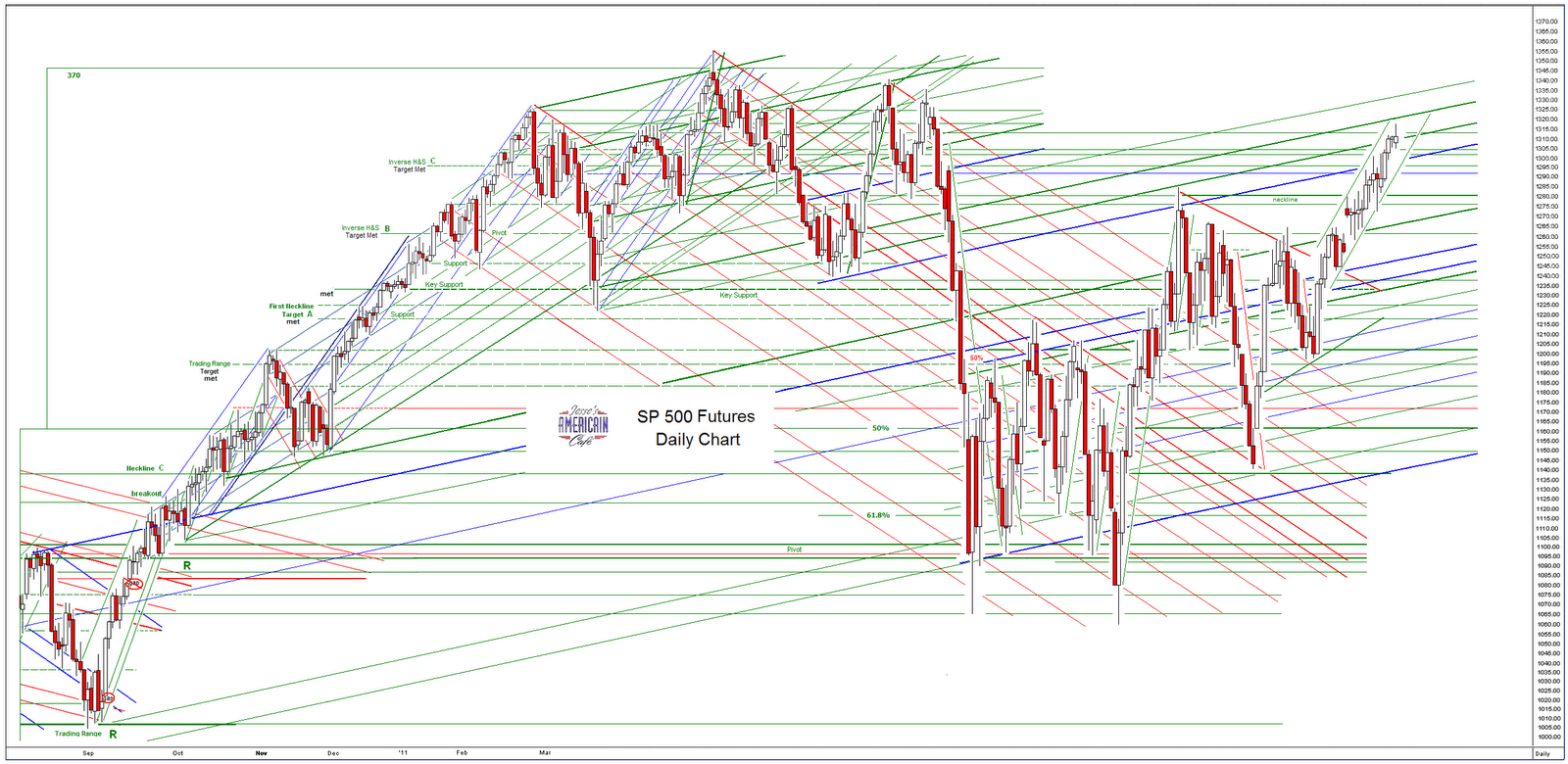
4Q 2011 Advance GDP is out tomorrow morning.
The selling today had little volume behind it, and it looked more like a consolidation than a top, at least so far.
I'm flat the market now, and waiting to see what happens next.


"You have accepted things you would not have accepted five years ago, a year ago, things that your father, even in Germany, could not have imagined. Suddenly it all comes to be, all at once. You see what you are, what you have done, or more accurately what you haven’t done. For that was all that was required of most of us: that we do nothing. You remember everything now, and your heart breaks. Too late. You are compromised beyond repair."
Milton Mayer, They Thought They Were Free


MFGFacts
CFTC Warnings When Bankruptcy Codes Conflict: And a Still Secret Meeting
Last week we witnessed lawyers dueling in the bankruptcy court on the details of exactly what code of law supports customer priority in liquidation of the parts of MF Global Holdings, and gosh!….is the Holdings is even a broker ? Why are lawyers debating these questions at this late date?
First we’ll cover what started the fight and then move onto the genesis of why it has come to this so far into the proceedings. Do stick with the story as it might sound like legal minutiae, but does have everything to do with recovery of customer funds.
It started with the Sapere Wealth Management, LLC assertions (among others) that the MF Global estate must be administered under 17 C.F.R paragraph 190. Remember paragraph 190 as you will hear more about this in the next weeks. Applying this clause of the bankruptcy code to the liquidation of MF Global Holdings would assure customer priority in the liquidation of MFGH, which is also claimed to have taken customer assets out of MFGI, the commodity brokerage unit of the Holdings company, MFGH — before and after the bankruptcy.
That all customer property as defined in paragraph 190 of the code, must be returned to commodity customers free and clear of other claims is also supported by others parties, including the CFTC. The CFTC, however, also asserts that existing principles of law are available to ensure this, but first the court needs to make “antecedent determinations.” In other words, the CFTC legal team is playing the adult and indicating that we already have the laws on the books to deal with this once the court figures out what laws it wants to use.
So why is the question if MFGH is even a broker so important? Again, the key paragraph 190, which legally secures customer priority and distributions can only be applied to a brokerage Chapter 7 bankruptcy, which is used for brokerage bankruptcies, but was not used for MFGH, which is the holding company of MFGI. MFGH was filed as a Chapter 11 bankruptcy. This Bankruptcy Code is used for non-broker entities, seeking re-organization.
Also, and to use the words of the Sapere plea to the court, “A decision by the court that 17 C.F.R §190 applied to MFGH’s estate can, among other things, obviate the need for titan law firms representing MFGH and MFGI, respectively, to engage in battles with one another funded by “other people’s money,” i.e., at substantial costs to the estates of MFGH and MFGI.”
The ability to use many millions of customer funds locked in the estate to pay trustees and their “titan” law firms representing MFGH and MFGI is possible because the bankruptcy was filed as a Chapter 11 for the Holdings and Chapter 11 SIPC filing for MFGI, the commodity brokerage, and not under Chapter 7 for both.
As regular readers know, from the start of this sorry saga, MFGFacts.com has focused on the questions around why a Chapter 11 SIPC bankruptcy with almost non-existent securities accounts when neither SIPC nor Chapter 11 address brokerage liquidations. Additionally, Chapter 11 is the choice when a restructuring is planed, which is not so with MFGH.
A Breaking Investigative Report
Fortunately, these question are now receiving greater scrutiny in the industry press as we read in this investigation published last week by Mark Melin of Opalesque Futures Intelligence who contacted MFGFacts.com while conducting his investigation, Sold Out: How A Private Meeting Between Regulators Gave Away MF Global Investor Protections. In short, as Melin reports, “Deciding upon a Securities industry SIPA liquidation process for an FCM over the Commodity Exchange Act (CEA) liquidation and section 7 of the US Bankruptcy Code was a legal maneuver with far reaching consequences for customers with segregated funds and property with custodial banks. The selected SIPA liquidation does not recognize fund segregation or futures industry account regulations. The process considerably favors creditors.”
In other words, when the SEC threw the liquidation process to SIPC under for a Chapter 11 securities liquidation, and with the CFTC’s immediate agreement (under the conflicted Chairman Gensler who had not yet to recuse himself from MF Global issues), a framework of law was chosen where customers were — for the very first time ever — made creditors and their assets thrown into the entire MF Global estate. Many say what! And the industry is now asking how?
According to the report, the speculation is this: Robert Cook, SEC Director of Division and Trading and Markets is said to have been the lead regulator at the key meeting, the details of which are still not public. “Before joining the SEC, Mr. Cook was a partner at the powerful Washington D.C. law firm of Cleary Gottlieb Steen & Hamilton LLP, which represents JP Morgan, among other clients,” Melin reported. We all know that JP Morgan is the largest creditor to MF Global Holdings. Readers may reach their own conclusions about that. Yet, making the liquidation of MF Global Holdings and its parts a Chapter 11 and SIPC bankruptcy, set the stage for expensive dueling among lawyers over the fact if MF Global is even a broker or not. This also and — most importantly — tremendously enhanced the recovery position for non-customer creditors over all customers.
The CFTC Warned in the 1980s of Potential for Abuse and Problems when Bankruptcy Codes Conflict with a Duel Registered Entity
As Melin shares, that the CFTC – to the agency’s great credit — recognized and dealt with this problem: Citing the exemplary record in the futures industry in the event of bankruptcies, former CFTC Director of the CFTC Division of Trading, Andrea Corcoran writes in a January 1993 issue of Futures International Law Letter “As early as 1980, however, concerns were expressed about the ability to retain this record in the event of the bankruptcy of a dually-licensed firm – that is, a firm registered as both a futures commission merchant (FCM) and a securities broker-dealer.”
To rectify this, the CFTC then drafted rules we find under then now famous Part 190 where Corcoran writes, “In the final rules, the Commission noted that Section 7(b) of SIPA (read Securities Investors Protection Act) …proved that a trustee in a SIPA liquidation shall be subject to the same duties as a trustee in a commodity broker bankruptcy under Subchapter IV of Chapter 7 of the Code.”
The CFTC was well prepared for a MF Global-like event. Against this background, and as Melin also reports, the choice of a Chapter 11 SIPC bankruptcy code for the liquidation of a futures broker, makes Chairman’s Genslers “give away” even more baffling. We’d call it a throw away and ask if Chairman Gensler invited a single CFTC attorney into that early hour meeting before agreeing to file MFGI under MFGH as a Chapter 11 SIPC bankruptcy? Regardless, with that decision the fate was sealed. And not only were customers and the industry severely damaged, but there was a complete disregard of the decades of work, preparation and public service by the many professionals in the CFTC to which Chairman Gensler was entrusted.
And now we have the spectacle of “titanic” lawyers in one of the largest bankruptcies ever arguing if an entity is a broker or not.
"When a man has so far corrupted and prostituted the chastity of his mind as to subscribe his professional belief to things he does not believe, he has prepared himself for the commission of every other crime."So the set up and trend seems to be for a more notably historic impulse for change.
Thomas Paine
For immediate release
Federal Reserve Open Market Committee
January 25, 2012
Information received since the Federal Open Market Committee met in December suggests that the economy has been expanding moderately, notwithstanding some slowing in global growth. While indicators point to some further improvement in overall labor market conditions, the unemployment rate remains elevated. Household spending has continued to advance, but growth in business fixed investment has slowed, and the housing sector remains depressed. Inflation has been subdued in recent months, and longer-term inflation expectations have remained stable.
Consistent with its statutory mandate, the Committee seeks to foster maximum employment and price stability. The Committee expects economic growth over coming quarters to be modest and consequently anticipates that the unemployment rate will decline only gradually toward levels that the Committee judges to be consistent with its dual mandate. Strains in global financial markets continue to pose significant downside risks to the economic outlook. The Committee also anticipates that over coming quarters, inflation will run at levels at or below those consistent with the Committee's dual mandate.
To support a stronger economic recovery and to help ensure that inflation, over time, is at levels consistent with the dual mandate, the Committee expects to maintain a highly accommodative stance for monetary policy. In particular, the Committee decided today to keep the target range for the federal funds rate at 0 to 1/4 percent and currently anticipates that economic conditions--including low rates of resource utilization and a subdued outlook for inflation over the medium run--are likely to warrant exceptionally low levels for the federal funds rate at least through late 2014.
The Committee also decided to continue its program to extend the average maturity of its holdings of securities as announced in September. The Committee is maintaining its existing policies of reinvesting principal payments from its holdings of agency debt and agency mortgage-backed securities in agency mortgage-backed securities and of rolling over maturing Treasury securities at auction. The Committee will regularly review the size and composition of its securities holdings and is prepared to adjust those holdings as appropriate to promote a stronger economic recovery in a context of price stability.
Voting for the FOMC monetary policy action were: Ben S. Bernanke, Chairman; William C. Dudley, Vice Chairman; Elizabeth A. Duke; Dennis P. Lockhart; Sandra Pianalto; Sarah Bloom Raskin; Daniel K. Tarullo; John C. Williams; and Janet L. Yellen. Voting against the action was Jeffrey M. Lacker, who preferred to omit the description of the time period over which economic conditions are likely to warrant exceptionally low levels of the federal funds rate.



Bloomberg
Corzine Sued for RICO Violation by MF Global Customers
By Linda Sandler
January 20, 2012, 6:42 PM EST
Jan. 20 (Bloomberg) -- Jon Corzine, MF Global Holdings Ltd.’s former chief executive officer, was sued under U.S. racketeering law by commodity customers alleging he and other executives “unlawfully” took money from their accounts and failed to segregate their money as the law requires.
The suit alleges that hundreds of millions of dollars were transferred from customers’ accounts to other MF Global units, at a time when the company was short of cash and faced calls for collateral as its risky Eurobond and other investments fell in value.
Named in the suit, JPMorgan Chase & Co., the company’s banker, should have noticed the “depletion” of customer money, and should have investigated, according to the plaintiff. The customers are seeking unspecified restitution and damages.
The suit, filed in federal court in Manhattan today on behalf of Robert Marcin and other MF Global segregated account holders by Grant & Eisenhofer PA of New York, is one of at least 10 against Corzine and other MF Global executives. Plaintiffs including the Virginia Retirement System have been competing to lead a consolidated lawsuit seeking so-called class-action status....
Read the rest here.


Courthouse News Service
Chase Accused of Brazen Bankruptcy Fraud
By MATT REYNOLDS
January 17, 2012
LOS ANGELES (CN) - JPMorgan Chase routinely fabricated documents to deceive bankruptcy judges, going so far as to Photoshop documents to "create the illusion" of standing "in tens of thousands of bankruptcy cases," according to a federal class action.
Lead plaintiff Ernest Michael Bakenie claims that Chase's "pattern and practice of playing 'hide-and-seek' with debtors, judges and other bankruptcy players" bore rich fruit: that Chase secured motions for relief of stay and proofs of claim in 95 percent of its cases.
"Through the use of fabricated assignments, endorsements and affidavits that purport to transfer deeds of trust, notes and the rights to all monies due under the terms of tens of thousands of non-negotiable promissory notes (the 'MLNs'); Chase has demonstrated a pattern and practice of playing 'hide-and-seek' with debtors, judges and other bankruptcy players," the complaint states.
"Chase intentionally conceals the identity of the true parties in interest entitled to enforce the tens of tens of thousands of residential non-negotiable promissory notes (the 'MLNs') for its own financial benefit, at the expense of the class and to the detriment of the integrity of the bankruptcy system."
Bakenie says Chase used a network of attorneys to file more than 7,000 motions for relief from automatic stay in bankruptcy cases in the Central District of California, "wherein they falsely claim to be the party entitled to monies due under the terms of MLNs."
Chase rewards attorneys based on how quickly they can secure the stays, and uses fabricated documents to establish chain of title on loans, according to the complaint...
Read the rest here.


Bloomberg
Obama Considering Summers for World Bank
By Hans Nichols
Jan 18, 2012 11:47 AM ET
President Barack Obama is considering nominating Lawrence Summers, his former National Economic Council director, to lead the World Bank when Robert Zoellick’s term expires later this year, according to two people familiar with the matter.
Summers has expressed interest in the job to White House officials and has backers inside the administration, including Treasury Secretary Timothy Geithner and the current NEC Director, Gene Sperling, said one of the people. Secretary of State Hillary Clinton is also being considered, along with other candidates, said the other person. Both spoke on condition of anonymity to discuss internal White House deliberations.
Lael Brainard, the under secretary of Treasury for international affairs, is compiling a list of potential candidates to replace Zoellick, who was nominated to a five-year term that began in July of 2007 by then-President George W. Bush. By tradition, the U.S. president chooses the leader of the World Bank while the head of the International Monetary Fund is selected by European leaders. The nomination is subject to approval by the World Bank’s executive board.
"O, wonder! How many goodly creatures are there here! How beauteous mankind is!
O brave new world, That has such people in it!"
William Shakespeare, Tempest, Act 5, Sc. 1

"And remember, where you have a concentration of power in a few hands, all too frequently men with the mentality of gangsters get control. History has proven that."There are others ways to do this that do not benefit the few at the cost of the many in such a disproportionate manner.
Lord Acton
Financial Times
World Bank warns emerging nations
By Chris Giles in London
January 18, 2012 2:00 am
Developing countries should take steps to plan for a global economic meltdown on a par with 2008-09 if the European sovereign debt crisis escalates, the World Bank warned on Wednesday in its latest economic forecasts.
Predicting significantly slower global growth in 2012 than it expected last summer even if the eurozone muddles through its crisis, World Bank economists said that if financial markets deny funds to eurozone economies, global growth would be about 4 percentage points lower than even these figures, with poorer economies far from immune.
Andrew Burns, head of macroeconomics at the Bank, told journalists in London: “Developing countries should hope for the best and prepare for the worst.”
Stressing the importance of contingency planning, he added: “An escalation of the crisis would spare no one. Developed and developing-country growth rates could fall by as much or more than in 2008-09.”
The world economy would find it much more difficult to grow out of a new economic crisis, the World Bank warned, because rich countries had little monetary or fiscal ammunition available to stem any vicious circle and poorer countries now have “much less abundant capital, less vibrant trade opportunities and weaker financial support for both private and public activity [than in 2009]”...
Read the rest here.
(RTTNews) - Sprott Physical Silver Trust (PSLV: News , PHS_U.TO) announced that it has priced its follow-on offering of 23 million transferable, redeemable units of the Trust at a price of US$13.20 per Unit.
As part of the Offering, the company said that it has granted the underwriters an over-allotment option to purchase up to 3.45 million additional Units. (15 percent)
The gross proceeds from the Offering will be US$303.60 million or US$349.14 million if the underwriters exercise in full the over-allotment option.
The company stated that it will use the net proceeds of the Offering to acquire physical silver bullion in accordance with the Trust's objective and subject to the Trust's investment and operating restrictions described in the prospectus related to the Offering.
Under the trust agreement governing the Trust, the net proceeds of the Offering per Unit must be not less than 100% of the most recently calculated net asset value per Unit of the Trust prior to, or upon determination of, pricing of the Offering.
PRICING: will be between $13.10 to $13.75 USD, which is a 5.6% to 10.0% discount from last trade, but a 12.3% to 17.9% premium to the latest Net asset value per unit.PSLV closed regular trading today at $14.56, but traded as low as 13.33 after hours.
Press Release
Sprott Physical Silver Trust Announces Follow-on Offering of Trust Units
TORONTO, Jan. 17, 2012
(NYSE: PSLV) (TSX: PHS.U), a trust created to invest and hold substantially all of its assets in physical silver bullion and managed by Sprott Asset Management LP, announced today that it has launched a follow-on offering (the "Offering") of transferable, redeemable units of the Trust ("Units").
The Trust will use the net proceeds of the Offering to acquire physical silver bullion in accordance with the Trust's objective and subject to the Trust's investment and operating restrictions described in the prospectus related to the Offering.
Under the trust agreement governing the Trust, the net proceeds of the Offering per Unit must be not less than 100% of the most recently calculated net asset value per Unit of the Trust prior to, or upon determination of, pricing of the Offering.
Sprott Physical Silver Trust (TSX: PHS.U, NYSE: PSLV) is issuing new units via an overnight follow-on offering. Anyone interested, please get back to me by 7:30 a.m. EST tomorrow (Wednesday, January 18) with their order quantity. Details are below.
The offering is expected to be for between $250 - $350 million USD. Eric Sprott will be participating as Sprott Inc., the Sprott Foundation and related entities or clients will invest at least $45 million in the offering.
PRICING: will be between $13.10 to $13.75 USD, which is a 5.6% to 10.0% discount from last trade, but a 12.3% to 17.9% premium to the latest Net asset value per unit.
Please note for Canadian investors, you can purchase silver at net asset value by buying the Sprott Silver Bullion mutual fund. Silver is Eric Sprott’s top investment thesis and as such, most of you already hold a substantial amount of silver through his Funds. As at December 30, 2011, 24% of the holdings in Sprott Canadian Equity Fund were silver bullion and for Eric’s Canadian hedge fund strategies, silver bullion makes up between 29-33% of the long portfolio.
If interested in this offering, if you have any questions or if you would like to take any other action with your portfolio, please send me an e-mail or call me.


Press Release
People's Bank of China
January 17, 2012 - People's Bank of China, Dubai and the UAE Central Bank have signed bilateral currency swap agreements, aimed at strengthening bilateral financial cooperation and promote bilateral trade and investment and jointly safeguard regional financial stability.
The 35 billion yuan swap / 200 million dirhams, is valid for three years and may be extended by mutual agreement.