02 July 2012

Credibility Trap: Silver and Financial Markets Are Manipulated, But So What?


"The world is now five years on from the outbreak of the financial crisis, yet the global economy is still unbalanced and seemingly becoming more so as interacting weaknesses continue to amplify each other. The goals of balanced growth, balanced economic policies and a safe financial system still elude us.

In advanced economies at the centre of the financial crisis, high debt loads continue to drag down recovery; monetary and fiscal policies still lack a comprehensive solution to short-term needs and long-term dangers; and despite the international progress on regulation, the condition of the financial sector still poses a threat to stability.

From time to time, encouraging signs raise hopes – but they are quickly dashed, delivering another blow to the confidence of consumers and investors."

Bank for International Settlements, Breaking the Vicious Cycle, 82nd Annual Report, 24 June 2012

Someone sent this video show below to me in response to the things I have written earlier today.

I find the whole clip absolutely remarkable when viewed from an objective, or at least a non-American and non-financial industry, point of view. The exceptionalism and denial in this discussion as it unfolds is surprising to watch, and the groups chastises Europe while dismissing the corruption in the Anglo-American banking system that significantly contributed to the crisis.

Normally we do not hear such relatively open talk until the late stages of an unfolding financial collapse when hiding the reality of what is happening becomes pointless.

What really "knocks one's socks off" is the general admission and conclusion beginning around minute 9 of this video that the banks are manipulating the financial and commodity markets, with silver specifically mentioned. And the panel accepts it as 'oh well, that's the banking system.' That's just the way things are and if you don't like it, well then tough luck for you.

I am sure these are all very nice people, but they are so deeply involved with the financial system that they have lost their perspective. And that is a general problem with some of the professions like economics and financial reporting. Perhaps this is why we seem to be getting the best information on this from non-financial sources, with a few notable exceptions.

This is a fine example of the credibility trap. The truth is so damaging to oneself as a member of a particular status quo that it can rarely be admitted, and if admitted, cannot be taken seriously. After all, the game is rigged, and everyone knows. Well at least everyone who counts, but for anyone who says it before its time they are ridiculed, shunned, and dismissed.

As I have said, at least CNBC is willing occasionally to entertain such discussions, as opposed to the extended infomercials and streaming agitprop carried in the guise of reporting on some of the other corporate news channels.

After a long discussion of how the private sector must suffer further, a somewhat eccentric but interesting review of the European postwar economies, and some additional economic babytalk, the group segways to JPM's upcoming earnings report and the London Banking scandal.

I particularly enjoyed Chris Whalen's description of JPM's CIO as a 'rogue hedge fund in London.' He knows better. And the dismissal of the LIBOR scandal as business as usual, which Mervyn King recently described as 'a culture of deceit,' is truly interesting. Does such self-serving hypocrisy have any limits, to not even bother to feign surprise?

I do not wish to pick on Chris, but he is a smart and generally well-educated fellow, a graduate of Villanova, but he is still a creature of the system, a former employee of the NY Fed and Bear Stearns, and captive to a cultural mind set, perhaps without even realizing it, that is apparent to an outsider.

Whalen: None of its [JPM's CIO losses] are acceptable, but see the whole point is Jamie got entangled in the media. (He got caught lying and gambling with customer money - Jesse) If this had just been a reported loss with a lot of other numbers we wouldn't be talking about it. It's a trivial number in the grand scheme of things.

Sorkin: What may be less trivial is this situation, this scandal involving LIBOR.

Whalen: Ah well, welcome to the banking industry. Come on, uh, you know... (wink wink, nod nod)

Sorkin: You hear about these things...

Whalen: Foreign exchange, Libor...

Sorkin: You used to think these were conspiracy theories. Right? You hear this about people manipulating LIBOR, you hear about people manipulating the silver market, and you'd say...

Michelle: And they are!

Sorkin: And they are!

And that, ladies and gentlemen, is the credibility trap in action, during the late stage decline and failure of a thoroughly rotten economic status quo.


The FT's Martin Wolf Shoots the 'Naturally Efficient Markets' Hypothesis in the Head


In the absence of effective regulatory oversight and objective restraint, the financial insiders rigged the market, not incidentally, but systemically and flagrantly over a long period of time.

Market manipulation is no obscure theory, not some secular transgression committed on the periphery by rogue traders, but a pervasive feature of the Anglo-American banking system that stubbornly resists reform through the accumulated power of a credibility trap.

A credibilty trap is a situation where the regulatory, political and informational functions of a society have been thoroughly taken in by a corrupting influence and a fraud so that one cannot even begin to discuss the situation honestly without implicating, at least incidentally, a broad swath of the power structure and the status quo who at least tolerated it, if not profited directly from it. Who will reform the reformers?

As I had hoped, the exposure of the LIBOR fixing scandal is proving to be a watershed moment, even though the common person outside the City of London hardly understands the implications of it yet.  It may not gain traction without another collapse, in times such as these, but it is an irrefutable landmark.

I think in time even the true believers in unrestrained markets, and so often the haters of all government, might find their faith in the natural goodness of those modern ubermensch, the financial corporations, to be shaken.

It was always a silly notion, that left to themselves people who are fraught with flaws and foibles and motivated by personal gain would act with perfect altruistic rationality like some sort of benign demi-gods. In prior days when educated people had learned history and philosophy and thereby some practical wisdom, as well as more marketable skills, the purveyors of such nonsense would have been laughed out of the room when proposing such an outlandish theory.

But change is hard to do. And we have several decades of the free-market follies running at a higher tide then normal now, with the utopian notion that we must knock down or cripple all the laws regulating the markets in order to be free. Free of the government, but naked and defenseless against private rapaciousness and the organized plunder of increasingly powerful supra-national corporations.

Their philosophy has been tried and found not only to be wanting, but barking mad. The problem with madness is that it is often unemcumbered by doubts and self-restraint, even as it falls into the abyss.

Martin Wolf's primary contribution to this is not some new and valuable insight, but rather the voice of a respected name, a 'serious person, who notes somewhat drily that the emperor is naked and we need to do something about it before he attacks the women and children in his ravings.

I chafe a bit at Mr. Wolf's somewhat unambitious prescription, that banks should be encouraged to charge higher fees, so they would not be so tempted to steal from their customers and the public, to fund their extravagant lifestyles. It does often appear to be a somewhat one-sided arrangement. Some US Banks Now Require Customers to Pay ALL Legal Fees in Disputes Regardless of Outcome.

I seem to recall a long period of time during which investment and utility banking were separate, and the incomes and lifestyles of the utility bankers were modest, more in keeping with an electric utility worker than a financial potentate.

Perhaps we should look to what went wrong with the banking and financial system, and re-learn the lessons of the past.

But do not expect this obvious thing to come easily. For as Robert F. Kennedy once observed, "About one fifth of the people are against everything, all the time." And the monied interests seem to have about one fifth of the people wrapped around their little fingers and whipped into a self-destructive hysteria these days.

But it seems as though the Allies are about to cross the Rhine, and the kings of Wall Street are huddling in their bunkers and ratholes, planning their final counterattack, moving divisions of hardened mercenaries and true believers to their defense, even as their enablers and sycophants in the Congress and the media start slipping slowly away.

This too shall pass, but not without causing further damage in the process. These are tricky and unscrupulous boys, and they have co-opted quite a bit of the system. But they have reached and surpassed their zenith, and their power begins to wane.  And so now it is time to leave.

It is always the hubris, and overreach, a step too far.

"My interpretation of the Libor scandal is the obvious one: banks, as presently constituted and managed, cannot be trusted to perform any publicly important function, against the perceived interests of their staff. Today’s banks represent the incarnation of profit-seeking behaviour taken to its logical limits, in which the only question asked by senior staff is not what is their duty or their responsibility, but what can they get away with.

As my colleague John Kay, has frequently point out, such behaviour, which might seem to be the logical consequence of profit-maximisation, is incompatible with the survival of a sophisticated market economy. Without trust in the probity of those one deals with a host of potentially profitable long-term arrangements will collapse. This is particularly true in banking, Trust is not an optional extra in banking, it is, as the salience of the word “credit” to this industry implies, of the essence.  ('credo, credere,' and all that - Jesse)

It is difficult to know how to restore not just the reality, but the perception, of trustworthiness, to this industry. But part of the answer must be a separation of the self-interested trading culture of today’s investment banking from the service-oriented culture of old-fashioned commercial banking. That has always seemed to me to be a strong argument for the ring-fencing of retail from investment banking that the ICB proposed...

The banking industry performs a set of vital public functions – the provision of credit and the management of money. But its culture is not that of service-oriented utilities, but rather of huge entities acting solely for their own purposes.

A full retail ring-fence, which separates the investment banking from the retail banking, (colloquially known as Glass-Steagall - Jesse)  plus much higher capital requirements, would be a good start. This combination would, I believe, see the disappearance of much unnecessary trading activity. Good riddance, I would say. But the UK would also have to accept that the present charging model for retail banking – free, if in credit – is also one of the reasons for the endless series of scandals. The model is broken, in the current low-interest rate environment. Banks must be encouraged to charge open fees for service, rather than make money by covert means...

Read the rest here.


That Most Dangerous Time in the History of a Great Nation


Someone reminded me of this passage from an old history book today. It was a memory of days gone by for me, when I studied Roman history for a whimsical second major in Classics as a bright eyed undergraduate.

People have been comparing the US to the Roman Empire in decline since at least the 1950's. It was a favorite meme of my mother, child as she was of the Great Depression and the Second World War.  And yet we sometimes look back now to that early postwar period as 'the good old days.'

Unstable times bring great risks. A.H. Beesley wrote this history shortly after the First World War, when the flower of Europe had been lost in the trenches and the British Empire was staggered.  Most people are not aware of the foundation of the Roman Republic with the overthrow of the monarchy around 500 BC, and the four hundred year period of the popular consuls, with their own decline, the third servile revolt of Spartacus, and the rise of the princeps, clever politicians and powerful generals, epitomized finally by the dictator, Julius Caesar.

Beesley asks the rhetorical question in 1921 that a Roman citizen might have asked in 70 BC, 'The hour for reform was surely come. Who was to be the man?'

And so, seemingly, here we are again.

Universal degeneracy of the Government, and decay of the nation

Everywhere Rome was failing in her duties as mistress of the
civilised world. Her own internal degeneracy was faithfully reflected
in the abnegation of her imperial duties. When in any country the
small-farmer class is being squeezed off the land; when its labourers
are slaves or serfs; when huge tracts are kept waste to minister to
pleasure; when the shibboleth of art is on every man's lips, but ideas
of true beauty in very few men's souls; when the business-sharper is
the greatest man in the city, and lords it even in the law courts;
when class-magistrates, bidding for high office, deal out justice
according to the rank of the criminal; when exchanges are turned into
great gambling-houses, and senators and men of title are the chief
gamblers; when, in short, 'corruption is universal, when there is
increasing audacity, increasing greed, increasing fraud, increasing
impurity, and these are fed by increasing indulgence and ostentation;
when a considerable number of trials in the courts of law bring out
the fact that the country in general is now regarded as a prey, upon
which any number of vultures, scenting it from afar, may safely
light and securely gorge themselves; when the foul tribe is amply
replenished by its congeners at home, and foreign invaders find any
number of men, bearing good names, ready to assist them in
robberies far more cruel and sweeping than those of the footpad or
burglar'--when such is the tone of society, and such the idols before
which it bends, a nation must be fast going down hill.

A more repulsive picture can hardly be imagined. A mob, a moneyed
class, and an aristocracy almost equally worthless, hating each other,
and hated by the rest of the world; Italians bitterly jealous of
Romans, and only in better plight than the provinces beyond the sea;
more miserable than either, swarms of slaves beginning to brood
over revenge as a solace to their sufferings; the land going out of
cultivation; native industry swamped by slave-grown imports; the
population decreasing; the army degenerating; wars waged as a
speculation, but only against the weak; provinces subjected to
organized pillage; in the metropolis childish superstition, whole sale
luxury, and monstrous vice.

The hour for reform was surely come. Who was to be the man?

A.H. Beesley, The Gracchi Marius and Sulla, 1921


30 June 2012

Lords of Finance: The Bankers Who Broke the World


Liaquat Ahamed, author of Lords of Finance, The Bankers Who Broke the World, discusses the parallels between the Great Depression and the Financial Crisis of today at The American Academy of Berlin.

I concur heartily with Mr. Ahamed on the primary causes of the bubble and collapse, especially with regard to the enormous policy errors of the Greenspan Fed.

But I always find it annoying that the conscious, widespread fraud that was promoted by Wall Street, both in 1929 and in the most recent crisis, is rarely discussed as the major corrupting influence that distorted both economic and monetary policy and the real economy.

I cannot speak to the 1920s, but there is little doubt in my mind that there was a concerted effort to game and corrupt the financial system that gained a major momentum in the 1990s, and that culminated in the financial collapse and economic malaise and instability that is plaguing the world today.

One needs look at the actions of Messrs. Greenspan, Rubin, and Weil, and the political administrations during Clinton and Bush and Obama, to begin to penetrate the veil of secrecy.

The only mania and madness of the people was in trusting the words of demagogues and conmen, and their associated supporters and enablers. And even today people continue to mouth their false slogans and fatal prescriptions.

The Banks must be restrained, and the financial system reformed, with balance restored to the economy, before there can be any sustained growth and recovery.


29 June 2012

Weekend Reading: You Are Called To a Great Undertaking


“Evil has no substance of its own, but is only the defect, excess, perversion, or corruption of that which has substance.”

J. H. Newman

“We are slow to master the great truth that even now Christ is, as it were, walking among us, and by His hand, or eye, or voice, bidding us to follow Him. We do not understand that His call is a thing that takes place now. We think it took place in the Apostles' days, but we do not believe in it; we do not look for it in our own case.

There is an inward world, which none see but those who belong to it.

God beholds you. He calls you by your name. He sees you and understands you as He made you. He knows what is in you, all your peculiar feelings and thoughts, your dispositions and likings, your strengths and your weaknesses. He views you in your day of rejoicing and in your day of sorrow. He sympathizes in your hopes and your temptations. He interests Himself in all your anxieties and remembrances, all the risings and fallings of your spirit.

He encompasses you round and bears you in His arms. He notes your very countenance, whether smiling or in tears. He looks tenderly upon you. He hears your voice, the beating of your heart, and your very breathing. You do not love yourself better than He loves you.

You cannot shrink from pain more than He dislikes your bearing it; and if He puts it on you, it is as you would put it on yourself, if you would be wise, for a greater good afterwards.

God has created me to do Him some definite service; He has committed some work to me which He has not committed to another. I have my mission -- I may never know it in this life but I shall be told it in the next.

I am a link in a chain, a bond of connection between persons. He has not created me for naught.

I shall do good, I shall do His work. I shall be an angel of peace, a preacher of truth in my own place while not intending it if I do but keep His commandments.

Therefore I will trust Him. Whatever I am, I can never be thrown away. If I am in sickness, my sickness may serve Him; in perplexity, my perplexity may serve Him. If I am in sorrow, my sorrow may serve Him.

He does nothing in vain. He knows what He is about.

He may take away my friends. He may throw me among strangers. He may make me feel desolate, make my spirits sink, hide my future from me -- still He knows what He is about.

Let us feel what we really are--sinners attempting great things. Let us simply obey God's will, whatever may come. He can turn all things to our eternal good. Easter day is preceded by the forty days of Lent, to show us that they only who sow in tears shall reap in joy.

Fear not that thy life shall come to an end, but rather that it shall never have had a beginning.

May the Lord support us all the day long, till the shades lengthen, and the evening comes, and the busy world is hushed, and the fever of life is over, and our work is done.

Then in His mercy may He give us safe lodging, and a holy rest, and peace at last.”

John Henry Newman


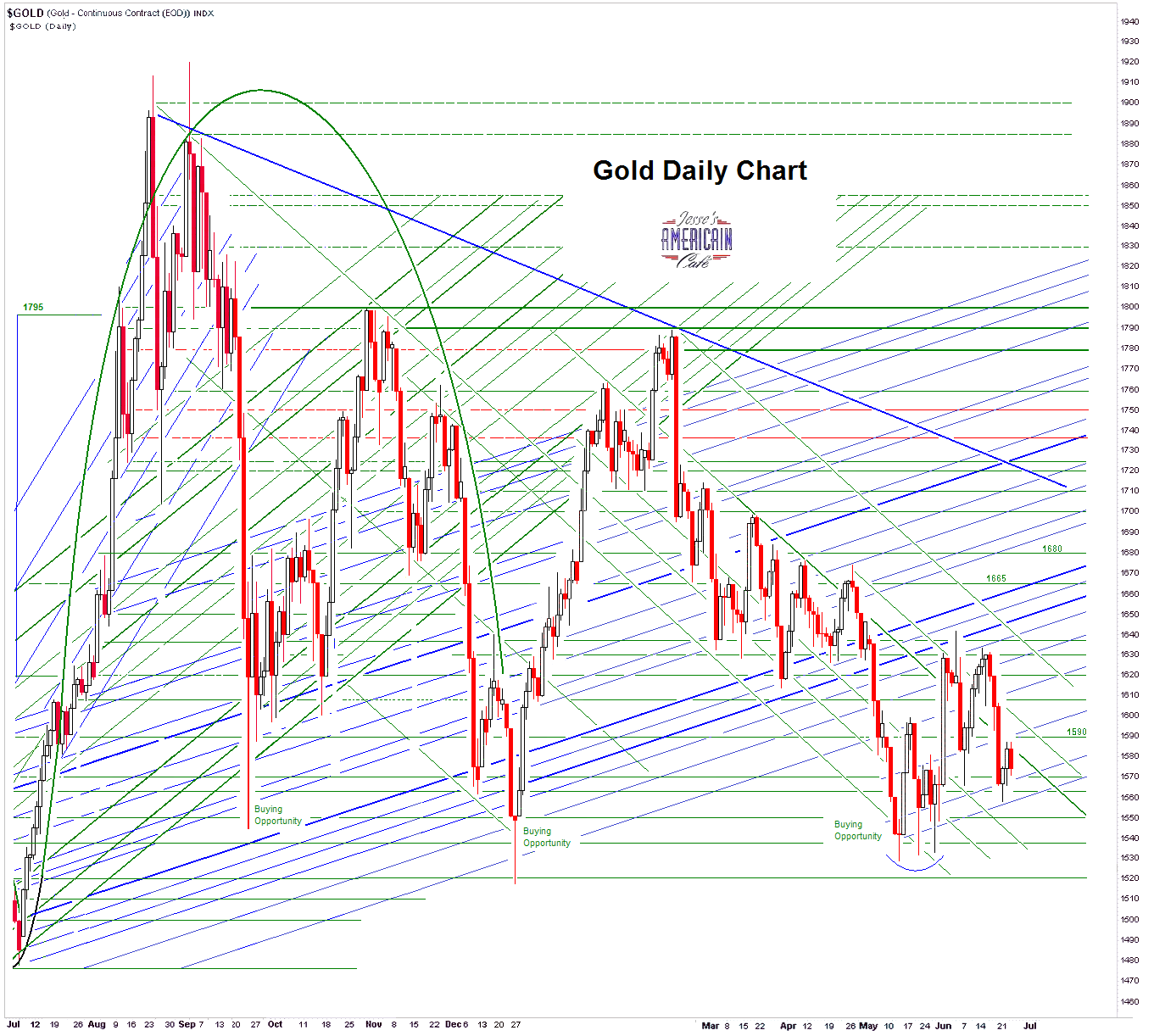
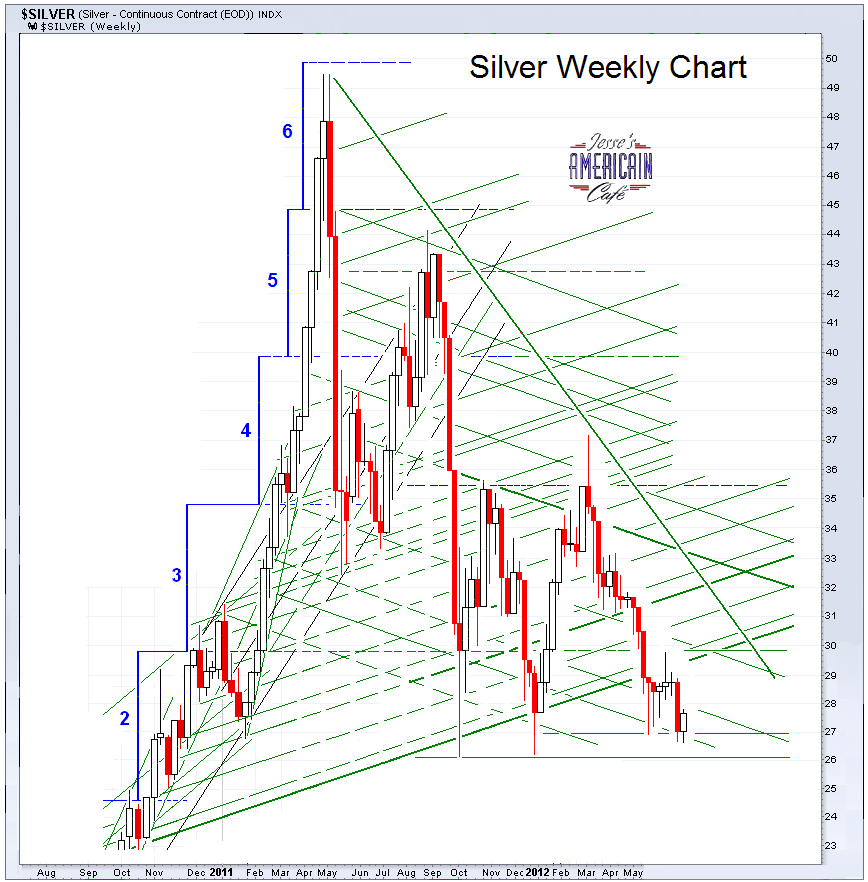
Gold Daily and Silver Weekly Charts - End of Quarter Rally After Steady Price Capping


The metals bears were stuffed today as it was risk on all the way.

Let's see how the next week closes now that the second quarter has been put to bed.


SP 500 and NDX Futures Daily Charts - End of Quarter And First Half 0f 2012


Quite a rally today based on the TARP like nature of the new bank bailout in Europe wherein the money is given directly to the banks and not their national sovereigns. Additionally there are signs that Europe may move to a Federal Reserve type structure.

Or it could just have been an excuse to run the market higher to make the end of quarter numbers look good.

US Consumer Spending and Confidence Fall to Lows of the Year

See you next week.


The US Supreme Court Upholds the Affordable Healthcare Act

Net Asset Value Premiums of Certain Precious Metal Trusts and Funds


28 June 2012

European Leaders Agree to $120 Billion Pact To Promote Growth and Paint Tape To Quarter End


Do you think some word of this leaked out to the markets? Aren't some of those fellows Goldman alums? lol

The financiers and politicians do like to make a 'splash' especially when they have nothing real to say. And it does provide a nice excuse for the end of quarter stock market charade.

To put the amount in context, the Spanish banks alone need that entire amount to remain solvent.

So far it looks like nothing of great significance and the stock futures are lackluster in their reception. It is more of a 'stimulus plan' and a collection of things already on the table.

Kicking the can...

The equity futures are not impressed.

Dow Jones newswire

European Union leaders meeting Thursday were set to commit to a growth pact worth 120 billion euros ($149.8 billion), including a boost in the capital of the European Investment Bank of EUR10 billion, as well as finalizing a plan to strengthen the euro zone by year-end, according to a draft of their conclusions.

"It is crucial to boost the financing of the economy. EUR120 billion (equivalent to around 1% of EU [general Net Income]) are being mobilised for fast-acting growth measures," the draft said.

The agreement of a growth pact would represent a political victory for French President Francois Hollande who pushed the issue during his election campaign. He argued the growth pact was needed to offset a fiscal compact agreed in January which ratcheted up further austerity policies in Europe.

Still, despite the big headline numbers, the pact seems to provide little new real money and relies on ideas that have been circulating for some time about how to better deploy the EIB and EU budget funds. Many EU officials have said they don't expect the policies to produce a significant change in the economic outlook.

The draft also said that European Council President Herman Van Rompuy would be asked to report back in October and finalize by year-end his report, released Tuesday, on ideas for deepening integration within the euro zone.

Mr. Van Rompuy prepared the report with European Central Bank President Mario Draghi, European Commission President Jose Manuel Barroso and Luxembourg prime minister and head of the euro-zone finance ministers Jean Claude Juncker.

Gold Daily and Silver Weekly Charts - Sitting on the Metals and Painting the Tape Into the Close


Stocks were weak after the morning GDP report which was flat but a nice increase in the chain deflator from 1.7% to 2.0%.

They took a dive as the US Supreme Court upheld the Affordable Healthcare Act, contrary to expectations. Robert Reich called this one and I think his reasoning is substantially correct. There were a few more political angles in that one that he allowed, but it was good enough to trade.

The stocks rallied in late afternoon, driven by algo buying centered in the SP futures. It looked like a tape painting exercise for the end of the second quarter as I had cautioned. They have struck a level and will seek to hold it into Friday's close.

The wiseguys sat on the metals to lessen the damage to their results from their naked short positions while they drove up prices on stocks in their portfolios. 

Gee Jesse do you really think they would do that? says the man wearing the 'kick me' sign on his back.

Are you kidding me?  After the revelations we have had the past ten years, including the long term and cavalier fixing of LIBOR, one of the cornerstones of the western financial system?   How many shots do you wish to give these jokers at destroying the real economy?

Most traders' empathy, outlook, and interests end around their belly buttons. and their attention spans and planning horizons are shorter than that.  Sociopaths are considered insufficiently ruthless for the more sophisticated firms, who ripen them over time into utterly self absorbed narcissim, if not borderline psychosis.

This is why I always laugh when 'serious people' in the media and the Congress turn to traders and speculators for public policy advice when it comes to financial regulation.  Why not ask a grifter or a loan shark what they think? 

Tomorrow's trade will probably be choppy and with a light volume, as the adults leave early for a long weekend at the beaches. There is late breaking news that the European leaders have agreed to some bailout package of 120 Billion euros, but details are scarce.

See you Sunday evening. Go Italy!


SP 500 and NDX Futures Daily Charts - Apply Paint to Tape In Afternoon For End of Quarter


Stocks spent most of the day much lower as the equity market did not get the expected 'pop' from the overturn of the Affordable Healthcare Act. There is intraday commentary on that, but suffice to say that Robert Reich was one of the few who read the tea leaves on that one correctly.

Stocks were a bit weaker after the Q1 GDP came in flat, but few noted the chain deflation increased from 1.7% to 2.0% which is quite an increase with no effect on the real GDP.

The market rallied in the afternoon quite strongly and surprisingly. There is almost no doubt in my mind that this was end of quarter tape painting as I had said although there is late word that the European leaders may have reached some agreement on a 120 Billion euro package..

So where does that leave us? Still concerned about Europe. I expect heavy action tomorrow and a lot of cross currents, and more light volume shoving and pushing as the adults leave early to head out to the beaches.


US Supreme Court Upholds Affordable Healthcare Act


The vote is out and it is 5-4 in favor of the constitutionality of the US Healthcare Reform Act.

Chief Justice Roberts provided the 'swing vote' in viewing the individual mandate as a 'tax' rather than accepting the Commerce Clause justification which Reich had thought would carry.  Justice Kennedy dissented, staying with the Republican appointees on the bench.  I am sure Antonin Scalia will provide an entertaining dissenting opinion.

The expansion of Medicaid was held to be unconstitutional 5-4, based on the argument that the government cannot withold funding for the entire program from states that do not comply with the expansion. In essense, the Medicaid expansion was fine, it was the penalty that was deemed to be an unconnected intrusion on the States since the Court saw the expansion as 'separate' and not part of the original program.

I remind the reader that 'Obamacare' with its private sector 'mandate' is in reality a long-standing Republican proposal, originally conceived in the conservative Heritage Foundation think tank, to use the private sector to try to manage healthcare costs, rather than the 'single payer' option.  Prior to Obama the largest implmentation of this approach was achieved and lauded in Massachusetts by guess who.


As it evolved the law was considered a betrayal of Obama's base by the progressive voters who strongly favored the expansion of single payer.  This inhibits its acceptance by a broad swath of the public as it is a sort of awkward compromise, still containing some rather popular facets such as inclusion of older children, the striking down of predatory pricing, and the refunding for excess profits. In essence, the law seeks to turn the health care monopolies into managed utilities.

Robert Reich was very close in his prediction yesterday of how this would come out.  Roberts was concerned that another blatantly political ruling would undermine the credibility of his court and his legacy.

I should remind the read that this interaction between the Administration and a conservative Supreme Court is a remarkable replay of the 1930's, in which the Court, packed with the legacy of prior Republican administrations, repeatedly struck down elements of the New Deal.

I think the most reliable forecast is that rational discussion will continue to decrease, while polarized hysteria will dominate much of the commentary and most of the conversation.

All this is of most interest to us because of its significance on the inability to generate economic recovery. 

And in the short term it did not support the two day stocks rally and caused those gains to be sold off.  Since I agreed with Reich I had put on a big short hedge, and it has worked.  

This will passd quickly and Europe and the domestic economy will become the driving forces.  This being an election year most of the activity in the Congress for the rest of the year will be theater.

Why the Supreme Court Will Uphold the Constitutionality of Obamacare
By Robert Reich
Wednesday, June 27, 2012

Predictions are always hazardous when it comes to the economy, the weather, and the Supreme Court. I won’t get near the first two right now, but I’ll hazard a guess on what the Court is likely to decide tomorrow: It will uphold the constitutionality of the Affordable Care Act (Obamacare) by a vote of 6 to 3.

Three reasons for my confidence:

First, Chief Justice John Roberts is — or should be — concerned about the steadily-declining standing of the Court in the public’s mind, along with the growing perception that the justices decide according to partisan politics rather than according to legal principle. The 5-4 decision in Citizen’s United, for example, looked to all the world like a political rather than a legal outcome, with all five Republican appointees finding that restrictions on independent corporate expenditures violate the First Amendment, and all four Democratic appointees finding that such restrictions are reasonably necessary to avoid corruption or the appearance of corruption. Or consider the Court’s notorious decision in Bush v. Gore.

The Supreme Court can’t afford to lose public trust. It has no ability to impose its will on the other two branches of government: As Alexander Hamilton once noted, the Court has neither the purse (it can’t threaten to withhold funding from the other branches) or the sword (it can’t threaten police or military action). It has only the public’s trust in the Court’s own integrity and the logic of its decisions — both of which the public is now doubting, according to polls. As Chief Justice, Roberts has a particular responsibility to regain the public’s trust. Another 5-4 decision overturning a piece of legislation as important as Obamacare would further erode that trust.

It doesn’t matter that a significant portion of the public may not like Obamacare. The issue here is the role and institutional integrity of the Supreme Court, not the popularity of a particular piece of legislation. Indeed, what better way to show the Court’s impartiality than to affirm the constitutionality of legislation that may be unpopular but is within the authority of the other two branches to enact?

Second, Roberts can draw on a decision by a Republican-appointed and highly-respected conservative jurist, Judge Laurence Silberman, who found Obamacare to be constitutional when the issue came to the U.S. Court of Appeals for the D.C. Circuit. The judge’s logic was lucid and impeccable — so much so that Roberts will try to lure Justice Anthony Kennedy with it, to join Roberts and the four liberal justices, so that rather than another 5-4 split (this time on the side of the Democrats), the vote will be 6 to 3.

Third and finally, Roberts (and Kennedy) can find adequate Supreme Court precedent for the view that the Commerce Clause of the Constitution gives Congress and the President the power to regulate health care — given that heath-care coverage (or lack of coverage) in one state so obviously affects other states; that the market for health insurance is already national in many respects; and that other national laws governing insurance (Social Security and Medicare, for example) require virtually everyone to pay (in these cases, through mandatory contributions to the Social Security and Medicare trust funds).

Okay, so I’ve stuck my neck out. We’ll find out tomorrow how far.

27 June 2012

Gold Daily and Silver Weekly Charts - More Criminal Manipulation in the News


There were two new developments in the ever unfolding crime drama known as the Anglo-American financial system.

Peter Madoff, brother to infamous Bernie and long time 'chief compliance officer' for the Madoff fund, is pleading guilty to the charge of 'falsifying documents.' As you may recall Harry Markopolos had attempted to call the fraudulent nature of the Madoff investment model to the attention of the regulators for years and was ignored, ridiculed, and threatened.

The bigger news of the day was the settlement with Barclays in the absolutely egregious fraud of fixing the LIBOR market rate. The Bank will pay a $450 million fine and incur no criminal penalties or trading sanctions.    The American CEO Bob Diamond says he will forgo his personal bonus as well.

Other banks were involved, but Barclays has settled. Barclays Pays 450m to End LIBOR Prove

Bart Chilton of the CFTC was on the news claiming victory for the regulators.

A read of the some of the emails discovered in the case shows that the manipulation was almost as blatant and obvious as placing food orders at a takeaway restaurant.
Ah hey old boy, our positions are up against it, so would you be a good chap and knock 50 basis points off LIBOR for us tomorrow morning please.

Anything for your my good man. Consider it done.
The Bloomberg TV crowd had fun with this story about Barclay's, with Matt Miller chuckling that the fine is 'only six weeks profits' for the Bank, and the market obviously doesn't take it seriously because 'look at the stock price.'  Barclay's stock finished the day down 3 cents.

Manipulating LIBOR is a BIG deal, one of the worst and most pervasive frauds to actually come to light since the widespread fraud in the CDO market.

That the firm faces no criminal charges, will not be barred from any markets, and is taking what the financial commentators dare to taunt openly as a minor fine is a disgrace.

And those who say that the markets should be without regulatory oversight and set the key interest rates without outside interference are living a romantic or ideological fantasy.

Do governments manage rates? Of course they do. That is a role of the Fed. They do it for policy decisions, and spend some time announcing and discussing those actions.

But this is not the same thing as private firms manipulating rates secretly for their private profit at the sake of other's losses. People who say they are equivalent are serial self-deceivers, and probably blinded by ideology.

Have no illusions. The fix is in, and often, in these markets. Those who scoff at such assertions as 'conspiracies' might bear both Madoff and Barclays in mind, not to mention Enron.

There will be more revelations of criminal conspiracies to defraud the public and the markets in the coming months.  But LIBOR is very significant.  It is a market touchstone.  And it was foul for a long time. 


SP 500 and NDX Futures Daily Charts


There are at least three major cross currents here.

First of course is Europe and the EU summit meant to speak to their sovereign debt crisis. There is much talk that Merkel will veto any action on Italy, Greece and Spain on behalf of Germany. Today Bloomberg TV was making the case that the EU skip the countries altogether and give the money directly to the Banks, so none is wasted. Nice sentiment if one is of the porcine clan. Personally I would just nationalize the banks, and take it from there with a forced restructuring based on their insolvency, and deal with the countries next.

Second is the US Supreme Court decision on the Healthcare Reform Bill. The court is expected to overturn at least a portion of the act, which may have a short term positive effect on equities.

And Third is the end of quarter and the painting of the tape by the funds to make their results (and bonuses) look better.

A consideration is the Fourth of July holiday in the States next week.


26 June 2012

Gold Daily And Silver Weekly Charts - The Money Matrix - Sic Transit Gloria Mundi


As a reminder, today was the silver option expiration on the Comex.

The EU Summit meeting is on Thursday and Friday of this week, 28-29 June.

Next Wednesday is the US 4th of July holiday.  I would expect many punters would like to be leaving early this week if they can.

This is also the last week of the second quarter.

The US Supreme Court is expected to rule on Obamacare on Thursday, overturning at least a portion of it. This may provide a sellable rally.

Quite often the markets search for some level, and then try and let the junior traders hold it in light volumes, unless something happens.

With algos running we sometimes get some interesting intraday action but little in the way of progress.

This is a week that also brings some important metals events.
June 26 Comex July silver options expiry
June 26 Comex July copper options expiry
June 26 Comex July silver futures last trading day
June 27 Comex June gold futures last trading day
June 27 Comex June copper futures last trading day
June 27 Comex July miNY silver futures last trading day
June 29 Comex July silver futures first notice day
June 29 Comex July copper futures first notice day
I made an effort to describe a relatively simple model of the US banking system briefly and in relatively common terms in an intraday commentary today. Back Again To Money: Money Creation and the Banking System - A Forecast of Sorts

It is a 'barebones' version of the domestic money model I keep in my head, to help incorporate new events and interpret them within some greater context. It really is not so hard to do, if you put a little effort into it. I think you might find it helps to understand some of the things that are happening today.

The international money system adds a significant layer of complexity, but one thing at a time. I plan to write something on that in the future.

Basically gold and to a somewhat lesser extent silver, are annoying rivals to fiat money. In times of distress they are a haven for individuals in protecting their wealth, and a threat to the status quo banking system because they are fundamentally difficult to manage and to control since they do not rely on a promise.

Bullion banks and trading desks, with the likely cooperation of the government and the banking system itself, have created a leveraged paper market that surrounds gold and silver bullion like a large, opaque cocoon, many times the size of what is apparently owned itself.

At some point that reality will be revealed, and all hell will break loose as various groups seek to grab bullion ownership as fast as they can. It will make what happened at MF Global look like recess on the schoolyard.

This in a nutshell is the premise that GATA has put forward for some time, and it makes sense based on everything that I have seen.

The world financial system has been slowly and surely changing since the 1990's. In keeping with that change, central banks have turned from net sellers to net buyers of gold, particularly in the faster developing economies, a fact that should not be ignored since it is very likely a sign of things to come.

The international sovereign and banking debt crisis is hardly resolved, and while it is interesting beyond the norm to someone like myself, it also carries a tinge of concern, fear if you like, with it, because the safekeeping of productive wealth is essential to modern life with its predominant division of labor and production.

So we all strive to understand what is happening, and look for the important events and sort them from the trivial, to formulate our own responses to change as best we can. And it is not an easy task because of the fog of confusion and misdirection that surrounds even such a novelty as a currency war.

I told my son the other day that in my experience managing the disposition of water and energy are the principal tasks in maintaining a home, in addition to normal wear and tear, particularly of the childhood variety. It's always something.

Similarly, the principal problem today in managing personal wealth, besides obtaining it in the first place, is identifying and managing risk and return. Thanks to the central banks, returns are hard to come by. So risk looms larger, and mispriced counterparty risk in particular, because it can come like a thief in the night.
"O quam cito transit gloria mundi."

"How quickly pass the glories of the world."

Thomas à Kempis
Gold held closely is, in the recent words of the regulators, a 'riskless asset.' I might add silver is as well, although to a slightly lesser extent.

Proposed Bank Regulation Would Drive Gold Prices Higher - WashingtonBlog

Draw your own conclusions from all that. Diversity of portfolio is an insurance against improbable events.


SP 500 and NDX Futures Daily Charts - Limbo European Style


The market is holding its breath waiting to see what happens in Europe.

The European Summit meeting is June 28-29, which may cause some cross currents into the weekend.

This week is also the end of the second quarter. 

The US Supreme Court is also expected to overturn a portion of Obamacare on Thursday. That may produce a brief but sellable rally ahead of the EU and the weekend. Very hard to say what will happen in these thin markets.

Next week Wednesday is the US July 4 holiday.


The Banking System and Money Creation - A Forecast of Sorts


Money in the modern fiat sense originates from a number of sources.  Among these is the conversion of credit potential into money by the expansion of debt.  For the sake of simplicity I simply refer to this process as 'credit.'

This does not mean that 'credit' is money, not in the least. Credit is a source of money, and amongst the most vital in a highly geared fractional reserve banking system, but is still not money itself.

In our modern world of financial innovation, 'money' is most often created through the leveraged expansion of credit by private banks, and its subsequent employment in supporting real economic activity in the form of savings, consumption, and investment.

Private banks have been licensed the privilege to increase the supply of money through the exercise of fractional reserve credit and receiving insured desposits in return for assuming the responsibility for assessing the risks,  adhering to regulations, conforming to inspections, and taking the full responsibility for any losses by their management, shareholders, and bondholders. Otherwise it would be a very exorbitant privilege, a thinly disguised racket, and a confidence game.

"Gentlemen! I too have been a close observer of the doings of the Bank of the United States. I have had men watching you for a long time, and am convinced that you have used the funds of the Bank to speculate in the breadstuffs of the country.  When you won, you divided the profits amongst you, and when you lost, you charged it to the Bank."

Andew Jackson
While some central bank, either officially or de facto, most often manages the private banking system, providing additional credit where needed, largely through the discount window as lender of last resort, the real economy is able to generate enough money through its own activity to support its natural growth, with allowance made for seasonal fluctuations. Natural growth is rarely linear, but given to advance and consolidation, ebbs and flows.

One measure of this activity is the velocity of money, that is, the amount of real economic activity relative to the existing money supply using some sort of measure.  The measure does not do anything of course, but it is merely a measure of what is happening in the interaction between money creation and real economic activity, rather like a speedometer.

There are a number of 'throttles' which a central bank, and banking management for that matter, can use to manage and regulate the creation of credit and thereby the supply of money. Among these are lending standards, reserve requirements and quality, bank leverage and investment guidelines, and short term interest rates.

I will not go into these individually now, but one can see that this is how the capitalisation and activity of a bank is shaped, either by sound private management or the force of some external regulatory body, ideally in some combination and mutual cooperation.

For whatever reason, be it some exogenous event, human or natural, or the result of a period of mismanagement, the credit creation process may fail and the banks become unable to generate credit sufficient to serve the needs of the real economy. I can give any number of examples of why this might happen.

An appropriate one might be bank insolvency, that is, a sudden deterioration of the assets upon which the bank's credit rating is based, impairing its ability to acquire money to fund its daily operations.  This funding is known as liquidity.   It might be a simple and yet not incorrect to think of solvency as net asset wealth marked to market, and liquidity as cash flow available to meet demands.

In a financial collapse as the result of a financial bubble, an entire banking system might be brought low by some natural disaster or the deterioration of assets based on some chronic mispricing of risk.  This is most likely to be systemically severe if the credit creation process is concentrated in a few big banks, and/or the banking system is highly interconnected by counterparty risk. 

As an aside, and admittedly off the top of my head, I seem to recall that the objection which some economic scholars like Ben Bernanke have had to the gold standard and the Great Depression is that it helped, in their analysis, to transmit and transfer the economic failure in some countries to many countries, in the manner of a contagion.  Thank God they eliminated that problem with their new banking model, right?

Concentration and interdependency are negative influences on portfolio diversification.

At the point of a credit creation failure, the central bank, and most likely the government, must step in to remedy the situation. The most effective approach seems to be the shutting down of the bank or banks, the cleansing of  balance sheets, prosecution for fraud as appropriate, and then the reopening of the banks as well-managed and functioning institutions again, as appropriate and practical.

Hopefully the unsuspecting depositors have been made whole, while serious losses are realized by management, the shareholders, and even the bondholders of the bank, who presumably have a significant interest and effect on how it had been managed.  This satisfies equability and justice.

This resolution of the banks' balance sheets and management is what is called a sine qua non. If this does not happen, then the situation will continue in some crippled manner until it is corrected.  Even in the case of a natural disaster or some completely exogenous event, a general banking failure is the sign of some systemic weakness and concentration in the system.

During a period of bank restructuring, the central bank will most likely be called upon to take a more active role in the supply of credit to the real economy. It does this through its own lending facilities with the banking system though an ability to inject credit by purchasing financial assets from the remaining sound banks. 

This is absolutely the function of the central bank. It has little other reason to exist in the form that it does as a bank, except to stand ready as lender of last resort. If it does not perform this function, it is merely another regulator.

If the damage to the real economy is deep enough, the central government may have to intervene beyond prosecuting fraud, restoring the funds of depositors and the granted of new licenses to restructured banks.

If the central bank's activity to sustain the money creation process is not sufficient because of a spiral of diminishing demand caused by a lack of confidence to spend and invest, it can increase its own spending thereby stimulating activity in the real economy.

This is often controversial because during a sustained economic downturn government finances should turn negative, since their income from taxes on real economic transactions fall off, and perhaps sharply, due to a decline in those transactions.

I know this is a bit of a simplification, but it does essentially represent what happens.

The collapse of the credit system can be called a 'deflationary event.' It is deflationary not so much because it destroys money per se,  but because it reduces the growth rate of money relative to the needs of the real economy, and sometimes significantly.

A money supply is rarely static. It grows as a population and an economy grows and expands, and seasonal demand fluctuates, and can still be called stable.

Try not to think of a money supply in purely nominal terms but in relation to something else, like the real economy. If the economy is growing at five percent per year, the money supply would also be growing at about five percent a year just to maintain its stability and to satisfy demand. 

If the real economy is growing at five percent, and the money supply has no growth, then it will begin to act as a constricting force on the economy unless investments can be obtained from some external source if that is possible.

If it has been growing rather quickly relative to the needs of the real economy for whatever reason, and then suddenly the money supply growth stops without regard to anything real changes, it will have an artificial dampening effect on the real economy, prices, interest rates, and so forth. 

So why are the developed economies in such trouble today?

Because for whatever reason, the central bank and the government have failed to take that most important first step in a sustainable recovery in the aftermath of a credit bubble:  reforming and restructuring the financial system.

It is really that simple.

The imbalance that gripped the banking system, the oversized growth of financialisation through innovations in fraudulent conveyances, is still in place.   The activity has just moved to other segments of the economy to feed a bloated and overpaid financial sector that largely unchanged, except that the names on their business cards may be different and fewer.

What we have now is an oversized financial bureaucracy that continues to suck the life out of the real economy which itself has decreased in size and is less able to carry on gracefully.

In those countries that have taken the necessary steps to cleanse the debt and corruption out of their banking systems and restore a balance that favors real growth rather than financial manipulation and speculation, there has been a recovery. Iceland is one recent example. The US in the 1930's is another very good example.

And almost every one of the protections that the people put in place in the 1930's, based on their sad experience in the financial collapse of the 1920's speculative bubble in fraudulent financial instruments, was struck down.

The approach of 'bailing out the banks' and then shifting the pain of economic adjustment from the bank management, shareholders, and bondholders to the public is not only unjust, it is also ineffective, because it merely perpetuates the problems and distortions that caused the banks to fail in the first place and makes them much worse.

The result of this is most likely to be a prolonged period of significant stagflation, if the country has a sovereign currency sound enough to continue on supporting it.  In Japan this presented itself as a prolonged period of economic stagnation but not private deprivation for some reasons peculiar to the structure of their real economy and the nature of their political system.

So here we are. What happens next will be a policy decision.

Although it is different for Greece, whose currency is controlled by an external, and some might say foreign, authority, for the US the limit of the ability of the Federal Reserve to create money is the amount of outstanding debt that it can buy for its balance sheet. 

When working in conjunction with the Treasury, which is the issuer of the sovereign debt, the effect limit of this money creation is the value of the dollar as a medium of exchange for real goods and services, most importantly to non-dollar economies. 

Therefore it is not simply something in the control of the Fed, but a more organic response from the political class.

On one hand we have a powerful set of monied interests who have been the primary beneficiaries of the distortions in monetary and fiscal policy for the past twenty years or so.  And on the other hand we have the bulk of the real economy and the public, including the somewhat fortunate to the newly destitute.

There is a quiet power struggle taking place behind the scenes today over the policy decisions that have been and will be made in response to the crisis by the political class.  The decision is not naturally for the greatest good, and so therefore the polarization has deepened.

Huge sums are being spent, and much talent and energy expended, to shape and influence and frame the attitude and context of the policy debates, including the outright buying of power and influence in the political process. And even more money is being spent on selling those outcomes to the public, and buying a determined and highly vocal minority.  This is nothing new in history.

The people are confused, and in their confusion often become angry, and even hysterically reactive.  These are periods often rich in demagogues, scapegoating, nativisim, and nationalism. 

So here we are.  Where we go next is substantially up to us.  It is not so much that the system has gone wrong, but that our priorities have changed, leading to distortions in the way the system functions.

"Capitalism does have a lot of strengths, including producing things that are very innovative. But what drives capitalism is the profit motive. You can profit not only by making good things, but also by exploiting people, by exploiting the environment, by doing things that are not so good. The narrative that you describe ignores the extent to which a lot of the inequalities in the United States are not the result of creative activity but of exploitive activity."
Joseph Stiglitz
Significant discussions need to occur, and someone or some group must stand up for the right, the greater good.  There should be no doubt that some groups will quickly stand up for the wrong, the narrowly beneficial and broadly destructive, with passionate intensity.

Europe is a much more difficult situation, because their euro is controlled by a fortunate few who are politically separate from those who are feeling the brunt of the pain in the short term. The entire system as it is now constructed is inherently unstable, and cannot stand the stress.

And the same can be said for the 'success stories' like China and the Asian tigers, whose centrally organized economies are based on an unstable global export growth and artificially structured currency regime.

The first reaction of most people,  besides those who just skip the tutorial about how things work and reflexively chime in with a slogan like 'government is the problem so we must eliminate it' and say 'first' is to understandably ask 'how can I protect myself and my family.' Complete self-sufficiency is not obtainable for most, so one must settle for self-sufficiency as is practical. Preserving one's wealth from a rapacious financial system is key. Providing some practical form of food, shelter and protection for one's family is obvious. How to do that depends on one's means and abilities.

I will caution though, that if things progress as I think they might, there will be no place of complete safety to hide. Obviously some local situations might deteriorate badly, and one would not want to be there. But all things being equal, I would rather be amongst friends and in familiar territory, than a stranger in a strange land.

As Walter Bagehot observed, "Life is a school of probabilities."   There is a difference, and often significantly so, between what is possible and what is probable.  One needs be aware of the possibilities, but plan and act based on the evolving probabilities.  A plan based on extreme outcomes is often an extremely impractical plan. 

We live in interesting times.   Changes are coming at us, and so flexibility is an important component of preparedness.  But the best outcome would be for a return to more normal economic growth and stability, and this is not possible without significant reform.

The Banks must be restrained, and the financial system reformed, with balance restored to the economy, before there can be any sustained growth and recovery.


25 June 2012

Gold Daily and Silver Weekly Charts - Big Bounce on 'Flight to Safety'


Gold and silver 'popped' today despite the higher dollar and risk off trade. It happened shortly after I posted the NAV premiums chart, having seen some odd action on the tape, and watching the action closely into the option expiration tomorrow in silver. It is also expiration for copper.

The metals often act oddly around their Comex Option Expirations, depending on a number of factors.  If you remember nothing else, remember that.  You can get some nice entry and exit points around those days, in the lead up and aftermath.

The fellows who write and trade those options play games against them and with them, make no mistake about it. People who buy options on the retail side are typcially gamblers unless they are hedging. 

Sometimes guys who are deeply knowledgeable of one or two indicators get lost in these little events that occur. But you can often spot them in the anomalies in the tape.

One has to watch many things and be open to various possibilities. That is why I do not like to 'predict' so much as calculate probabilities, since one tends to fall in love with their models and forecasts.

That is why I so often like Jim Sinclair's comments. He understands the short term moves for what they are, and treats them accordingly, ie with little regard but keeps his eye on the prize, the primary trend.

Chasing a model that predicts wiggles is a mug's game, wherein you are always chasing 'a better model.' If the model were any good, you certainly would not hear about it on a free web site. And for the most part, the wiseguys make money with practical models but gain their edge by 'cheating' using asymmetric information and stacking the odds in their favor.

And I hope to be in this for money, not a fan club.  So sorry, but there are no mechanistically precise models that crank out the future in advance which I can share with you.  There are plenty of other fellows who can do that for you, and often for a price. 

Do yourself a favor if you are not doing it full time for some reason AND making consistent money and just stop trading for the short term, or reduce your activity significantly. You cannot beat the shenanigans, mispricing of risks, and transaction frictions like commissions.

One can forecast the longer term trends on fundamentals, but that is something else entirely.   You have to be prepared to ignore the 'wiggles,' especially in the kinds of markets we have today.

At 58 the gold/silver ratio was a bit stretched against the peoples' metal.

Markets remain edgy about Europe.

End of quarter this week. Let's see how it goes. I remained concerned that some of the bigger wiseguys (JPM) might smack the metals to make their carried losses look smaller for quarter end. It is hard to see that since one does not know their overall net positions in all markets.


June 26 Comex July silver options expiry
June 26 Comex July copper options expiry
June 26 Comex July silver futures last trading day
June 27 Comex June gold futures last trading day
June 27 Comex June copper futures last trading day
June 27 Comex July miNY silver futures last trading day
June 29 Comex July silver futures first notice day
June 29 Comex July copper futures first notice day
July 26 Comex August gold options expiry
July 26 Comex August copper options expiry
July 27 Comex August miNY gold futures last trading day
July 27 Comex July gold futures last trading day
July 27 Comex July silver futures last trading day
July 27 Comex July copper futures last trading day
July 27 Comex August miNY gold futures last trading day
July 27 Comex August E-mini copper futures last trading day
July 31 Comex August gold futures first notice day
July 31 Comex August copper futures first notice day


SP 500 and NDX Futures Daily Charts - Risk Off on Euro Summit Concerns


It was a 'risk off' day as stocks were sold and investors moved into safer plays.

This is the end of quarter week, so the tape may begin to take a coat of paint in a day or so, barring more storms from the continent.

Funds tend to sell their losers first, then pump up their holdings to mark them as winners. So watch out for the old 'one-two.'

Interesting that gold and silver went countertrend today. I am surprised at how few have figured it out.


NAV Premiums of Certain Precious Metal Trusts and Funds - Silver Undervalued


The premiums of some of the more popular Funds are back to 'normal' levels, but certainly not overly enthusiastic.

And we see a significant divergence between the metals and stocks today, suggesting perhaps that the selling in the metals had been overdone. Stocks are sharply lower, but the metals are stubbornly positive. And yet the US dollar is higher as well. A flight to safety? It looks like it.

The Gold/Silver ratio at 58 reflects the underperformance that silver has shown of late, in response to its higher beta and partial industrial component, and most recently I think because of its option expiration at the Comex tomorrow. The call holders may have been shaken, and so it is now time to skin the put buyers.


24 June 2012

Michael J. Burry's Commencement Address at UCLA - Credibility Trap and the Predator State


Burry is describing the credibility trap that followed in the aftermath of the financial fraud that gripped the developed world through the Anglo-American banking cartel, perhaps without realizing it in those terms. This is why there is no honest discussion of what has been happening.

The financial crisis is not over. The bank bailouts and subsidies are as much a part of the vast financial fraud that is destroying the real economy as the original packaging and promotion of risky mortgages had been.

"Michael J. Burry is one of the few who saw the crisis coming in all its glory and bet heavily on that unmistakable eventuality. Bernanke and Geithner and Greenspan and Summers and Rubin did not see it coming. Yet, who has been in charge of guiding us out of this predictable and self-inflicted crisis? Greenspan's prodigies: Bernanke, Geithner, Summers, Rubin and many other profoundly compromised parties.

Michael J. Burry, in the video below, delivers the keynote address at the 2012 UCLA Department of Economics Commencement. In it, he describes the process he undertook in determining that the credit bubble would pop, the housing sector would crash, and that the financial world's blindness to the obvious would, if property harnessed, vault him into the 1%. All of it t was 100% foreseeable. There was no "black swan". Yet, our most esteemed economic leaders were completely blind to it.

In 2010, Burry wrote an op/ed in the New York Times entitled, I Saw the Crisis Coming. Why Didn’t the Fed? No member of government ever reached out to Burry to discuss the issue - to see if there was any way to bring his focused wisdom and uncompromised analysis to a government that was tragically deficient. Instead, within 2 weeks of the publication of the op/ed, all 6 of his defunct funds were audited. Soon thereafter, the FBI initiated an investigation into his activities.

Greenspan's prodigies are beyond compromised. That the IRS and the FBI were sent to create havoc for Burry is a form of abuse of process. Our democracy is failing us. Checks and balances have been subverted by money, people in leadership positions protecting their failed legacies, and absolute impunity for the power elite who are successfully marginalizing the truth-tellers. As Burry notes, they are rewriting history."

Capitalism Without Failure


High Anxieties: The Mathematics of Chaos


"The hyper-rich are facing something worse than death: becoming poor. Do you think they will go quietly? I think they will do whatever it takes and sell it to us in the name of 'saving the system.'"

David Malone, Debt Generation

This documentary was started in 2007 by David Malone and Mark Tanner on commission from the BBC. David had finally persuaded the network that a financial collapse was coming, a situation which he had been watching and documenting for some years.

It was finally finished on 12 September 2008, the Friday before the collapse of Lehman Brother. Two days later it was aired on BBC4.

David Malone writes a financial blog Golem XIV.

A number of people had been warning of a collapse including myself. The bubble in housing and dodgy credit was apparent to anyone who had eyes to see, the time and training to look, and a mind unclouded by conflicts of interest.

I remember after one particular rant of mine on an establishment economics site about the coming collapse, someone asked, 'What do you think he wants?'

And that is perhaps the heart of what went wrong. Few were acting from conscience and principle, and most, as is so human, were guided by self-interest, ideology, rosy thinking, careerism, and the flawed models that supported inaction in the face of monstrous injustice and transfers of wealth from the relatively innocent and unsuspecting to the financial predators.

I will tell you now that what is coming next will be as awful as anything that has gone before, and quite possibly much worse. Poison is being offered as a cure, and if taken, will contribute to the suicide of the middle class.

There is still some time to act, but it is quickly slipping by. We seem to have learned nothing.


Author’s Note from Debt Generation By David Malone

"From the very start of this crisis what concerned me, above all else, was the almost total lack of any real and meaningful debate. Decisions have been made that will affect us for generations to come, but did we ever truly hear competing ideas, explanations and alternative solutions? I certainly didn’t. All I heard was a worrying unanimity.

Bankers, financial experts, journalists and politicians all repeating each other with the same absolute, shrill, conviction. Only a seemingly endless series of vast bank bailouts, they told us, could avert otherwise certain and catastrophic disaster. It was all far too complicated for the likes of you and me to question what we were not qualified to understand.

Such absolute certainty always gives me cause for thought, so I did what I do in such situations: I began to read – but not economics books. I already knew, from a film I was making at the time, that the assumptions economists used about the real world were fatuous at best. I chose to read what actual traders inside the crisis were saying to each other, day to day, on the message boards where they exchange ideas and information.

Most of what is said on such boards is in trader gibberese, but some of it is a brutally clear analysis of what is happening. I didn’t have to agree with their politics to learn from what they had to say. There was another view of the crisis. There were other ideas of what should be done. Radically different ideas.

The more I read, the stronger my conviction grew that the mainstream media’s reporting of the crisis was alarmingly wrong. After three months of reading, I began to write. That was in early 2008. I had no intention of writing a book. I simply felt compelled to voice opposition to the deafening certainties being thrust at me from all sides. What I wrote, under the name GolemXIV, were comments on the Guardian newspaper’s website responding to financial news stories.

We had been denied, I argued, a meaningful discussion of the nature of this crisis and the futility of what was being done in the name of fixing it. As the crisis unfolded, I became more and more convinced that what was being done in the name of helping us would instead, whether by design or stupidity, turn us and our children into the Debt Generation: the generation whose principle use and fate would be to pay off other people’s debts. It made me angry. Angry at those engineering it, angry at those who justified it, and angry at those who told me there was no alternative.
After nearly two years of commenting on the Guardian, I started my own blog where I still write.

What you have in your hands is a condensation of all that anger, frustration, reading and thinking. My friend and collaborator on many films, Mark Tanner, took everything I had written and formed it into what we hope and believe is a jargon free and readable critique of what, to this day, we are still being told by all the experts, bankers, politicians and journalists.

If, like us, you feel the need to have a different account of our current situation and what we should be doing about it, then I sincerely hope this book offers you something valuable and important."

The Loophole That Placed MF Global Customers At Risk Was Still Being Used


Apparently the 'loophole' that allowed MF Global to use customer assets for their own purposes and not set aside sufficient funds to cover them is still in place and still being used by some brokers.

The CFTC has sent a letter this month to all futures brokers telling them to stop using this loophole, and intends to close it through additional formal actions.

Change occurs, but slowly.

NY Times
A Loophole Big Enough To Lose a Billion
By James B. Stewart
24 June 2012

If nothing else, the collapse of MF Global has made one thing clear: The notion that customer assets were safe was a sham.

MF Global’s customers, who discovered that the firm had plundered $1.6 billion of their property, learned that the hard way. But they aren’t the only potential victims. The loophole that allowed MF Global to convert more than $1 billion in customer property to its own reckless bet on European debt is still in effect — although the Commodity Futures Trading Commission, which regulates futures and commodities brokers, said it had since pressured other firms to stop using it.

The CME Group, which is both the largest commodities and futures exchange and also regulates many brokers, told me this week that when MF Global collapsed last year, four of the 40 firms it oversees were still using an “alternative” calculation of customer assets that vastly understates what firms actually owe. A spokeswoman declined to name them, saying such information was confidential. In my view, they should all be identified publicly so their customers can demand reassurances that the practice has stopped — and that their assets are safe.

Since the Depression, when thousands of customers were wiped out by failing brokerage firms, the idea that customer assets are protected has been sacrosanct, embodied in laws and regulations that require the assets to be safely segregated. Violating these requirements is a crime.

The rules require a firm to put aside the amount it would owe if its customers’ accounts were liquidated. This would seem simple common sense: if a brokerage firm closed or failed, customers should expect to get the full value of their assets.

But the rules apply only to accounts in the United States. In 1987, the commodity commission approved a series of rules governing foreign futures and options transactions, one of which provided an alternative calculation of how much firms needed to put aside for accounts that traded on foreign exchanges.

The alternative calculation almost always resulted in a lower amount — sometimes much lower — that needed to be segregated in foreign accounts, because it covered only options and futures. Cash and securities held in customer accounts didn’t count. So if a customer held only cash and securities, the firm had no segregation requirement at all...

To its credit, the commodity commission is taking action. This month the commission sent a letter to all regulated futures brokers telling them the agency expects them to use the net liquidating calculation — and not the alternative calculation — for all accounts, American and foreign, “pending adoption of the new rules.” It said those new rules would include “the elimination of the Alternative Method.” The letter also said that all firms still using the alternative method had agreed to discontinue using it...

Read the rest here.