12 August 2012

How Andrew Jackson Killed the Second Bank of the United States


"Gentlemen! I too have been a close observer of the doings of the Bank of the United States. I have had men watching you for a long time, and am convinced that you have used the funds of the bank to speculate in the breadstuffs of the country.

When you won, you divided the profits amongst you, and when you lost, you charged it to the bank. You tell me that if I take the deposits from the bank and annul its charter I shall ruin ten thousand families. That may be true, gentlemen, but that is your sin!

Should I let you go on, you will ruin fifty thousand families, and that would be my sin! You are a den of vipers and thieves. I have determined to rout you out, and by the Eternal, (bringing his fist down on the table) I will rout you out."

From the original minutes of the Philadelphia bankers sent to meet with President Jackson February 1834,
from Andrew Jackson and the Bank of the United States (1928) by Stan V. Henkels


"...It is to be regretted that the rich and powerful too often bend the acts of government to their selfish purposes. Distinctions in society will always exist under every just government. Equality of talents, of education, or of wealth can not be produced by human institutions. In the full enjoyment of the gifts of Heaven and the fruits of superior industry, economy, and virtue, every man is equally entitled to protection by law; but when the laws undertake to add to these natural and just advantages artificial distinctions, to grant titles, gratuities, and exclusive privileges, to make the rich richer and the potent more powerful, the humble members of society-the farmers, mechanics, and laborers-who have neither the time nor the means of securing like favors to themselves, have a right to complain of the injustice of their Government. There are no necessary evils in government. Its evils exist only in its abuses. If it would confine itself to equal protection, and, as Heaven does its rains, shower its favors alike on the high and the low, the rich and the poor, it would be an unqualified blessing. In the act before me there seems to be a wide and unnecessary departure from these just principles.

Nor is our Government to be maintained or our Union preserved by invasions of the rights and powers of the several States. In thus attempting to make our General Government strong we make it weak. Its true strength consists in leaving individuals and States as much as possible to themselves-in making itself felt, not in its power, but in its beneficence; not in its control, but in its protection; not in binding the States more closely to the center, but leaving each to move unobstructed in its proper orbit.

Experience should teach us wisdom. Most of the difficulties our Government now encounters and most of the dangers which impend over our Union have sprung from an abandonment of the legitimate objects of Government by our national legislation, and the adoption of such principles as are embodied in this act. Many of our rich men have not been content with equal protection and equal benefits, but have besought us to make them richer by act of Congress. By attempting to gratify their desires we have in the results of our legislation arrayed section against section, interest against interest, and man against man, in a fearful commotion which threatens to shake the foundations of our Union.

It is time to pause in our career to review our principles, and if possible revive that devoted patriotism and spirit of compromise which distinguished the sages of the Revolution and the fathers of our Union. If we can not at once, in justice to interests vested under improvident legislation, make our Government what it ought to be, we can at least take a stand against all new grants of monopolies and exclusive privileges, against any prostitution of our Government to the advancement of the few at the expense of the many, and in favor of compromise and gradual reform in our code of laws and system of political economy.

I have now done my duty to my country. If sustained by my fellow citizens, I shall be grateful and happy; if not, I shall find in the motives which impel me ample grounds for contentment and peace. In the difficulties which surround us and the dangers which threaten our institutions there is cause for neither dismay nor alarm. For relief and deliverance let us firmly rely on that kind Providence which I am sure watches with peculiar care over the destinies of our Republic, and on the intelligence and wisdom of our countrymen. Through His abundant goodness and their patriotic devotion our liberty and Union will be preserved."

Excerpt from Andrew Jackson's Veto Message to the Senate on the Second Bank of the United States, 1832

11 August 2012

Michael Parenti: Functions of Fascism and Capitalism's Self Inflicted Wounds


One thing that Parenti does not discuss is the similarity between state communism and fascism in their anti-humanism, central planning, and self-destructive fanaticism.

Many thinkers distinguish between fascism and communism in their attitude toward globalization: the fascists are nationalists and the communists are internationalists.

I believe that my model of the socio-political continuum bridges that gap by referencing the extremes against a measure of their attitude towards the individual as a reference, and not in their approach to how they might organize a world government to which they all seem to aspire.

It also helps to explain how easily parties can cross the divide between the extremes. A Hitler can take a workers party like the NSDAP and turn it into a fascist dictatorship. The neo-cons can morph from far left to far right.

Extremes call out to their opposite extremes. Communism breeds fascism, and vice versa.  Extremes breed extremes, and crowd out the balanced approach to life of the mind, body, and spirit. 

And those on the extremes can no longer see the middle ground;  everything becomes 'the other.'  And so they first fail by avoiding all compromise as a sign of weakness in their increasing ideological rigidity, and then compound error upon extreme error as they silence their critics.  Their errors compounded, they finally take themselves and their followers into the abyss of their own excess.

Parenti is certainly further to the left of my own views.  He seems to be a progressive by much more comfortable with the role of government.   And yet government has a role.

One may not make the poor better off by destroying the rich, but one can certainly help the greater part of the public from becoming poor by restraining the rich and the powerful with the rule of law, transparency and enforcement,  and equal justice for all.  And that requires a good government with the power and willingness to enforce the law.

Great wealth unexplained is often the accumulation of a series of crimes and illegalities undiscovered, from insider trading to market manipulation, monopolies and official corruption, occasionally mixed in with sheer dumb luck and ruthless disregard for the law.

That is why the wealthy are rarely the great artists, athletes, or inventors who they hold up as the example of excellence to which they can hardly presume. They modern wealthy generally create nothing except a climate of injustice, fraud, and corruption.
"Le secret des grandes fortunes sans cause apparente est un crime
oublié, parce qu' il a été proprement fait."

"The secret of a great success for which you are at a loss to account
is a crime that has never been found out, because it was well executed."

Honoré de Balzac, Le Père Goriot


10 August 2012

Healthcare Costs: France and the US


Hint: The US is the one where the costs are substantially higher.


Thank you to Business Insider for the chart.

And for good measure here is another piece debunking myths about Canadian healthcare.


Gold Daily and Silver Weekly Charts - Dull Trade to End the Dullest Week


"You need to be prepared for firm decisions and action, without losing gentleness towards those who obstruct or abuse you.

It's as great a weakness to be angry with them as it is to abandon your plan of action and give up through fear."

Marcus Aurelius

Ted Butler had some words on the CFTC Silver Investigation.

The DOJ gave Goldman Sachs a complete pass on their fraudulent activities leading up to the financial crisis in selling what they knew was crap to their customers and betting against it. That speaks volumes about the rule of law in case you were still wondering.

Volume on the NYSE today was only 400 million shares, and the week's trade was the lowest since 1995.

So there is little point in making commentary on such a dull, technically traded market, except to note that it will be event driven, so watch out for any macro or exogenous developments.

The momentum traders will hop on anything that even smells like a trend breakout or breakdown.

Gold and silver are still coiling for a move.

Have a pleasant weekend.


SP 500 and NDX Futures Daily Charts - Lowest Weekly Volume Since 1995


Quiet trading is an understatement.

This is the quietest week for trading on the NYSE since 1995.

The market action is largely meaningless until volume returns. The markets will be event-driven.


09 August 2012

Morris Berman On the Decline of Empire: 'Why America Failed'


To say that Morris Berman has a 'dark vision' to share is an understatement.

I think his view is legitimate, but only if you look at one somewhat narrow aspect of the American character, and ignore all the rest. It seems to be singularly focused to the point of distortion by a depressive fatalism.

I have traveled all over the world. To my own view, people are on the whole much the same everywhere. The primary difference is that some cultures tend to incent and reward certain characteristics and behaviours more others, and at different times. This creates a certain 'flavor' to that region or country.

The best example I have observed is the profound difference in the assumptions between the Japanese and American cultural views. But one can still find those sorts of differences in regions of a large country like America, despite the homogenizing effect of mass consumerism and entertainment. But alas, they are becoming less vibrant and distinctive.

My own view is quite a bit more in line with Thomas Hartmann. I do think that America 'went off the tracks' in the 1980s, and bought this 'greed is good' meme, which has been repeatedly reinforced by a well funded PR campaign.

And there was a kind of financial coup d'etat that is distorting American policy and character in profound ways even now. It is very apparent if you can somewhat remove yourself from it and then look at it from a 'distance.'

The public and the governmental and financial elite are diverging, becoming almost two different things, as the elites swing further to the extreme, carrying a vocal minority of camp followers with them.

"Even in a time of elephantine vanity and greed, one never has to look far to see the campfires of gentle people."

Garrison Kellor
Such minorities have taken over whole nations before, particularly when the people have become intellectually and emotionally exhausted, but only for a time, and only by the use of systemic violence and repression with which to maintain control and spread the contagion of their madness.

This period now seems very similar to other cyclical changes in the past in American history, that were followed by awakenings and changes in attitudes. One need only to compare the gilded Age with what came after it, for example. And if I compare America today it seems more like modern China than the America of the 1960's.

But whatever you might think this discussion is thought provoking.  Again, I am sorry to go to this source for such discussions, because I know it upsets some people, but the topic and speakers such as this are not often presented on the mainstream media.

Morris Berman has a blog, appropriately named Dark Ages America.


Gold Daily and Silver Weekly Charts - Coil and Cap


Until Europe resolves and QE asserts itself again I don't see any of the markets doing anything significant.

Keep in mind that if there is a liquidity driven selloff in markets that gold and silver are likely to decline as well.


SP 500 and NDX Futures Daily Charts - Another Dull Day


They like to run stocks higher during the day, but they do not hang on to them into the close.


Neil Barofsky On the Economy


I think there is a general recognition that the economic and financial systems are broken, no matter what words one wishes to use to describe them.

A credibility trap impedes honest discussion of what happened and what is wrong. The corrupt bargain between the politicians and the monied interests casts a fog over any investigations and the rule of law.

Reform efforts like The Tea Party have been quickly turned by the corporate money powers into platforms for further economic repression of the weak. People are easily led during times of high emotion, no matter how superior they may think themselves to be. Even a cultured, educated people are capable of monstrous acts of madness.

So it is a tough situation, when no one loves the truth, and when appeals to hate and greed find such a ready footing amongst a vocal minority. Sounds familiar to those who read history.

Power structures that have outlived their time remain in control through force and fraud. And as the fraud deteriorates, the force increases.

I found it interesting that Barofsky thinks that the impulse to reform might require another financial crisis to make it happen. I happen to think that there will be another crisis and that it will be pivotal. Which way it goes depends on who grabs the reins of power and who can hold them the longest.


"Barofsky served the watchdog role for the Troubled Asset Relief Fund for years and knows a thing or two about how money and politics are paired in Washington. Now with the current state of the country still causing concern even after his tenure with TARP, Barofsky made little effort to paint a pretty picture to the readers of Gawker.com when offering his input.

In a question-and-answer session hosted on the website this week, one commenter didn’t hold back by asking Barofsky for confirmation on America’s current condition.

So we're just totally f*cked, right?” a user with the online handle grebeck asked. “As citizens, like no-way-out f*cked?”

Barofsky eventually responded to the inquiry with a bit of optimism, but not before confirming that fear with a simple, two-word statement.

“Pretty f*cked,” Barofsky wrote.

“But there is a way-out,” he added. “We need to convince those seeking or trying to retain power that they will not get our votes unless and until they commit to meaningful change of a financial system.

Might not work until we are in the grips of another crisis, but worth trying until then.”

RT, Top Obama Watchdog: We're Pretty F*cked

The problem is that it does not matter if you vote for them or not, if they control who makes it on the ballot.  This is why some people have concluded that working within the system is death by a thousand cuts, and the only recourse at this point is alternative movements and peaceful demonstrations such as the country saw in the civil rights movement.

And these movements should take care in who offers to fund and lead them, keeping the Tea Party in mind as to how quickly reform movements can be co-opted by those with money, slick public relations skills, and ulterior motives.
"That humanity and sincerity which dispose men to resist injustice and tyranny render them unfit to cope with the cunning and power of those who are opposed to them. The friends of liberty trust to the professions of others because they are themselves sincere, and endeavour to secure the public good with the least possible hurt to its enemies, who have no regard to anything but their own unprincipled ends, and stick at nothing to accomplish them."

William Hazlitt

Marshall Auerback: Central Banks Will Need to Recover Their Gold


Although I have heard this line of reasoning before, it was interesting to see it coming from the economist Marshall Auerback.

There is not much doubt in my mind that the markets are being 'managed' here. By whom, for what reasons, and for how long is another question. But the trades and the tape are telling their tale.

I am wondering if this is a new phase of the Fed's interference in the markets in lieu of genuine economic reform. They have used indirect means to pump equities as a means of wealth transmission before. This was a favorite ploy of Robert Rubin when he was Treasury Secretary.

It would not surprise me if the gold price was being held around 1600 in order to give the banks an opportunity to redeem their leased gold IOU's to avoid embarrassment before things get 'messy' in Europe. The people in Germany, Italy, Spain, England, and Portugal will be angry enough, and to find out that their irresponsible banks had sold off their gold to their cronies in the bullion banks on the cheap might be a bit much. As for the US, that is a murky situation indeed.

I tend to view this as a long term trend. So whether it comes to light next week, next month, or next year is of less consequence than the continual leaking of information that confirms the great changes that are occurring.

If one is looking for quick hot money there are plenty of places and ways to chase that rainbow. And plenty of carnival barkers and tricksters to tell you how easy it is to do it.


Get Ready for the Gold Rebound Before It Is Too Late: Marshall Auerback
by Brian Sylvester of The Gold Report
August 8, 2012

The Gold Report: Marshall, in a July 12, 2012, post on the Pinetree website, you suggest that some central banks may have forward-sold their gold against their initial positions, thereby eliminating them altogether. Can you tell us more?

Marshall Auerback: I have seen these central banks in action and have met with people from several of them. They would contend it was their obligation to maximize the yield on any of the assets they had in their reserves, including gold.

Back when gold was in the low $300s/ounce (oz), the Bundesbank considered gold nuclear waste from the old gold-standard era. There are some suggestions, based on Roger Lowenstein's work, that the Bank of Italy lent out some of its gold to Long Term Capital Management as a funding source. The point is that these banks have been a major source of flows into the market. These flows have had the same impact as de facto sales, in that they make available gold to the forward market and help fill the gap between supply and demand.

This is significant that the Bank for International Settlements has talked about reclassifying gold for commercial banks from a Tier 3 to a Tier 1 asset, which effectively means that gold will have 100% weighting, as opposed to 50%. This reflects a change in how the official sector views gold.

The second phenomenon is what has been happening in the Eurozone. A fiat currency is vaporizing before our eyes. A number of central banks hold a substantial amount of euros in their foreign exchange reserves that may be worth nothing. Some central banks may have gold holdings, but not as much as they claim, because of forward sales. There is most likely a structural short in the market from the central banks.

A decade ago, the mining companies would have been selling forward production, and the private sector would have had the structural short position. Today, nobody is selling forward gold because companies are much more optimistic about the price, and nobody wants to borrow it right now. As usual, the central banks are on the wrong side of the trade.

TGR: Are you willing to speculate about which central banks are shorting gold?

MA: From what I have heard, it would not surprise me if the International Monetary Fund and the Bank of Italy have done it. The Bank of Spain and the Bank of Portugal have sold a lot of their gold and may be lending the rest; also the Bundesbank.

A lot of these sales took place many years ago when the price of gold was $500–1,000/oz. My point is that the actual holdings these banks retain are much smaller than what appears on their balance sheets. Of course, they would want to get that gold back to spare the embarrassment if the euro blows up. This is why I have suggested that even if there is one more selloff in gold, the declines will be cushioned because the central banks will be bidding to buy back what they sold forward.

TGR: Could this information create a spike in the gold price?

MA: Many thoughtful people would see the demise of the euro as very bullish for gold, along with the possibility of higher inflation in China and all of the qualitative easing introduced by the Federal Reserve lately. Yet, gold has gone nowhere.

If one measures the position of traders reports on the Comex and then factor in that the Over the Counter market (OTC) is about 5–10 times the size, the net long position of speculative interest in gold is huge. That said, net positions have been reduced substantially in the past several months—several hundred tonnes would be my guess—and yet the price hasn't declined that much, which suggests that there is a bid in the market. The official sector, perhaps?

I would say there could be another 400–500 tons liquidated, which would easily be absorbed by the central banks. Ultimately, this slow, ticking time bomb will resolve itself with a much higher gold price.

Source: Auerback at The Gold Report

08 August 2012

Gold Daily and Silver Weekly Charts - Cap and Coil, Cap and Coil


The Chris Powell interview which I posted the other day is quite good, and I suggest you watch it if you have not done so already.

Someone is leaning all over the precious metals market. It is hard to tell who and why and when it might stop, but history suggests that if these fellows lose control of it, the result could be impressive.

That might make for a fairly straightforward trading strategy, except that Europe is tilting on a knife's edge of insolvency, and that induces quite a bit of event risk in the cash markets.

The real economy is faltering, the international money exchange system is broken, the financial system is crooked, and the politicians are in the grip of the monied interests and a nasty credibility trap.

Other than that, everything is fine.

This is 'the phony war' phase of the ongoing currency war. I suspect we might see some serious fireworks in September-October for a number of reasons that I do not care to go into at this time.


SP 500 and NDX Futures Daily Charts - More Low Volume Flim Flam


I do not wish to sound like a broken record, but the markets are clearly marking time until Europe falters, and then they hope the central banks step in with loads of newly printed money which can be used to bail out the bondholders, and which the financiers can channel into a fresh round of speculative excess.

So for now its summertime, and the living is easy.


Neil Barofsky on the Fed and Treasury Anger over Standard Chartered


This is the credibility trap.

Some of it is professional not-initiated-hereism, but quite a bit more is a culture of privilege and practical exemptions for the few who run the system. And professional courtesy with London for both our banks and theirs.

Cronyism and complicity, active or passive, take your pick.
"If you want to understand exactly what's going on here, reread the four or five pages in chapter 1 of my book about my battles with Washington over the FARC case. Exactly the same thing happening here.

They'd rather trash a potentially legitimate case than admit that they were asleep at the switch, especially now after the recent revelations about their failures with LIBOR and HSBC."

Neil Barofsky, speaking about the Standard Chartered affair.

Read the entire story at Business Insider here.

They didn't "fail" to regulate LIBOR. They did not even bother, for whatever motives that you care to impute or infer. They knew what was going on and turned a blind eye to it, just as they are doing with the rigging of the commodity and equity markets.

The incompetence and non-involvement defense is getting a little worn out in this financial scandal.

Casual corruption of the markets is now being accepted as a necessary system overhead, as a tax on the public to support the failed financial system, which is being kept alive to support a kleptocracy of politicians and the monied interests. It is sustained through fraud and force, but has little to do with the real economy anymore.

It is important to get this to understand what is going on.

As Glenn Greenwald describes it so well, the kleptocracy based on class position has become fully rationalized and institutionalized.
"What is radically different about today is not that the rule of law suddenly is not always being applied faithfully, because that has always been true. What is different about today, radically, is that we no longer bother to affirm that principle...

You can often, and I would say more often than not, in leading opinion-making elite circles, find an expressed renouncement or repudiation of that principle...All of these acts entail very aggressive and explicit arguments that the most powerful political and financial elites in our society should not be, and are not, subject to the rule of law because it is too disruptive, it is too divisive, it is more important that we should look forward, that we find ways to avoid repeating the problem...the rule of law is not that important of a value any longer...

The law is no respecter of persons, but the law is also a respecter of reality, meaning if it is too disruptive or divisive that it is actually in our common good, not the elite criminals, but in our common good, to exempt the most powerful from the consequences of their criminal acts, and that has become the template used in each of these instances."

Glenn Greenwald

Lawyers and Banks Offer a Full Range of Elite Criminal Services


There is a two-tiered system of rules, with Liberty and Justice for some.

If you knew how routinely it is marketed, and understood the full extent of it, you would be surprised and angry at the cynical injustice of those who consider that only the 'little people' should bear the burdens for their country and the consequences of their actions.
Do What Thou Will Shall Be the Whole of the Law.
And the demimonde of lawyers, banks, and corrupt politicians may have a pre-packaged solution for you, as long as you have the connections and the means to afford it.

There has always been corruption. But it is rarely as routine and systemic as in the last twenty years. It becomes an open secret.

But many ordinary people are so propagandized by clever PR campaigns and energized by prejudice and hatred that they are no longer able to think. Or it becomes too painful.

More at The Real News

Fed and Treasury Irate at NY Bank Regulator's Vulgar Display of Public Diligence with Standard Chartered


Spitzer: If they shut me up, who'll take my place?

Lawsky: I will

The NY Banking regulators clearly do not understand the regulatory 'hands off' philosophy of Treasury and the Fed towards the pampered princes of finance and the privileged few.

This was supposed to have been privately settled amongst gentlemen with a gentle wristslap and a thorough coverup.

And of course this exposes the Federal government and their financerati as utter hypocrites, especially when they are stoking the fires of conflict.

Only the little people are meant to suffer for their country. For the favored few, everything is just another law-bending, money making opportunity.

Some of the wording in this is priceless, especially considering the extent of what the Bank had done and with whom.

I won't be holding my breath for the US regulators to clean up their own manipulated markets and privileged insiders. It might muss someone's ruffled sleeves and Presidential cufflinks.

Liberty and justice -- for some.

Reuters
Exclusive: Regulators irate at NY action against StanChart

By Carrick Mollenkamp and Emily Flitter and Karen Freifeld
August 8, 2012

NEW YORK/LONDON (Reuters) - The Treasury Department and Federal Reserve were blindsided and angered by New York's banking regulator's decision to launch an explosive attack on Standard Chartered Plc over $250 billion in alleged money laundering transactions tied to Iran, sources familiar with the situation said.

By going it alone through the order he issued on Monday, Benjamin Lawsky, head of the recently created New York State Department of Financial Services, also complicates talks between the Treasury and London-based Standard Chartered to settle claims over the transactions, several of the sources said.

Lawsky's stunning move, which included releasing embarrassing communications and details of the bank's alleged defiance of U.S. sanctions against Iran, is rewriting the playbook on how foreign banks settle cases involving the processing of shadowy funds tied to sanctioned countries.

In the past, such cases have usually been settled through negotiation - with public shaming kept to a minimum.

In his order, Lawsky said Standard Chartered's dealings exposed the U.S. banking system to terrorists, drug traffickers and corrupt states.

But the upset expressed by some federal officials, who were given virtually no notice of the New York move, may provide ammunition for Standard Chartered to portray the allegations as coming from a relatively new and over-zealous regulator...

Read the rest here.

07 August 2012

Gold Daily and Silver Weekly Charts - Capping and Coiling


The metals are capping are coiling under some fairly stubborn price resistance.

Let's see how they do if stocks take a short term drop.

Otherwise this looks like a delaying action, a cosmetic appliqué.


SP 500 and NDX Futures Daily Charts - Technical Trade


Priceline getting hammered after hours for its miss.

Disney is slightly down after hours

This is all light volume technical trade. I think the wiseguys are pumping up a dull market to cheapen the costs of downside insurance (puts) in order to set up the next dump to the lower end of the trend channel.

But, one can never really tell which way the fraud is blowing.

Supposedly stocks rallied today because of the BLS' JOLTS (Job Openings and Labor Turnover Survey) which came out flat. Consumer Credit came in quite a bit light.

As I said, this was all technical, and one can apply whatever rationale they prefer.


06 August 2012

BBC: Banking With Hitler


It is little known that some American and British banks and businessmen continued to do business with the Third Reich, even benefiting from slave labor and the victims of the Holocaust, while the war raged.

If you do not believe that this same mentality, and these same kind of people doing the same things, are at work today, then you may be quite the optimist, or perhaps naive.

Profit has no loyalty and greed has no conscience. And where there is no penalty, few of the nationless oligarchy will be discouraged from participating.


NY Times

Regulator Says British Bank Helped Iran Hide Deals

By JESSICA SILVER-GREENBERG
August 6, 2012

Using its New York-based operations, a major British bank schemed with the Iranian government for nearly a decade to launder $250 billion, leaving the United States financial system vulnerable to terrorists and corrupt regimes, New York’s top banking regulator charged on Monday.

The New York State Department of Financial Services accused Standard Chartered, which the agency called a “rogue institution,” of masking more than 60,000 transactions for Iranian banks and corporations, motivated by the millions of dollars it reaped in fees.

Senior management at the 150-year-old bank used the New York branch “as a front for prohibited dealings with Iran — dealings that indisputably helped sustain a global threat to peace and stability,” according to a regulatory order sent to the bank. The order requires the bank to explain the apparent violations of law in a hearing later this month and justify why its license to operate in New York shouldn’t be revoked...

Read the rest here.

IMPACT 2012 in NYC: Chris Hedges and Robert Johnson


The Banks must be restrained, and the financial system reformed, with balance restored to the economy, before there can be any sustained growth and recovery.


Currency Wars: Move to Make Treasury's Geithner a Permanent Member of US National Security Council


"To put it crudely, the US wants to inflate the rest of the world, while the latter is trying to deflate the US. The US must win, since it has infinite ammunition: there is no limit to the dollars the Federal Reserve can create.

What needs to be discussed is the terms of the world’s surrender: the needed changes in nominal exchange rates and domestic policies around the world."

Martin Wolf, Financial Times, 12 Oct 2010


"...the Treasury secretary, who has primary authority on economic and financial issues in the cabinet, should be at every meeting to advise on how economic and security issues intersect, and to ensure that the United States is using its economic and financial strength in the most effective way."

Robert Kimmitt, NY Times, 23 July 2012

Looks like the US is getting ready to flex its financial muscle.  I don't think the Anglo-American banking cartel will relinquish the dollar reserve currency supremacy easily.  This is currency war.

I somehow missed this editorial when it first came out. But over the weekend and today I heard echoes of the same sentiment from various places in what looks like a loosely organized public relations campaign.

The National Security Council, formed in 1947 and comprised of the President, Vice-President, Secretary of State, Secretary of Defense, Director of the CIA, and the Joint Chiefs of Staff.

The National Security Council has an unmistakable military flavor.

The move to add the Treasury Secretary as a permanent member is just another sign of the currency wars heating up. At least from the US perspective, there is an unmistakable convergence between military and economic action.

As I have noted before, the language used often suggests that the US considers its TBTF's to be a modern form of financial battleship, able to move key markets at will to support official policy. And the credit rating agencies are like agile destroyers.

I think this will become very interesting.

NY Times
Give Treasury Its Proper Role on the National Security Council
By Robert M. Kimmitt
July 23, 2012

THE National Security Act of 1947, which created the National Security Council, the Defense Department, the Joint Chiefs of Staff and the Central Intelligence Agency, turns 65 on Thursday. But it’s not ready for retirement; it needs, instead, to be rejuvenated by making the Treasury secretary a statutory member of the National Security Council, rather than an invited attendee.

The act and the organizations it created performed well during the cold war, the post-cold-war decade and the period after 9/11. But they need to be updated to recognize the close connection between security and economic issues as we look forward from the global financial crisis of the last few years. The concept of national security has broadened considerably since the N.S.C.’s early decades, elevating economic and financial issues to crucial elements to our nation’s security, alongside the traditional diplomatic and military issues. Diplomatic and military issues are still important, of course. Iran, Syria and North Korea make that clear. But the growth areas in national security policy are economic and financial.

During the cold war, the German chancellor, Helmut Kohl, knew with precision the throw-weights of American nuclear weapons based in Germany; today, Chancellor Angela Merkel has to know with equal precision the spreads on Spanish and Italian sovereign debt.

It may seem odd that the Treasury secretary would have been left off the list of statutory members of the National Security Council by the generation of American leaders who helped lay the groundwork for Western Europe’s postwar revival with the Bretton Woods conference and the Marshall Plan. But at the time, military, diplomatic and economic policies were seen as largely separate tracks. And as the cold war deepened, the military challenge from the Soviet Union assumed overwhelming importance.

This is where the National Security Act has not kept pace. The statutory members of the National Security Council are still the president, vice president, secretary of state and secretary of defense, with the chairman of the Joint Chiefs of Staff and the director of national intelligence as statutory advisers. This is a good, but incomplete, team. Even though the Obama White House says that Treasury Secretary Timothy F. Geithner is a regular attendee, along with the statutory members, it is now time to add the secretary of the Treasury to the list of statutory members. That would ensure that the economic and financial dimensions of national security challenges are given equal weight in council deliberations, now and into the future...

There are, of course, other officials integral to international economic and financial success, like the secretary of commerce and the United States trade representative. They should still be invited to N.S.C. meetings. But the Treasury secretary, who has primary authority on economic and financial issues in the cabinet, should be at every meeting to advise on how economic and security issues intersect, and to ensure that the United States is using its economic and financial strength in the most effective way.

Read the entire editorial here.


Gold Daily and Silver Weekly Charts - More Confusion and Concerns at the Comex


Light trading today despite all the overnight excitement.

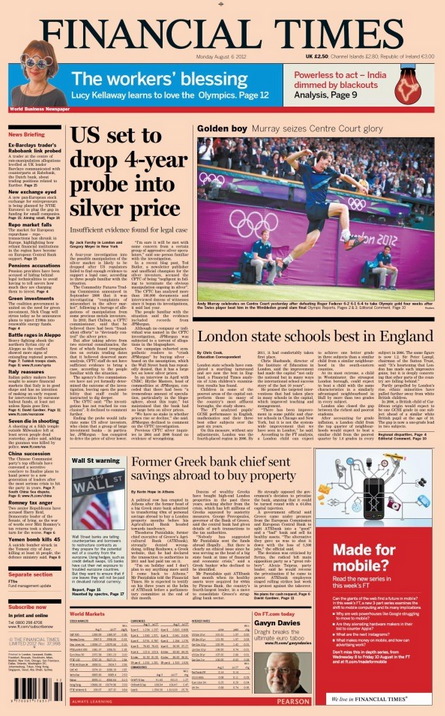
Last night The Financial Times ran an online story that was their front page lead today suggesting that the CFTC was going to simply drop their four year investigation of manipulation in the silver market.

It is of course possible they would do this, but it seemed rather heavy-handed and clumsy to just drop a four year study one month before its expected release, especially since it is judged to be somewhat controversial. And it involves a futures market that has been rocked by scandal after scandal over the past two years.

Today we find out that the FT may have gotten their information wrong which is certainly a faux pas for a major news media outlet that generally would not run something like that without a dual confirmation of the facts, especially when it involves key market information.

At the end of the day, in the longer term, I am not sure that any of this matters. I think the market is heading towards a default in silver unless there is some sort of action or settlement imposed by the government and the exchange.

The metals manipulation has been as bad or even worse than LIBOR, and at some point rude reality is going to intrude given the stubbornly physical nature of bullion. At least that is what history suggests will happen after a long period of price manipulation.

But let's see what happens.

Still, this sort of nonsensical uncertainty and lack of transparency suggests that something is very wrong behind the scenes, and The Major Players and Very Serious People are trying to figure out what to do about it.

And of course, there is the impediment of the credibility trap for the government and the regulators to consider. Especially if He-Who-Must-Not-Be-Allowed-To-Fail has his tit irretrievably caught in the wringer, as they used to say, on the short side of a rising market where covering might not be 'practical.'

I hear the Brits are fit to be tied about the hypocrisy, especially after the public brow-beating they have taken over Barclays and LIBOR. And now the Yanks have the temerity to interfere with the attempts to clean their own house because of the potential collateral damage to Wall Street.

Read what Glenn Greenwald has to say about the modern rule of law with liberty and justice for some, and you will get the picture:

"You can often, and I would say more often than not, in leading opinion-making elite circles, find an expressed renouncement or repudiation of that principle...All of these acts entail very aggressive and explicit arguments that the most powerful political and financial elites in our society should not be, and are not, subject to the rule of law because it is too disruptive, it is too divisive, it is more important that we should look forward, that we find ways to avoid repeating the problem...the rule of law is not that important of a value any longer...

The law is no respecter of persons, but the law is also a respecter of reality, meaning if it is too disruptive or divisive that it is actually in our common good, not the elite criminals, but in our common good, to exempt the most powerful from the consequences of their criminal acts, and that has become the template used in each of these instances."

And for any who think that the problems are insurmountable, and that nothing can be done, here is a fine example of how wrong they can be. Each generation must take up its struggle with the principalities and powers, and dark forces in high places, especially those in their own hardened hearts.


SP 500 and NDX Futures Daily Charts - Technical Trade on Light Volume

Today's US equity markets were trading on light volumes largerly driven by professionals.

I think the late sell off in the SP futures was a fairly clear sign that momentum traders dumped their positions into the close, preferring not to hold them overnight.

It is really all about Europe at this point, and what the central banks may do in order to provide additional liquidity to the financial system via official debt channels.

Risky market.  Unless you are willing to swim with the sharks it is best to stay out of the water.


Curiouser and Curiouser: Bart Chilton Informs the Press About the 'Erroneous Report' on Silver


"A society becomes totalitarian when its structure becomes flagrantly artificial: that is, when its ruling class has lost its function but succeeds in clinging to power by force or fraud."

George Orwell

I am hearing from people who say they have received brief email replies from CFTC Commissioner Bart Chilton. 

Apparently if there is a move afoot to can the silver investigation without presenting any findings after four years, he has not gotten the memo.

He has informed the press about 'the erroneous story' according to emails I have seen from people who have heard from him on the matter.

If this was a front page article on the Financial Times one would hope they double confirmed it, and the sources were good. That makes this even more puzzling.

So let's see what happens. As I said in my lead sentence from last night, this could have been a 'trial balloon' to gauge the reaction and blowback if they did ditch the investigation, not wanting to expose the findings, or expose a coverup to later instances of perjury.
This leak to the FT *could* just be a 'trial balloon' by Mr. Gensler and his crew to see if they can get away with it. But that seems more like the plot of a novel.

This could be one of the best examples of the credibility trap in action. The government regulators can say nothing because of the shadow government's long term complicity.
Mr. Gensler was the assistant to Robert Rubin and Larry Summers in the 1990's and is a Goldman alumnus, where he was the right hand to Jon Corzine. It could be that Bart as a dedicated civil servant is not on the A-team.

Or this could just be the usual shenanigans that the Street likes to play with the press.

All of this highlights the problems of the credibility trap and the lack of transparency in the US markets, made especially sensitive by a shocking series of financial scandals that are repeatedly distorted and often covered up.

Addendum:

Mr. Chilton apparently made this statement to the editor of the SilverDoctors site.
"The Financial Times report related to silver is not only premature, but inaccurate in several respects.

Whenever the CFTC does take an action or actions related to our silver investigation, I am hopeful that we will do so in a fulsome and transparent manner. That will certainly be my desire in anything we do.

I continue to believe, consistent with my previous statements to which you referred, and based upon information from the public, that there have been devious efforts related to moving the price of silver. Incidentally, I also believe there have been silver and gold market anomalies outside of the silver investigate window that have raised, and continue to raise, market concerns.

Perhaps there will be more coverage on this matter soon."

Now I am beginning to wonder if during this 'four year investigation' that the actual window of investigation into the market was relatively short, and that there was some effort made for the market participants to behave themselves during that window.

I have seen that sort of thing happen before. The investigators, who were industry consultants, exposed the pararmeters of the study window to their market cronies. The CFTC can then say that the formal investigation was 'inconclusive' and kick the can down the road.

One hears different and sometimes disturbing things about the US regulators. I even heard that the US Treasury is discouraging a UK initiative to beef up their Serious Fraud Office, and turn it into an Economic Crimes Agency with a more effective focus and resources.

Apparently the key metric in determing investigations into economic fraud these days is political. And this is the essence of the Glenn Greenwald piece I ran last night, which is that the rule of law has been replaced by the rule of expediency, where might makes right, or at least grants special exemptions from the law.

05 August 2012

CFTC Said to "Drop" Four Year Investigation Into Silver Just Before Promised Release


CFTC To Investing Public: 'Drop Dead.'


This leak to the FT *could* just be a 'trial balloon' by Mr. Gensler and his crew to see if they can get away with it. But that seems more like the plot of a novel.

This could be one of the best examples of the credibility trap in action. The government regulators can say nothing because of their government's long complicity.

If the CFTC in fact does 'drop' the investigation without presenting findings, one could consider that a slap in the face of the American public which on the whole asked for the investigation to be done in the first place, by the regulators who purportedly are hired and paid to serve their interests.

Given the recent admissions about widespread manipulation in LIBOR, the timing of this outcome to the CFTC invesigation could hardly be more arrogant and high-handed, and designed to put the investing public in their places.  It will certainly not inspire any confidence in the integrity of the markets and their regulation.

It would probably be unwise for the investing public to accept this outcome without presenting some consequences.

I suggest that a mass cancelling of futures trading accounts and the withdrawal of all funds deposited there might be a step in the right direction.

Given the serial criminality that has been exhibited in the US futures markets, that action might be long overdue on the basis of common sense.

Financial Times
Four-year silver probe set to be dropped
By Jack Farchy in London and Gregory Meyer in New York
August 5, 2012 10:00 pm

A four-year investigation into the possible manipulation of the the silver market looks increasingly likely to be dropped after US regulators failed to find enough evidence to support a legal case, according to three people familiar with the situation.

The Commodity Futures Trading Commission first announced that it was investigating “complaints of misconduct in the silver market” in September 2008, following a barrage of allegations of manipulation from a group of precious metals investors.

In 2010, Bart Chilton, a CFTC commissioner, said that he believed there had been “fraudulent efforts” to “deviously control” the silver price.

But after taking advice from two external consultancies, the first of which found irregularities on certain trading dates that it believed deserved more analysis, CFTC staff do not have sufficient evidence to bring a case, according to the people familiar with the situation...

Read the rest here.


Glenn Greenwald On the Rule of Law: With Liberty and Justice For Some


"Most of the events that we consider to be progress in American history were driven by the reverence for this concept that we are all equal under the law, that equality under the law is how we determine if we are perfecting the union...And what I think is radically different about today is not that the rule of law suddenly is not always being applied faithfully, because that has always been true. What is different about today, radically, is that we no longer bother to affirm that principle...

You can often, and I would say more often than not, in leading opinion-making elite circles, find an expressed renouncement or repudiation of that principle...All of these acts entail very aggressive and explicit arguments that the most powerful political and financial elites in our society should not be, and are not, subject to the rule of law because it is too disruptive, it is too divisive, it is more important that we should look forward, that we find ways to avoid repeating the problem...the rule of law is not that important of a value any longer...

The law is no respecter of persons, but the law is also a respecter of reality, meaning if it is too disruptive or divisive that it is actually in our common good, not the elite criminals, but in our common good, to exempt the most powerful from the consequences of their criminal acts, and that has become the template used in each of these instances."

Glenn Greenwald

I have been thinking along these lines for some time, that the rule of law in the West is becoming supplanted by a new kind of utilitarianism, relying on expediency in the service of power and the faux science of amoral economics, in order to excuse the massive frauds and criminal acts of the Anglo-American Empire that seems to be increasing.

Any concerns about the rule of law are roundly dismissed as a false concern with moral hazard as we saw so clearly in the great push for $700 Billion TARP based on a couple of handwritten sheets of paper, and a general amnesty for the perpetrators.


Sunday Viewing: Martin Luther King - 1965 - The Rhyme of History


This interview is interesting for several reasons.

First, it shows what a news discussion program looked like in 1965. One can compare that to the clash of the talking heads that often passes for news discussions today, especially on the mainstream media. It often seems to be a shameful spectacle of sophistry and cynicism.

Secondly, it reminds us of how great movements and protests, even the ones that later come to be viewed as historic, can initially be viewed as 'silly' and 'pointless.'

Thirdly, it is especially meaningful as a reminder that 'the good old days' that people may remember had a particularly ugly and seamy underside of violent repression and the abuse of the weak and the other.

The impulse to evil is not the domain of any particular people or time, but a recurrent problem that must be confronted by each generation, and each individual person, in their own way and calling.

There is always the temptation to look upon such gross injustices as insurmountable, and to simply conclude that things are going to hell in a handbasket, and turn away and to wash our hands of such troubles saying, What is the use of trying, and even further, 'what is truth?'

That is the way of those who who have ceased trying to be human, who have given themselves over to self-absorption, addictions, or despair, who are dying inside, and who when the time comes will make beasts of themselves, to escape the painful fragility of their own insubstantial being.


The 16th Street Baptist Church in Birmingham, Alabama was bombed on Sunday, September 15, 1963 as an act of racially motivated terrorism. The explosion at the African-American church, which killed four girls, marked a turning point in the U.S. 1960s Civil Rights Movement and contributed to support for passage of the Civil Rights Act of 1964.


Martin Luther King Jr. broadened his support for civil rights to human rights, and spoke out forcefully against the US War in Vietnam in January of 1967. He gave a famous speech linking the civil rights and anti-war movements on April 4, 1967 at Riverside Church.

He was assassinated one year to the day on April 4, 1968.

Robert F. Kennedy, another outspoken critic of the war who was running for President, was assassinated a little less than two months later in Los Angeles on June 5, 1968.

Richard M. Nixon was elected President. America finally left Vietnam five years later.

Nixon resigned the Presidency on August 9, 1974 upon facing formal impeachment charges of obstruction of justice, abuse of power, and contempt of Congress.

04 August 2012

A Tale of Two Cities: Holocaust of the Vanities


"They plunder, they slaughter, and they steal. This they falsely name Empire. And where they make a desert, they call it peace."

Tacitus, Agricola


"The time was to come, when that wine too would be spilled on the street-stones, and when the stain of it would be red upon many there. The time would come when blood, too, would be spilled on the streets, and many of the people would be stained with it.

And now that the cloud settled on Saint Antoine, which a momentary gleam had driven from his sacred countenance, the darkness of it was heavy—cold, dirt, sickness, ignorance, and want, were the lords in waiting on the saintly presence—nobles of great power all of them; but, most especially the last. Samples of a people that had undergone a terrible grinding and regrinding in the mill, and certainly not in the fabulous mill which ground old people young, shivered at every corner, passed in and out at every doorway, looked from every window, fluttered in every vestige of a garment that the wind shook.

The mill which had worked them down, was the mill that grinds young people old; the children had ancient faces and grave voices; and upon them, and upon the grown faces, and ploughed into every furrow of age and coming up afresh, was the sigh, Hunger. It was prevalent everywhere. Hunger was pushed out of the tall houses, in the wretched clothing that hung upon poles and lines; Hunger was patched into them with straw and rag and wood and paper; Hunger was repeated in every fragment of the small modicum of firewood that the man sawed off; Hunger stared down from the smokeless chimneys, and stared up from the filthy street that had no offal, among its refuse, of anything to eat."

Charles Dickens, A Tale of Two Cities

I thought this was an exceptionally insightful article.  I excerpted the entire piece.

There are two nations in the US, growing more and more apart. 

The comfortable well-to-do are attempting to ignore the deepening plight of the majority of Americans, based on dodgy economic principles, pure unadulerated greed, self-serving rationalization, a false history of the widespread economic fraud, and a generally apathetic numbness towards the suffering of others that appears to be fully sociopathic.

The poor are merely a calculation in the struggle for the greatest share of the dwindling power and wealth of a declining Empire.  We are not quite there yet, but it will not take much to push things too far.   Austerity applied with a whip hand and a disdain for justice and genuine reform would do it.

This callous arrogance and brutality is nothing new to the one third of the world that has been repeatedly 'saved' by the Pax Americana in its benevolent self-delusions.

The blowback that is coming at home and abroad is going to blow like a hurricane.

And the elite in America will recoil with horror and surprise, and will not understand it.  Or at least,  will pretend not to understand it, once again.  And will blame it on envy, and try to hold on even harder to the status quo in a battle that, in their childish lack of real world perspective, they think they can win.  After all, they are 'winners.'  And they are just itching for yet another war.

There may be blood.  Quite a bit of it. But there will almost certainly be a holocaust of the vanities.

New York Magazine
Why Washington Accepts Mass Unemployment
By Jonathan Chait
3 August 2012

In the years since the collapse of 2008, the existence of mass unemployment has stopped being something the economic powers that be even pretend to regard as a crisis. To those directly impacted, the economic crisis is an emergency, a life-altering disaster the damage from which will endure for years. But most of those in a position to address it simply have not seen it in such terms. History will record that the economic elite has viewed the economic crisis from a perspective of detached complacency.

Two events from the last week have underscored this disturbing reality. The most widely covered was the Federal Reserve’s announcement that, despite a weakening economy, it still would not take steps to stimulate growth. The Fed may not like mass unemployment, but it dislikes inflation even more, and in its calculus, the hypothetical prospect of the latter outweighs the immediate reality of the former.

Here’s a second case, smaller but even more telling. The Obama administration has tried to prevail upon Edward DeMarco, the acting director of the Federal Housing Finance Agency, to offer lower mortgage rates to underwater home owners through Fannie Mae and Freddie Mac, which he controls. What interests me is not the proposal itself, nor even DeMarco’s obstinate refusal, but an editorial in the Washington Post applauding DeMarco for refusing to implement the program.

The Post is the voice of the Washington centrist establishment, and the logic of the editorial is a telling signpost. The Obama administration had argued to DeMarco that the mortgage relief was a pure win-win. Not only would the lower mortgage rates provide relief to Americans desperate to keep their homes, and secondarily to give them more purchasing power for other things that would provide a small economic stimulus, it would save the government money: with lower mortgage rates, fewer would default on their government-owned mortgages. DeMarco replied that he believed the taxpayers would end up spending money on the deal: not much, but some.

The Post’s thumbs-up editorial of DeMarco endorsed the reasoning that only a relief program that could be assured to cost the taxpayers nothing was worthwhile. It concluded, “with signs multiplying that the housing market may be finally bottoming out without this additional stimulus, perpetuating this particular battle does not strike us as the best use of the secretary’s time.”

There are signs we’ve hit bottom. Nothing to worry about here. Why risk the possibility of a small outlay merely to provide relief to hundreds of thousands of desperate people? This is such a perfect statement of the way the American elite has approached the economic crisis. They concede that it is a problem. But there are other problems, you know.

It’s important to respond to arguments on intellectual terms and not merely to analyze their motives. Yet it is impossible to understand these positions without putting them in socioeconomic context. Here are a few salient facts: The political scientist Larry Bartels has found (and measured) that members of Congress respond much more strongly to the preferences of their affluent constituents than their poor ones. And for affluent people, there is essentially no recession. Unemployment for workers with a bachelors degree is 4 percent — boom times. Unemployment is also unusually low in the Washington, D.C., area, owing to our economy’s reliance on federal spending, which has not had to impose the punishing austerity of so many state and local governments.

I live in a Washington neighborhood almost entirely filled with college-educated professionals, and it occurred to me not long ago that, when my children grow up, they’ll have no personal memory of having lived through the greatest economic crisis in eighty years. It is more akin to a famine in Africa. For millions and millions of Americans, the economic crisis is the worst event of their lives. They have lost jobs, homes, health insurance, opportunities for their children, seen their skills deteriorate, and lost their sense of self-worth. But from the perspective of those in a position to alleviate their suffering, the crisis is merely a sad and distant tragedy.

Read the original article here.

I think you all know how I feel about all these things. Without serious reform, no amount of stimulus will correct the problems that are plaguing America. The parasites of Wall Street will pounce on any additional liquidity supplied by the Fed.

But I think there is a legitimate case to be made that the Fed has done everything it can for the Banks, but is relatively indifferent to the plight of the real economy. As a regulator the Fed is a colossal hypocrite and failure.

The trillions that have been spent bailing out the wealthy and subsidizing their greed are a scandal of the first order. And yet all they can say is 'more.'

The callous ugliness of many in this nation is of concern. They are encouraged to say outrageous things, and feel justified in taking outageously harsh, anti-human positions. And they are proud of it, having given themselves over completely to greed and hate and pride.

And they will be called to account. God will not be tolerant of such arrogance.

"And those who are rich should boast that God has humbled them. They will fade away like a little flower in the field.

The hot sun rises and the grass withers; the flower droops and falls, and its beauty fades away. In the same way, the rich will fade away with all of their worldly things." James 1:10-11


“We can believe what we choose. We are answerable for what we choose to believe.”

John Henry Newman

03 August 2012

Gold Daily and Silver Weekly Charts - Phony Market Action Cycle


The wiseguys would like to take the equity markets up a little higher in order to short them. The problem they are facing is that most of the non-professionals are sitting this action out.

The metals markets are meaningless in the short term, given the corruption in the trade that pushes prices around the plate without any respect to genuine price discovery.

Today's 'rally' after Wednesday's 'decline' is a perfect example of the action in these markets that is more phony than prescient.

Don't feed the sharks. 

Your most powerful weapon is your refusal to participate in this sham.


SP 500 and NDX Futures Daily Charts - Rally On the Technicals


'Better than expected' Non-Farm Payrolls number, but meaningless in itself, except as another data point in a weak recovery and a sideways trend in jobs after an initial recovery from a horrendous loss of employment a few years ago.

But today's rally did provide the jokers an excuse to rally the markets and hammer those who took shorts ahead of the number expecting something worse.

This market is heavy with technical action and being hollowed out by lack of genuine investor participation. It will end badly, and everyone will be surprised. The only question is how many times Ben will feed it with monetary subsidies.

See you Sunday evening.


Net Asset Value Premiums of Certain Precious Metal Trusts and Funds


The premiums on silver, especially on PSLV, remain modest by historical standards.

The Gold/Silver ratio remains somewhat high at about 58.

This 'lean' towards gold suggests that the markets see rough monetary and overall market waters ahead.

Let's see if this trend continues and obtains more validity.