15 October 2012

Fassbeck: Low Wages and High Unemployment Paralyzing Western Economies


"Morality cannot be legislated but behavior can be regulated. Judicial decrees may not change the heart, but they can restrain the heartless.”

Martin Luther King

This is like a bad dream, as though we have learned nothing and are doomed to repeat the worst episodes in history.

When capitalism goes bad and turns predatory, in the latter stages it turns on itself and begins to cannibalize its own customers, suppliers, and eventually self-destructs.

I would take issue with Heiner Fassbeck about slack wages starting in the US with the financial collapse. The history of median wages show a stagnation beginning to set in almost 20 years ago, as well-paying manufacturing jobs were arbitraged to developing countries with lower standards of living, fewer human rights, and less regard for pollution.

Unrestrained globalism inevitably drives all to the lowest common denominator. And if oligarchies with virtual slave labor economies exist, the world will emulate them.

This is the big lie from economics with regard to the necessity of globalism and 'free trade' superior to all other moral claims and considerations.

I have just finished an interview with my friend Ilene of MarketShadows newsletter, and in there I reiterate my forecast for stagnation leading to stagflation. Stagflation is the result of the egregious policy error of not reforming the system that led to the collapse, but rather bending monetary policy to support the unsustainable. And, may I dare add, corruptly so, with an increasing lack of transparency, active perception manipulation, and increasingly audacious acts of deception. The amount of blatant lying being done in this latest Presidential campaign is truly breathtaking. It will get worse.

Japan was caught in a credibility trap for twenty years given their essentially single party government in partnership with the powerful corporate combines or keiretsu. And Japan is still caught up within it although their power is beginning to wane.  The primary difference is that Japanese crony capitalism is not so casually brutal to their own people who happen to be unfortunate, although it does manifest in negligent disasters like Fukushima and occasional financial frauds and insider scandals. 

The US and Europe are on a similar trajectory.  The good news is that there is nothing mathematical or deterministic about a stagflationary outcome.  The bad news is that powerful forces are aligned against changing it, and they believe in the principle that history does not judge the victors. So they are quite determined to win.

More at The Real News

Why Are We Bailing Out the Banks Part III (of IV) - The Big Lie


Economics and the corporate media did exemplary service in promoting 'the Big Lies' of the financialisation crisis, most notably efficient markets theory and the trickle down theory of stuffing the rich with even greater power and wealth in the thought that some of the excess would fall on the path for the little people.
"Mr. David Stockman has said that supply-side economics was merely a cover for the trickle-down approach to economic policy—what an older and less elegant generation called the horse-and-sparrow theory: If you feed the horse enough oats, some will pass through to the road for the sparrows."

John Kenneth Galbraith, New York Review of Books, 1982
They have tied these old canards so carefully to emotional arguments that even after the crisis and collapse, many people will still respond reflexively to anything that shakes their faith in a failed, fallen system.

One only has to verbally put a certain color shirt on a group of people's backs, and paint a different color shirt on some others, and given some prompting and rationalization, they will descend on the others with all the reckless passion and unfeeling of the school yard, even doing unspeakable things to others that they know is wrong, in the name of the expediency of winning. Such people are easily led as they surrender their will to expediency, and a more powerful force of will.

Some years ago I remarked on a sad gathering of a knot of old school Communists in Red Square that I saw, lamenting the passing of the Soviet Union and Stalinism. There were those who had benefited from it, leading those who could not accept that the system had failed and change was coming. They huddled in the winter winds that blew across the square, their old banners fluttering, looking for someone to tell them what to do.

I see the same thing growing in the US and the UK today. But the lament is not for Communism but for the saving of crony capitalism, the heartless abuses of the oligarchy and the robber barons that have been cross branded with freedom and liberty.   Their campaign is well funded and staffed with willing minds who will say or do almost anything for money. They have not yet destroyed themselves, but they are well on their way.

The gullible, like the poor, are always with us. And in tough times people often seek comfort in hardness and passionate anger. It provides a relief from thinking. And this is why there is increased polarization, as people drift to the extremes. The kind of extreme Social Darwinism that would have previously been dismissed as mental illness becomes compelling, and engages a passionate following.
"Humanitarianism is the expression of stupidity and cowardice...Nature is cruel; therefore we are also entitled to be cruel. When I send the flower of German youth into the steel hail of the war without feeling the slightest regret over the precious German blood that is being spilled, should I also not have the right to eliminate millions of an inferior race that multiply like vermin."

"If you feed them, if you feed the children three square meals a day during the school year, how can you expect them to feed themselves in the summer?”
Its a neat trick, to make the intended victims in the middle class a party to their own victimization.  Even while they think they are being hard out of necessity, driven by the expedient and practical need to condemn those others below them to suffering, while barely realizing that they are winding the nooses around their own necks.   As a particularly astute reader recently observed:
"The fortunate want to believe that their good fortune is NOT due to luck, but to their inherent goodness, their superiority to the mass of humanity. The poor deserve bad treatment because their poverty is a manifestation of their inherent 'badness' or inferiority. Thus, seeing the poor suffer, the well off feel that they deserve their privileged position.

To be kind to the poor out of a sense of common humanity or compassion would put them in the position of not being able to be proud of their 'differences.' So they seek to leave the poor to their misery and act to increase it, in order to feel better about themselves; a logic appropriate to a 5 year-old school bully."
This sounds like the gospel of prosperity, the distorted type of Calvinist determinism that is quite popular in some circles today, both on the extreme left and right. No one wants to be what they really are. And meanness and rudeness and even cruelty become an appromixation of power as the would be fortunate few slowly renounce their common humanity.

Believe what you will, but you will be held responsible for what you believe. Whom you serve you will abide, now and forever after.

Why are we bailing out the banks? part three – Lies and Opposition
By Golem XIV
October 15, 2012

At the end of part two I suggested that the mainstream justification for bailing out the banks, namely that by so doing we have provided them with the money they need in order to lead the rest of us to recovery by investing in the real economy – was what Goebbels and his boss would call The Big Lie. The banks have demonstrably and unequivocally NOT used the money they have taken from the public purse to invest in the real economy. Nor are they going to.

Why not? The reasons often offered for not lending are that there is no demand or that by not offering loans to businesses that look unsure in unsure times, they are just being prudent. And surely we want them to be prudent? These are excuses.

The reason they are not going to lend and lead a recovery is because that is not what banking is about. Helping recoveries is what governments might chose to try and do but it is not what banking is about. Banking is about making maximum profit for those who own the banks (shareholders), those to whom the banks owe money (The Bond holders) and increasingly the senior staff whose bonuses depend not on how much the bank has helped anybody, but on how much money the bank has made. And the fact of our present predicament is that the banks can make much more money, more more rapidly by playing, even deepening, this recession than they can by trying to help us out of it.

This is an unpalatable truth, so it is important that there are lies to distract from us from realizing it. Thus we have been subjected to a multi trillion dollar lie that has been repeated on every news programme and in every financial column of every newspaper for the last four years.

Goebbels and A.H. said that if you repeat a big enough lie often enough people will come to believe it. What this maxim leaves out is ‘how’ people come to believe something they once knew, or at least suspected, was a lie. Why does a big lie work better than a small one? I think the mechanism is not forgetting or the over-writing of truth with lies, but relies on escalating mental dissonance. A small lie leaves the rest of reality untouched. The unmasking of a small lie does not require any great re-adjustment of the rest of your beliefs or your grasp of reality.

A big lie, a very big lie, however, ties in to itself so much of the rest of your judgment of what is real and reliable that to question it becomes a painful mental act. It requires you pull the rug out from beneath yourself. It requires you undermine the very ground upon which you stand. That ground which you used to feel, still need to feel, is solid and firm.

To tackle a big lie can feel as if you are weakening yourself more than those you oppose. You feel the branch you are sitting on starting to weaken. Which makes it all the harder to defend what you are doing and saying against those who cast doubt not just upon what you say but upon your motives and even your sanity.

For many people the feeling of self-inflicted unease becomes too great. And the bigger the lie the greater this effect. To oppose a really big lie, particularly one vocally supported by a network of mutually re-enforcing powerful people and institutions who all claim they have your best interests at heart, is hard because of the sheer scale of what your opposition entails. To oppose the well constructed, well supported, really big lie you are faced with having to question far more than you want to.

Questioning is hard to do. It sets one apart. No one likes to be set apart.We are by instinct social animals. If we must set ourselves apart we at least want to feel confident of where we stand. The really big lie ups the ante. It forces us to feel the widening circles of disruption of our own beliefs.

One can oppose the small lie from the solid ground of the rest of your beliefs. The big lie’s strength and defense is that it forces you to question all the ground you thought was solid; the ground you thought you could stand upon to make your stand. To question the big lie is to feel that you are casting yourself out. It is not a great feeling.

Which brings me to a point I have wanted to make for a while. Why do I write this blog? Why do you come here and expose your own thoughts? Why do we do it? My answer is to ask why do families tell each other the stories of their life together. Why do people recount the events they all already know? Why? Because the act of telling and listening to what is familiar and shared is how we bind ourselves together and how we create for each other new ground upon which to stand firm. I suggest we come here to tell each other the stories which bind us together and transform us from outcasts to builders and occupiers of a new society.

In doing that we make for ourselves the things which our rulers fear most, which they wish most fervently we did not have – Clarity, Truth and from them Power.

Source

13 October 2012

Keiser: Nick Verbitsky On Wall Street's Confidence Game


Never allow them to make us forget the poisonous and deliberate fraud that was at the center of the financial collapse.


12 October 2012

A Vignette of the US Political Scene


I did not watch the VP Debate in the US elections.

Someone sent me this video clip because it illustrates the principle which I have mentioned that is very much in play amongst the hypocrites that "money that comes to me and mine is for growth and to create jobs but money for anyone else is handouts and mooching."

Ayn Rand descried social programs and help for the unfortunate as 'handouts,' and glorified rule by the fittest and the fortunate all her life.

But when she needed it she gratefully took the same Social Security and Medicare that was so pernicious to society.

And the point is, did she learn from this? Did she change her mind or say she was sorry for being so wrong, so unfeeling, so willfully ignorant of the vagaries of life?

No not one bit. And that is the mindset of a sociopath. Not that she took what she was entitled to because of the efforts of others to create a safety net. No, but because she would still denounce and deny that same 'insurance' against misfortune to others, while taking it for herself.

Or I could mention a person I know who likes to rail against any government efforts to help the disabled and the poor, even today. He finds it highly offensive.

And yet this same person directly participated in making millions from the aid and the bailouts of the US auto industry, and would have faced a grave personal loss himself if the government had not prevented its bankruptcy. He acts as though this was all his doing, his superior performance, and is now entitled to -- everything and then some.

And the financiers of Wall Street are even worse.

Politics is the art of hypocrisy. And some of the fortunate ones and their minions and stooges raise it to a high art indeed. They are shameless as well as heartless.


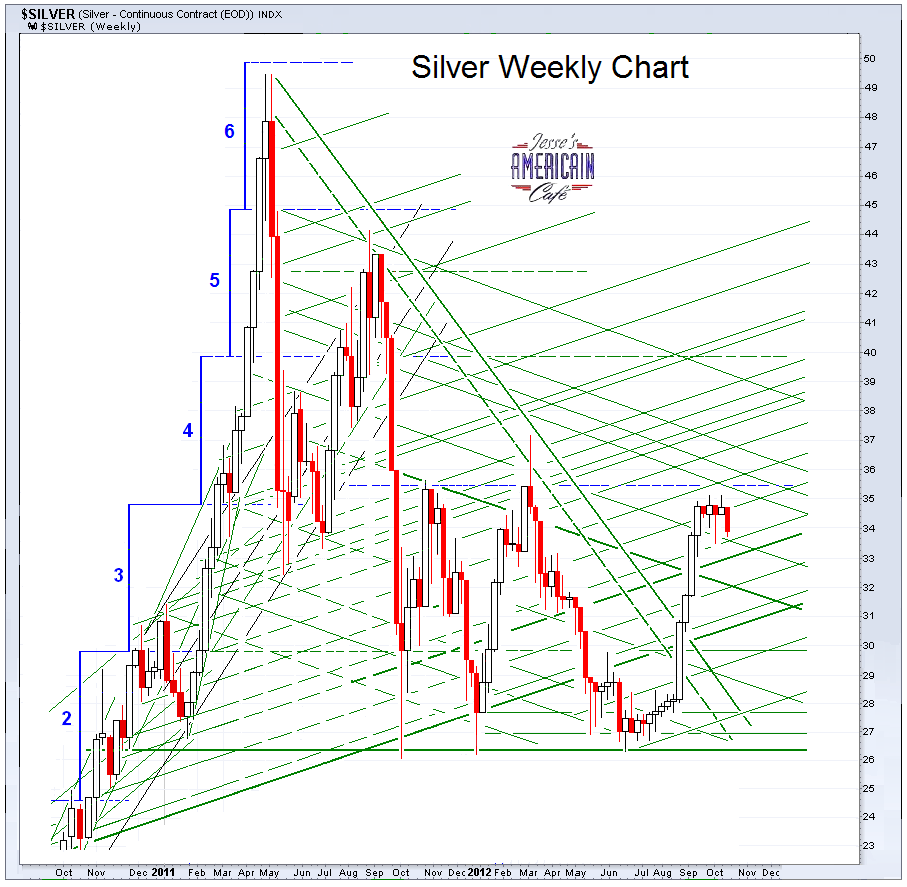
Gold Daily and Silver Weekly Charts - Selling in the Afternoon


The Producer Price Index (PPI) is running hot showing some goods cost inflation.

Wells Fargo reported record earnings this morning, but a worse than expected net margin from the low interest rate environment. JPM made their numbers, but they did it by tapping loan loss reserves.

And all that led to weakness in the banking sector which led to a weak SP 500.

Gold and silver were under pressure after the London PM fix, and the selling went on into the afternoon. Both metals went out lower for the day.

What next? Europe, to bail or not to bail.

I took a silver position this afternoon on the if/come. It's been a while.

Let's see what happens.


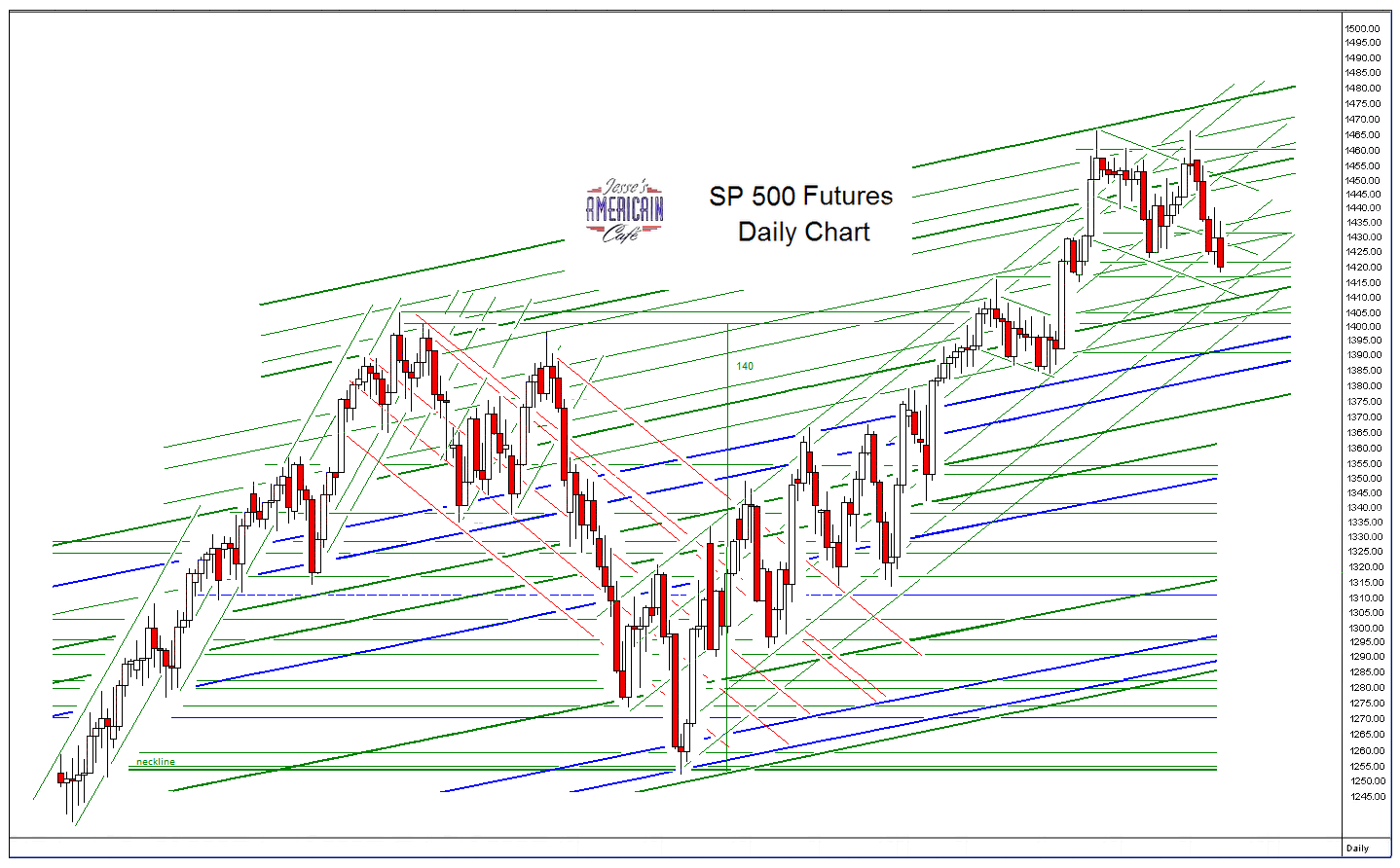
SP 500 and NDX Futures Daily Charts - Weakness From Wells


Stocks were weak today as Wells Fargo reported record earnings, but also showed net margins that were much lower than expected on the interest rate squeeze of the QE kind, which make banks and therefore SP weak.

Let's see if the bulls can rally it next week. If not, down we go.


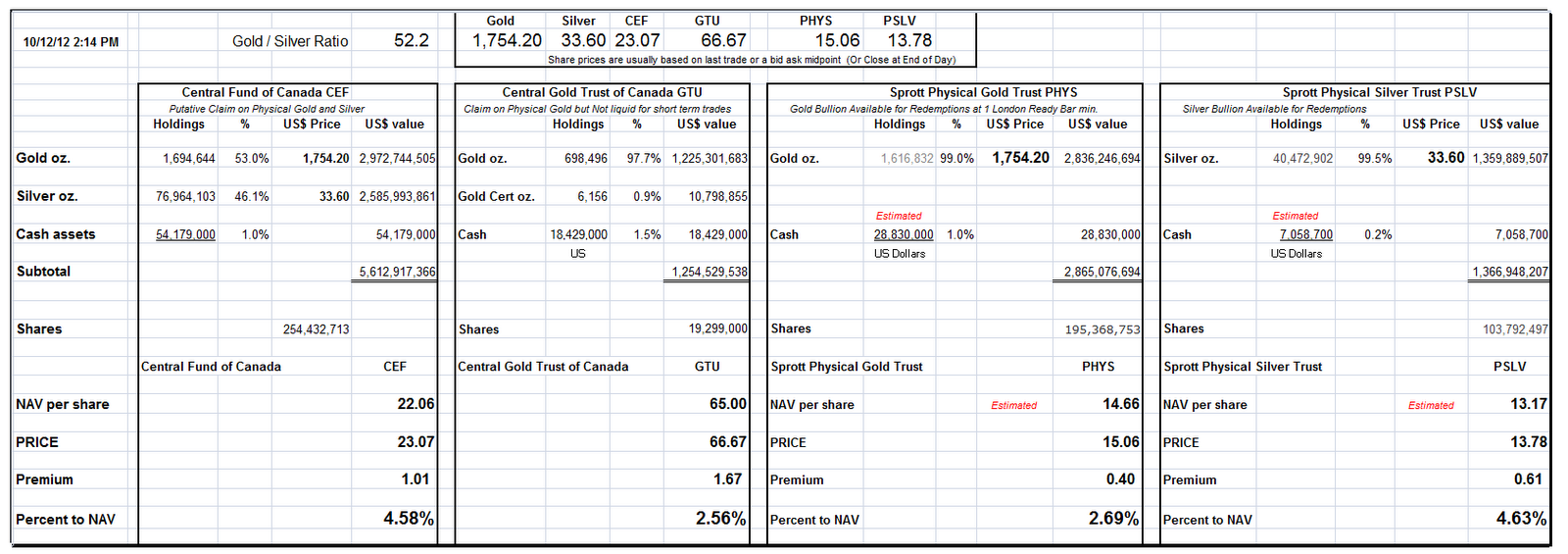
Net Asset Value Premiums of Certain Precious Metal Trusts and Funds


11 October 2012

Gold Daily and Silver Weekly Charts - Negative Real Yields Are Good for Gold


Today's 30 year Treasury auction was described as 'soft' as the cover rates were not as robust as yesterday's ten year. Ten-year notes started the day yielding 1.679% and were recently yielding 1.684%, while 30-year bonds were up 12/32 in price to yield 2.875%.

Personally I think that buying a 30 year bond yielding under 3 percent is insanity.

Negative real yields on Treasury debt is a highly bullish indicator for gold.


SP 500 and NDX Futures Daily Charts - Another Dull Day


Stocks showed a little bounce today but not much.

The bulls need to get their footing in order to make this a correction and not a trend change.


What Drove the US Budget Deficits


The biggest drivers of the current and near term US budget deficits are the unfunded wars, unfunded tax cuts especially for the wealthiest, bailouts for the banks, and the economic downturn.

Tax cuts and subsidies for the wealthy are good for giving much more discretionary wealth to the wealthiest, and not much else. And their use of the money is for the most part self-indulgent and predatory.

Discretionary wars are excellent sources of profiteering, and the price for them falls heaviest on the broader public, who pay in money, misery, and blood.

Bailouts are windfalls for the powerful and well-connected.

The US financial system as it is constituted today is mostly predatory rather than productive.   Gordon Gekko has many incarnations with high public profiles today. And they are shameless to the point of reckless arrogance.

The efficient market theory and trickle down economics are what the Brits like to call 'bollocks.' If you wish to take from the weak and the poor and the elderly and and give it to those who have the most already, just say it, proudly. 

But don't try to fool yourselves, in addition to everyone else.  Whatsoever you sow, that you will also reap.

Downturn and Legacy of Bush Policies Drive Large Current Deficits
Economic Recovery Measures, Financial Rescues Have Only Temporary Impact
By Kathy Ruffing and James R. Horney
October 10, 2012

Some lawmakers, pundits, and others continue to say that President George W. Bush’s policies did not drive the projected federal deficits of the coming decade — that, instead, it was the policies of President Obama and Congress in 2009 and 2010.

But, the fact remains: the economic downturn, President Bush’s tax cuts and the wars in Afghanistan and Iraq explain most of the deficit over the next ten years — according to this update of our analysis, which is based on the Congressional Budget Office’s most recent ten-year budget projections (from August) and congressional action since we released the previous version of this analysis in May 2011.

The deficit for fiscal year 2009 — which began more than three months before President Obama’s inauguration — was $1.4 trillion and, at 10 percent of Gross Domestic Product (GDP), the largest deficit relative to the economy since the end of World War II. At $1.3 trillion and nearly 9 percent of GDP, the deficits in 2010 and 2011 were only slightly lower. If current policies remain in place, deficits will likely exceed $1 trillion in 2012 and 2013 before subsiding slightly, and never fall below $700 billion for the remainder of this decade.

The events and policies that pushed deficits to these high levels in the near term were, for the most part, not of President Obama’s making. If not for the Bush tax cuts, the deficit-financed wars in Iraq and Afghanistan, and the effects of the worst recession since the Great Depression (including the cost of policymakers’ actions to combat it), we would not be facing these huge deficits in the near term. By themselves, in fact, the Bush tax cuts and the wars in Iraq and Afghanistan will account for almost half of the $18 trillion in debt that, under current policies, the nation will owe by 2019.[1] The stimulus measures and financial rescues will account for less than 10 percent of the debt at that time.

President Obama, however, still has a responsibility to propose, and put the weight of his office behind, policies that will address our key long-term fiscal challenge — preventing the significant rise in debt as a percentage of GDP that will occur under current policies. Allowing the flagship Bush tax cuts — which initially were slated to end after 2010 and were extended for two years — to expire on schedule at the end of 2012 would halt the rise in the debt-to-GDP ratio. In fact, that step — or an equivalent, substitute package of deficit reductions — would reduce the debt-to-GDP ratio and stabilize it at about 70 percent in the second half of the decade. Of course, with the economy still fragile, it is prudent to continue the middle-class portion of the tax cuts for a while longer. But there is no justification for extending the entire set of expiring tax cuts indefinitely. To keep the debt stable over the longer run, when the fiscal impacts of an aging population and rising health care costs will continue to mount, policymakers will need to take large additional steps on both the expenditure and revenue sides of the budget...

Read the entire report here or download a PDF here.


10 October 2012

Gold Daily and Silver Weekly Charts - Silver Resilient - US Debt Auctions


Well, you may throw your rock and hide your hand
Working in the dark against your fellow man,
But as sure as God made black and white
What's down in the dark will be brought to light.

You can run on for a long time
Run on for a long time,
Run on for a long time
Sooner or later God'll cut you down
Sooner or later God'll cut you down.

Johnny Cash, Sooner or Later God'll Cut You Down

The metals were under pressure most of day along with stocks as the US Ten Year Notes were in the trading spotlight.
"Treasuries rose as the failure of European leaders to reassure investors the region’s sovereign- debt crisis will be contained led to higher-than-average demand at a U.S. auction of $21 billion in 10-year notes.

The bid-to-cover ratio, which gauges demand by comparing total bids with the amount of securities offered, was 3.26, versus 2.85 in September and an average of 3.11 for the prior 10 sales. Benchmark 10-year yields declined from the highest level in more than two weeks as Spain’s Prime Minister Mariano Rajoy, struggling to contain the country’s deficit, met in Paris with French President Francois Hollande.
As I recall, Big Daddy takes the center stage in a $13 billion auction tomorrow. Unless Ben and Timmy decided to just journal entry them over for a change of pace, without the middlemen of finance getting involved. Naw, never happen. John Galt always takes his risk free vig in war and peace. It's the American way.

Silver proved unwieldly for you know who to handle, even as the big chief of the firm was pontificating on the economy from the veranda of the Council on Foreign Relations on how lucky we are to have him and his crew. The title might have been, "Beyond God's Work."

What next? Stocks need to find some footing, and gold and silver continue to assert some connection between the paper markets and reality.

I suspect someone big is in the silver market negotiating for physical, and that sends shocks waves into the highly leveraged trading world as every ounce of physical bullion removed from the LMBA's spin machine takes the basis for about 100 paper ounces with it.

How much is too much leverage? 100 to 1? 500 to 1? It really doesn't matter how fast you are going, it is the relative distance to that wall up ahead, and how quickly you stop.

Have a pleasant evening.


SP 500 and NDX Futures Daily Charts - Showtime for the Bulls


What had been a correction is nearing the point where it may become a sell off if the bulls cannot find some footing for themselves around here or not too far from this.

A retracement is 50% in the kind of vaporous rally which we have enjoyed for the late summer months. More than that may be something else altogether.

Where is all that 'cash on the sidelines' that was so sad for having missed the summer rally? Probably parked over the customers' yachts.

A certain (in)famous Wall Street firm was heavily recruiting quants (engineers, physicists, mathematicians) at my nephew's university. Apparently the machines and those who tend them will be increasingly replacing the highly paid, frosted nose hair clothes horses of the investment banking world with silently humming digital highwaymen prowling the capital flows of commerce among nations. Progress!

The Romney rally failed awfully quickly. I cannot tell if the financiers are short of hope or just short of cash. Mom and pop are no mystery; they are just getting by.


Inverted Totalitarianism


"Thus the elements are in place: a weak legislative body, a legal system that is both compliant and repressive, a party system in which one party, whether in opposition or in the majority, is bent upon reconstituting the existing system so as to permanently favor a ruling class of the wealthy, the well-connected and the corporate, while leaving the poorer citizens with a sense of helplessness and political despair, and, at the same time, keeping the middle classes dangling between fear of unemployment and expectations of fantastic rewards once the new economy recovers.

That scheme is abetted by a sycophantic and increasingly concentrated media; by the integration of universities with their corporate benefactors; by a propaganda machine institutionalized in well-funded think tanks and conservative foundations; by the increasingly closer cooperation between local police and national law enforcement agencies aimed at identifying terrorists, suspicious aliens and domestic dissidents."

Sheldon Wolin, Inverted Totalitarianism, 2003 essay

I thought it would be interesting to find the seminal essay from 2003 in The Nation magainze in which Sheldon Wolin describes the emerging US empire as an 'inverted totalitarianism.'  It is still not quite clear to me what the distinction is between this and an oligarchy, although the difference from fascism is apparent. 

One learns by asking questions and making distinctions. Ignorance abhors questions and makes few distinctions, preferring dogma, bias and arrogant disdain to discernment and an informed perspective. This is what passes for knowledge and news today. That was certainly apparent in Jamie Dimon's address today to the Council on Foreign Relations on the nature of finance and the US economy. He is yesterday's man. But unfortunately there are quite a few of them hanging on to power, dragging the West down.

If the US is an inverted totalitarian regime, what are China and Russia? Certainly not the personal fascist dictatorships of the era of Hitler, Stalin, and Mao, albeit the latter two with a proletarian façade, but more a totalitarianism by bureacracy or committee perhaps, wherein business and government are in partnership for their own ends, because they are increasingly one.  Is it a matter of emphasis, of ascendancy between the private and corporate?  What if there really is little difference between them?

I cannot yet say although I suspect for Wolin it would be that the corporate holds the whip hand and most of the direct implementation of policy, even if the government may codify it. 

And what of the UK, which is without an empire of its own, but has a remarkably similar political structure to the States, but with vestigial figureheads to enhance the illusion. A sidekick to Empire, in the manner of Robin to Batman, or faithful retained, like Afred?

I am a little disappointed that I was not familiar with it contemporaneously,  but I was deeply involved in the study of money and macroeconomics from 1999 through 2006 and missed quite a bit.

I am surprised that I did not encounter  this perspective through my readings of Chalmers Johnson, whose review of Wolin's book Democracy Incorporated is included below. I also have a video excerpt of Chris Hedges' use of the concept.

The Nation
Inverted Totalitarianism
By Sheldon Wolin
May 1, 2003

The war on Iraq has so monopolized public attention as to obscure the regime change taking place in the Homeland. We may have invaded Iraq to bring in democracy and bring down a totalitarian regime, but in the process our own system may be moving closer to the latter and further weakening the former.

The change has been intimated by the sudden popularity of two political terms rarely applied earlier to the American political system. "Empire" and "superpower" both suggest that a new system of power, concentrated and expansive, has come into existence and supplanted the old terms. "Empire" and "superpower" accurately symbolize the projection of American power abroad, but for that reason they obscure the internal consequences.

Consider how odd it would sound if we were to refer to "the Constitution of the American Empire" or "superpower democracy." The reason they ring false is that "constitution" signifies limitations on power, while "democracy" commonly refers to the active involvement of citizens with their government and the responsiveness of government to its citizens. For their part, "empire" and "superpower" stand for the surpassing of limits and the dwarfing of the citizenry.

The increasing power of the state and the declining power of institutions intended to control it has been in the making for some time. The party system is a notorious example. The Republicans have emerged as a unique phenomenon in American history of a fervently doctrinal party, zealous, ruthless, antidemocratic and boasting a near majority. As Republicans have become more ideologically intolerant, the Democrats have shrugged off the liberal label and their critical reform-minded constituencies to embrace centrism and footnote the end of ideology.

In ceasing to be a genuine opposition party the Democrats have smoothed the road to power of a party more than eager to use it to promote empire abroad and corporate power at home. Bear in mind that a ruthless, ideologically driven party with a mass base was a crucial element in all of the twentieth-century regimes seeking total power.

Representative institutions no longer represent voters. Instead, they have been short-circuited, steadily corrupted by an institutionalized system of bribery that renders them responsive to powerful interest groups whose constituencies are the major corporations and wealthiest Americans. The courts, in turn, when they are not increasingly handmaidens of corporate power, are consistently deferential to the claims of national security.

Elections have become heavily subsidized non-events that typically attract at best merely half of an electorate whose information about foreign and domestic politics is filtered through corporate-dominated media. Citizens are manipulated into a nervous state by the media's reports of rampant crime and terrorist networks, by thinly veiled threats of the Attorney General and by their own fears about unemployment. What is crucially important here is not only the expansion of governmental power but the inevitable discrediting of constitutional limitations and institutional processes that discourages the citizenry and leaves them politically apathetic.

No doubt these remarks will be dismissed by some as alarmist, but I want to go further and name the emergent political system "inverted totalitarianism." By inverted I mean that while the current system and its operatives share with Nazism the aspiration toward unlimited power and aggressive expansionism, their methods and actions seem upside down. For example, in Weimar Germany, before the Nazis took power, the "streets" were dominated by totalitarian-oriented gangs of toughs, and whatever there was of democracy was confined to the government. In the United States, however, it is the streets where democracy is most alive--while the real danger lies with an increasingly unbridled government.

Or another example of the inversion: Under Nazi rule there was never any doubt about "big business" being subordinated to the political regime. In the United States, however, it has been apparent for decades that corporate power has become so predominant in the political establishment, particularly in the Republican Party, and so dominant in its influence over policy, as to suggest a role inversion the exact opposite of the Nazis'. At the same time, it is corporate power, as the representative of the dynamic of capitalism and of the ever-expanding power made available by the integration of science and technology with the structure of capitalism, that produces the totalizing drive that, under the Nazis, was supplied by ideological notions such as Lebensraum.

In rebuttal it will be said that there is no domestic equivalent to the Nazi regime of torture, concentration camps or other instruments of terror. But we should remember that for the most part, Nazi terror was not applied to the population generally; rather, the aim was to promote a certain type of shadowy fear--rumors of torture--that would aid in managing and manipulating the populace. Stated positively, the Nazis wanted a mobilized society eager to support endless warfare, expansion and sacrifice for the nation.

While the Nazi totalitarianism strove to give the masses a sense of collective power and strength, Kraft durch Freude ("Strength through joy"), inverted totalitarianism promotes a sense of weakness, of collective futility. While the Nazis wanted a continuously mobilized society that would not only support the regime without complaint and enthusiastically vote "yes" at the periodic plebiscites, inverted totalitarianism wants a politically demobilized society that hardly votes at all. Recall the President's words immediately after the horrendous events of September 11: "Unite, consume and fly," he told the anxious citizenry. Having assimilated terrorism to a "war," he avoided doing what democratic leaders customarily do during wartime: mobilize the citizenry, warn it of impending sacrifices and exhort all citizens to join the "war effort."

Instead, inverted totalitarianism has its own means of promoting generalized fear; not only by sudden "alerts" and periodic announcements about recently discovered terrorist cells or the arrest of shadowy figures or the publicized heavy-handed treatment of aliens and the Devil's Island that is Guantánamo Bay or the sudden fascination with interrogation methods that employ or border on torture, but by a pervasive atmosphere of fear abetted by a corporate economy of ruthless downsizing, withdrawal or reduction of pension and health benefits; a corporate political system that relentlessly threatens to privatize Social Security and the modest health benefits available, especially to the poor. With such instrumentalities for promoting uncertainty and dependence, it is almost overkill for inverted totalitarianism to employ a system of criminal justice that is punitive in the extreme, relishes the death penalty and is consistently biased against the powerless.

Thus the elements are in place: a weak legislative body, a legal system that is both compliant and repressive, a party system in which one party, whether in opposition or in the majority, is bent upon reconstituting the existing system so as to permanently favor a ruling class of the wealthy, the well-connected and the corporate, while leaving the poorer citizens with a sense of helplessness and political despair, and, at the same time, keeping the middle classes dangling between fear of unemployment and expectations of fantastic rewards once the new economy recovers. That scheme is abetted by a sycophantic and increasingly concentrated media; by the integration of universities with their corporate benefactors; by a propaganda machine institutionalized in well-funded think tanks and conservative foundations; by the increasingly closer cooperation between local police and national law enforcement agencies aimed at identifying terrorists, suspicious aliens and domestic dissidents.

What is at stake, then, is nothing less than the attempted transformation of a tolerably free society into a variant of the extreme regimes of the past century. In that context, the national elections of 2004 represent a crisis in its original meaning, a turning point. The question for citizens is: Which way?

Sheldon Wolin is the author of Alexis de Tocqueville: Man Between Two Worlds and Democracy Incorporated: Managed Democracy and the Specter of Inverted Totalitarianism.

A Review of Sheldon Wolin's Democracy Incorporated by Chalmers Johnson.


Net Asset Value Premiums of Certain Precious Metal Trusts and Funds - Three Stooges


The Three 'Stooges'
"Extreme careerism is the propensity to pursue career advancement, power, and prestige through any positive or negative non-performance based activity that is deemed necessary."

Bratton and Kacmar, The Dark Side of Impression Management

The revolving door has a long runway and a vast lobby.

The cash levels in PSLV continue to draw down, making an additional shelf offering highly likely within the next four months. This may be why the premium is historically a bit thin.

Sprott will almost certainly start to secure supply before the offering which may provide some resilisence to the physical market.  I am not informed sufficiently to say if these are merely verbal inquiries or firmer commitments in the nature of contracts with contingencies.  Each ounce of physical silver taken out of the highly leveraged LBMA shell game machine takes the basis for about 100 paper ounces with it.

The physical silver market is an accident waiting to happen, and the CFTC stands firmly in the center of responsibility which they will attempt to avert through the usual CEO style defenses of plausible deniability.

At least they will not be able to easily admit that they were merely following orders, although they probably are.   The question is, whose?   So hard to tell the rank and responsibility without the uniforms.

Jamie Dimon is spinning his vision of the future and a particular version of the past using the bully pulpit of the Council On Foreign Relations today. It is quite the show.

C'est la guerre des monnaies.


Chris Hedges: The Rise of the Corporate Class


"Oh you who are born of the gods, easy is the descent into Hell. The door of darkness stands open day and night. But to retrace your steps, and come back out into the brightness above, that is the work, that is the labor."

Vergil, The Aeneid

I struggle with Hedges' perspective at times, because in his revulsion he places himself to the left of 'the liberal class' which is the well-educated middle and upper middle class and traditionally benevolent social power such as church organizations, universities, and the 'thought leaders' or intellectuals and even the media. But his insights are often brilliant.

To me the last thirty years of the Anglo-American empire merely testifies to the corrosiveness and calcifying nature of greed on the hearts of the gifted, and the logical outcome of irresponsible and reckless selfishness on position. This is a euphemism, of course, for what has been traditionally called a rising lust for power and the commensurate 'wages of sin.' The familiar meme is of the gifted one becoming a good guy gone bad through some excess or fatal flaw. One's strength is their weakness. Hamartia (ἁμαρτία).

We are not in hell yet, but the path ahead is easy. It's all downhill from here.
"And I saw a white horse, its rider having a bow, and there was given to him a crown, and he went forth overcoming not in righteousness, but that he may conquer."


09 October 2012

Golem XIV: What Are We Bailing Out the Banks? Part Two


It is remarkable how gentle democractic freedom goes into that good night, and how easily the 'reform' movements fall prey to the monied interests. They seem to get better at this sort of thing with time.

Why are we bailing out the banks? Part two. Theory, Ideology and Failure.
by Golem XIV
October 9, 2012

In part One I argued that if we want to understand why our rulers have insisted we MUST bail out the banks we simply have to look at who owns the banks and the vast bulk of the wealth they house. And surprise, surprise the owners of most of the financial ‘wealth’ are…our rulers and their friends.

I ended by suggesting that true though I felt this was, there were also theoretical reasons why some people felt the banks must be protected at all costs -as long as the burden of paying that cost was placed firmly upon the backs of the little people, you understand...

Read the entire essay here.

Gold Daily and Silver Weekly Charts - Commercials Vs. Specs


Hats off to Dandy Don Norcini who peered into the COT structure and saw the setup for a near term 'flush' in the price of precious metals as the specs were leaning rather hard on the long side.

The pits looked like a gang fight today with the boys in black trying to mug the white knights of the metals who hung on despite fearsome odds. See the video replay below.

No way of telling if this correction is over yet. But the 'short stocks' hedge is clearly working at least for now.

For long term players this is a wiggle and not worth a second look.


SP 500 and NDX Futures Daily Charts - Retracement


Stocks were slumping today off the IMF forecast of an 'alarming risk of a global slump.'

Well Fargo was sued today for making reckless mortgages sending their stock lower.
JPM and Wells both report earnings on Friday.

Alcoa kicked off earnings season after the bell by beating on both earnings and revenues, although not by much. Still, it was 'better than expected.

YUM brands beat on earnings but was light on revenue. US same store comps were up, but were slack to lower in China and rest of the world. The market liked that. Taco Bell, Taco Bell, product placement with Taco Bell.

The market action still has an artificial feel to it.


Net Asset Value Premiums of Certain Precious Metal Trusts and Funds


Abraham Lincoln: A Meditation In Time of War and of Peace


This fragment was found by John Hay, one of President Lincoln's White House secretaries, who said it was "not written to be seen of men." 

Some of the thoughts expressed here, written after his intense personal sorrow over the death of his 11 year old son Willie earlier that year in February of 1862, and military victories and grueling defeats, also appear in Lincoln's Second Inaugural Address of 1865.

"The will of God prevails. In great contests each party claims to act in accordance with the will of God. Both may be, and one must be, wrong. God cannot be for and against the same thing at the same time.

In the present civil war it is quite possible that God's purpose is something different from the purpose of either party -- and yet the human instrumentalities, working just as they do, are of the best adaptation to effect His purpose.

I am almost ready to say that this is probably true -- that God wills this contest, and wills that it shall not end yet. By his mere great power, on the minds of the now contestants, He could have either saved or destroyed the Union without a human contest.

Yet the contest began. And, having begun He could give the final victory to either side any day.

Yet the contest proceeds."

Abraham Lincoln
Washington D.C.
September, 1862

Near the end of the war, Lincoln took his second term not in triumph, but with a profound sense of humility.
"...One-eighth of the whole population were colored slaves, not distributed generally over the Union, but localized in the southern part of it. These slaves constituted a peculiar and powerful interest. All knew that this interest was somehow the cause of the war.

To strengthen, perpetuate, and extend this interest was the object for which the insurgents would rend the Union even by war, while the Government claimed no right to do more than to restrict the territorial enlargement of it.

Neither party expected for the war the magnitude or the duration which it has already attained. Neither anticipated that the cause of the conflict might cease with or even before the conflict itself should cease. Each looked for an easier triumph, and a result less fundamental and astounding.

Both read the same Bible and pray to the same God, and each invokes His aid against the other. It may seem strange that any men should dare to ask a just God's assistance in wringing their bread from the sweat of other men's faces, but let us judge not, that we be not judged. The prayers of both could not be answered. That of neither has been answered fully.

The Almighty has His own purposes. "Woe unto the world because of offenses; for it must needs be that offenses come, but woe to that man by whom the offense cometh."

If we shall suppose that American slavery is one of those offenses which, in the providence of God, must needs come, but which, having continued through His appointed time, He now wills to remove, and that He gives to both North and South this terrible war as the woe due to those by whom the offense came, shall we discern therein any departure from those divine attributes which the believers in a living God always ascribe to Him? Fondly do we hope, fervently do we pray, that this mighty scourge of war may speedily pass away.

Yet, if God wills that it continue until all the wealth piled by the bondsman's two hundred and fifty years of unrequited toil shall be sunk, and until every drop of blood drawn with the lash shall be paid by another drawn with the sword, as was said three thousand years ago, so still it must be said "the judgments of the Lord are true and righteous altogether."

With malice toward none, with charity for all, with firmness in the right as God gives us to see the right, let us strive on to finish the work we are in, to bind up the nation's wounds, to care for him who shall have borne the battle and for his widow and his orphan, to do all which may achieve and cherish a just and lasting peace among ourselves and with all nations.

Abraham Lincoln
Second Inaugural Address
4 March 1865

The American Civil War ended a little over a month later on 9 April 1865 with the treaty signed at Appomattox Courthouse in Virginia.

On 15 April 1865 Abraham Lincoln died of a grievous head wound received from an assassin's bullet the previous evening.

08 October 2012

Golem XIV - Why Are We Bailing Out the Banks? Part 1


Here is a new essay from Golem XIV that asks the simple question, 'Why are we still bailing out the banks?'

As you know my conclusion has been the power of the status quo and the intractable nature of the credibility trap, going back as far as the economic forecast from 2005.

Why should the rich and powerful stop what they are doing when greed feels so good?  At some point the frenzy is so powerful all one can say is 'more.'  They cannot help themselves.  It is like an addiction, like endless war.

And the downside of reform is not only spoiling you and your fellows 'good thing,' and incurring their displeasure, but perhaps also implicating yourself.  Favors and hidden knowledge go a long way in the halls of power.

Plausible deniability, obfuscation, and the excuse of poor but honestly mistaken judgement are the standard defenses employed by modern financial management,  CEOs, and even former chairmen of the Federal Reserve.

What is most fascinating is that this compulsion to bail out the banks has swept the leadership of the West with little or no dissent, except for a few unruly victims, at least for now.  And maybe Iceland.

Fascism had its fashion in the 1930's.  So why not some new fashionable idea now, as irrational as it may seem? Not the fascism of the jackboot, but a more subtle and clever autocracy of the financial system. None shall buy or sell...

This is nothing new.  Roosevelt is said to have saved capitalism from the capitalists, and Churchill saved Britain from the collaborators and appeasers.  What if there had been no Roosevelt, or Churchill?   What if the face of fascism had not become a raving Hitler, but a Mussolini and a Franco and a Mosley, practical men of business with industrial appeal, worthy of fawning cameos on the cover of Time Magazine?

It is the real motives that are more of a puzzle. Could such destruction be caused by simple greed and a lust for power? There is some precedent for this.

Enjoy.

Why are we bailing out the banks? Part One. The Simple Answer.
by Golem XIV
October 8, 2012

We’ve all seen the film ‘Groundhog Day’. Well, we’re in it. Every morning the radio plays a song which has the chorus, “I rob you babe”. And sure enough when the news comes on, they have. A full five years of pumping money in to the banks and still our leaders will not even consider that they might be wrong. They still insist, as they have from the start, that “There is no alternative’. Call it bail outs, call it QE, call it monetary policy, rescue or suicide, it doesn’t matter. What matters is we’re still doing it.

When our leaders embarked on their policy of bailing out the banks’ private debts, even those of us like me, who believed our rulers were hideously wrong to do so, still harboured a hope that they were at least sincere; that they really were, as they claimed, trying to fix things for all of us. I find this impossible to believe now. If any of the bankers, their experts and our politicians ever were sincere when they claimed we would all be in this together, it now seems terribly clear that none of them has any intention of being with us in what is being forced upon us now.

Just this morning George Osborne and his lick spittle coalition partners have agreed to another £10 billion in cuts to welfare, health, education and the rest while saying that imposing any further taxes on the wealthier will have to wait. They promise to look at that …soon. Promise.

The problem with discussing why we are bailing out the banks is that in the 5 years since the bank debt implosion began, ‘saving’ the banks has now become enmeshed in – and in the headlines replaced by – what the banks and our rulers absolutely insist is an entirely separate ‘crisis’. The financial world and their political friends in all parties have spent two years trying to brainwash us, that the problem is no longer the banks but is a ‘crisis’ of public, sovereign overspend and indebtedness. Putting money in to the banks is now seen as a technical matter rather than anything the public should concern itself about. Indeed there is a desire to return to the idea that the public must stop feeling they should be entitled to have a ‘concern’ about things too technical for them to comprehend ‘in the right way’. The ‘right way’ is to understand that the proper concern of the public should be cutting what the financial experts tell us is the terrible debt problem caused by too much public spending.

The ‘right way’ makes no further mention of public money still supporting the banks nor of the billions more being printed up right now so yet more public money can be lent to them. In fact the right way insists there is no connection between the huge sums nations have pumped in to the banks and the sudden ballooning of sovereign debt in those nations. The ‘right way’ means refusing to see any connection whatever between policies of cutting public spending in the real economy and a shrinking of that economy. No connection at all…obviously. Any economic Phd can see that.

5 years on and more people are more confused than ever. People cannot understand how the same politicians can insist it is essential to keep ‘helping’ the banks with ever larger sums (trillion is the new billion) regardless of what debt it incurs, while with equal fervor insisting it is absolutely imperative that we cut spending on anything other than the banks – because we are in debt. And so with their certainties chained to our legs, we are sinking in to a mire of suffocating confusion, lies and fraud.

Sometimes in a world of increasing confusion it is good to ask simple questions. Why are we bailing out the banks?..."


Read the entire essay including the 'simple answer' here.


Blueprint For Accountability: Drone Warfare


Blueprint For Accountability: Drone Warfare
Monday, October 29, 2012 at 7:00 pm

Culture Project
45 Bleecker Street, New York City

Tickets and additional info may be found here.

"Medea Benjamin visited Afghanistan just weeks after the 2002 American invasion. There, on the ground, talking with victims of the strikes, she learned the reality behind the “precision bombs” on which U.S. forces were becoming increasingly reliant. Drone Warfare is a comprehensive look at the growing menace of robotic warfare, with an extensive analysis of who is producing the drones, where they are being used, who “pilots” these unmanned planes, who are the victims and what are the legal and moral implications."

General admission tickets $15. Student & Senior tickets $10.

They may be purchased here or by phone at 866-811-4111.

I am given to understand that patrons of Le Cafe can use promo code "BP4ABENJAMIN" online or by phone for to buy discounted $10 tickets without regard to status.

Le Cafe is not affiliated with the Culture Project and receives no consideration or compensation for anything which I may do, say, or provide, from them, or anyone else for that matter.

Your patronage and good company are sufficient. But if you ever have the desire to give something back to Le Cafe, please pay it forward. And in particular remember the needs of the poor, the unfortunate, and the neglected. Sometimes it does not take much to make a difference and bring a little light into the world.

Gold Daily and Silver Weekly Charts - Pullback on a Light Volume Day


The US bond markets were closed today for Columbus Day, but the equity markets and futures were open for trade. The bond traders tend to be the adults, and the equity markets the domain of the kids. So the adults had the day off by and large.

A light day with a theme of weakness based on concerns for the start of earning season and the unfolding tragedy that is Europe, and the western financial system in general.

So what next. We have to wait and see which way things break in the short term. It is just that simple.

Based on the printing of money the path of least resistance is higher, but the macroeconomic reports present a bit of a headwind, and the shakiness of the global governance by the financiers gives the wobbles to asset values.

Mom and pop are largely sitting this bubble in stocks out. Of course gold and silver are still a long term hold. One cannot tell if it is wisdom for the smaller spec to shun the equities, or just empty pockets that make it so.

Wells Fargo and JPM report earnings on Friday. The financials are probably the locus of this particular asset bubble. Well those jokers, and of course, AAPL. The banks make AAPL or even Facebook look like blue chip electric utilities, substance-wise.

But Bennie has their backs, and everyone else has been encouraged to look the other way, so they may do well. There is a meme that says that if the banks failed in the 1930's, the way to prevent another Depression is to keep them from failing this time by stuffing them, or at least a favored few, with money, the public outrage notwithstanding.

That is what is commonly known as the 'cargo cult economics' subcategory of the neo-liberal school, and makes efficient market theory look like the theory of relativity. At least they are not outright liquidationists, which is the 'intellectual enema' subcategory of the human sacrifice school of economic thought.

That is how things stand in a thumbnail view: nuttier than usual, but nothing we have not already overcome in the past. Leadership and attitude make all the difference. And we are poorly led, and short sighted greed prevails.


SP 500 and NDX Futures Daily Charts - Lightest Day of the Year


About 400 million shares were traded on the NYSE today as the adults took a holiday from the bond market and the kids came in to trade equities.

Nothing done really. Earnings kick off this week. Widespread concerns about slowing growth. The pigmen are rampant.

Facebook was cut to sell today by an analyst who had concerns about their ability to grow future revenues. Is the Facebook IPO some sort of watershed event? We will not know for a few years, but Benny will almost certainly to do his best to keep the party going.


SP 500 Futures - A Closer Look - Miseria Ex Machina


The woods decay, the woods decay and fall,
The vapours weep their burthen to the ground,
Man comes and tills the field and lies beneath,
And after many a summer dies the swan.

Alfred Lord Tennyson, Tithonus

This is a classic "wash and rinse cycle" within a greater uptrend. Whether it may continue to be so could be determined by the new earnings cycle that begins this week, the dilemma that is Europe, or the ongoing political process of financialisation.

Far from being a capital forming mechanism, the US equity market has been allowed to degenerate, once again, into a vehicle largely dominated by frauds and schemes of wealth transferral.

A person might as well brag of making a fortune in the stock market by short term speculation in the same manner that a first rate pickpocket might boast of making a rich harvest in the town square during some public event, distracting by spreading rumours, alarms, and other misdirection.

Having made their wealth in a generational fraud, the oligarchs mean to keep it by any and all means, including beggaring the world if only to make their own fortunes shine brighter.

This is capitalism in decline, as justice fails, or more precisely, is bought into silent partnership. And the killing of conscience in financial things opens a Pandora's box of maladies of the spirit and the madness of hardened hearts.

And there is no finer symbol of this decline than the current electoral contest, which appears but a Hobson's choice between the corruptly lax magistrate and the pre-eminently audacious highwayman.

Nanex: Investors Need to Realize that the Machines Have Taken Over


Net Asset Value Premiums of Certain Precious Metal Trusts and Funds


07 October 2012

Weekend Reading - Ode to Financial and Political Narcissists and Sociopaths


The expense of spirit in a waste of shame (Sonnet 129)
by William Shakespeare

The expense of spirit in a waste of shame
Is lust in action; and till action, lust
Is perjured, murderous, bloody, full of blame,
Savage, extreme, rude, cruel, not to trust;
Enjoyed no sooner but despisèd straight:
Past reason hunted; and no sooner had,
Past reason hated, as a swallowed bait,
On purpose laid to make the taker mad:
Mad in pursuit, and in possession so;
Had, having, and in quest to have, extreme;
A bliss in proof, and proved, a very woe;
Before, a joy proposed; behind, a dream.
     All this the world well knows; yet none knows well
     To shun the heaven that leads men to this hell.

This video below illustrates why the rational expectations model of efficient markets is a dangerously misinformed theory, and perhaps a deadly rationalization for plunder. The theory, like so many flawed economic models, discards the outliers of the norm, who in the real world are in sufficient number to have a statistically significant effect on the outcome and the shape of the market.

And this is why self-regulation without objective oversight, the rule of law, and justice for all in equal measures is a path to self-destruction.

Power attracts certain personality types, and organizations that value power, or ruthless determination to achieve results at any cost, often end up being run by people with the mentality of predators. And the predatory environment can become self-reinforcing and self-sustaining given time.


“A nation can survive its fools, and even the ambitious. But it cannot survive treason from within. An enemy at the gates is less formidable, for he is known and carries his banner openly. But the traitor moves amongst those within the gate freely, his sly whispers rustling through all the alleys, heard in the very halls of government itself.

For the traitor appears not a traitor; he speaks in accents familiar to his victims, and he wears their face and their arguments, he appeals to the baseness that lies deep in the hearts of all men. He rots the soul of a nation, he works secretly and unknown in the night to undermine the pillars of the city, he infects the body politic so that it can no longer resist.

A murderer is less to fear.”

Marcus Tullius Cicero

06 October 2012

William K. Black On the Failure to Reform the Financial System


Obama's most striking betrayal of his base and his mandate to reform is in his kid gloves treatment of one of the worst financial crimes in American history. And of course he is not alone. The Congress is a disgrace, falling to historic lows in their public approval. The Republicans are shameless in their obstructionism, and there is not a leader worthy of the name amongst the Democrats.

I struggle quite a bit with his motives, constantly arriving at the conclusion that he is held captive by the system that rewarded and elevated him.   Ignorance does not suffice, and moral cowardice does not seem appropriate.   More likely is the expedient amorality of the modern managerial mind.   The deal is what is important.  

And sadly enough, there is no real alternative in Romney, who as the modern predatory financial manager will say or do anything to make the deal happen.   And the pigmen are licking their lips at the thought that their man might take the reins.

This is the weakness of the two party system, and a Presidency that, excepting for the occasional impeachment, allows a President to reign for four years once he (or hopefully some day she) manages to persuade the electorate to accede in their ascendancy to power.

"The debate revealed that Obama does not stand for anything positive when it comes to the banksters or distressed homeowners. Geithner is not a banker or a technocrat. He is an American apparatchik who rose by attaching himself to powerful political patrons and telling them what they want to hear. That reflects badly on Obama.

Geithner gave Obama the answers Obama wanted to hear – we must not act against our largest donors (and Geithner’s most likely future employer), the banksters, by holding them accountable for their frauds because if we were to do so the economy would collapse. Geithner’s answer, which became administration policy, was to lie about the banksters’ role in causing the crisis and the financial condition of the banks.

Obama should hold Romney accountable for his endemic lies during the campaign and debate, but he would be in a better position to do so if he fired Geithner and Holder, ended his administration’s lies about the banksters, and reversed the administration’s unjust and destructive financial policies.

Obama needs to stand for something – he should stand for the American people against the banksters and the SDIs. The irony is that by following Geithner’s advice Obama acted dishonorably and foamed the runway for Romney’s lies about the financial crisis."

Read the entire essay by William K. Black here.

05 October 2012

Gold Daily and Silver Weekly Charts - Profit Taking


Stocks failed to break out today as traders took profits, and so it was for gold and silver which pulled back retracing some of their recent gains.

If you look at the weekly Silver chart you can see that silver has essentially moved sideways for the past four weeks.

Have a pleasant weekend. Monday is a bank holiday in the States. See you Sunday evening.


SP 500 and NDX Futures Daily Charts


Stocks had a big pop in the morning from the drop in unemployment, even though the actual number of jobs added were a bit below expectations.

Traders took profits in the afternoon. AAPL weighed on the tech sector all day.

Very quiet day and traders were complaining that the volumes on most exchanges are down from their heyday. Is there anything but traders left in these markets? Mom and pop seem to be keeping their money closer to home, much to Wall Street's dismay.

The CEO of Morgan Stanley said that Wall Street employs too many people at too high a rate of pay. Amen to that, but he's about five years to late in realizing it.

How many times have we said here that we can foresee a day when the traders will be back to tossing paper airplanes at each other in the pits? I suppose HFT and their wash trades is the electronic equivalent of that.

I suspect that increasingly the money centers of London and NY and Chicago will begin to lose their influence over world commodity prices.

You can cheat some of the people all of the time, and all of the people some of the time...

Monday is a bank holiday in the States. Columbus Day.

Have a pleasant evening and weekend.


04 October 2012

Gold Daily and Silver Weekly Charts


Gold and silver popped a bit today on a sunnier outlook for the economy and the continued running of the printing presses.

Non-Farm payrolls tomorrow.


SP 500 and NDX Futures Daily Charts


The market rallied on a 'Romney win' in the presidential debate and a decent Spanish bond auction.

The ECB left rates unchanged.

The Non-Farm Payrolls report is tomorrow.