24 March 2014

Martens: Ghouls of Wall Street - JP Morgan Bets BillIons On the Death of its Workers


"Plunderers of the world, when nothing remains on the lands to which they have laid waste by wanton thievery, they search out across the seas. The wealth of another region excites their greed; and if it is weak, their lust for power. Nothing from the rising to the setting of the sun is enough for them. Among all others only they are compelled to attack the poor as well as the rich. Robbery, rape, and slaughter they falsely call empire; and where they create a desolate wasteland, they call it peace."

Tacitus, Agricola

IF the Banks are self-insured, and IF they are offering death related benefits to the employees for which this employee insurance is strictly a hedge, then this might make some moral and legal sense. But it does not appear to be the case.

And certainly for years companies have taken out life insurance on key employees, whose loss would be a blow to the company, as the article acknowledges.  But they go on to point out that this program is not related to key employees, but is widespread, and continues on even after they leave their employment with that firm.

It seems that there is some perverse loophole in the tax laws and insurance calculations that makes it profitable for a corporation to 'bet' on the deaths of its employees, for its own profit, as this article implies, and not as any hedge against the loss of their talent. And if they are doing the insurance and reinsurance through subsidies, they may be moving any losses from book to book in order to further game the tax laws, similar to the methods by which multinationals create 'income' in subsidiaries located in tax havens offshore.

The point is not that this is nefarious, but that it epitomizes the kinds of government subsidies for non-public-beneficial activities that corporations exploit. 

The failure of the Fed and the Regulators in general is in not aligning the interests of the Banks with the success of Main Street.  Banks are not making loans that encourage capital investment in sound projects and activities.  Instead the Banks are incented to game the system, play the markets, and invest their innovation and energy into the financialisation of nearly everything, including the deaths of their own employees.

In some other news  analysis of the day, What is Wrong with American Capitalism, it has been pointed out that US corporations are busily engaged in buying their own stock to improve their quarterly earnings and stock option returns for executives, rather than investing in infrastructure, rather than in research, innovation, and employee development and training.  This is another subsidy and distortion promoted by the government in service of corporations.

As the article below by Martins reminds us, Senator Carl Levin said that JPMorgan has 'the lowest loan-to-deposit ratio of the big banks, lending just 61 percent of its deposits out in loans.' Apparently, said Levin, 'it was too busy betting on derivatives to issue the loans needed to speed economic recovery.'

And gaming the markets as well, Senator, as well as all sorts of other extracurricular activities other than serving Main Street and efficiently allocating capital. 

And you can place a large portion of that blame on those in Washington who are only too eager to take soft bribe money in the form of large campaign contributions and other perks and revolving door payoffs from the Banks, Super PACs, and corporate interests.

I am aware that not only JPM does this, or even started this practice. I remember the stories about Walmart doing this as well some years ago. Their abuse of this prompted legal action and a thorough public shaming.

Generally speaking, Code section 101(a) of the US Tax Code makes the receipt of insurance proceeds nontaxable. Wal-Mart was insuring the lives of its employees for $50,000 or thereabouts and collecting the money if the employee died. Its employees apparently were not aware of this, and Wal-Mart was making money on this insurance 'program' free of income tax without providing any benefit to the employee or their heirs.

A new tax provision 101(j)in 2006 made insurance proceeds in excess of premiums paid taxable as income to the employer unless the employee consents in writing before the issuance of the insurance contract. The notice must state affirmatively that the employer may continue the insurance coverage even after the employee is no longer employed.

There is an income tax form (Form 8925) that a company must file and sign indicating if the employee has affirmatively consented.

If memory serves Walmart was shamed into discontinuing this practice by the publicity. Apparently JPM and the TBTF Banks have turned it into a sizable line of business, after having been bailed out by the Fed, and the taxpayers, with billions in subsidized dollars and forgiveness for their gambling losses and frauds. 

And therein is the point. JPM and the other Banks are only nominally Banks, and therefore do not deserve the protections, exemptions, and subsidies extended to them by the government for banking and depository activity, which is becoming a smaller portion of their overall activity.  The Volcker Rule was intended to change this, and given the London Whale and other abuses, including some not yet come to light, it is not working.

Corporate capitalism is turning ghoulish, and it is not just the western Banks and corporations that are joining in on the feast, but their political associates here and abroad who are enabling the death of whole countries for profit. Neo-Liberalism As Social Necrophilia: The Case of Greece.

'And what rough beast, its hour come round at last, slouches towards Bethlehem to be born?'

JPMorgan Chase Bets $10.4 Billion on the Early Death of Workers
By Pam Martens and Russ Martens
March 24, 2014

Families of young JPMorgan Chase workers who have experienced tragic deaths over the past four months, have been kept in the dark on many details, including the fact that the bank most likely held a life insurance policy on their loved one – payable to itself.  Banks in the U.S., as well as other corporations, are allowed to make multi-billion dollar wagers that their profits from life insurance policies on employees will outstrip the cost of paying premiums and other fees. Early deaths help those wagers pay off.

According to the December 31, 2013 financial filing known as the Call Report that JPMorgan made with Federal regulators, it has tied up $10.4 billion in illiquid, long term bets on the death of a large segment of its employees.

The program is known among regulators as Bank Owned Life Insurance or BOLI. Federal regulators specifically exempted BOLI in passing the final version of the Volcker Rule in December of last year which disallowed most proprietary trading or betting for the house. Regulators stated in the rule that “Rather, these accounts permit the banking entity to effectively hedge and cover costs of providing benefits to employees through insurance policies related to key employees.” We have italicized the word “key” because regulators know very well from financial filings that the country’s mega banks are not just insuring key employees but a broad-base of their employees.

Just four of the largest U.S. banks, JPMorgan Chase, Bank of America, Wells Fargo and Citigroup hold over $53 billion in investments in BOLI according to 2013 year-end Call Reports. Death benefits from life insurance is purchased at a multiple to the amount of the investments, meaning that $53 billion is easily enough to buy $1 million life insurance policies on 159,000 employees, and potentially a great deal more. Industry experts estimate that the total face amount of life insurance held by all banks in the U.S. on their employees now exceeds half a trillion dollars.

When the General Accountability Office (GAO) looked into the matter for Congress in 2003 and 2004, it found the insidious practice of continuing the life insurance even after the employee had left the company – nullifying any ability to consider him or her a “key” to the business. The GAO wrote: “Unless prohibited by state law, businesses can retain ownership of these policies regardless of whether the employment relationship has ended.” The GAO found that multiple companies held life insurance policies on the same individual...

One reason banks are enamored with taking out policies on other people’s lives and keeping the practice as hush-hush as possible with the willing consent of regulators is that the gullible U.S. taxpayer who bailed out the banks to the tune of trillions of dollars from 2008 to 2010 and is now subsidizing too-big-to-fail through an implied permanent Federal backstop, is also subsidizing these death wagers. Both the buildup in the cash value of the policy over time and the payment of the death benefit are tax-free income to the bank; the more workers they insure, the more tax-free income they receive to help their bottom line; and the less corporations pay in their share of Federal income taxes, shifting more and more of the burden to the struggling middle class.

Banks have also exploited other tricks with the billions invested in these policies. JPMorgan is the assignee for Patent number 5,806,042 at the U.S. Patent and Trademark Office, titled “System for Designing and Implementing Bank Owned Life Insurance (BOLI) With a Reinsurance Option...”

Read the entire article here.


21 March 2014

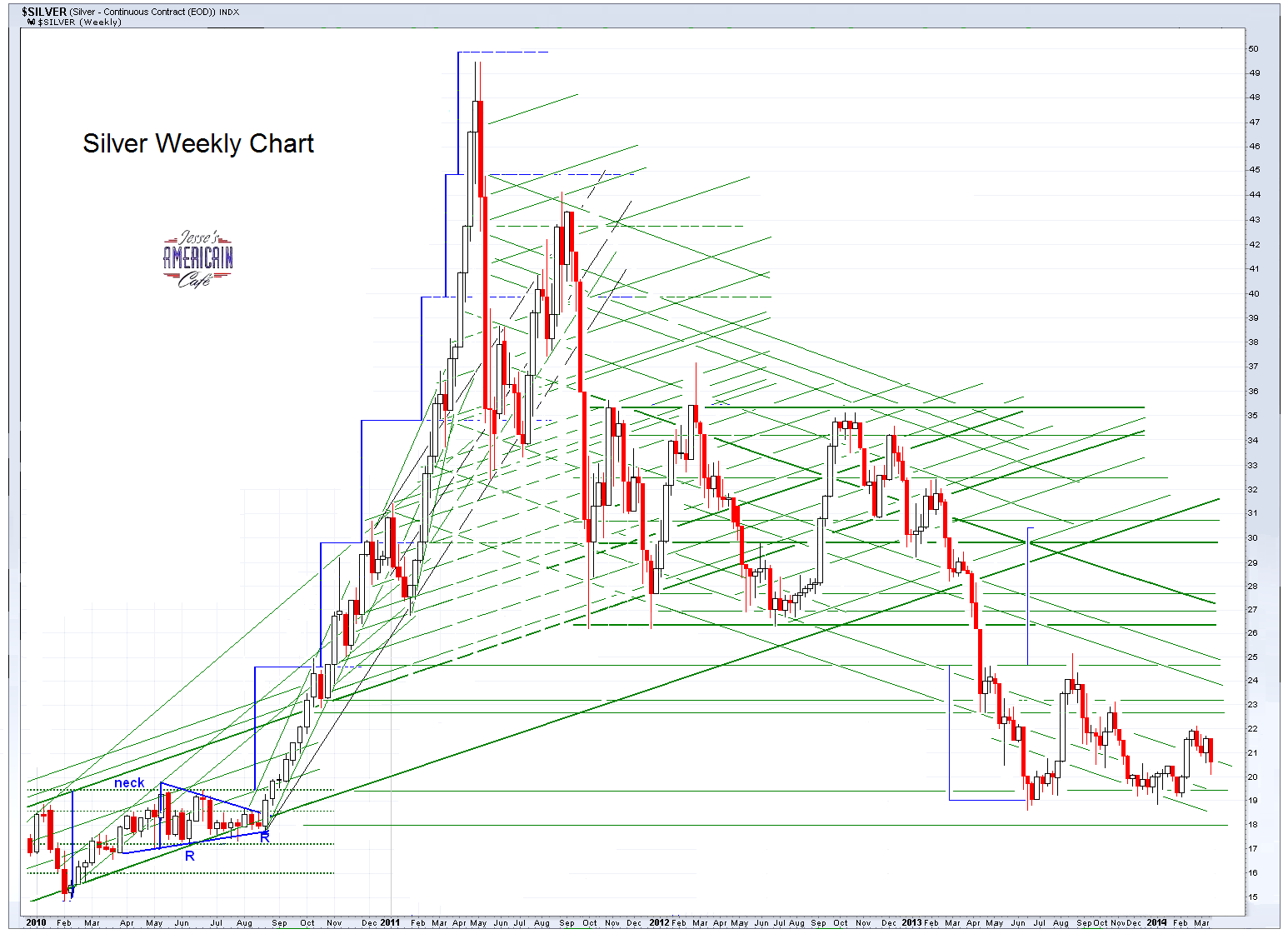
Gold Daily and Silver Weekly Charts - The Hunger Games


Last night Nick Laird showed me some excellent original data analysis from his site, Sharelynx.com, that demonstrates that a decline in the price of gold during an FOMC week is no sure thing, but more normally distributed. And we have to balance that against a different, and much less statistically robust graph, that was on ZH, and which I also presented here, that clearly showed declines in FOMC weeks, and no similar declines in off weeks, but for a much shorter period of time.

Nick looked at full weeks, and even much tighter spreads of days, but only looked at FOMC events, and a lot of them going back to 2006, and then even to 1994. I plan on looking at some of his data much more closely, but it does drive home the conclusion that simply betting blindly on around certain events does not work. If it was that easy, everyone would do it. Rather, there are other variables at play, of that I am certain. And I will take a much closer analytical look at all the data, and not just cycles and dates, when I have a greater opportunity.

Next week is an option expiration for the precious metals futures on the Comex. A large tranche of gold was deposited into the JPM warehouse. Perhaps these are preparations for the next active month for physical bullion which is April. Otherwise things were quiet.

Another thing of which I am reasonably confident is that there is a 'currency war' in progress, and some great changes in the composure and complexion of international finance and trade. This 'war,' more like a new kind of cold war than a military war, ebbs and flows, manifesting itself first in one way and then in another. And sometimes it pokes its head out of the financial pages and onto the headlines, as it has recently done in the Ukraine and Crimea.

As you might always expect in times of change and contention, truth is in short supply. And I think some long standing trends are coming to a head. And so we should expect the unexpected, and look for things to happen, particularly from the top down, that we had not seen coming.

I will never forget how, shortly after the tragic events of 911, and the expected response against the Taliban in Afghanistan, that the word was given out from the top down, 'attack Iraq.' And people looked at each other and said with their eyes, what? And the media machine was put into gear, and the march to Iraq was begun.

I mean that sort of unexpected thing, that does not seem to make sense if you have been following some logical sequence of things, but that the media picks up from the top and repeats without fairly batting a jaundiced eye.

If you want a vision of the future, I would not look for a 1984 type boot stomping endlessly on a human face. Rather, I think we will see the kind of bifurcated society of a few effete haves in a few cities, and the great number of have nots, as is depicted to some effect in The Hunger Games. President Snow reminds me of the consummately ruthless CEO, moreso than a dictator. The various District have been reduced to their basic economic elements, and the people of the Capitol are living large on their efforts.

Like most works of fiction it is an oversimplification. But it has a resonance with the kids, wildly popular in the teens and younger set. The young have a tendency to pick up on trends based on behaviours that are not carried overtly perhaps in the official news and the spoken words of adults. When the books became popular I read them, just to keep in touch with my own children and what was attracting those of them who were thinking. And now the movies are coming out. The books are better, but you may find the movies to be diverting.

So it looks like interesting times ahead. And may the odds be ever in your favour.

Have a pleasant weekend.


SP 500 and NDX Futures Daily Charts - Quad Witch Boogie Woogie


Today was a quadruple witching expiration, with the futures rolling over to June, and the options expiration on US equities.

And naturally we saw the rest of the wash and rinse cycle, the up and down, that has characterized this week.

So what next. Ukraine is the visible manifestation of the currency war, and it seems to be getting warmer, not colder. With round two of the financial retaliation of the US going forward, with credit cards and accounts being frozen, and downgrades from the credit ratings agencies, a message is going out to the rest of the world, loudly and clearly.

I expect this will be a volatile year overall, with stocks tottering a bit on their lofty heights. I am not looking for a crash or anything such as that, although this is the kind of environment in which an exogenous event would cut to the bone.

The Fed has the market's back, and certainly the backs of their owners at the Banks. The pundits were touting the financial stocks today. Of course, these are the same types who would say things like, "The signs are that the end is near. Up next, a list of stocks that are expected to outperform in the apocalypse."

Have a pleasant weekend.


NAV Premiums of Certain Precious Metal Trusts and Funds


As you may recall today is the 'quadruple witch' for the equity markets.


The premiums are at their 'new normal' levels.

The cash level continues to be historically thin at Sprott Silver, although they seemingly face no short term needs from their cash burn rate.  But at some point they will have to do another offering. 


Ted Butler: J. P. Morgan And Precious Metal Price Manipulation On the Comex


I am no legal expert, and therefore have no idea of the merits of this as a prospective case.  The law involves things like intent, opportunity, evidentiary proof, and so forth. Apparently one can sue another entity for just about anything, but that does not mean that the case has any merit.   And I certainly could not advance such a case based on even industry knowledge. That strikes to the heart of my own issue.

My primary concern is a lack of transparency. And that lack of transparency in these markets is not conducive to market efficiency.  It allows for gaming the system, either occasionally or, as we have seen, systematically.

I cannot tell if these markets are manipulated because so much of what is being done is hidden.  And it does not help that the CFTC conducted a five year long study into the subject, and then quietly killed it without ever having issued any information about their findings.

Some have shown evidence they say that proves that it is the tech funds that set price, and that JPM is just 'making a market.' If this is true, then additional transparency on the part of JPM and the other market makers would be perfectly reasonable to allay any doubts about the honesty and fairness of the markets for precious metals.  This is why the people have established, and paid for, regulators.  So they do not have to resort to lawsuits in order to achieve justice and equity in their transactions.

Considering the widespread rigging of key benchmarks and prices, I think to just dismiss these concerns with a sneer and a snigger is unreasonable, requiring people to maintain an almost slavish belief in the integrity of the Banks, trading desks, and the system.  Given the amount of abuse that has been exposed already along these same lines, that does not seem to be a thing that a thinking person would ask.

The major objection to transparency, by the way, is that it would diminish the profits of those in the position of market makers.  Well, market making is intended to be a utility function, with a small but regular return.  It is not appropriate for market making to be in the hands of those who are also major market players.  It is a certain invitation to corruption.

One of the more general things that struck home in this commentary by Ted is the concern that the Comex is becoming like a bucket shop, a betting parlor that is at arms length from the markets for which they are presumably setting prices.   The lack of delivery and the ability to create large amounts of contracts to receive or deliver on the fly, and then to transact them at whatever price you wish without seeming constraint if you are big enough, with deep enough pockets and enough advantageous information, is tantamount to setting up a con game, and then trusting in men to be angels.

Relying on self-regulation, under the discipline of private lawsuits, merely reinforces our increasingly bifurcated society, in which a small minority have ease and rights and freedom and even justice, because they can afford it.  And those many who rely on the justice provided by government will be faced with an upward facing and unresponsive bureaucracy, and with that, hard times.  Like quality Healthcare, there will be Justice, for some.

As you know I am no longer hopeful of change in the short term, given the nature of the credibility trap that has encompassed the political party process and the mainstream media. To paraphrase the discouragement pessimism of Czech author and political figure Václav Havel:
“No attempt at reform could ever hope to set up even a minimum of resonance in the rest of society, because that society is ‘soporific,’ submerged in a consumer rat race... Even if reform were possible, however, it would remain the solitary gesture of a few isolated individuals, and they would be opposed not only by a gigantic apparatus of national (and supranational) power, but also by the very society in whose name they were mounting their reform in the first place.”
It is no accident that the nascent movements for financial reform were either ruthlessly crushed, as in the case of the almost rudderless Occupy Wall Street, or co-opted by money and politics, as unfortunately happened with the Tea Party. Co-opt if you can, crush if you must.

Ted presents some of the facts in the contrary case, and I found them to be interesting.  It is hard to believe that the London Fix is so corrupt, but the Comex, which is the major pricing platform, is pristine, since the players are playing across all global markets.

Suing JPMorgan and the COMEX
Theodore Butler|
March 21, 2014

I’ve had some recent conversations with attorneys who were considering class-action lawsuits regarding a gold price manipulation stemming from reports about the London Gold Fix. I told them that while there is no doubt that gold and, particularly, silver are manipulated in price, I didn’t see how the manipulation stemmed from the London Fix. I wished them well and hoped that they may prevail (the enemy of my enemy is my friend), because you never know – if the lawyers dig deep enough they might find the real source of the gold and silver manipulation, namely, the COMEX (owned by the CME Group) and JPMorgan.

So I thought it might be constructive to lay out what I thought a successful lawsuit might look like, although I’m speaking as a precious metals analyst and not as a lawyer. I’ll try to put the whole thing into proper perspective, including the premise and scope of the manipulation as well as the parties involved...

Read the entire article for free here.

20 March 2014

Celebrating Policy Errors And Corruption With Bogus Milestones in The Recovery™


Or Why Is Unemployment Falling Along With the Labour Participation Rate?

The pat answer from learned economists is that this is 'the new normal,' and 'structural.'    It is all part of an aging population gracefully moving into their comfortable retirement.   They say this even though people are working in great numbers into older age because they have little savings and pension security, and the real median income continues to stagnate.   And while corporations and the one percent reap rich profits and increases in income from the Fed's trickle down monetary stimulus.

So many odds things occurring.  We have a bear market in the price of gold, even while the physical supply of it is disappearing, and major benchmarks have been found to have been manipulated by the financial system.  Curiouser and curiouser.

The answer is that the government and their corporate partners are painting pictures of a recovery, and placing them along the highways and byways, in order to convince us that things are getting better.  In this Wonderland where nothing is real, perception is everything, and everything is its image.

This is why I first called this 'The Potemkin Economy' some time ago.

Ralph Dillon from Global Financial Data passed this along, and I thought this was interesting. The commentary is his.
If unemployment benefits were extended indefinitely would this chart look any different? Is the decline in labor participation due to the extension of federal unemployment benefits? Would we continue to see the duration of unemployment keep trending higher if it was?

This chart is amazing in many regards. First, the duration of consecutive weeks of unemployment has never been over the overall labor participation rate in 45 years of recorded statistics. Second, the parabolic increase in the duration of those unemployed is staggering starting in 2009. Third, we have never seen the two series in lock step as they currently are.

And finally, is the decline in how long someone is unemployed correlated to the drop in those who are actually employed? Shouldn’t the participation rate go up if the duration of those unemployed is improving? What will this chart look like in say 10 years?

I continue to be fascinated with employment in this country. It seems the importance of decade’s worth important economic statistics have been turned upside down. Further, they are being looked upon differently according to what message you are trying to send.


For example, the Federal Government has had a target of 6.5% unemployment. Four years ago this was considered a milestone of achievement for a broken economy. Yet yesterday, in testimony before congress, Fed Chair Janet Yellen, indicated that the unemployment target having been reached, is no longer a goal. It had been a goal since the unemployment rate reached its highs after the 2008 financial crisis.  If we reached that goal, then things must be going well, right?

Not if you look at this chart it doesn’t. The 45 year average of the duration of unemployment is 101 weeks. Today we are at 200 weeks! Since the crisis started, we have doubled the duration of time that those are unemployed stay unemployed. Not very good. But what about the improving economy we keep hearing about? More jobs right?

Wrong. The overall civilian labor force participation rate is at the lowest level in over 3 decades yet we are at 6.5% unemployment. What then are we going to set as our next goal?

If we keep setting goals that are meaningless then why are we setting them at all? If the economy is so good, then why are we continuing the Quantitative Easing program? Sure it’s been scaled back a bit, my inclination is that the easing is skewing the traditional statistics that we have been using to measure the economy for decades.

If something is truly broken, like the labor market, why not set out and fix it instead of making it worse and celebrating its bogus milestones that are truly failures. Who does Quantitative Easing help anyway. They say Main Street, but many feel Wall Street.

They say that facts and numbers do not lie. Only politicians do.
(and those who work in the service of power and the status quo, such as mainstream media pundits, academic and professional economists, and other Very Serious People of titles and great consequence. They like to use terms like 'the new normal' to prepare people for being economically abused and repressed until exhaustion and collapse. - Jesse.)

"Robbery, rape, and slaughter they falsely call empire; and where they create a desert, they call it peace."

Tacitus, Calgacus' Speech from Agricola