20 May 2010

Wall Street Threatens Washington as Reform Vote Approaches; Europe Acts Pre-emptively Against Fraud


Naked shorting is illegal in the US, and for very good reasons. On a larger scale, it is used for price manipulation, and is the equivalent of counterfeiting. The removal of the uptick rule by the SEC on July 6, 2007, which had been created in 1938 as part of the New Deal regulatory reforms, cleared the way for its more heavy handed uses and control frauds.

The ban on naked short selling was not enforced by regulators who were willing to turn a blind eye to blatant market manipulation. Under the DTCC regime it turned epidemic. The alarm was raised by many whistle blowers who were either ignored or vilified by the corporate media.

Let me be clear on this. I am not opposed to short selling. It is a trade that has many legitimate uses. It is naked short selling that lends itself so readily to abuse, particularly when there are not limits on position sizes and massed selling to drive down prices. The deregulatory movement, based on such lofty principles, has become nothing more than a means to a fraud, systematically knocking down all the regulatory safeguards that were put in place to protect the public during the Great Depression.

And this was the result of a long and expensive campaign, led by the wealthy elite and the Wall Street banks, to lobby the Congress and dupe the people to energize their frauds. As such, it shows premeditation and deliberate intent, the organized corruption of one of the most connected of all global resources, the US financial system and control of the international monetary reserves.

It became so outrageous that the US had to intervene during its banking crisis that triggered this global financial crisis, and selectively enforce the law to protect its banks from each other and the packs of unregulated hedge funds led by Goldman Sachs.

Germany recently stepped in to ban NAKED short selling, which was being used to attempt to take down certain prices to trigger the highly lucrative and largely unregulated Credit Default Swaps.

And commentators were outraged and even hysterical over this action by Germany, which was the kind of responsible market regulation that the US reserves to itself, and only when it is in support of protecting its banking oligarchs.

This surprise and shock indicates how low our standards have fallen, and how given over to Stockholm syndrome so many otherwise intelligent people have become regarding the speculators and the banks. Death by professors, chief strategists, and the pampered princes of the corporate media.

I found it interesting that the heavy selling today in US equities, triggered by the selling of large tranches of SP futures near the open, in addition to news indicating the recovery is not gaining traction, and the threat of another flash crash was tied by traders this morning over ‘unease the the Congress has not yet killed Blanche Lincoln’s amendment to prohibit the banks from dealing in Credit Default Swaps.’

Regarding the recent gold action John Brimelow says:

"Waves of selling hit gold on Wednesday in the European and NY midmornings. As noted earlier, apparent CME volume pre-open was 90,000 lots, and estimated volume between 9AM and Noon NY, during which time gold dropped some $21, was a heavy 95,000 lots. ScotiaMocatta simply refers to gold being “bludgeoned down” and Reuters quotes a COMEX gold floor trader, “the big banks just put in sell orders that hit the market."
Anyone close to the market can see this manipulation. It is neither sophisticated nor clever. That is the shame of the regulators and insiders, who find their coverage in pleading ignorance. And what they do in gold they are doing in equities and other markets, while working their way up the food chain to the sovereign debt markets. None are safe when corruption partners with government.

All this pain and uncertainty is designed to maintain their impossibly perfect trading results for their proprietary accounts as their customers bleed for their bonuses. And what makes this such a perfect con is that they are bullying the public using the money taken from the Federal Reserve and the Congress, the public's own money.

I would that Obama and the Congress had half the courage of Merkel. And that commentators and the middle class would realize the sorry state that their economy is in, held hostage by a bunch of spoiled brats and well heeled thugs, and a government by and for the highest bidder.

"Gentlemen, I have had men watching you for a long time and I am convinced that you have used the funds of the Bank to speculate in the breadstuffs of the country. When you won, you divided the profits amongst yourselves, and when you lost, you charged it to the Bank... Beyond question this great and powerful institution has been actively engaged in attempting to influence the elections of the public officers by means of its money...

You tell me that if I take the deposits from the Bank and annul its charter, I shall ruin ten thousand families. That may be true, gentlemen, but that is your sin. Should I let you go on, you will ruin fifty thousand families, and that would be my sin. You are a den of vipers and thieves. I intend to rout you out, and by the grace of the Eternal God, I will rout you out."

Andrew Jackson on The Second Bank of the United States which was the Central Bank of his day.
A dangerously simplistic view? More like common sense, and the plain spoken truth, at last. You have been given a Republic, indeed, if you can keep it, if only for the honor of your fathers, and the sake of your children.

19 May 2010

Gold Is In a Classic Cup and Handle Formation Targeting 1,450


A "Cup and Handle" is a bullish continuation pattern in an uptrend.

The 'cup' is best shaped as a "U" and the broader the bottom the better. The 'handle' is a retracement when the right side of the 'cup' reaches its prior highs. The handle often resembles a bullish pennant.

The retracement usually does not exceed 1/3 of the advance of the cup to its second high, although it can go as deep as 1/2 in a volatile market.

Here is a textbook picture of a 'cup and handle formation' from Investopedia.


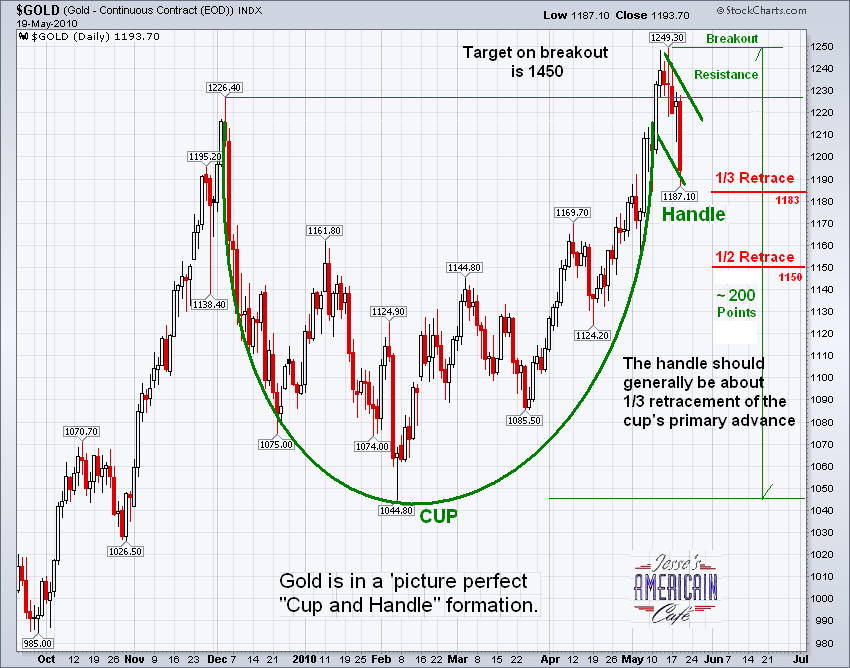
Here is the daily chart of Gold. It is in a classic cup and handle formation, with the handle having dropped down today near the 1/3 retracement target of 1183. A number of technicians have been watching it form. The advance to a new high, and the subsequent pullback, have made it now worth noting.

The handle has been shaping for four days from the peak at 1249.30. The handle generally takes from four days to two weeks to form before price advances again with fresh buying to retest the resistance around the prior high.

One might watch for the current Comex option expiration to pass next Tuesday, given the large concentration of calls around the 1200 level before gold can make its move higher. There is always the possibility of a counter squeeze, but it is difficult to fight paper with paper given the wide availablility of derivatives, and the laxness of regulation by the CFTC despite recent noises made about reform. Nothing has changed yet.

There is a possibility of a triple top, although this is why it is important that the cup have a broadly tested bottom.


The target for a breakout in this cup and handle formation above would be a minimum of 1450. The breakout should be accompanied by increasing volume. The more volume the more bullish the post breakout run will be.

This is consistent with the weekly chart which we posted a few days ago that shows an inverse H&S continuation pattern targeting 1350 as a minimum objective. In fact, one could draw the cup more conservatively, ignoring the intra-day spikes, and strike a target much closer to 1350.

And what makes this gold manipulation such a perfect con is that they are bullying the public using money taken from the Federal Reserve and the Congress, the public's own money.

What levels might be expected after the intermediate targets are reached?

My friend Brian at the Contrary Investor has produced a series of targets based on the prior high deflated by a number of measures. Here is one that I thought had a certain 'ring' to it. Keep in mind that M2 is a moving target, and moving lower for now. If it turns around and begins to expand again, the price could be much higher. But for now it is in a firm downtrend. So it conceivably could be lower.

Gold Deflated By M2 Projects to $3,912 to Match Its Prior High


Here are targets for gold and silver based on their prior highs but adjusted for inflation using the Bureau of Labor Statistics CPI, and John Williams' (SGS) unadjusted CPI estimates.

If Silver were to reach $450 per ounce, and gold to $7,500, the junior miners might provide a quite impressive performance. lol.


Bear Raid In Gold Results in an Historic One Day Liquidation: Höllenmädchen Merkel und die Straßenschreier


According to John Brimelow:

"Open interest plunged 21,256 lots, 66.11 tonnes or 3.53%, one of the largest changes in history..."
And this was before the latest round today after this early report.

Open Interest is the total number of contracts for a given future category. When the Open Interest declines on a marked price decrease this is generally considered the net liquidation of long positions. And conversely, on a rising price it is considered short covering. The weekly reports give more insight into who was doing the buying and selling. The report should be daily, and should include specific position changes for traders with aggregate positions higher than 5 percent of any total market for a specific product.

Next Tuesday is the option expiration for Calls and Puts on the Comex gold futures. There was a particularly large concentration of contracts at the 1200 level which we were watching from Monday when we promised you many market shenanigans in the coming option expiration, for both the mining stocks and precious metals.

We also picked up quite a bit more activity on the part of 'posting trolls,' who are traders both independent and with hedge funds who set the stage for major bear raids with sensationalistic statements and exaggerated 'headlines.'

The impunity with which this bear raid was conducted makes us wonder if the CFTC and SEC will ever do anything to clean up these markets. The best defense is not to rise to the bait, and trade in the short term in markets so obviously given to manipulation by large trading interests with fraudulent intents. These markets are tainted.

If the trend is broken it will be time to step aside. Until then we sell strength and buy weakness, slowly. For most it is better to take small incremental positions and then just let them ride the ups and downs.


As an aside, the hysteria, or Straßenschreier, with which the actions of Germany to curb naked short selling were greeted was very funny last night, and highly entertaining.

As you may not realize, naked short selling has been illegal in the US for some time, as least as far as equities are concerned. It was not enforced as the regulators turned a blind eye to many abuses that crept into the 'naturally efficient markets' on their watch. It is tantamount to counterfeiting, and in the hands of a party with pockets deep enough to permit it to dominate small markets, it is a blatant form of control fraud.

By the way, I hear that there has been almost no coverage of William K. Black's highly credible and shocking revelations on the public media in the States, outside of a piece on Bill Moyers' Journal. Can anything be so obvious as the control wielded by the corporatists?

But what is of concern to the Wall Street demimonde are their beloved CDS, which are as foul a form of white collar criminal abuse as ever has been seen since the creation of the Federal Reserve Bank. Any attempts to limit them will be resisted with threats, promises of dire outcomes and ruin, and buckets of money for politicians and regulators.

The rest of the world is beginning to act with revulsion at the destructive corruption of Washington and New York, and the American oligarchs.

Merkel made them squeal with her own version of shock and awe, and it was music to many ears. You go, Höllenmädchen.


Merkel und die Banken (Sarkozy ist Salieri)


18 May 2010

Merkel to The Banks and Hedge Funds: Sprechen Sie Deutsche? Then Droppen Sie Dead


There is much surprise that the German government has declared a ban on naked short selling, including CDS, as of midnight tonight, with no prior notice and the courtly deference demanded by the Banks when government chooses to regulate them. This action seems to have perturbed some and confused many.

The reason for this may be quite simple.

After tonight, when hedge funds and The Banks call upon German financial firms and European governments to make payments on Credit Default Swaps or other financial instruments that are subject to the ban, the Germans will have a rather large hammer in hand to help them to negotiate the terms, and respond to any threats and coercion.

Since the CDS will be deemed to be no longer legal, at least in the quantity and leverage desired by those gaming the system, the opportunity to default on them with the backing of the government may be an option. This seems quite similar to the stance that the Chinese government took on behalf of some Chinese firms that were caught on the wrong side of energy derivatives.

I have heard from several sources that there was a general disappointment in Europe and in some parts of Asia at the lack of progress being made in the US Congress towards creating meaningful reforms in their financial system. In fact, there is a widespread belief that Washington is being dictated to by the Banks, and that their lobbyists are directing the conversation, and in many cases writing the actual legislation. The final straw was when the Obama Administration itself sought to water down and block key provisions of the legislation to limit the power and size of the Banks.

"To some degree this is a battle between the politicians and the markets," she said in a speech in Berlin. "But I am firmly resolved -- and I think all of my colleagues are too -- to win this battle....The fact that hedge funds are not regulated is a scandal," she said, adding that Britain had blocked previous efforts to do this. "However, this will certainly have taken place in Europe in three weeks," she said, without giving more details." Reuters 6 May 2010
"German Chancellor Angela Merkel accused the financial industry of playing dirty. 'First the banks failed, forcing states to carry out rescue operations. They plunged the global economy over the precipice and we had to launch recovery packages, which increased our debts, and now they are speculating against these debts. That is very treacherous,' she said. 'Governments must regain supremacy. It is a fight against the markets and I am determined to win this fight.'"UK Telegraph 6 May 2010
The financiers have been saying that 'Europe cannot print money faster than Goldman Sachs can create naked Credit Default Swaps.' Well, Goldman can still create those swaps, but they may have trouble finding counterparties for them in Europe. And those who buy them may do so at their peril, since Europe is obviously seeking to isolate itself from the consequences of speculative excess by an overleveraged financial system.

Merkel said she was going to reassert the primacy of government over the multinational speculators.

This is only the opening salvo. It will not be effective without further effort. And it is likely to draw the ire and criticism of the corporate media in NY and London, and the financiers' well-kept demimonde.
"Oh no, naked CDS are essential to price discovery. Naked shorting adds liquidity. The system will fall apart if you do not let the Banks have their way with the global economy. Oh my God, someone in government actually did something that was not vetted and pre-approved by the Wall Street Banks. They have actually outlawed naked shorting, which is tantamount to legalized counterfeiting. How dare that headstrong and impertinent frau Dr. Merkel attempt to protect her people from the gangs of New York!"
But one has to admit that the lady has style, and, unlike her American counterpart, is not afraid to occasionally take the wheel and drive, rather than sit in the back seat offering platitudes, and fine sounding words, and toothlessly petulant criticism.

Bloomberg
Germany to Ban Naked Short-Selling at Midnight

By Alan Crawford
May 18, 2010

May 18 (Bloomberg) -- Germany will temporarily ban naked short selling and naked credit-default swaps of euro-area government bonds at midnight after politicians blamed the practice for exacerbating the European debt crisis.

The ban will also apply to naked short selling in shares of 10 banks and insurers that will last until March 31, 2011, German financial regulator BaFin said today in an e-mailed statement. The step was needed because of “exceptional volatility” in euro-area bonds, the regulator said.

The move came as Chancellor Angela Merkel’s coalition seeks to build momentum on
financial-market regulation with lower- house lawmakers due to begin debating a bill tomorrow authorizing Germany’s contribution to a $1 trillion bailout plan to backstop the euro. U.S. stocks fell and the euro dropped to $1.2231, the lowest level since April 18, 2006, after the announcement.

“You cannot imagine what broke lose here after BaFin’s announcement,” Johan Kindermann, a capital markets lawyer at Simmons & Simmons in Frankfurt, said in an interview. “This will lead to an uproar in the markets tomorrow. Short-sellers will now, even tonight, try to close their positions at markets where they can still do so -- if they find any possibilities left at all now.”

Merkel, Sarkozy

Merkel and French President Nicolas Sarkozy have called for curbs on speculating with sovereign credit-default swaps. European Union Financial Services Commissioner Michel Barnier this week called for stricter disclosure requirements on the transactions.

Allianz SE, Deutsche Bank AG, Commerzbank AG, Deutsche Boerse AG, Deutsche Postbank AG, Muenchener Rueckversicherungs AG, Hannover Rueckversicherungs AG, Generali Deutschland Holding AG, MLP AG and Aareal Bank AG are covered by the short-selling ban.

“Massive” short-selling was leading to excessive price movements which “could endanger the stability of the entire financial system,” BaFin said in the statement.

The European Union last month proposed that the Financial Stability Board, the group set up by the Group of 20 nations to monitor global financial trends, should “closely examine the role” of CDS on sovereign bond spreads. Merkel said earlier today that she will press the Group of 20 to bring in a financial transactions tax.

Merkel’s ‘Battle’

In some ways, it’s a battle of the politicians against the markets” and “I’m
determined to win,” Merkel said May 6. “The speculators are our adversaries
.”

Germany, along with the U.S. and other EU nations, banned short selling of banks and insurance company shares at the height of the global financial crisis in 2008. The country still has rules requiring disclosure of net short positions of 0.2 percent or more of outstanding shares of 10 separate companies.

The disclosure of the rules drew criticism from lawyers who said that they should have been announced well ahead of time.

“The way it’s been announced is very irresponsible, and it’s sent many market participants into panic mode,” said Darren Fox, a regulator lawyer who advises hedge funds at Simmons & Simmons in London. “We thought regulators had learned their lessons from September 2008. Where is the market emergency that necessitates the introduction of an overnight ban?”

Short-selling is when hedge funds and other investors borrow shares they don’t own and sell them in the hope their price will go down. If it does, they buy back the shares at the lower price, return them to their owner and pocket the difference.

Credit-default swaps are derivatives that pay the buyer face value if a borrower -- a country or a company -- defaults. In exchange, the swap seller gets the underlying securities or the cash equivalent. Traders in naked credit-default swaps buy insurance on bonds they don’t own.

A basis point on a credit-default swap contract protecting $10 million of debt from default for five years is equivalent to $1,000 a year.


17 May 2010

Gold and Silver Intermediate Targets


Both Gold and Silver bullion have inverse H&S formations 'working' on their weekly charts with the breakouts above their current necklines.

As is easily seen on the gold chart below, this bull market move is a series of inverse head and shoulders bottoming formation as the gold bull struggles to rise against determined shorting from the bullion banks. Each formation is more properly called a 'consolidation formation in an uptrend' rather than a bottom.

Gold is currently above the neckline which is around $1200. While it remains above this neckline, the target for this leg of the move would be $1350 as a minimum measuring objective.

If the price breaks below 1200 it is no longer an active formation, but it remains potential while the price is above 1044.


Silver is much more volatile than gold, with a significantly higher risk beta. This is important to note if you are using any sort of leverage, including miners that have a heavy exposure to silver.

Silver has a massive inverse H&S bottom, that is 'working' while it is above 18.80. The target for this move is around $30 per ounce. But it remains valid and potential while the price of silver is above 16.

If the price of silver falls below 18.80 then the formation is not active. It remains valid however while the price is higher than 17.


The relationship between the miners and the bullion is leveraged, with a beta exposure to the SP 500. Further, gold is a more pure currency play than silver, which has a partial correlation to its industrial use.

It should be noted that in our opinion both markets are being subjected to significant manipulation by large short interests, which are particularly concentrated in the case of silver, and especially stubborn and 'official' in the case of gold, involving the central banks. This is our judgement based on the circumstantial evidence.

We also suspect that the Fed is buying across the US Treasury curve, but especially at the longer durations, and that the Treasury and Fed are working with one or more groups to support the equity markets primarily through the SP futures.

This adds quite a bit to the picture, although it is difficult to forecast since it is not natural market action and can distort the trends, but only in the short term.

SP Futures Have an Inauspicious Open for Options Expiration Week


The SP 500 Futures dropped to 1120 off the open this evening on weakness in Asia, and continued concerns about sovereign debt in the Eurozone. There is still plenty of overnight, thin volume trade to permit a bounce.

This is an option expiration week, so shenanigans will be in vogue as the banks trading desks take out the wash, and rinse.


16 May 2010

Western Elite Are in the Firm Grip of Fear, Fraud, and Denial


The lie is comfortable, an illusion easy to live with, familiar, and safe.

Writing from the 'disgraced profession' of economics, James K. Galbraith speaks of the unspoken, the many frauds and deceptions underlying the recent financial crisis centered in the US. Many will read this and shake their heads in agreement, but will be unable to take the next logical step and internalize the implications of the depth and breadth of the dishonesty that enabled it then, and continues to sustain it, even today. Galbraith is asking 'why' and framing a further inquiry into the consequences of this unwillingness to reform.

"Some appear to believe that "confidence in the banks" can be rebuilt by a new round of good economic news, by rising stock prices, by the reassurances of high officials – and by not looking too closely at the underlying evidence of fraud, abuse, deception and deceit. As you pursue your investigations, you will undermine, and I believe you may destroy, that illusion."
It is easier to go with the flow, relax, rationalize, and be diverted and entertained by 'the show.' The truth may set you free, but before that it can make you feel very insecure and uncomfortable, especially when it requires challenging the 'official story' and policy decisions. Better to say nothing offensive to the oligarchs, and even occasionally to utter intelligent sounding condemnations of those who dare to question the very things you wonder about, and fear, in order to prove your loyalty and to reassure yourself that you are a right-thinking, practical individual. For the disparity that is unavoidably noticed between what is seen and what is said makes one uneasy, fearful that they are losing their bearings, if not reason. And the vested interests play on those fears. See Techniques of Propaganda

The consequences of 'extend and pretend' will be to worsen the final outcome, the day of reckoning.
"The initial deviation from the truth will be multiplied a thousandfold." Aristotle
The banks must be restrained, the financial and political system reformed, and balance restored to the economy, before there can be any sustained recovery.

Alternet
Why the 'Experts' Failed to See How Financial Fraud Collapsed the Economy
By James K. Galbraith
May 16, 2010

Editor's Note: The following is the text of a James K. Galbraith's written statement to members of the Senate Judiciary Committee delivered this May.

Chairman Specter, Ranking Member Graham, Members of the Subcommittee, as a former member of the congressional staff it is a pleasure to submit this statement for your record.

I write to you from a disgraced profession. Economic theory, as widely taught since the 1980s, failed miserably to understand the forces behind the financial crisis. Concepts including "rational expectations," "market discipline," and the "efficient markets hypothesis" led economists to argue that speculation would stabilize prices, that sellers would act to protect their reputations, that caveat emptor could be relied on, and that widespread fraud therefore could not occur. Not all economists believed this – but most did.

Thus the study of financial fraud received little attention. Practically no research institutes exist; collaboration between economists and criminologists is rare; in the leading departments there are few specialists and very few students. Economists have soft- pedaled the role of fraud in every crisis they examined, including the Savings & Loan debacle, the Russian transition, the Asian meltdown and the dot.com bubble. They continue to do so now. At a conference sponsored by the Levy Economics Institute in New York on April 17, the closest a former Under Secretary of the Treasury, Peter Fisher, got to this question was to use the word "naughtiness." This was on the day that the SEC charged Goldman Sachs with fraud.

There are exceptions. A famous 1993 article entitled "Looting: Bankruptcy for Profit," by George Akerlof and Paul Romer, drew exceptionally on the experience of regulators who understood fraud. The criminologist-economist William K. Black of the University of Missouri-Kansas City is our leading systematic analyst of the relationship between financial crime and financial crisis. Black points out that accounting fraud is a sure thing when you can control the institution engaging in it: "the best way to rob a bank is to own one." The experience of the Savings and Loan crisis was of businesses taken over for the explicit purpose of stripping them, of bleeding them dry. This was established in court: there were over one thousand felony convictions in the wake of that debacle. Other useful chronicles of modern financial fraud include James Stewart's Den of Thieves on the Boesky-Milken era and Kurt Eichenwald's Conspiracy of Fools, on the Enron scandal. Yet a large gap between this history and formal analysis remains.

Formal analysis tells us that control frauds follow certain patterns. They grow rapidly, reporting high profitability, certified by top accounting firms. They pay exceedingly well. At the same time, they radically lower standards, building new businesses in markets previously considered too risky for honest business. In the financial sector, this takes the form of relaxed – no, gutted – underwriting, combined with the capacity to pass the bad penny to the greater fool. In California in the 1980s, Charles Keating realized that an S&L charter was a "license to steal." In the 2000s, sub-prime mortgage origination was much the same thing. Given a license to steal, thieves get busy. And because their performance seems so good, they quickly come to dominate their markets; the bad players driving out the good.

The complexity of the mortgage finance sector before the crisis highlights another characteristic marker of fraud. In the system that developed, the original mortgage documents lay buried – where they remain – in the records of the loan originators, many of them since defunct or taken over. Those records, if examined, would reveal the extent of missing documentation, of abusive practices, and of fraud. So far, we have only very limited evidence on this, notably a 2007 Fitch Ratings study of a very small sample of highly-rated RMBS, which found "fraud, abuse or missing documentation in virtually every file." An efforts a year ago by Representative Doggett to persuade Secretary Geithner to examine and report thoroughly on the extent of fraud in the underlying mortgage records received an epic run-around.

When sub-prime mortgages were bundled and securitized, the ratings agencies failed to examine the underlying loan quality. Instead they substituted statistical models, in order to generate ratings that would make the resulting RMBS acceptable to investors. When one assumes that prices will always rise, it follows that a loan secured by the asset can always be refinanced; therefore the actual condition of the borrower does not matter. That projection is, of course, only as good as the underlying assumption, but in this perversely-designed marketplace those who paid for ratings had no reason to care about the quality of assumptions. Meanwhile, mortgage originators now had a formula for extending loans to the worst borrowers they could find, secure that in this reverse Lake Wobegon no child would be deemed below average even though they all were. Credit quality collapsed because the system was designed for it to collapse.

A third element in the toxic brew was a simulacrum of "insurance," provided by the market in credit default swaps. These are doomsday instruments in a precise sense: they generate cash-flow for the issuer until the credit event occurs. If the event is large enough, the issuer then fails, at which point the government faces blackmail: it must either step in or the system will collapse. CDS spread the consequences of a housing-price downturn through the entire financial sector, across the globe. They also provided the means to short the market in residential mortgage-backed securities, so that the largest players could turn tail and bet against the instruments they had previously been selling, just before the house of cards crashed.

Latter-day financial economics is blind to all of this. It necessarily treats stocks, bonds, options, derivatives and so forth as securities whose properties can be accepted largely at face value, and quantified in terms of return and risk. That quantification permits the calculation of price, using standard formulae. But everything in the formulae depends on the instruments being as they are represented to be. For if they are not, then what formula could possibly apply?

An older strand of institutional economics understood that a security is a contract in law. It can only be as good as the legal system that stands behind it. Some fraud is inevitable, but in a functioning system it must be rare. It must be considered – and rightly – a minor problem. If fraud – or even the perception of fraud – comes to dominate the system, then there is no foundation for a market in the securities. They become trash. And more deeply, so do the institutions responsible for creating, rating and selling them. Including, so long as it fails to respond with appropriate force, the legal system itself.

Control frauds always fail in the end. But the failure of the firm does not mean the fraud fails: the perpetrators often walk away rich. At some point, this requires subverting, suborning or defeating the law. This is where crime and politics intersect. At its heart, therefore, the financial crisis was a breakdown in the rule of law in America.

Ask yourselves: is it possible for mortgage originators, ratings agencies, underwriters, insurers and supervising agencies NOT to have known that the system of housing finance had become infested with fraud? Every statistical indicator of fraudulent practice – growth and profitability – suggests otherwise. Every examination of the record so far suggests otherwise. The very language in use: "liars' loans," "ninja loans," "neutron loans," and "toxic waste," tells you that people knew. I have also heard the expression, "IBG,YBG;" the meaning of that bit of code was: "I'll be gone, you'll be gone."

If doubt remains, investigation into the internal communications of the firms and agencies in question can clear it up. Emails are revealing. The government already possesses critical documentary trails -- those of AIG, Fannie Mae and Freddie Mac, the Treasury Department and the Federal Reserve. Those documents should be investigated, in full, by competent authority and also released, as appropriate, to the public. For instance, did AIG knowingly issue CDS against instruments that Goldman had designed on behalf of Mr. John Paulson to fail? If so, why? Or again: Did Fannie Mae and Freddie Mac appreciate the poor quality of the RMBS they were acquiring? Did they do so under pressure from Mr. Henry Paulson? If so, did Secretary Paulson know? And if he did, why did he act as he did? In a recent paper, Thomas Ferguson and Robert Johnson argue that the "Paulson Put" was intended to delay an inevitable crisis past the election. Does the internal record support this view?

Let us suppose that the investigation that you are about to begin confirms the existence of pervasive fraud, involving millions of mortgages, thousands of appraisers, underwriters, analysts, and the executives of the companies in which they worked, as well as public officials who assisted by turning a Nelson's Eye. What is the appropriate response?

Some appear to believe that "confidence in the banks" can be rebuilt by a new round of good economic news, by rising stock prices, by the reassurances of high officials – and by not looking too closely at the underlying evidence of fraud, abuse, deception and deceit. As you pursue your investigations, you will undermine, and I believe you may destroy, that illusion.

But you have to act. The true alternative is a failure extending over time from the economic to the political system. Just as too few predicted the financial crisis, it may be that too few are today speaking frankly about where a failure to deal with the aftermath may lead.

In this situation, let me suggest, the country faces an existential threat. Either the legal system must do its work. Or the market system cannot be restored. There must be a thorough, transparent, effective, radical cleaning of the financial sector and also of those public officials who failed the public trust. The financiers must be made to feel, in their bones, the power of the law. And the public, which lives by the law, must see very clearly and unambiguously that this is the case. Thank you.

James K. Galbraith is the author of The Predator State: How Conservatives Abandoned the Free Market and Why Liberals Should Too, and of a new preface to The Great Crash, 1929, by John Kenneth Galbraith. He teaches at The University of Texas at Austin.

Rick Santelli: Paper Gold Defaults and US Dollar Distortions


It is questionable whether Rick Santelli, maverick commentator on CNBC, gave Larry Kudlow the answer he was fishing for.

Santelli brings up the question of a divergence between the paper commitments to gold ownership, with the claims outstripping the actual bullion available. Rick keys in on the ETFs, but other disclosures seem to indicate that the problem is much more serious and close than even he might know.

The other point he raises of course is the distorted strength in the US dollar because of the outmoded structure in the DX index. It is heavily weighted to the euro, yen and the pound, which is hardly indicative of the state of the world trade or even GDP distribution perhaps.

The problem according to Santelli is that this apparent strength is causing people to ignore developing problems in the basis of dollar denominated assets, and slowing the calls for reform, and the restructuring of the economy that will help it to withstand the cold winds that will start blowing shortly in the States.

Rare to hear the truth spoken on CNBC these days, and refreshing when it comes out.

These hidden shoals are the foundation of the panic to come. And when it does come, it may sweep aside the facade of strength and stability like a hurricane. It will certainly exposed much corruption, and the decay of justice and public stewardship.


h/t Stacy Herbert at Max Keiser

14 May 2010

SP Futures Daily Chart


The SP futures set a higher low at support around 1122, and managed to rebound.

Follow through next week is everything. The prior low beckons, but the volumes are once again thin, and so amenable to efforts towards reflation.

“Pleasure can be supported by an illusion; but happiness rests upon truth.”

Sébastien-Roch Nicolas De Chamfort


Here is a slightly more detailed version of the same chart.

The resistance and support are part of a complex arithmetic progression.


The implications may not be so obvious, but they are worth thinking about.