06 February 2013

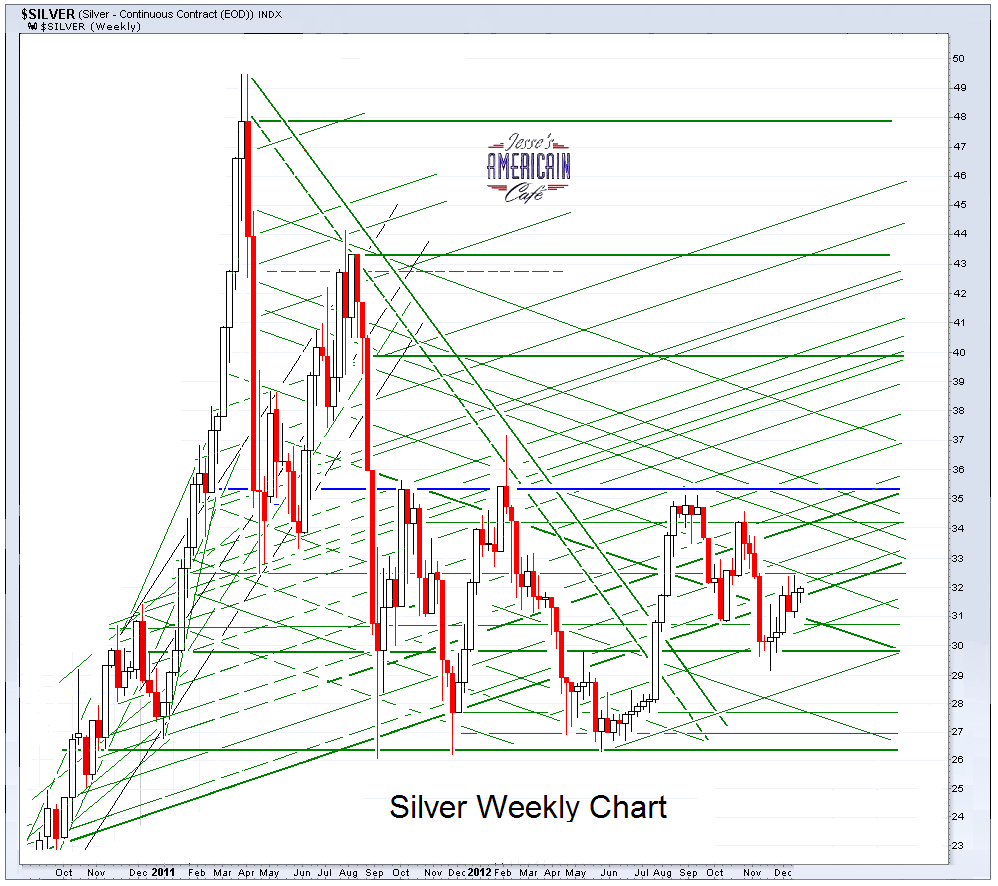
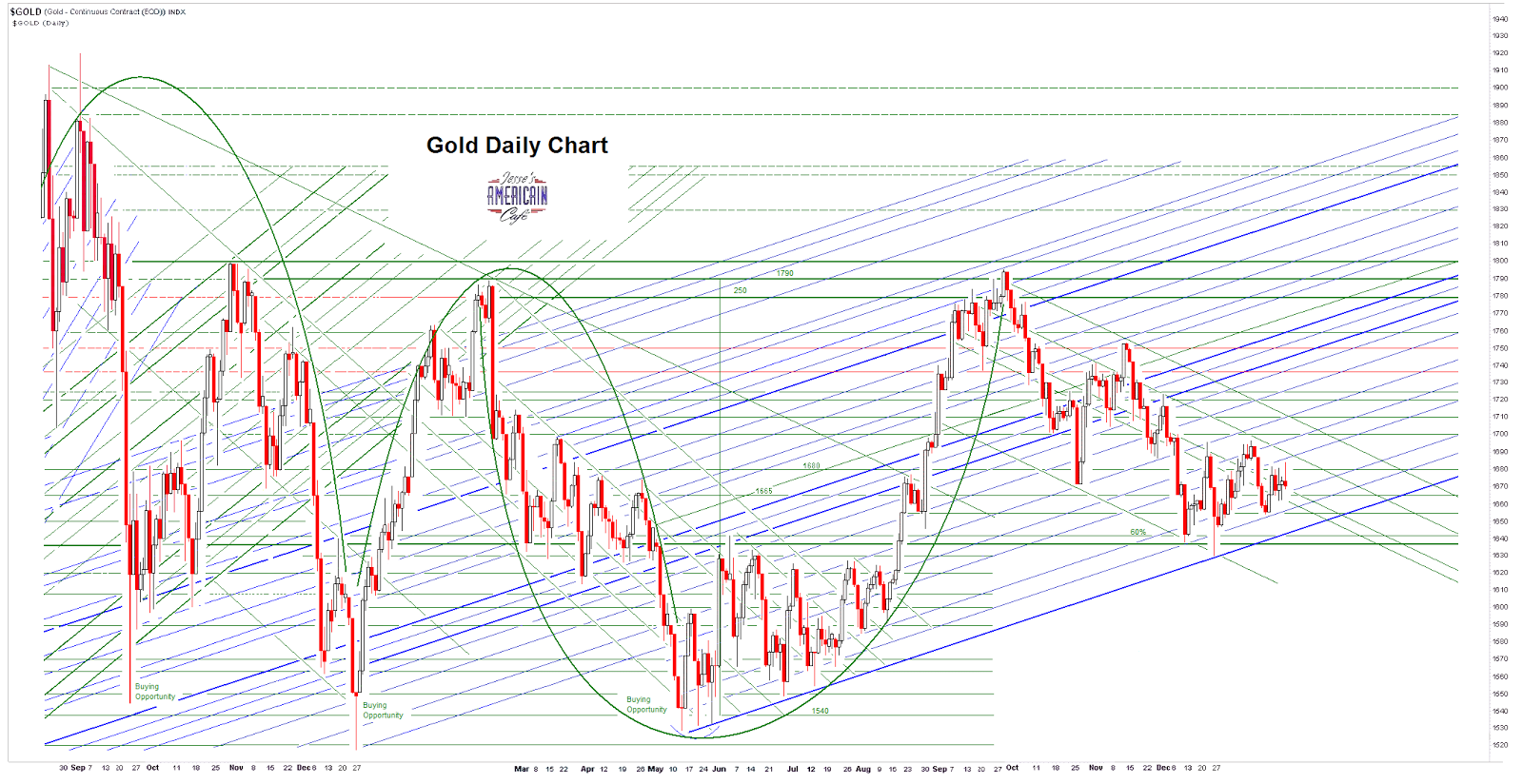
Gold Daily and Silver Weekly Charts


There is some serious coiling going on in these markets, and sentiment seems very discouraged.

As it stands now, I find the gold chart to be exceptionally interesting.  I think we might see something for the technical analysis books developing here.

Here is what Louise Yamada has to say about gold and silver.


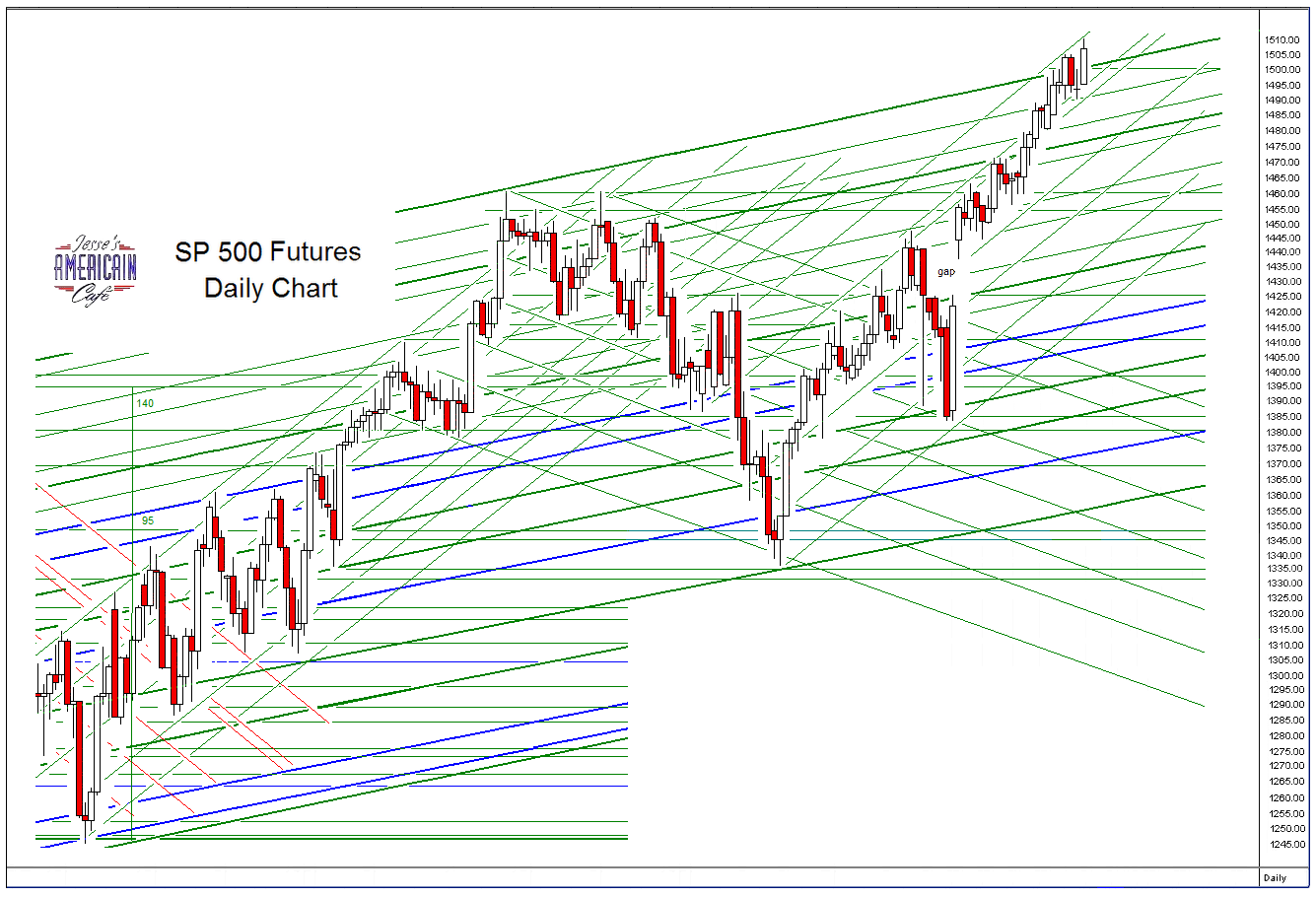
SP 500 and NDX Futures Daily Charts


There was quite a push to get the SP futures to finish flat to green, with another significance divergence as big tech lagged.

Earnings guidance is trending negative, with tech the worst and banks the best.

This is indicative of the policy error of the Fed and the Treasury which addresses the big banks and the management of perceptions in certain key market pricing, while neglecting the growth of the real economy.

This is how the financial engineers create zombie economies. 


Net Asset Value Premiums Of Certain Precious Metal Trusts and Funds


I compare the Net Asset Value Premium table of today to that of Monday, with a snapshot of them taken at a time when the spot prices of both gold and silver are almost identical.

I just thought the thinness of the premiums was interesting.

There is a lot of discouragement in the metals out there.

Wednesday 6 February


Monday 4 February


Is All Stimulus Equally Effective?


I think we can understand the principle of government spending as a spur to aggregate demand, which can be useful in certain circumstances where the economy has been caught in a 'feedback loop' of stagnancy.

I won't go into it in detail now, but if the government buys things in the real economy, or provides money for other people to buy things in the real economy, the demand for real goods increases.  Simple enough. One can argue about aftereffects, but the demand increase remains the same. And the principle is that this temporary stimulus will help the real economy break out of a crisis induced feedback loop of stagnation. And I would add a serious caveat, IF other changes have been made to those problems and policies which have caused the crisis in the first place.

This is called 'stimulus' in economics.

There are other instances of stimulus being applied to an otherwise healthy but sub-optimal economy, and again, I will leave that to some other discussion. But there is the obvious caution about using artificial stimulants inappropriately to hide deficiencies in healthy organic growth, especially when caused by policy errors.

Here I speak only about stimulus in the aftermath of a crisis, an economy which is marked by endemically slack demand and investment. And I do think the principle of liquidity trap has been mistaken to the extent that the symptoms are treated rather than causes. I call this cargo cult economics. And Geithner and Bernanke are its high priests of a plummeting velocity of money supply.

But even in the case of post crisis slump, I wonder about this principle of stimulus in application. If the government wishes to add $1 Trillion in stimulus to a slack economy, would it be the same thing to just give $1 Billion each to the top 1000 richest people in the nation, or $10,000 each to 100 million randomly selected people, to be paid out over the period of a year.

I am sure that in the long run, there are equations and rationales that 'prove' that the effect of both actions are the same.  And I would imagine that some of the neo-liberal economists will likely argue that the one percent will put the funds to work as productive investments, and the hoi polloi will merely waste their money on drugs, alcohol, and video games.  This probably says less about reality and more about the inherently skewed perspective of the elite who consider the 47% to be sub-human. But there is merit in thinking that simple one time payments with no work attached are not as effective as something more substantial. 

What is the government gave 10 million people a job that paid them a living wage which, together will spending on capital assets, allowed them to repair bridges, improve parks, enhance the electrical system, build up safeguards against flooding and storms,  clean up the streets, and remove and replace dangerously dilapidated buildings.

But I think common sense and a bit of more granular thinking will show that in terms of stimulus to the real economy, if measured in a reasonably confined time horizon (ie. less than five years) one can see how the broader distribution of stimulus directly to those most inclined to spend it on real goods, rather than the accumulation of more productive assets in the face of slack aggregate demand, would have a demonstrably more effective result on stimulating demand in the real economy.

In a period of slack aggregate demand, wealth tends to accumulate. The wealthy buy more resources, and assets 'on the cheap,' and economic power and resources tend to concentrate, further dampening aggregate demand as measured not nominally but against a basket of real goods.

And this was the genius of Franklin Roosevelt, not an economist, but a practical, problem-solving leader. He reformed the banks, rather than stuffing them full of money, and hoping they would make more loans. And through a series of programs he sought to apply stimulus directly to where it was needed, in the relief of privation of course, but also in jobs which performed necessary functions and also built up the infrastructure of the nation.

Granted, there was trial and error in his method.  And he made some errors in judgement for certain, including some of his actions regarding the gold standard and the method of refunding the banks.  But we should note that he did this all under a duress that was more real and compelling and visceral than the singular crisis that caused the Congress to pass TARP.

And providing funds directly to the people without passing them through the hands of the one percent angered the elite of his day to the point of considering an actual coup d'etat, in addition to every form of political obstructionism one can imagine. And he did fail to stay the course, and allowed the money supply to contract prematurely after he thought the worst was over.  And the oligarchs still hate him, and seek to distort his record and his legacy.

 But all in all, he was a real leader at a time when most of the developed world was turning to the malady of fascism, militarism, and destruction.  He took the somewhat effete theories of Keynes, and put real substance into those principles, while engaging in sweepingly effective reforms that served his country for over sixty years, until a new generation forgot the lessons of the past.

And compared to the faceless bureaucrats and economists at the Federal Reserve and the Treasury, and their own series of failed financial asset bubbles, he was a natural genius.

05 February 2013

Gold Daily and Silver Weekly Charts - A 'Risk On' Day


Gold was pushed back hard from its attempt to break out above its 50 DMA which is around 1684.

Silver held its ground a little better.

Cap, cap, cap.

C'est la guerre monétaire.

I found this comment from a reader on the equity markets to be resonant with my own thoughts.
"High frequency trading software that focuses on feedback loops is a useful diversion to hide front-running, short squeezing, and other parasitic activities. The current BS about rotation out of bonds is merely an attempt to attract retail because they’ve run out of shorts to squeeze to take the markets higher.

If you can put aside your moral outrage, this strategy is a thing of beauty – disgusting, evil, and fraudulent but beautiful in its execution."

Frauds R' Us.   Its the major growth industry, and the dominant export of the US and UK.


SP 500 and NDX Futures Daily Charts - The Dell Computer Market


It was rally mode today as traders celebrated the great economy in Europe, which is allowing their banks to pay back the ECB as they get 'healthy.'

Huh? Well, that's what the spokesmodels said. Its a 'better-than-expected' world, at least for the one percent.

This is the Dell Market, with lots of money flowing around the plate, but little value being added, just a further concentration of money and power.


Is that Mr. Megaphone Talking on the SP 500 Futures Chart? Or Yet Another Headfake?


Is that a megaphone top forming up on the SP 500 March futures chart?  Or is the Fed just glad to keep fueling this glorious rally for freedom?

Formations like this are fun to watch as potential indicators, but they really do not work until they 'work.'

That is, they are not active until activated by a clean trend break in one direction or the other.  This is true of all chart formations that represent a possibility that can become more or less probable over time, depending on which way things develop.

Charts don't do anything.  They merely reflect the underlying reality in an easier to grasp representation, for those with that sort of visual inclination.  They are a roadmap, not the road.

Right now 'the market wants to go up,' meaning lots of market participants want it to go up, want to take it up and keep squeezing the bears who piled on ahead of the fiscal cliff and sequestration.

My interpretation of this 'megaphone' is that the market is undecided about the viability of the rally continuing given the impasse in Washington and the impending battle of the budget over sequestration which should happen in about four or five weeks.  And despite the recent happy talk, the European situation remains volatile, and the currency war continues.

If you want to play a formation like this, thenwait for it, and give up bragging rights and save yourself a loss from being 'too early' or just plain wrong.

There is a word for those who bet against the market on the if-come.  They are called 'broke,' and spend most of their time badgering people on chat boards.  They are often wrong, but rarely in doubt.


Why Bears Should Tread Carefully

Enter the Credibility Trap: A Prediction About the S&P Ratings Lawsuit


No, I do not predict that there will be no criminal indictments and convictions to follow the suit, or even serious personal penalties from the civil action beyond something that is tax deductible as a cost of doing business. That is like predicting that a heavy rain will make puddles.

I predict that the primary defense that will be offered by S&P will be based on 'the credibility trap' itself.

The usual defense in cases like this is the First Amendment, that S&P was merely voicing an opinion. In this particular case, after having combed through over 20 million documents, the Department of Justice will attempt to prove that S&P was not merely voicing an opinion, but lying for gain, which is not 'protected speech.'

And most of them obviously cannot use the CEO defense of non-involvement and general ignorance of the entire situation, since they were being paid to write professionally informed judgements based on a factual due diligence.  It would be like a surgeon arguing against malpractice because he was watching porn while performing surgery, and was so distracted he did not really notice what he was doing and was therefore merely a hapless bystander.  Don't laugh.  It seems to be working for MF Global, and several national governments.

Having these usual avenues thwarted, I suggest that S&P will point to all the other credible voices of the economists and politicians, 'very serious people,' who said either absolutely nothing, or voiced similarly misplaced opinions and 'mistakes in judgement' about the true nature of the unfolding financial frauds.  How can you blame us, when no one of consequence said anything differently, forcefully.

So rather than key actors in a massive control fraud, they will portray themselves as hapless victims of the same mass delusion that affected most of the New York-London-Washington establishment, with many top universities in their supporting cast. 

Will Alan Greenspan offer to be an expert witness on the perils of mistakes made while blinded by a sincerely held ideological delusion?  Poor fellow, just a good chap making an honest error in judgement.  He used a bad model.  Who can blame him.

The defense will be 'the credibility trap' itself.  You cannot convict us, without indicting yourself.  

And if they are as I think they are, the S&P team will bring some credible implications of their case for the sacrosanct TBTF crowd to the plea bargaining process, and make its objective the best terms in a settlement while admitting no wrongdoing.   We chose to settle because it was cheaper.  We are victims of big government.   The usual suspects will run with that.

It is a corollary to the credibility trap that no one who knows 'where the bodies are buried' will be personally inconvenienced beyond mere appearances.

It will be interesting to see how this plays out.  It might set the tone for the 'investigations' of the coming collapse and scandal in the paper silver market.   How could we have done anything wrong when the CFTC investigated us for five years, and sat next to our people almost every day?

What Time Is the Next Crisis? - An Historic Warning From John Hussman


"The enemy of the conventional wisdom is not ideas but the march of events."

John Kenneth Galbraith

This is from John Hussman's latest weekly observations which you can read here.

In every instance he cites with which I am familiar, any concerns about the gross mispricing of risk were lightly dismissed, because 'the market says that everything is all right.'   As if the financial markets were some prescient, infallible instrument, and not overtaken by the manipulation of insiders and the monied interests. 

The 'rising market' kept most criticism of the policy errors in the growth of the credit bubble cowed and quiet, until the inevitable market break and crisis. That the financiers have not yet completely destroyed the global economy is not particularly reassuring, while they are still working at inscribing their arrogance, writ large on the pages of history, chapter by dreadful chapter.

Or more cynically one can conclude that yes, things are getting out of control, but we must keep dancing while the music is playing, and say nothing while the money is flowing in order to 'save the system,' while disabling the smoke alarms and stuffing one's pockets.

As long as the Fed can keep printing money and delivering it to the Banks and the one percent, and not to the real economy, through its purchases of their (fraudulently) mispriced financial assets, this could keep going, while maximizing the damage.  While it does give the financial engineers some feeling of control, it really does nothing constructive except to delay the essential reforms.

The combination of constructively applied stimulus and sweeping financial reform was the genius of Roosevelt, and the lack of it is the failure of Obama.

And the big correction might not even show up all that readily, in nominal terms at least, in the equity markets for some time, being papered over by a blizzard of new money.  And so that implies a crash in the bond markets, as we saw a few years after the Great Crash of 1929.  But they are getting better at the cover ups, so who can say.

The tail of financialization and leverage is still 'wagging the dog' of the real economy.   After reading the current thoughts in mainstream economics, and Modern Monetary Theory, it seems quite likely that history is about to deal out another hard lesson in real wealth and value.

I am ambivalent to the exact timing since I cannot know it.    And so if another year passes and 'nothing happens' I may not be cheered by it while the fundamentals like median wage continue to deteriorate.  This is the mechanism in which bubbles develop, and we have seen more of them than most, and with increasingly intensity.

But I am more confident that the punchline to this comedy, if it continues unabated, will be the devaluation of the currency and at least a de facto default on the debt which can take several forms. And the usual yahoos will rise up and seek power, promising an hysterical people to take away their pain, while inflicting it on 'the others.'

"Present market conditions now match 6 other instances in history: August 1929 (followed by the 85% market decline of the Great Depression), November 1972 (followed by a market plunge in excess of 50%), August 1987 (followed by a market crash in excess of 30%), March 2000 (followed by a market plunge in excess of 50%), May 2007 (followed by a market plunge in excess of 50%), and January 2011 (followed by a market decline limited to just under 20% as a result of central bank intervention). These conditions represent a syndrome of overvalued, overbought, overbullish, rising yield conditions that has emerged near the most significant market peaks – and preceded the most severe market declines – in history:
  1. S&P 500 Index overvalued, with the Shiller P/E (S&P 500 divided by the 10-year average of inflation-adjusted earnings) greater than 18. The present multiple is actually 22.6.
  2. S&P 500 Index overbought, with the index more than 7% above its 52-week smoothing, at least 50% above its 4-year low, and within 3% of its upper Bollinger bands (2 standard deviations above the 20-period moving average) at daily, weekly, and monthly resolutions. Presently, the S&P 500 is either at or slightly through each of those bands.
  3. Investor sentiment overbullish (Investors Intelligence), with the 2-week average of advisory bulls greater than 52% and bearishness below 28%. The most recent weekly figures were 54.3% vs. 22.3%. The sentiment figures we use for 1929 are imputed using the extent and volatility of prior market movements, which explains a significant amount of variation in investor sentiment over time.
  4. Yields rising, with the 10-year Treasury yield higher than 6 months earlier.

The blue bars in the chart below identify historical points since 1970 corresponding to these conditions.

MIchael Lewis and the Heart of the US Economic Policy Failure and Crisis


"Corruption is a tree, whose branches are
of an immeasurable length: they spread
Everywhere; and the dew that drops from thence
Hath infected some chairs and stools of authority."

Beaumont and Fletcher, The Honest Man's Fortune

Michael Lewis has written an excellent pocket analysis of the financial crisis in The New Republic, in his review of Greg Smith's book about why he left Goldman Sachs.  I have to admit some prejudice, because he says all of the things which I have been saying, and says them very well.

Crony capitalism has always been with us, but it took wing in the 1990's, and has brought us to this place where we would not wish to be.

Michael Lewis does an excellent job of distilling the problem and its solution to the basics, without necessarily touching on the need to reform the political campaign process, and the revolving door that enriches the politicians and regulators through betraying the spirit, if not the technical word, of their oaths of office.

Is a policy error still an 'error' if it is done purposefully? 

I had hoped that Obama might have risen above that as an 'outsider' with a mandate for change, but that notion was quickly dispelled in his first 100 days in office.  He has pursued a policy of subsidy and appeasement and failed leadership that is killing the legacy and effectiveness of his administration, but enriching many participants in the process. And it works, because the US has become a culture of personal greed. 

One can speculate on motives endlessly, but we'll leave that one to history.  The end result remains the same.  And the pity is that the 'opposition party' is even worse, even more servile to special interests.

And the oddest thing is that this is almost a general phenomenon throughout the developed world, and not some anomaly of the US. And the culture of greed and economic repression was spread by highly placed political appointments affiliated in many cases with the same handful of US-UK banks.

In the aftermath of the first Great Depression there was a general spread of militant fascism, and a great world war.  So why not a rise of oligarchies employing financial repression this time, with a global currency war?  There appears to be some precedent of corruptible, power mad people rising to the occasion.

The Western governments have come to resemble competing crime families, more than an open democratic process of policy formulation for the good of the entire nation through constructive give and take.  It's mostly take, with the common people being taken, while the media and the pundits weave an alternative reality for them with words and emotion.

So, here we are.

What do you want to do tonight, Marty?

"Stop and think once more about what has just happened on Wall Street: its most admired firm conspired to flood the financial system with worthless securities, then set itself up to profit from betting against those very same securities, and in the bargain helped to precipitate a world historic financial crisis that cost millions of people their jobs and convulsed our political system.

In other places, or at other times, the firm would be put out of business, and its leaders shamed and jailed and strung from lampposts. (I am not advocating the latter.) Instead Goldman Sachs, like the other too-big-to-fail firms, has been handed tens of billions in government subsidies, on the theory that we cannot live without them. They were then permitted to pay politicians to prevent laws being passed to change their business, and bribe public officials (with the implicit promise of future employment) to neuter the laws that were passed—so that they might continue to behave in more or less the same way that brought ruin on us all.

And after all this has been done, a Goldman Sachs employee steps forward to say that the people at the top of his former firm need to see the error of their ways, and become more decent, socially responsible human beings. Right. How exactly is that going to happen?

If Goldman Sachs is going to change, it will be only if change is imposed upon it from the outside—either by the market's decision that it is no longer viable in its current form or by the government's decision that we can no longer afford it. There is a bizarre but lingering aroma in the air that the government is now seeking to prevent the free market from working its magic in the financial sector-another reason that the Dodd-Frank legislation is still being watered down, and argued over, and failing to meet its self-imposed deadlines for implementation.

But the financial sector is already so gummed up by government subsidies that market forces no longer operate within it. Could Goldman Sachs fail, even if it tried? If someone invented a cheaper way to finance productive enterprise, would they stand a chance against the big guys?

Along with the other too-big-to-fail firms, Goldman needs to be busted up into smaller pieces. The ultimate goal should be to create institutions so dull and easy to understand that, when a young man who works for one of them walks into a publisher's office and offers to write up his experiences, the publisher looks at him blankly and asks, 'Why would anyone want to read that?'"

Michael Lewis, The Trouble With Wall Street


04 February 2013

Gold Daily and Silver Weekly Charts


There was some top calling after the big run up last week, especially given the ebullient cover of Barron's over the weekend.

Let's see if we get a trend break before the bears come out of the woods to pile on.

The capping on gold and silver is determined. When they break free, then we will see this market wiggle out of the grip of the pigmen, who are using it as their personal ATM.


SP 500 and NDX Futures Daily Charts - Correctamundo


The equity markets corrected today after an extremely overbought run up last week, marked by an obtuse interpretation of the Non-Farm Payrolls report on Friday.

The NDX took it on the chin, but the SP 500 hung stubbornly on to the more aggressive uptrend.

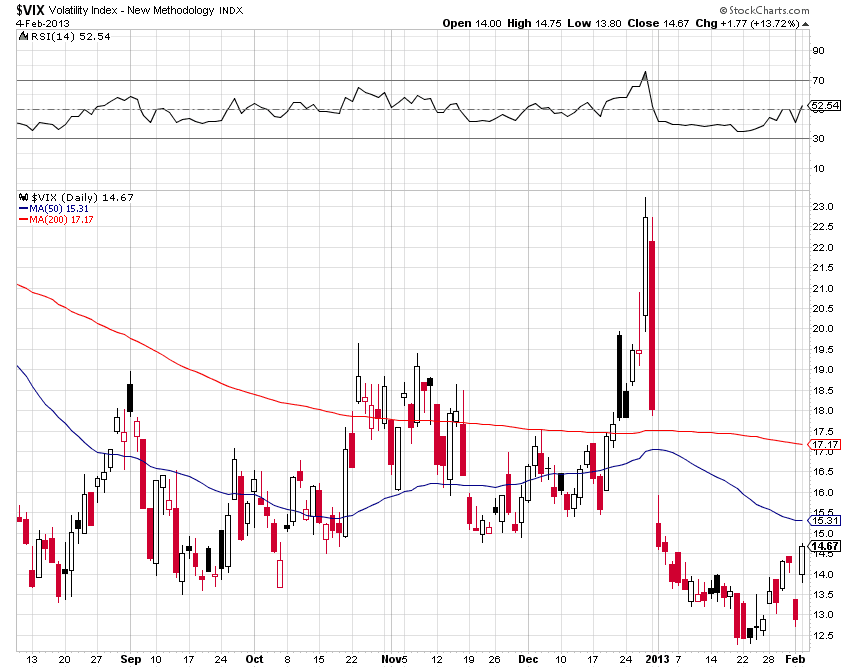
VIX climbed, but did not give any definite signal.

Let's see if this was just a correction, a one day wonder, or something more substantial.


The Triumph of Spectacle


“Sadism dominates the culture. It runs like an electric current through reality television and trash-talk programs...

Washington has become our Versailles. We are ruled, entertained, and informed by courtiers -- and the media has evolved into a class of courtiers. The Democrats, like the Republicans, are mostly courtiers.

Our pundits and experts, at least those with prominent public platforms, are courtiers. We are captivated by the hollow stagecraft of political theater as we are ruthlessly stripped of power. It is smoke and mirrors, tricks and con games, and the purpose behind it is deception...

A culture that does not grasp the vital interplay between morality and power, which mistakes management techniques for wisdom, and fails to understand that the measure of a civilization is its compassion, not its speed or ability to consume, condemns itself to death.”

Chris Hedges, Empire of Illusion: The End of Literacy and the Triumph of Spectacle


"As flies to wanton boys are we to the gods, They kill us for their sport."

William Shakespeare, King Lear

They would be as gods, and so revel in violence and death which, unable to create life, is their greatest power.   These will live and prosper, and those will live miserably, and die.  And the winners will owe their allegiance to the system.

They seek to master death with their illusions.  The prospect of their own death drives their fears into madness.

And they hide their nakedness with spectacle, and fill their empty being with excess, fads, and distractions.

Welcome to the Hunger Games. And may the odds be ever in your favor.


“Why do you think we have a winner?,” Snow asks while cutting a white rose.

"What do you mean?,” Seneca asks. “I mean, why do we have a winner?,” Snow repeats, before pausing. “Hope.”

“Hope?,” Seneca replies slightly bewildered.

“Hope. It is the only thing stronger than fear. A little hope is effective, a lot of hope is dangerous,” Snow declares.

“A spark is fine, as long as it’s contained. So, contain it,” Snow warns.

Suzanne Collins, The Hunger Games


Net Asset Value Premiums Of Certain Precious Metal Trusts and Funds


Not exactly a crowded trade, and enthusiasm for silver seems subdued.

Gold made new highs in the Japanese yen.

Each currency takes its turn on the downward spiral of competitive devaluation and printing. The central bankers which to 'coordinate' this more closely, and silence gold as best they can.

They can only 'print' paper gold, and only for so long.


03 February 2013

Weekend Reading: The Touchstone of Faith Is Love


For all the people of God, love is the touchstone of our faith, the way to know if what we believe is with Him, or with something else, if we are walking with Him, or with something else, if the one who speaks is speaking for Him, or for something else.

Love cannot be pretended for too long, but always shows itself to be genuine or not. It does not speak with hate or anger or fear, but with a fullness of existence that can only be counterfeited but never achieved by that which is opposed to His existence.

When you are in doubt or confused, look for the light of love. And if it is not there, if it is wrapped in the hardness of pride disguised as 'love,' then you will know what it is.

Love is not easy; it is not a natural state. It seems weak and foolish, and even despicable to the fallen. 

It is a conscious disposition of the mind and the heart, an act of will. It is a habit of acting and looking at things, that becomes easier and more comfortable as we carry that yoke on our weaker nature and our emotions.   Over time that yoke becomes light, and a light to steady us in life's darker moments. But it is never easy or natural.

This is how the people of God may judge themselves and their own actions along the way. If there is no love evident in the words and the heart, then the words and the actions are not of God, but of something else.

Love is not what we do, but how we do what we do.  Love is found in the most practical things, not in grand gestures and sacrifices, but in the small daily acts, done lovingly, and with care, for His sake.  It is how we carry our cross, not in front of a crowd, but in the quiet, little things. 

We do not need to hate and reject the world, and despise His creation. They are a gift from God, to which we bring our good use and order, and wonder. We can work with His gifts lovingly, and not abuse them from self-absorption and greed.

It is not the world that is a source of evil, but the willfulness of our hearts, hardened with pride. Only love is productive.  And the pity is, not to love.

God is the essence of all existence, which is love.

"If I speak in the tongues of mortals and of angels, but do not have love, I am a noisy gong or a clanging cymbal. And if I have prophetic powers, and understand all mysteries and all knowledge, and if I have all faith, so as to move mountains, but do not have love, I am nothing. If I give away all my possessions, and if I hand over my body so that I may boast, but do not have love, I gain nothing.

Love is patient; love is kind; love is not envious or boastful or arrogant or rude. It does not insist on its own way; it is not irritable or resentful; it does not rejoice in wrongdoing, but rejoices in the truth. It bears all things, believes all things, hopes all things, endures all things.

Love never ends. But as for prophecies, they will come to an end; as for tongues, they will cease; as for knowledge, it will come to an end. For we know only in part, and we prophesy only in part; but when the fullness comes, the partial will come to an end.

When I was a child, I spoke like a child, I thought like a child, I reasoned like a child; when I became an adult, I put an end to childish ways. For now we see in a mirror, dimly, but then we will see face to face. Now I know only in part; then I will know fully, even as I have been fully known. And now faith, hope, and love abide, these three; and the greatest of these is love."


“You shall love the Lord your God with all your heart and with all your soul and with all your strength and with all your mind, and your neighbor as yourself.”

02 February 2013

A Secret History: The Ku Klux Klan


"The new generation has to hear what the older generation refuses to tell it."

Simon Wiesenthal


“Man’s capacity for justice makes democracy possible; but man’s inclination to injustice makes democracy necessary.”

Reinhold Neibuhr


"Keep America American."

Ku Klux Klan slogan from the 1920's

Most nations have things in their past which they wish to forget.

And they obscure them in a mythos, with a false memory of their own self-righteousness.

But to forget them is to invite their return, in words that are echoes of the past, and the objectification of 'the other' as they choose to define them.

Like financial frauds, the sins of the past keep coming back with new names, but the same old words and false propositions.


01 February 2013

Gold Daily and Silver Weekly Charts - The Failure to Reform


"But there is a sort of 'Ok guys, you're mad, but how are you going to stop me' mentality at the top."

Robert Johnson

Audacious oligarchy.

This will not end well.

And a preview of Matt Taibbi and Bill Moyers discussing Why We Can't Let the Banks Off the Hook.

Ignoring such pervasive white collar crimes, which are still ongoing by the way, creates a climate of extreme moral hazard, festering corruption, and teaches felony by example.

I think they give Obama, the regulators, and the Congress far to much credit in ignoring these crimes 'for the good of the system.' It is all about careerism, the credibility trap, and going along to get along.

They cannot reform the system because they are the system, and the political and financial elite are doing just fine with the system the way that it is, thank you very much. They do not want things to change.


SP 500 and NDX Futures Daily Charts - Fragility of Vain Illusions


Fame, power, and gold, are loved for their own sakes — are worshipped with a blind, habitual idolatry. The pageantry of empire, and the fame of irresistible might, are contemplated by the possessor with unmeaning complacency, without a retrospect to the properties which first made him consider them of value.

It is from the cultivation of the most contemptible properties of human nature that discord and torpor and indifference, by which the moral universe is disordered, essentially depend.

So long as these are the ties by which human society is connected, let it not be admitted that they are fragile.

Percy Bysshe Shelley

The employment number was worse than expected, and the unemployment rate ticked up.

The equity markets, aka the cash cow entitlement of the one percent, ran higher because of extensive revisions to past months.
This will not end well.


31 January 2013

Gold Daily and Silver Weekly Charts - Bill Gross Says 'Buy Gold'


"Still, investors cannot simply surrender to their entropic destiny. Time may be running out, but time is still money as the original saying goes. How can you make some?...

Transition from financial to real assets if possible at the margin: buy something you can sink your teeth into – gold, other commodities, anything that can’t be reproduced as fast as credit."

Bill Gross, PIMCO - Credit Supernova

Non-Farm Payrolls report tomorrow.

I will try and take a close look at them as January is known as a volatile month. Unemployment claims came in on the high side this week, but that really does not imply too much for the monthly jobs report given the huge adjustments that are made for seasonality and imaginary job creation. The corruption in the US stock market is still appalling.


SP 500 and NDX Futures Daily Charts - UPS Guides Lower


UPS, which is America's largest package delivery company, guided lower for the year.

Non-Farm Payrolls tomorrow.