05 December 2011

The Difference Between Eurodollars and M3 Eurodollars


My friend Bart at Nowandfutures.com and I have discovered the cause of the discrepancy between his, and presumably John Williams' estimate of Eurodollars for their M3 estimates, and the BIS reports of Eurodollars.

The Fed's estimate seems to be limited to foreign branches of US banks only.

The Board of Governors of the Federal Reserve discontinued the Weekly Report of Eurodollar Liabilities Held by Selected U.S. Addressees at Foreign Offices of U.S. Banks (FR 2050; OMB No. 7100-0068) in March 2006. In November 2005, the Federal Reserve decided to cease collecting, constructing, and publishing the M3 monetary aggregate, effective in March 2006. As a result of the Federal Reserve's decision to cease constructing the M3 monetary aggregate, data collected on the FR 2050 are no longer needed.

This voluntary report collected two items of daily data once a week: (1) total non-negotiable Eurodollars and (2) negotiable term Eurodollars held in custody accounts, both payable to U.S. addressees other than depository institutions and money market mutual funds. The primary use of the data was to construct the Eurodollar component of the M3 monetary aggregate. The data were also used for analysis of depository institutions' funding practices.

This puts a more practical cast on the discontinuance of the M3 report.

As the BIS reports make very clear, the Fed's method was greatly underestimating the amount of dollars held by overseas banks, which is how the marketplace had come to define Eurodollars.

"A dollar-denominated deposit made in foreign banks or foreign branches of U.S. banks. Depositors sometimes transfer their funds to European banks in order to take advantage of higher interest rates. The Eurodollar is one type of Eurocurrency. Eurodollars are US currency deposited in banks outside the United States but not always in Europe. Certain debt securities are issued in eurodollars and pay interest in US dollars into non-US bank accounts. Eurodollars are a form of eurocurrency."

I think the term Eurodollars outgrew its origins, as it had come to refer to all dollars held overseas outside the jurisdiction of the Fed and the US Federal Government.  As you may recall, eurodollars started as a movement by certain entities to hold their US dollar assets outside the Fed to avoid the freezing and seizure of their assets, but it become much more broadly used as the dollar grew into the global reserve currency.

The Fed was faced with the choice of incurring the expense of going back and correcting their numbers to reflect the broader definition.  And since they have no authority over non-member banks, they would have to rely on BIS to provide them the data.  Their decision was to either redefine M3, or simply discontinue it.  They chose the latter.

So to avoid confusion, Eurodollars will refer to any US dollar held as foreign currency as defined by the BIS. M3 Eurodollars will refer to the discontinued series by the Fed which estimated the dollars held overseas at branches of US banks.

I would agree with the Fed that their definition was becoming quaintly irrelevant to the markets. I estimate that today the M3 eurodollars represent less than half of Eurodollars held around the world if one includes official reserves as well as reported commercial bank holdings.

Since it is the total amount of dollars held overseas in liquid form that is of interest to us, we will be using the BIS data to track eurodollars as we have been doing.  It does render M3 estimates less interesting however.

04 December 2011

Gold and US Official Debt Instruments Held by Central Banks


If the Eurodollars chart wasn't enough heartburn for the paper-huggers, here is a chart from Ed Yardeni showing the correlation between the price of gold and the amount of US Treasury and Agency Debt held by Central Banks.

Personally I like to track the Eurodollars and the real interest rates, but this works about the same as I had suggested.   Central banks are not profit-seeking organizations and are notorious for mispricing risk when it suits them.


03 December 2011

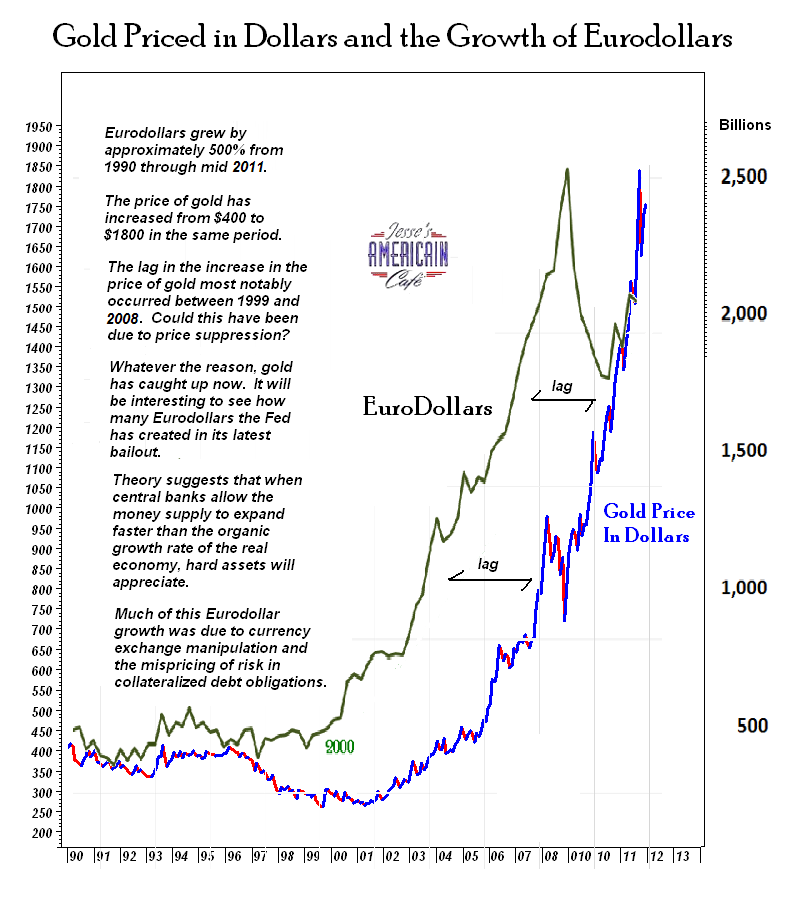
Gold, Eurodollars, and the Black Swan That Will Devour the US Futures and Derivatives Markets


The Eurodollars estimate in the chart below is based on the BIS Banking Statistics from Commercial Banks and may not include official reserves held by Central Banks. 

As you know the Federal Reserve stopped reporting Eurodollars some years ago, with the consequence that it also stopped reporting M3 money supply.

I like to think of Eurodollars and banking system derivatives as the Fed's off-balance-sheet method of monetization and policy implementation, with plausible deniability.  

Swap lines are provided to other Central Banks, and they in turn make the loans to their member banks, and from there to their customers.  So this eurodollar creation is made outside the real domestic economy, and therefore has no immediate effect on domestic money supply and prices at the end of the money chain.  But the effect is there, and the smart money closer to the financial system sees it coming. 

I do not know if the Fed's swap line activity actually shows up immediately in their Balance Sheet and therefore the Adjusted Monetary Base.  But I think it is fairly obvious that if swaps are used to create dollars by foreign central banks, who in turn loan those dollas to their own members, the impact of that broader dollar creation will only be felt with a significant lag in the domestic US economy.   But it will be felt at some point.

When the Fed was tracking Eurodollars, I believe that they were not counting certain assets, or liabilities from the banks point of view, as money.  What exactly those assets might be and how liquid they are is a open question.  How much of them were held in Agency debt, and how much in Treasury debt?  Is a liquid obligation held by a foreign source part of the broad money supply, or not?  Since it can be quickly converted into dollars, and then into another currency, leaves little question that it is potential money at least.

At least part of the problem being faced by Europe in this crisis is the sharp point of the deleveraging of US assets underlying dollar denominated debt.   And if foreign confidence in the US dollar debt breaks, the losses would be daunting for the holders of that debt, so there will first be a rush into Treasuries and away from Agency debt and CDOs.  This will be like the ocean retracting, causing people to flock to the shore in wonder at the cheapness of the debt.  But eventually the returning tsunami of US dollars may very well swamp the Fed's Balance Sheet and the domestic US economy and the savings of many.

The hyper-inflation of financial paper is happening quietly and  off the books. The growth rate in derivatives held by the Banks is mind boggling.  And how this will manifest in the real world economy is not fully known.  A good sized chunks of the financial system may simply vaporize.  And I suspect that the policy makers will heavily allocate the damage to the least powerful members of the private sector. 

Ownership of the real economy will continue to be concentrated in fewer and fewer hands. Stagflation is the most likely outcome because of this lack of reform and the rise of a self-serving oligarchy.

As for the US Dollar, as I have said on numerous occasions, inflation and deflation are at the end of the day a policy decision.  Period.  Those who see a hyper-deflation or a hyper-inflation as inevitable elude my knowledge of the facts as they are.   The Fed owns a printing press, and it uses it selectively. 

Speaking of lags, I think the unusually long lag between the growth in Eurodollars and the price of Gold can be attributed to the gold sales programs by the Western Central Banks. Once those programs were suspended, and the Banks turned again into net buyers, the gold price rose dramatically.

The most recent Eurodollar operation of the Central Banks in relieving the Dollar short squeeze in euro is not yet in the totals.

It should also be noted that there are other correlations one can use in determining the gold price, most notable 'real interest rates.' However, there are linkages amongst all the variables, given a non-organic increase in the money supply and artificially low interest rates for example being among them.

So, when will the price of gold stop rising? Most likely when the Central Banks stop printing money, and return to transparently set market based interest rates and a productively reformed financial system.

'Not on the horizon' does come to mind.

I do not know if it will happen in gold or silver first, but the price management schemes that have been in place for a few decades now in the metals markets are reaching a tipping point.

To paraphrase what Kyle Bass recently said, 'There is $80 billion in open interest in gold futures and options, and there is $2.4 billion in deliverable gold at the exchange. The exchange is a fractional reserve system, and they plan for a one percent redemption. In the event of a greater demand for redemption, they assume that price will take care of it. The decision for a fiduciary is simple; take your billion in gold out now.'

And the situation in the silver market is even worse. It is a disaster waiting to happen.

At some point a 'black swan' event, or perhaps something the classical world would have simply called 'nemesis,' is going to knock the US futures market off its foundations.   The government and exchanges will seek to force a solution on market participants through the de facto seizure of positions and accounts, with a settlement dictated by the Banks.   MF Global looks like a dry run for that much larger default.

They will say once again that 'no one could see it coming.'  And the truth will fall into the same credibility trap that has swallowed all the other financial scandals, cover ups and bailouts since the S&L crisis.

"Why is surprise the permanent condition of the U.S. political and economic elite? In 2007-8, when the global financial system imploded, the cry that no one could have seen this coming was heard everywhere, despite the existence of numerous analyses showing that a crisis was unavoidable.

It is no surprise that one hears precisely the same response today regarding the current turmoil in the Middle East. The critical issue in both cases is the artificial suppression of volatility -- the ups and downs of life -- in the name of stability. It is both misguided and dangerous to push unobserved risks further into the statistical tails of the probability distribution of outcomes and allow these high-impact, low-probability "tail risks" to disappear from policymakers' fields of observation...

Complex systems that have artificially suppressed volatility tend to become extremely fragile, while at the same time exhibiting no visible risks. In fact, they tend to be too calm and exhibit minimal variability as silent risks accumulate beneath the surface.

Although the stated intention of political leaders and economic policymakers is to stabilize the system by inhibiting fluctuations, the result tends to be the opposite. These artificially constrained
systems become prone to “Black Swans” — that is, they become extremely vulnerable to large-scale events that lie far from the statistical norm and were largely unpredictable to a given set of observers.

Such environments eventually experience massive blowups, catching everyone off-guard and undoing years of stability or, in some cases, ending up far worse than they were in their initial volatile state. Indeed, the longer it takes for the blowup to occur, the worse the resulting harm in both economic and political systems."

Nassim Taleb, The Black Swan of Cairo, Foreign Affairs
It is not yet clear when, or exactly how, but it seems inevitable that this scheme of the Anglo-American banking cartel will founder on the hard rocks of gold, silver, and the will of the people to be free, if they have but the mind to use it.


02 December 2011

Gold Daily and Silver Weekly Charts


Gold and silver popped with stocks today, but gave up most of their gains into the close.

I think this is a period when they pause, and will tend to follow stocks at least for the short term as the markets move up and down with rumours and headlines.

The fundamental trend is still very much intact. And the recent Fed activity in providing more dollars to Europe will at some point trigger a rally in gold, and silver, as priced in US Dollars. I have not recently calculated the lag in this. It does vary with the markets and seasons, the meddling of the banks in the precious metals markets being what it is.

I am informed that Greg Weldon sees gold's breakout level around 1804.  You may read about that here.  It makes some sense since that is roughly the high from the last big gold rally prior to the option expiration smackdown.  Personally I see a breakout test around 1830 depending on what point we hit that angular trend channel top.  But these are just quibbles.  The big prize will be when gold takes out 2000, and then sticks a close above 2100. At that point the public might wake up and smell the burning paper.  But perhaps not even then.  It depends on what takes us there.  It may turn out to be a 'blip' in a greater move higher.

I remain convinced that at some point the gold and silver bulls are going to 'break the bank,' and they will be using brooms and dust pans to carry out the punters on the wrong side of that trade.  But perhaps the exchanges will just close down and settle cash at a dictated price, after confiscating the accounts and the positions of small specs.  Oops, already did that last one.

If you have not yet read it, you may wish to at least glance at today's report on Eurodollars posted earlier.  It helps to demonstrate the expansion of dollars in the world, based largely on artificially mispriced derivatives and financial instruments, setting up the dynamic of the financial crisis and this phase of the currency wars.


SP 500 and NDX Futures Daily Charts - Second Flop, One More Try At Most


This is the second day in a row that the SP 500 has 'popped and flopped' in a failure to advance its admirable weekly gain on the back of the Central Bank initiative to make more dollars available globally.

The big drop in the headline unemployment percentage was totally misleading.  And we took some shorts near the apex of that pump and dump,  flipping them into the close. 

So what next?

The SP needs to close the year around 1250-5 in order to end the year 'flat.' There is some political-economic desire to make this happen, so this will not be counted as a 'losing year' for US stocks.

The headwinds are a tremendous headline risk out of Europe, and a somewhat hidden Bank instability of the insolvency and the liquidity kind. The game plan to date has been to patch up the liquidity problems in the short term, and to hope that inflation, time, Fed monetization, and phony accounting help to avoid the insolvency problems.

The SP 500 managed to fight its way back into the small symmetrical triangle, but remains in a larger one from 1160 to 1255. They may end up at the top end of the range into year end, but the risk is that it breaks down again, and falls through 1160, which sets up a decline of about 130 SP points from there to retest the lows of the year and then some to 1030ish.


Euro Dollars - The Great Dollar Overhang and Missing M3 Component - Gold and Silver


These figures are from the Preliminary BIS Reports of November 2011 which reflect reporting bank positions as of the Jun 2011 quarter. Obviously therefore they do not yet reflect the recent Fed expansion of the swap lines for dollars.  The first chart represents the total dollars held by banks as 'foreign currency.'

As you will recall, a 'euro dollar' is any US dollar being held overseas, in currency or in electronic digits, whether in Europe or Asia.  I should add that a certain amount of physical dollars in private hands overseas are held outside the official banking system, particularly in the illicit substances and materials sector.

The 'Euro Dollar Gap' Chart which is the second chart reflects the difference between the reporting banks Liabilities and Assets in foreign held dollars. This gap can cause a Eurodollar short squeeze such as we had seen in 2008, and to a lesser extent in 2010. We are also in a eurodollar short squeeze now, as exemplified by the recent Central Bank effort to make more dollar swaps available to Europe. The BIS figures have obviously not yet caught up with this yet, but they will in time.

As discussed previously, one of the reasons that European Banks require Dollars is because customers were demanding the return of their dollar deposited financial instruments while the Banks dollar assets had markedly decreased in value because of bad investments in Dollar denominated Collateralized Debt Obligations.

In the third chart I compare the Fed's Eurodollar figures in the series that was discontinued in the beginning of 2006. Although the lines are relatively similar, it should be noted that the magnitudes of the numbers just do not match, with the BIS reporting significantly higher numbers even though the relative changes in the lines are similar. I do not know, for example, if the Fed was including Central Bank Reserves or not.

But I think one takeaway is that the amount of Eurodollars are significantly higher now than they have ever been as a result of the growth of the dollar bubble in US financialization of debt, much of which had been purchased by European banks.

The gap between Dollar Assets and Liabilities creates short term demand spikes, as we have just recently seen in the actions by the Fed and a few other Central Banks to make more US dollars available in swaps.

There is another set of BIS reports I am examining that render higher figures with current Eurodollars in the neighborhood of 3.2 Trillion.  I am trying to figure out what these amounts include that the other measurements do not.   In the interim I am using the lower of the two. 

The bigger picture is that this enormous growth in Eurodollars is a result of the US financialization, more colloquially known as 'The Credit Bubble' and the US ownership of what is still the world's reserve currency.

I have some queries into BIS to understand if these figures include official reserves held by Central Banks. I do not think they do.

However, IF the dollar is supplanted by something else, or some combinations of things, as the world's reserve currency, there are obviously going to be an excess of US dollars looking for some place to go from their current havens overseas. And it is mostly likely that they will come home to roost.

I am sure that the Fed has a plan to sterilize this expansion in dollars available for domestic use. Whether that plan can work is another matter altogether. I do not believe that there is any precedent for it.

But one thing that is clear to me is that since 2002 'we aren't in Kansas anymore, Toto,' at least with respect to the growth of the US dollar overseas. And I think there is a linkage between this and the rather impressive bull market in gold and silver.


01 December 2011

Gold Daily and Silver Weekly Charts - The Pause That Refreshes?


I changed the weighting of the long gold - short stocks pair back to 'neutral' to slightly short.

There might be some tax loss selling in early December and headline risk remains highly elevated.

Still it is wise not to underestimate the Fed's willingness to debase the currency for their friends.

As a reminder, the Non-Farm Payrolls Report is tomorrow.

I still think the Europeans should nationalize their troubled banks and let the US take care of its own. But that seems rather unlikely.


SP 500 and NDX Futures Daily Charts - Wall Street Talking Up a 'Santa Claus Rally'


The SP 500 has managed to work its way back into the symmetrical triangle from which it had broken down, with a lot of help from Bernanke and the western Central Banks.

Let's see if they can hold it here, and even break out. Headline risk remains elevated, and nothing has really changed except for a short term blast of dollar liquidity.

As a reminder, tomorrow is the Non-Farm Payrolls Report.


Will there be a 'Santa Claus Rally' on the US stock market this year,
or will things just keep getting worse?


The Y-T-D Performance of Various Assets: Gold, Silver, US Stocks, Bonds, and AAPL


Doing Nothing Is Still Making a Choice
And the winner is gold, at least for now with one month left in the year.

I included AAPL because it is the poster child for the stock rally and is often touted by shills for Wall Street and the hedge funds as a superior investment amongst stocks on chat boards and 'news programs.'

It should be noted that recently the US 30 Year Bond has greatly outperformed the US 10 Year Note because of the Fed's 'Operation Twist.' It has still underperformed gold in the short term at about 19% unless you wish to compare some derivative of the bond like zero coupons or a fund rather than the bond plus accrued interest. The discrepancy there between the bond and the derivatives is most likely an indication of speculation based on the Fed's actions.

Remember the charts below do not include any interest payments received on the notes so the overall return is a little higher.

Also, Silver is notoriously volatile, and it is perfectly capable of 'catching up' with gold rather quickly. And I do think the silver market is being massively manipulated for some reason by one or two of the money center banks. When that manipulation breaks down, the resultant rally could be memorable.  But as you know I do think that silver is more 'speculative' than the safer haven of gold.

But for now the comparisons are what they are. If you have held gold through thick and thin you have done well.

And if you think of all the money you could have made if you had traded in and out of it cynically, be warned that those gains are illusory.

Thanks to notorious lapses and the ideology of deregulation this is one of the most corrupt and treacherous markets I can remember in thirty years, or even read about except perhaps for a few of the pre-crash bubble markets.

I think Ian McAvity has summarized this quite well:

The big change has been the utter corruption of Wall Street and that nearly 80% of the trading on the New York Stock Exchange now is being done by high-velocity computers. When an investor puts in an order, it's basically one computer versus another computer operating in nanoseconds. That's why all of a sudden the volume is up or down 10 to 1 and you get a couple of hundred points added on or taken off the Dow in minutes. To me that's a corruption of the process. "Ethics" and "Wall Street" are words you never use in the same sentence.

The trading mechanism is broken down. Leveraged exchange-traded funds (ETFs) are designed to consume the client's capital in leveraging and rebalancing premiums. The high velocity traders literally get the opportunity to "front-run" public orders as the order flow to "the market" is available to them for a fee. It's outrageous in the sense that they've legalized front running for those who pay up for the high-speed data feed. And then there's the initial public offering (IPO) business. Anytime the public can get shares in an IPO, they don't want it. If they can get some, it's only because it's not going to be that good a deal...

It's the culture of greed coming out of the banking system. The Street always wanted to make money. That's never gone away. But there was a time when good clients were actually respected by a firm. A firm wanted to do well for a good client because it wanted to keep the family assets in the firm. These days a client is considered to be a mark. The system is designed to convert the client's capital into their fees and income as quickly as possible. The public is being chased out. There have been persistent outflows from domestic equity mutual funds since 2007. A lot of people justifiably don't trust it...

As you know my personal preference is to hold gold and silver bullion in a fully owned and secure situation, and to keep the rest of your wealth in specific income producing investments which you closely control and manage preferably in an area in which you are experienced and knowledgable.

And as you must, find the safest banks available and store your necessary cash holdings there. Canadian and Swiss banks come to mind. US Treasury Direct in short term maturities is acceptable for those who must hold Dollars, but keep in mind that at some point those funds too may be subjected to the same seignorage by Wall Street that all other paper assets and savings are now enduring.

The mispricing of risk always involves the inevitable loss for some and gains for others. And as a rule of thumb, the further your money is away from the Wall Street and global money center banks, the better off it may be. As desperation sets in, the cheating and theft will become increasingly brazen and blatant, until the system breaks down and then is hopefully reformed.

Something like MF Global was unthinkable just a few years ago, for those who have forgotten the lessons of history. And it will get worse before it gets better.    Do what you can to support change and reform, even if it is to passively support those who speak out, or to stop encouraging the worst by continually fall for their tricks and  mindlessly repeating their false arguments and propaganda.

But at the very least protect yourself.  A few things may be relatively safer, but nothing will be easy.  It is going to be a rough year ahead.

And for those who have a mind to it, you may wish to consider how foolish it is to endlessly worry about how to protect your money, while giving so little care about not losing the only thing  that you really possess and may take from this world, which is yourself, your very being.  "For what does it profit a man...."


30 November 2011

The Other One Percent: Corporate Psychopaths and the Global Financial Crisis


Anyone who has ever worked in a large corporation has seen the empty suits that seem to inexplicably rise to positions of power.  They talk a great game, possessing extraordinary verbal acuity, and often with an amazing ability to rise quickly without significant accomplishments to positions of great personal power, and often using it ruthlessly once it is achieved.

Their ruthless obsession with power and its visible rewards rises above the general level of narcissism and sycophancy that often plagues large organizations, especially those with an established franchise where performance is not as much of an issue as collecting their rents.

And anyone who has been on the inside of the national political process knows this is certainly nothing exclusive to the corporate world.

Here is a paper recently published in the Journal of Business Ethics that hypothesizes along these lines. It is only a preliminary paper, lacking in full scholarship and a cycle of peer review.

But it raises a very important subject. Organizational theories such as the efficient markets hypothesis that assume rational behaviour on the part of market participants tends to fall apart in the presence of the irrational and selfish short term focus of a significant minority of people who seek power, much less the top one percent of the psychologically ruthless.

Indeed, not only was previously unheard of behaviour allowed, it became quite fashionable and desired in certain sections of American management where ruthless pursuit of profits at any cost was highly prized and rewarded.  And if caught, well, only the little people must pay for their transgressions.  The glass ceiling becomes a floor above which the ordinary rules do not apply.

If you wish to determine the character of a generation or a people, look to their heroes, leaders, and role models.
This is nothing new, but a lesson from history that has been unlearned. The entire system of checks and balances, of rule of law, of transparency in government, of accountability and personal honor, is based on the premise that one cannot always count on people to be naturally good and self-effacing. And further, that at times it seems that a relatively small group of corrupt people can rise to power, and harm the very fabric of a society.

‘When bad men combine, the good must associate; else they will fall one by one, an unpitied sacrifice in a contemptible struggle.’

Edmund Burke


'And remember, where you have a concentration of power in a few hands, all too frequently men with the mentality of gangsters get control. History has proven that.'

Lord Acton

These things tend to go in cycles.  It will be interesting to see how this line of analysis progresses. I am sure we all have a few candidates we would like to submit for testing.   No one is perfect or even perfectly average.  But systems that assume as much are more dangerous than standing armies, since like finds like, and dishonesty and fraud can become epidemic in an organization and a corporate culture, finally undermining the very law and principle of stewardship itself. 

'Our government...teaches the whole people by its example. If the government becomes the lawbreaker, it breeds contempt for law; it invites every man to become a law unto himself; it invites anarchy.'

Louis D. Brandeis

MF Global, and the reaction to it thus far, is one of the better examples of shocking behaviour that lately seems to be tolerated, ignored,  and all too often met with weak excuses and lame promises to do better next time, while continuing on as before.

"These corporate collapses have gathered pace in recent years, especially in the western world, and have culminated in the Global Financial Crisis that we are now in.

In watching these events unfold it often appears that the senior directors involved walk away with a clean conscience and huge amounts of money. Further, they seem to be unaffected by the corporate collapses they have created. They present themselves as glibly unbothered by the chaos around them, unconcerned about those who have lost their jobs, savings, and investments, and as lacking any regrets about what they have done.

They cheerfully lie about their involvement in events are very persuasive in blaming others for what has happened and have no doubts about their own continued worth and value. They are happy to walk away from the economic disaster that they have managed to bring about, with huge payoffs and with new roles advising governments how to prevent such economic disasters.

Many of these people display several of the characteristics of psychopaths and some of them are undoubtedly true psychopaths. Psychopaths are the 1% of people who have no conscience or empathy and who do not care for anyone other than themselves.

Some psychopaths are violent and end up in jail, others forge careers in corporations. The latter group who forge successful corporate careers is called Corporate Psychopaths...

Psychologists have argued that Corporate Psychopaths within organizations may be singled out for rapid promotion because of their polish, charm, and cool decisiveness. Expert commentators on the rise of Corporate Psychopaths within modern corporations have also hypothesized that they are more likely to be found at the top of current organisations than at the bottom.

Further, that if this is the case, then this phenomenon will have dire consequences for the organisations concerned and for the societies in which those organisations are based. Since this prediction of dire consequences was made the Global Financial Crisis has come about.

Research by Babiak and Hare in the USA, Board and Fritzon in the UK and in Australia has shown that psychopaths are indeed to be found at greater levels of incidence at senior levels of organisations than they are at junior levels (Boddy et al., 2010a). There is also some evidence that they may tend to join some types of organisations rather than others and that, for example, large financial organisations may be attractive to them because of the potential rewards on offer in these organizations."

Clive R. Boddy, The Corporate Psychopaths Theory of the Global Financial Crisis, Journal of Business Ethics, 2011


Gold Daily and Silver Weekly Charts - Crony Capitalism and More On Modern Monetary Theory


Bernanke and the western Central Banks stepped in to provide a jolt to the paper markets, and of course, the commodity markets including precious metals.

Intraday commentary on this here.


Steve Schwarzman, Chairman (and co-founder with Peter G. Peterson) of Blackstone and a Prince among crony capitalists, was on Bloomberg television today. Blackrock is the world's largest private equity fund.

Last year Steve referred to any attempt to raise taxes on his income via changes to the 15% rate on carried interest as 'a war,' the equivalent of 'Hitler invading Poland in 1939.' This was said in a private meeting, and was a big departure from his smoothly polished public persona.

His solution to the financial deficit is to have poor and lower income people pay more federal income taxes, in addition to state, sales, gasoline, and payroll taxes, to 'broaden the tax base' as it were, so they can have 'more skin in the game.' His own taxes should obviously remain unchanged.

I was intrigued by this particular general principle that Steve shared: "Whenever credit is more constrained, it is extended to someone. The key is to be that someone."  No matter what it takes.  And at advantageous rates I presume, in order to buy distressed assets like sovereign assets on the cheap.

Steve strongly endorsed Mitt Romney for President as a personal choice saying, "I've made money with that man." 16x their money on the first, and 24 x on the second to be exact. And he hopes to make and keep even more with Mitt as President.

Speaking of money, here is a short primer on Modern Monetary Theory.


And the Regulatory Process in Efficient Markets


SP 500 and NDX Futures Daily Charts


What European crisis? What Bank downgrades? lol

As a reminder, today was the end of the month, and the funds had a lot of catching up to do after one of the worst Thanksgiving week markets on record.


Currency Wars: Fed Acts To "Increase the Availability of Dollars Outside the United States"


Several people have asked what I think about this.

I wrote about this just yesterday.   I could not ask for a better straight man than Ben Bernanke.

"I think the major monetization is already occurring in the Eurodollar markets, and an ongoing stealth bailout of European debt, in order to save the big money center banks at home and broaden the reach of the Dollar.

And this is why the Fed stopped reporting on Eurodollars some years ago, as a component of M3. It was to pave the way for the monetary equivalent of a financial neo-con, to addict European governance to the US dollar and pave the way for a stronger position for the dollar as a one world currency."

Currency Wars: The Anglo-American Century and Why the Financial Engineers Hate Gold and Silver

Here is a primer on the Fed Swaps. Keep in mind that it is written by the Fed.

I had also suggested after the bell that there would be an effort to blow off the downgrade of the big money center banks. I suspected there would be a more singular effort to pump up the SP futures from the Fed's house banks, but it appears the Central Banks, led by the Fed, decided to hit the markets with a major sugar rush of cheap dollars. That is US dollars.

"I will be surprised if they do not try and rally stocks in the face of this to put the brave face on and whistle past the graveyard once again. This is what traders like to do when they have been caught offsides by the news. But they may not be able to sustain it without official help from the strong trading desks of the financial sector."

The Chinese cut reserve requirement ratio on their banks by .5 percentage points. This will help them release more of their huge hoard of US dollars back into the global financial system.

This action, led by the US Fed, has had a marked effect on commodity prices in dollars. So the beneficiaries, or at least those protecting their wealth, are those holding precious metals and positions in dollar sensitive commodities.

Although the Fed will say that there is no potential loss in this to US taxpayers, in fact there is ALWAYS a loss to be realized at some point in the deliberate mispricing of risk.  This loss will be taken by all holders of US dollars.

This is not QE3 and does little to help the US economy per se.  This is just a big serving of a quick energy drink to ease the short term liquidity problem in Eurodollars. It is also timed to dull the news impact of the bank downgrades.

When the sugar rush wears off, and it will because this is does little to help the average person in the real economy, we will see how the markets react to the ever growing piles of paper dollars covering the landscape of a mismanaged and ruined economy.

But it was extraordinarily kind of the Fed to announce this just in time for the banks and the hedge funds to repair some of the damage from the stock market decline before they close their trading books on November.

The Eurozone problems have not been solved by this. The US domestic economy has not been improved by this, except to weaken the dollar and increase commodity prices.

It has only bought the Western banks some time, and further addicted the world to US dollars. This is government of the one percent, by the one percent, and for the one percent.

NY Times
Central Banks Take Joint Action to Ease Debt Crisis
By Binyamin Appelbaum
November 30, 2011

WASHINGTON — The Federal Reserve moved Wednesday with other major central banks to buttress financial markets by increasing the availability of dollars outside the United States, reflecting growing concern about the fallout of the European debt crisis.

The central banks announced that they would slash by roughly half the cost of an existing program under which banks in foreign countries can borrow dollars from their own central banks, which in turn get those dollars from the Fed. The banks also said that loans will be available until February 2013, extending a previous endpoint of August 2012.

"The purpose of these actions is to ease strains in financial markets and thereby mitigate the effects of such strains on the supply of credit to households and businesses and so help foster economic activity," the banks said in a statement. The participants in addition to the Fed are the Bank of England, the European Central Bank, the Bank of Japan, the Bank of Canada and the Swiss National Bank.

The move makes clear that regulators increasingly are concerned about the strain that the European debt crisis is placing on financial companies, which are facing increasing difficulty in borrowing through normal channels the money that they need to fund their operations and obligations.

The European Central Bank borrowed $552 million through the existing facility during the week ending Nov. 23 to meet the liquidity needs of European banks. Data for the past week is not yet available.

Under the new terms of the program, the existing interest rate premium of 0.1 percentage points on those loans will be reduced by half, to 0.05 percentage points, effective Dec. 5.

The other central banks said they had also agreed to make similar loans of their own currencies as necessary, but they noted that the only extraordinary demand at present was for dollars.

Stocks surged after the action was announced, with European markets up more than 4 percent in afternoon trading, while United States stock futures were up sharply.

“U.S. financial institutions currently do not face difficulty obtaining liquidity in short-term funding markets. However, were conditions to deteriorate, the Federal Reserve has a range of tools available to provide an effective liquidity backstop for such institutions and is prepared to use these tools as needed to support financial stability and to promote the extension of credit to U.S. households and businesses,” the Fed said in its statement.


29 November 2011

$500 Million in Missing MF Global Customer Money Found in London and at JPM


As predicted, the London operations of MF Global, the group that received bonuses the day before the bankruptcy filing, was apparently involved with the 'misplacement' of customer account money. And some of that customer money was in the hands of JP Morgan.

Bloomberg
KPMG Recovered $500 Million of MF Global U.K. Client Assets
By Kit Chellel
Nov 29, 2011 2:12 PM ET

MF Global (MF)’s U.K. administrators have recovered about half of the estimated $1 billion of customer funds frozen when the brokerage collapsed on Oct. 31.

The final recovery amount will depend on how much can be taken back from the third-party financial firms which held money for MF Global’s U.K. clients, said Richard Heis, a partner at KPMG LLP.

KPMG, which was appointed to supervise the administration of MF Global UK Ltd., said Nov. 27 that it hoped to return some money to the broker’s clients by March.

MF Global Holdings Ltd., the New York-based holding company, sought protection on Oct. 31 in the fifth-largest financial company bankruptcy by assets. There may be more than $1.2 billion missing from MF Global Inc.’s customer accounts in the U.S., according to the court-appointed trustee in the U.S., James Giddens.

About $200 million of the missing customer funds may have been found at JPMorgan Chase in the U.K., the New York Times reported today.

While KPMG wouldn’t confirm the accuracy of the report, it said it didn’t believe the $200 million reportedly found would affect recoveries for U.K. clients.

“Based on the information available, the joint special administrators are not aware of any threat to the segregated money held on behalf of MF Global U.K. clients arising from the matters set out in the New York Times report,” the firm said in an e-mailed statement today.

S&P Cuts Credit Ratings On 37 Global Banks


If Europe wobbles any harder, the global money center portion of the financial sector may slide into the sea. Or more likely onto the backs of the unsuspecting public.

I will be surprised if they do not try and rally stocks in the face of this to put the brave face on and whistle past the graveyard once again. This is what traders like to do when they have been caught offsides by the news. But they may not be able to sustain it without official help from the strong trading desks of the financial sector.

Forbes
S&P Goes On Downgrade Spree, Hits Most U.S. Banks
By Michael Aneiro
November 29, 2011, 5:04 PM ET

Standard & Poor’s on Tuesday afternoon grabbed its downgrade stick and went on a rampage, whacking just about every major financial institution in sight. Most big U.S. banks got hit, as did many European institutions. The downgrades were part of the rating agency’s application of its revised bank criteria to 37 of the largest rated banks. Here’s a partial list of the carnage:

Bank of America Corp. (BAC) to A- from A
Bank of New York Mellon Corp. (BK) to A+ from AA-
Barclays PLC (BCS) to A from A+
Wells Fargo Bank N.A. (WFC) to AA- from AA
Citibank N.A. (C) to A from A+
Goldman Sachs & Co. (GS) to A from A+
JPMorgan Chase & Co. (JPM) to A from A+
Morgan Stanley (MS) to A- from A


Bloomberg
BofA, Goldman, Citi Credit Ratings Reduced by S&P
By Dakin Campbell and Hugh Son
Nov 29, 2011 5:14 PM ET

Nov. 29 (Bloomberg) --Bank of America Corp. (BAC), Goldman Sachs Group Inc. (GS) and Citigroup Inc. (C) had long-term credit grades reduced to A- from A by Standard & Poor’s after the ratings firm revised criteria for dozens of the largest global lenders.

Standard & Poor’s made the same cut to Morgan Stanley (MS) and Bank of America’s Merrill Lynch unit. JPMorgan Chase & Co. (JPM) was reduced one level to A from A+. S&P upgraded Bank of China Ltd. (3988) and China Construction Bank Corp. (939) to A from A- and maintained the A rating on Industrial and Commercial Bank of China Ltd., giving all three lenders higher grades than most big U.S. banks.

The moves may increase pressure on firms bracing for Europe’s mounting sovereign debt crisis and navigating economic weakness. Bank of America, which has plunged 62 percent this year in New York trading, said in a regulatory filing this month that it may have to post billions of dollars of additional collateral and termination payments on its trades if it were to be downgraded one level by rating companies.

“It’s evident that stress from the European banking system is taking its worldwide toll,” Guy LeBas, chief fixed-income strategist at Janney Montgomery Scott LLC in Philadelphia, said in an e-mail.

S&P, a unit of New York-based McGraw-Hill Cos. (MHP), has been changing the way it looks at debt after its faulty grades contributed to the credit-market seizure that brought down Lehman Brothers Holdings Inc. and Bear Stearns Cos. It started to review the methodology in December 2008, months after the collapse of those two firms.
`Adverse Impact'

Downgrades “could likely have a material adverse effect on our liquidity, potential loss of access to credit markets, the related cost of funds, our businesses and on certain trading revenues, particularly in those businesses where counterparty creditworthiness is critical,” Charlotte, North Carolina-based Bank of America said in this month’s filing.

The company, which noted the risk of downgrades from S&P and Fitch Ratings in its third-quarter filing, previously said it has prepared by lining up funding for a year.

The following table shows firms that were downgraded by S&P, followed by a list of banks that were upgraded.

Downgraded:
Banco Bilbao Vizcaya Argentaria S.A.
Bank of America Corp.
Bank of New York Mellon Corp.
Barclays Plc
Citigroup Inc.
Rabobank Nederland
Goldman Sachs Group Inc.
HSBC Holdings Plc
JPMorgan Chase & Co.
Lloyds Banking Group Plc
Morgan Stanley
Royal Bank of Scotland Plc
UBS AG
Wells Fargo & Co.

Upgraded:
Bank of China Ltd.
China Construction Bank Corp.

Gold Daily and Silver Weekly Charts - S&P Downgrades the Credit of Most Big US Banks After the Bell


Intraday commentary on gold, silver and the world currency situation here.

American Airlines declared bankruptcy today.

After the bell S&P downgraded JP Morgan, UBS, Wells Fargo, Citi, Goldman, Bank of America et al.

"Bank of America Corp. (BAC), Goldman Sachs Group Inc. and Citigroup Inc. (C) had long-term credit grades downgraded to A- from A by Standard & Poor’s after the ratings firm revised its criteria for the banking industry.

Standard & Poor’s also made the same cut to Bank of America’s Merrill Lynch unit. S&P listed its ratings for 37 of the largest financial institutions in a statement today.

The move may increase pressure on Bank of America, which has plunged 62 percent this year in New York trading. The second-biggest U.S. lender by assets said in a filing this month that a ratings cut could trigger billions of dollars in collateral payments and crimp access to credit markets.

Downgrades may be costly for banks. Bank of America said in a regulatory filing this month that it may have to post $5.1 billion of additional collateral and termination payments on its trades were it to be downgraded one level by rating companies.

Ratings downgrades “could likely have a material adverse effect on our liquidity, potential loss of access to credit markets, the related cost of funds, our businesses and on certain trading revenues, particularly in those businesses where counterparty creditworthiness is critical,” Bank of America said in the filing.

The company, which noted the risk of downgrades from S&P and Fitch Ratings in its third-quarter filing, previously said it has prepared by lining up funding for a year."

Some of my friends and I noted in our discussions today that the Banks were lagging the SP 500 noticeably, especially on FAZ and some other plays on bank stock declines. Because of the divergences between the SP 500 and the Banks, as well as the weakness in the NDX 100 I shifted my positions to decidedly bearish into the close.  Long gold bullion, a little silver, and short stocks.

Bloomberg says the SEC will look into any unusual activity on the bank stocks today in light of these after hour downgrades. Yeah, uh huh, sure. And they will file the information with the silver manipulation report from the CFTC.

When it comes, the financial reckoning will be like a thief in the night. Or like MF Global if you prefer. There will be a bank holiday, and after a few days you will be informed by the bank on how much of your money you have left, and when you can expect to have access to it.


SP 500 and NDX Futures Daily Charts - Bank of America And Citi Credit Ratings Cut After the Bell


American Airlines declared bankruptcy today.

After the bell the credit ratings of Bank of America and Citigroup were cut from A to A- with a negative outlook.

Additional news includes other banks including Goldman, UBS and JP Morgan.

One of my friends remarked during the day that the banks index was lagging badly, but it was not fully reflected in the SP 500 futures. Perhaps now we see why.


Currency Wars: The Anglo-American Century and Why the Financial Engineers Hate Gold and Silver


"It is only with the heart that one can see rightly; what is essential is invisible to the eye."

Antoine de Saint Exupéry

'Nominal GDP targeting' is a way of raising the Fed's inflation target without admitting to it explicitly.

Nominal GDP means that one can meet their growth target simply by inflating the money supply to make up the difference between 'real growth' and 'headline growth.'  Some parties are raising NGDP as the next policy initiative from the Federal Reserve.

NGDP targeting is so obvious and clumsy that I doubt that the Fed will try and hide their enormous efforts at monetization of the debt under such a small fig leaf, as Jim Rickards suggests, except to direct attention away from their more serious efforts.   The growth in money supply would be apparent to many and the Internet would be used to spread the word.   No, a more clever and covert attempt at persuasion is required, and more in keeping with the Bernanke Fed's penchant for secrecy.

I think the major monetization is already occurring in the Eurodollar markets, and an ongoing stealth bailout of European debt, in order to save the big money center banks at home and broaden the reach of the Dollar.

And this is why the Fed stopped reporting on Eurodollars some years ago, as a component of M3. It was to pave the way for the monetary equivalent of a financial neo-con, to addict European governance to the US dollar and pave the way for a stronger position for the dollar as a one world currency.

Money is power, and the ability to control the distribution and value of money and wealth is power in its most refined and effective form. One only needs relatively small armies to retain the power to control the money in order to subordinate vast resources and peoples if you can control their definition of wealth and the distribution of money, and all that follows from it.  

If you are able to create money at will, and give it to your friends and allies with even relative discretion, you are able to confiscate, without visible effort, the labor and wealth of every person who holds that currency, wherever they are and however they seek to protect it. It is the end of sovereignty and the right to private ownership of all goods and property that are valued by that currency. And it is a power too great to be held inviolate by any small group of men with the ability to act in secret.

I believe that the original purpose of this effort to shape the world economy was well-intentioned, or at least was represented as such to many participants as the logical solution to the devastating wars that repeatedly bloodied the last century.  

Most of what is transpiring now has not been planned, but events make the moment, and moment gives rise to the man.  And history shows us that too much power in too few hands never fails to end in exploitation.  With the rise of a single world super-power, no matter how good it might have been at its heart, the tide of corruption rose with it.  This is why central planning invariably fails.

The dominant global currency regime 'could' come in the form of the SDR for global trade if the composition of the SDR continues to contain a significant dollar-pound component.  Yes, the IMF has the ability to 'print' SDRs, but the SDR is a currency for use between nations, and its value is linked to a basket of individual domestic currencies.   Hence, it cannot be printed limitlessly, but must be linked to the value something else, some external standard.

Here is a prior blog entry here that explains the struggle for the SDR that is now occurring.   Even the 'reformed' basis for the SDR is ludicrous, with its over-representation of the dollar and the pound.  And now proceeds the dismantling and pacification of the eurozone.  And the hysterical antagonism by the Western bankers against the inclusion of gold and silver in the SDR basket as proposed by the BRICs.

Here is a broader overview of what I call the Currency Wars.

A slightly different plan has been underway for Asia, whose economies have become addicted to export production for US dollar paper, which makes up a huge portion of their reserves and financial system.

At some point those Eurodollars may come home, in the event that Europe finds a way out of its dilemma that was caused in part by the US banks and hedge funds, and of course Europe's own political weakness and greed. And the Fed is confident they have a way to stem that tide of dollars 'back in the system.'

But they do not expect this to happen, because the ratings agencies and the funds have the power to submit any government to a relentless credit assault on their sovereign debt.

Have you ever bothered to wonder why there have been no real investigations and prosecutions of the bankers and the credit ratings agencies?  And why they have been permitted to continue to operate, largely unimpeded?  The credibility trap is one explanation, but it fails to include so many other seemingly random events. Some of the banks may have become instruments of state policy, too big and important to prosecute. They and the state are becoming one.

As I have suggested in the past, the model has been to bring the system to a crisis, and then to have the bankers' representatives make an 11th hour 'offer which they cannot refuse' to the people of the nation, as they did in the adoption of TARP in the US.  'Adopt our plan, or suffer the consequences.'  

And I believe that the Anglo-American banking cartel will make this same play again, but this time with Europe and the world.  Financial crises are an effective tool in the mass redistribution of wealth and power, and often done in secret, making their appearance only at the offering of terms.

In a remarkably effective ploy of misdirection and mass persuasion, the kleptocrats and oligarchs have focused the attention and the anger of the middle class on the 'welfare state,' the poor and the elderly and the weak, under the moralistic banner of austerity. Meanwhile they are scooping up the income and wealth of nations for the top one percent, who are ironically portrayed as champions of freedom.

The sticking points in the US financiers plan are the key commodities, precious metals like gold and silver, and of course food and oil. It is a pivotal point of control that will become much more prominent in the future.  China and Russia will play that card with some of their BRIC allies.  But in the short term the Anglo-Americans are solidifying their power in the oil rich Middle East, since like gold and silver, oil is a powerful piece in this global chess game. But I do not think they can just 'take it' for themselves. And so the Mideast will remain a very important piece on the board. Perhaps it will be carved up, and perhaps it will be fought over, in the valley of Megiddo.

To paraphrase von Clausewitz, 'Currency war is the continuation of politics by other means,' especially when global military war has been rendered economically unviable in the post-atomic age.

Those who believe that China and Russia will oppose this to the bitter end believe in the purity of those regimes, and their ability to resist the temptation to participate in a deal that gives them rule over their portion of the globe. Since for the most part they are already oligarchies, this does not seem likely. The apparent disagreement and contention now may be more of a discussion of terms and territories than principles.

It may devolve into a number of popular revolutions, or even the rise of a worldly power unlike anything seen before, a new Rome. Or something else might occur. What that is, obviously no one can say with certainty for now.

A daunting set of prospects one might say, as Woody Allen once noted in his Speech to Graduates:  "More than any other time in history, mankind faces a crossroads. One path leads to despair and utter hopelessness. The other, to total extinction. Let us pray we have the wisdom to choose correctly."  

We can take great comfort that we are not the first generation to face difficulties, and what appear to be fearsome odds.  So often when they appeared to be at the very height of their power, great empires have tumbled, and the spirit has endured and risen once again.  As Dostoevsky noted, "If they drive God from the earth, we shall shelter Him underground."

But for now, if you at least understand the objective of the game and the roles of the players, what is happening on the field can begin to make more sense. 

Even if we cannot yet see it, the greatest probability remains that the monied interests will fail in their overreach and pride, but many ordinary people will be harmed in the process.  And our goal is to do what we can to limit the damage inflicted upon ourselves and our families, and our neighbors, and associate with like-minded individuals, to try to restore some semblance of civility and justice for our grandchildren.

This currency war is happening now, and it is something new in the history of warfare, because I do not believe that a fiat currency regime has ever existed before to this extent on a global scale, with a mutually destructive threat like nuclear power dampening the impulse to wide scale military conflict.

But as in all war, some things never change.

"When the rich wage war, it is the poor who die."

Jean-Paul Sartre

At some point the dawn will come, but first the darkest hour. Our business is not to surrender to discouragement, and cooperate with evil,  but to carry on in our missions, whatever they may be, as God gives us light.

"When I despair, I remember that all through history the way of truth and love has always won. There have been tyrants and murderers and for a time they seem invincible, but in the end, they always fall — think of it, always."

Mohandas K. Gandhi

The ascendancy of evil in the world is a shameful episode in history; the triumph of dark powers in claiming our souls for all time, without end, is a tragedy.

In the meantime, here is an exposition of 'Nominal GDP targeting' so you can become familiar with it, in case it does make an appearance.


28 November 2011

Gold Daily and Silver Weekly Charts


After the bell, Fitch reiterated the US AAA credit rating but changed the outlook from stable to negative.

"The Maastricht treaty set a limit of 60% for Government debt as a Percentage of GDP. As of May, 2011 only 4 of the 17 countries in the Euro-zone are below this requirement. The worst violators of the debt limit requirements are probably obvious: Greece at 157.7%, Italy at 120.3%, Ireland at 112%, Portugal at 101.7%, and Belgium at 97%. (By the way, Belgium debt was downgraded on Friday following downgrades of Portugal and Hungary.)

But readers will probably be surprised by the next two countries which are currently above the Maastricht limit: France currently has 84.7% debt to GDP and Germany is close behind with 82.4%. Both of the two 'fiscal leaders' of Europe have a worse debt to GDP than Spain which is three places better than Germany at 68.1%!

The only countries which currently adhere to the Maastrict treaty limit for debt to GDP are Finland, Slovakia, Slovenia, and Luxembourg, certainly not what most investors would consider the leaders in Europe! The average Euro-zone debt limit as of last May is 87.7%, over 25 percentage points above the required limit. I have gone on a bit too long about this, but the slide really brings home the fact that the treaties of the EU don't need to be tightened, but instead the adherence to these treaties need to be strengthened. Leaders can talk about new requirements all they want, but what good is this talk if no-one is going to adhere to these new requirements anyway?"

Chris Gaffney, The Daily Pfennig, 28 Nov 2011

Gold and silver enjoyed a post-option expiration bounce back to trend.

Markets overall remain headline driven.

"Every nation ridicules other nations, and all are right."

Arthur Schopenhauer