14 April 2012

Saving Capitalism From the Capitalists: Are the Trading Desks Destroying the Futures Markets?


Dan Norcini is my friend, one of the more savvy people I know in the markets. He has made his living as an off-exchange trader for many years. The concerns he has about the viability of the markets is genuine, and of great importance.

People forget the reasons why some markets exist, what their function in support of the real economy is fundamentally all about.

The responsibility for this distortion of the markets, and their taxing effects on the real economy, are the responsibility of the Congress and the regulators. Unfortunately they have been bought by unenlightened, short term self-interest in a variety of ways. And the same people who bought them have sold the public a bill of goods, and appealed to the worst of their emotions to keep them from thinking.

And the public bears some responsibility in this for their long standing willingness to see themselves and their fellows duped, abused, and ill-used for the sake of some outlandishly misguided idealism or a craven selfishness.

There is nothing new or unique in this. As long as there have been markets there have been those who would tip the scales, cheat and defraud, buy the judges, and take what belongs to others, often hiding their misdeeds under sanctimonious camouflage like slogans about freedom and the flag.

The difference is that this time it is not our fathers and grandfathers and great grandfathers that stand the watch on the wall, but ourselves.  And our children and grandchildren will live with the results of our faithfulness or folly.

This deterioration in the quality of the markets is another nail in the coffin for the efficient markets hypothesis, and the power of deregulation to free the natural goodness of traders and bankers in its full flower.

Order in society is the result of hard work, sacrifice, integrity and a never ending devotion to the principles of justice. On the other hand, the natural outcome of unbridled greed and fear is crime, injustice, and anarchy.

Algorithms Gone Wild - AGAIN, and AGAIN, and AGAIN
By Dan Norcini
April 13, 2012

What more is left to say at this point other than the fact that the hedge fund computers and their damnable algorithms have destroyed the integrity of the US futures markets. The sheer size, extent, ferocity and volatility of the moves that these pestilential computers are creating have rendered these markets basically useless for what they originally came into being for, namely, risk management for commercial entities.

Price swings of this magnitude are blowing up hedged positions put on by commercials and other end users/merchants/processors, etc. While margins are reduced for legitimate hedgers, they still must meet any and all margin calls on any hedged position, whether that is a long position or a short position. Some will say that all they need to do is to buy or sell the corresponding physical commodity and while simultaneously lifting the hedge. That might work fine on paper but in the real world it is a fabrication.

A cattle feedlot, a grain elevator owner/operator, a cocoa processor, a cotton mill, etc, may or may not have the actual product ready to sell as it is still maturing or growing in the field or may not be ready yet to actually buy the product but they might have hedges in place while they are waiting. So much for their hedges in this sort of idiotically insane trading environment. Their hedges are getting blasted to kingdom come but they must maintain the thing if it moves against them meaning that they need cash to meet any and all margin calls.

At some point, the cost of doing so, with hedge fund running prices all over the damn planet on a daily basis, is no longer feasible.

I am predicting here and now that unless something is done to corral these hedge funds, the futures market is going to become useless as a risk management tool for non-speculative entities...

Read the rest here.

13 April 2012

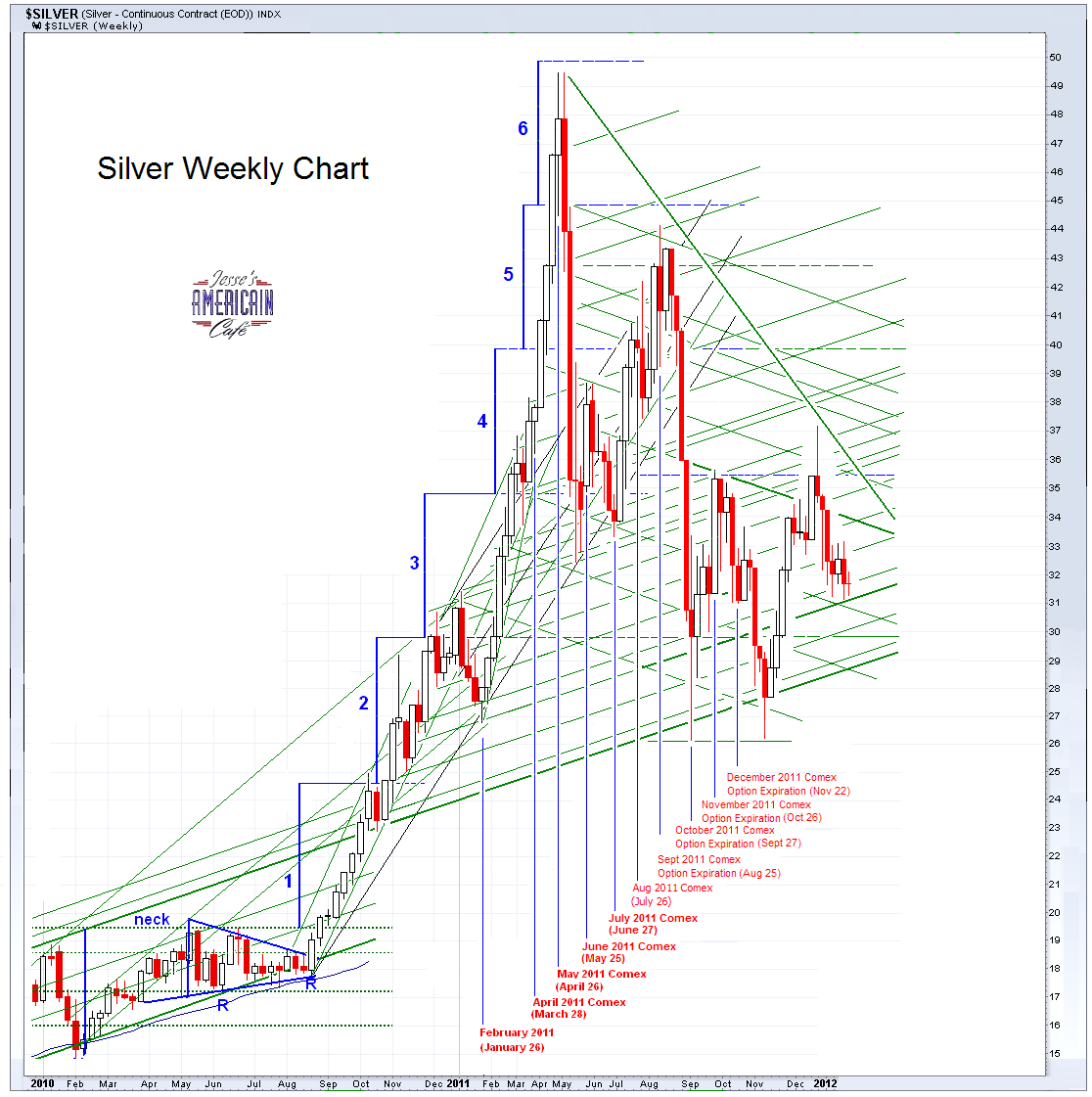
Gold Daily and Silver Weekly Charts


Gold and silver both gave up gains today as it was 'risk off' in the markets and at least for today that meant the metals went lower.

The chart formations on the daily price charts are obvious. What is not so clear is what the market is going to do with them, since we are in the sort of situation where we must wait for the market to signal which way it is going to break out of some big symmetrical triangles.

Have a pleasant weekend.


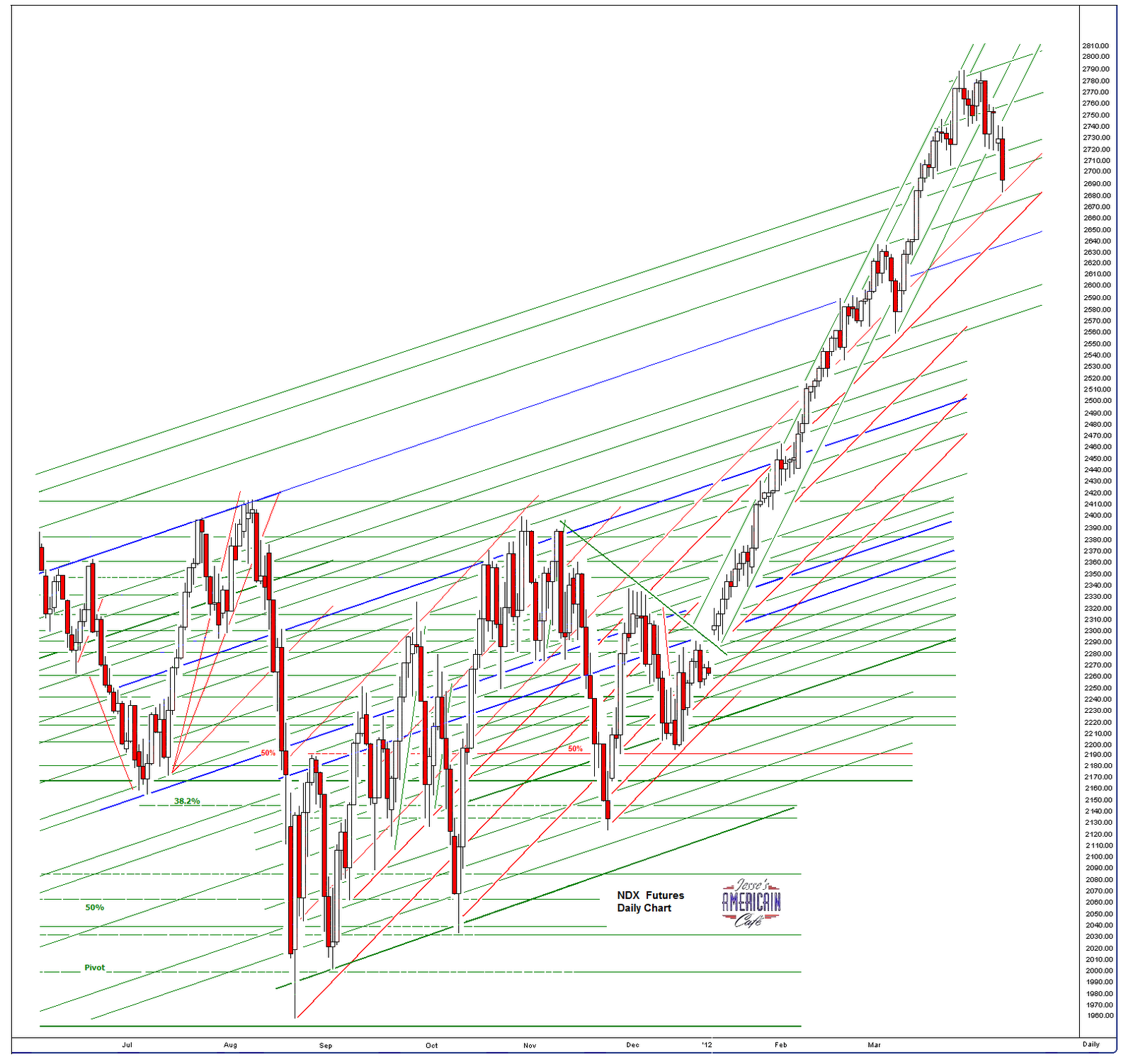
SP 500 and NDX Futures Daily Chart - Risk Off in the Wash and Rinse Cycle


Wells Fargo set record profits this morning and JPM beat the numbers.

Despite this stocks slumped giving back their gains from yesterday.

Citi reports before the bell on Monday and the Street is pessimistic.


12 April 2012

For Capitalism to Survive, Crime Must Not Pay


There are too many people in the financial sector, with their enablers, familiars, and camp followers, engaged in distorting markets and public policy discussions while collecting their enormous and counterproductive entitlements from corruption, fraud, and the misery of others.

They are crippling the economic recovery. These are not 'job creators' or even real wealth creators; they are con men, parasites, and leeches.

I was planning on writing something like this, but Bruce Judson says it quite well.

If the people allow it, the crony capitalists will destroy the capitalist economy and the democratic republic that sustains it. They will destroy it because they hate it.

They hate the risk and the narrow profits of honest competition and productive work in a free and open society, and so they create monopolies, cartels, private privilege, and fraud. They also hate equality, and the freedom that threatens to give other people the ability to curtail their insatiable lust for power.

If the people allow it, they will destroy themselves in their vanity and greed, which might not be all that bad as in the case of Bernie Madoff, Ken Lay and Jon Corzine, for example, but they tend to take a lot of innocent and good people with them, and that is a shame, and most often a tragedy.

For Capitalism to Survive, Crime Must Not Pay
by Bruce Judson
04/12/2012 - 3:52 pm

Unequal enforcement of the law will distort and destroy any capitalist society, and we may be witnessing just such a downward spiral in the financial sector.

Capitalism is not an abstract idea. It is an economic system with a distinct set of underlying principles that must exist in order for the system to work. One of these principles is equal justice. In its absence, parties will stop entering into transactions that create overall wealth for our society. Justice must be blind so that both parties — whether weak or powerful — can assume that an agreement between them will be equally enforced by the courts.

There is a second, perhaps even more fundamental, reason that equal justice is essential for capitalism to work. When unequal justice prevails, the party that does not need to follow the law has a distinct competitive advantage. A corporation that knowingly breaks the law will find ways to profit through illegal means that are not available to competitors. As a consequence, the competitive playing field is biased toward the company that does not need to follow the rules.

The net result of unequal justice is likely to be the destruction of the overall wealth of our society. I don’t mean the wealth of individuals; I mean the total wealth of goods and services that are the benefits of healthy competition. To the extent that unequal justice prevails, entities that are exempt from the laws will, in all likelihood, be more profitable than law abiding competitors. Then they use their profits to further weaken competitors by using their illegal profits to further build their businesses at the expense of competitors. All of this business building activity is based on a foundation of sand, and ultimately the entire industry — or even the larger economy — becomes distorted. The “rogue” company gains power, changes markets, and destroys direct and indirect competitors because it is playing by different rules...

Read the rest here.

Gold Daily and Silver Weekly Charts


To say that these are fairly cynical traders' markets, rather than anything tied to fundamental valuations, is an understatement.

The trading desks engage in heavy handed bear raids, smacking the price of bullion and related markets like miners down lower, and then ride them slowly back up to trend.

Wash, rinse, repeat.

There are far too many people in the financial sector collecting the counterproductive entitlements of fraud.


SP 500 and NDX Futures Daily Charts - Wash, Rinse, Repeat


A continuing rebound in the trend channel, as the Street anticipates more sugar from Uncle Ben.


Securitization - The Undead Heart of the Shadow Banking System


Here is a study of the shadow banking system, and what changed that helped to fuel the credit bubble and the financial collapse.

The root of this was in the overturning of the Glass-Steagall, the well funded lobbying effort for deregulation in the financial sector under the banner of the efficient markets hypothesis and the trickle down theory, and of course, a systematic undermining of regulation, the media, and the law by the monied interests.

Debt is not money. But it can be animated and treated as faux money through fraud, and the end is always bitter for the many, but sweet for the perpetrators of this scheme, if they can get away with it and keep their loot.  They are actively on the look out for fall guys and patsies, and their number one target are their past victims.

There is a difference, the subtlety of which is lost on many, between the deleveraging of a debt inflation and a genuine monetary deflation itself.  In this case the traditional money supply is expanded to save the banking system, which is the primary victim of a debt asset deflation.  That highly unproductive expansion of the fiat money supply, without a commensurate increase in production of real wealth, is what is causing the recession in the real economy today, and the soaring price of hard currency alternatives. 

The real economy is starved for real money, but instead is flooded with counterfeits which flows to frauds of every type.  It cannot bear to submit to economic discipline because it is not born of savings and investment.

Since this is someone else's thoughts it would be extraordinary for me to agree with everything, but I found it a fresh take and well said, and substantially congruent with my own thoughts.

Enjoy.

Securitization – the Undead heart of the Shadow banking machine
By Liar's Lexicon

At the centre of all debates about the Banking crisis, the shadow Banking system and the bank bail-outs is Debt. For a long time I have been arguing that what this debt is, is in fact a new, bank created, bank issued and ultimately bank debased debt-backed currency. And the collapse in value of this unregulated currency IS the crisis. Its cause and its logic.

In order to explain why I think this and why I do not think ‘fixing’ the banking system back to any semblance of how it was, just prior to the crash, will be anything other than a disaster, I have to explain how debt is turned into money. And how, clever as this process is, it also contains within it the seeds of its own undoing.

To do so I have to take you into the undead heart of the machine – securitization. Securitization is what animates the global financial and shadow banking system in whose shadow we now live. It is how modern finance turns debt into money. It is the impious alchemical dream of turning lead to gold, water into wine.

When Securitization was invented it soon wrested control of the money supply away from nations and gave it to the banks. Nations still printed and controlled their currency. But securitization gave banks the ability to print their own currency. And this new securitized currency, based on debt, was theirs to print, control, spend, and ultimately to debase. In short, it gave banks a power to rival nations. It is worth, therefore, understanding its outlines at least.

Please don’t panic. Like most financial stuff its not nearly as difficult as the priesthood would have you believe...

Read the rest of Part 1 here.

Read Part II here.

Read Part III here.

Net Asset Value of Certain Precious Metal Trusts and Funds


The premium on PSLV remains rather low by historical standards.


SP 500 Futures IntraDay


This is obviously a bounce off the longer term trend, that is now starting to challenge the short term downtrend.


11 April 2012

Gold Daily and Silver Weekly Charts


Intraday commentary on the eurodollar and gold here.


SP 500 and NDX Futures Daily Charts - Bounce - VIX Remains Slightly Elevated


Stocks bounced today after the big decline yesterday in part because of some optimism on earnings after last night's Alcoa beat.

The rally was a bit subdued. Let's see if more earnings come in positively.


Eurodollar Update - Hunting The Black Swan - Gold and the Eurodollar


As you know eurodollars are US dollars held anywhere overseas by banks as a foreign currency liability or asset.

Eurodollars were formerly tracked by the Federal Reserve and were included in their M3 figures. In fact, the reason that the Fed stopped issuing its M3 is because it stopped tracking eurodollars. The other components remain.

But the Bank for International Settlements, or BIS, continues to track the dispersion and concentration of global currencies in their reporting banks in their quarterly reports. And this is the source I have been using to derive estimates in the magnitude and changes in dollars held overseas.

Based on my reading of their documentation these figures do not include 'official dollar reserves' of central banks, but rather the dollar holdings as foreign currency of their reporting private credit institutions.

From what I can tell, there is a definite difference between the Fed's tracking of eurodollars, which was based primarily on the foreign branches of their own member banks, and the BIS, which reports on dollars held by a greater universe of ALL banks around the world.  This seems consistent with the Fed's statement at the time that continuing to continue to track eurodollars reliably would become cost prohibitive.  I am curious as to their seeming lack of ability to exchange and share data with BIS.  I would judge the BIS number to be the superior number.  At the end of the day, dollars are dollars, unless there is a selective default, different currency classes, or some benign accounting notation.  The BIS data have every appearance of legitimate dollar claims.

For more on M3 and eurodollars read here.

Even a casual glance at the data shows that there was a trend change in the growth of eurodollars in the mid 1990's. This trend is something I have identified as one potential source of a US dollar crisis if the currency begins to fall in value or lose its appeal US in an uncontrolled manner.

I have not tracked the actual source of the eurodollar growth although it seems to be tied to the trade deficit and a variety of components in the Balance of Payments.

My current estimate of eurodollars is 2.25 trillion which is not insignificant even in these days of an exploding Fed Balance Sheet.

As an aside, the last time the US repatriated funds held by US companies overseas through a tax reduction program was in the 2005 Homeland Investment Act. That seems to have had no material effect on the level of eurodollars at least judging from the charts, and probably did more to inflate the income of the wealthy and stock prices.

During the financial collapse there was a eurdollar short squeeze, primarily in Europe. This is because the dollar denominated assets which they held against their dollar liabilities because to collapse in value, in large part due to the mispricing of risk and fraud.

The trend to an increase in Eurodollars has resumed after a steep drop after the financial crisis.

In the second chart we can see that the banks overseas have adjusted their shortfall, or 'the squeeze,' in part due to the swap lines that the Fed opened through their central banks to relieve the pressure.

There are correlations between gold, the US dollar, US dollar LIBOR and the related TED spread, and eurodollar demand that I have discussed in the past, particularly here, but also here and here.


Last Official Report on Eurodollars from the Fed was in 2006 when they were just over $400 Billion

10 April 2012

Comex Registered Silver Inventory Falls Below 30 Million Ounces Again


Comex Registered Silver inventory has dipped back below the 30 million ounce level as deliveries and withdrawals bring it back down near historic lows.

Perhaps they can lease some from SLV as the situation may require. The central banks may stand ready to lease increasing amounts of gold for sale into the markets if the price rises too fast, as Mr. Greenspan had said, but they are fresh out of silver, and have been so for some time.

A dangerous and volatile situation it appears. I am glad that the Masters of the Universe are not 'directionally positioned' and are merely honest clerks, if not practically innocent maidens. That might turn out to be an awkward position to be caught in some day.

But it will put the lie to Daniel Drew, because I doubt any of them will be going to prison.
'He who sells what isn't his'n
Must buy it back, or go to prison.'
But that is not to say that there will not be plenty of 'bagholders' served up on the wrong end of the short side when the time comes. No honor among thieves, the big hanging the little, hedge funds for breakfast, and all that. If you are not among the financial illuminati even a cash settlement can be made rather painful and pricey, at least when they know they have got you, and on their terms.

You may refresh your understanding of eligible and registered inventory here.


Mike Maloney on Gold and Silver Manipulation


Gold Daily and Silver Weekly Charts - Remarkable Flight to Safety on Euro Jitters


There was a remarkable intra-day reversal in gold as stocks slumped hard on fresh European debt jitters of the Italian and Spanish variety.

This divergence was probably a flight to safety, as gold soared but silver lagged.

Gold had also come to the bottom of its short term trend channel, so the selling algos were likely a bit old.

I did some buying in the early part of the day as gold and silver were down and some of the better mining stocks including some lesser names were just battered.


SP 500 and NDX Futures Daily Charts - Sharp Correction on Risk Off


The equity markets sold off sharply today on fresh jitters about the sovereign debt of Italy and Spain.

It is also quite important to remember that stocks have been very overbought short term and were ready for a correction.


Gold Moves Sharply Higher For No Particular Reason Yet Seen - Remarkable Divergence


I am checking various rumours, but so far nothing in the news can explain this remarkable short term rally in gold.

I am not going to bother repeating the rumours at this point, as they are mere speculation in my opinion.

This is a significant divergence from the equity markets. Silver also has rallied, but lagged a bit.

I would not chase it here, although that is easier for me to say as I did some additional buying earlier today, and then went out for a walk and some light reading on the patio. Spring is in the air. It is too nice to stay inside. The days are warm, and the evenings crisp.

Did some news leak out to the trading desks? Or is this a TBTF trading desk running the metal up in a cynical rally before hitting it with another bear raid, 'London Whale-style.'  If that is the case, then I would like to think that even the CFTC would be shamed into action.

It could even be the technical exhaustion of a selling program. But the divergence is highly remarkable.

The noticeable artificiality of big money moving prices around is what makes these light volume markets so difficult to trade in the short term. That, and that they are rather noticeably corrupt. Almost shamefully so in New York and London.

Gold and silver look like good long term holdings. But even they are only material things, and while they might help keep us alive, yet they cannot give us happiness and lasting life. They are things we are granted, like all material things and talents, and at the end our return to the master will be weighed, and hopefully, not found wanting.

Here is what I had been reading after my walk today. How kind is God, and wondrous his gentle mercies.

"Life passes, riches fly away, popularity is fickle, the senses decay, the world changes, friends die. One alone is constant; One alone is true to us; One alone can be true; One alone can be all things to us; One alone can supply our needs; One alone can train us up to our full perfection; One alone can give a meaning to our complex and intricate nature; One alone can give us tune and harmony..."

John Henry Newman


09 April 2012

Gold Daily and Silver Weekly Charts


A pop up rally on expectations that the demise of QE is greatly exaggerated.

I have rarely seen a market that is subject to so much blatantly phony 'commentary' as the metals market.

The talk on Bloomberg financial television this afternoon was that the Jobs Report was misleading, and that more people are not working because they want to 'take it easy.' 

The unemployed just want to retire and lead the good life on Social Security and/or their 'savings.'

John Williams: US Unemployment Rate Now at 22%


SP 500 and NDX Futures Daily Charts


Earnings season kicks off after the bell tomorrow with Alcoa.

A fairly moderate reaction to stocks in the first day of trading after the 'big miss' in the Jobs Report last week.


Net Asset Value Premiums of Certain Precious Metal Trusts and Funds


JPM Trader Bruno Iksil Driving Derivatives Markets with 'Massive Positions' and 'Excess Capital'


A secretive JPM Trader in London, alternatively known as 'the London Whale' or 'Voldemort,' is distorting the credit derivatives markets with massive positions, and a willingness to move them advantageously in the markets.  It is a classic case of gambling with other people's money, in this case the excess capital provided by the Fed and the Treasury.

I am sure they are all legitimate hedging positions as Blythe Masters just asserted without proof.  lol.

There may be action on this, however, as JPM is hurting other trading desks and not the average person.  The public is prey but the financial powers take care of their own.

JPM is TBTF (Too Big To Fail) and TCTP (Too Connected To Prosecute).

This must seem ironic given Jamie Dimon's recent 38 page letter complaining about regulations which are stifling his firm.  See this Bill Moyers interview with Paul Volcker about 'Gambling with Other People's Money.

London and NY are the centers of global market abuse, particularly London which provides a haven for privileged abuse.

JP Morgan has to all appearances been distorting various markets for years with impunity. They dominate the silver market with opaque positions and have been the subject of an inquiry by the CFTC which has been quietly stalled for years, most likely based on their political influence and government ties.

If the full truth ever comes out it may be a scandal larger than Enron, Lincoln Savings, and Madoff combined. And that is why it likely will not ever be fully revealed, because it compromises so many in the political and financial establishment. It is a premier example of the credibility trap that is stifling genuine reform and real economic recovery.


JP Morgan Trader's Heft Distorting Markets - The Times of India


06 April 2012

Blythe Masters Speaks Out On JPM and Market Manipulation: Take Our Word For It


A number of people have asked me what I think about Blythe Masters' interview on CNBC in which she categorically denies that JPM is involved in anything but legitimate hedging of customer positions in the silver market.

I think a detailed description of all of JPM's hedging positions in the futures and derivatives market, and the related customers and bullion holdings, should be supplied to Gary Gensler's CFTC as government regulator so they can look them over.    That is what the CFTC has been asked by the people who pay them, the investing public, to do.

And he and his staff should examine the evidence for any conflicts of interest and anomalies in them, for example, hedging related to SLV. They should also carefully examine trading patterns that JPM engaged in over a one year period with special attention to daily drops in price of over 3 percent.

And then Mr. Gensler can present his report to Congress, and the details to select members of the Finance Committee including Ron Paul, and swear under oath that these are legitimate hedging positions and that there is no manipulation in silver market. And then I might believe it.

Mr. Gensler has been working on such a report for almost four years and has said nothing. JPM had been previously sued for manipulation in the metals market, and one of their co-defendants, Barrick, reportedly put forward a motion to dismiss on the grounds that they were acting under the direction of the Fed.

So you might understand any skepticism as to what Blythe Masters might have to say about her substantially profitable trading positions to a friendly interviewer on a financial network.

JPMorgan Trader’s Positions Said to Distort Credit Indexes.

Predatory JPM Swap Deal Pushes Alabama County Into Bankruptcy

Given the actions and recent history of the financial industry, it is rather disingenuous, if not presumptuous and even arrogant, for anyone to demand the public's faith in it, their confidence and trust, without the firm reassurance of objective evidence and the rule of law.


MF Global Trustee Giddens in 'Substantive Talks with JPM' Over Return of Stolen Customer Funds


It is nice to see that JPM is cooperating with Mr. Giddens, who is investigating their role in the funds that were stolen from MF Global's customers.

It remains to be seen how much, if any, money that they will return.

But it is good news to see that someone is stepping up besides the Commodity Customer Coalition.

It will be interesting to hear what Edith O'Brien will disclose when she testifies, and how it will be received.

Her situation is outlined here: The Big Fix Was In - MFGFacts

The legal rationale for their actions which JPM might take is outlined here: MF Global Warning: The Financial Markets Have Not Been Fixed - MFGFacts

The SIPA Liquidation of MF Global Inc.
James W. Giddens, Trustee
STATUS OF TRUSTEE'S INVESTIGATION OF CHASE
Date: April 4, 2012

The Trustee has conducted an investigation of the actions of JPMorgan Chase Bank, N.A. regarding JPMorgan's activities in connection with MF Global.

JPMorgan has cooperated with the Trustee's investigation, which has included witness interviews and review of extensive documentation by the Trustee's professionals, including attorneys and forensic accountants from Ernst & Young.

The Trustee and JPMorgan are presently engaged in substantive discussions regarding the resolution of claims.

JPM In Talks Over Missing MF Global Customer Money - New York Times

05 April 2012

Gold Daily and Silver Weekly Charts - The Dr. Evil Strategy and Some Targets


"The exact methodology being deployed that enables the dominant commercial traders to pull this scam off repetitively, aside from outright collusion, is High Frequency Trading (HFT). HFT is the collusive bundling of advanced computer hardware and software that is so advanced and powerful that it has achieved the power to move prices sharply with little actual trading required in setting prices. The way HFT works is that the collusive trading programs suddenly flash great numbers of contracts for sale. But before much actual selling occurs, all the other traders in the market see the great volumes of contracts apparently offered for sale and these other traders withdraw buy orders and start entering their own sell orders to get ahead of the great wave of HFT sell orders offered. Then a not so funny thing happens. Most of the time, very few of the HFT orders originally offered for sale get filled or executed. Instead, they are quickly cancelled. There's even an operative term for this practice that's perfect – spoofing.

Most of the HFT orders are never filled, nor are they ever intended to be filled. These spoof orders are intended to scare others into selling so that the dominant commercial traders can buy gold and silver contracts. And make no mistake, this phony HFT activity has been successful, to the great shame of the regulators at the CFTC, who know that this manipulative trading is against commodity law. The proof that it is manipulative trading lies in the data published by the CFTC. That data shows the big dominant commercial traders are always the big net buyers on the big down days. It is not possible for that to be coincidence; it as close to cause and effect as is possible."

Ted Butler, Butler Research


“The tactic is always the same. The gold banks enter the COMEX and offer more gold for sale at the market than has been mined in the last five years. Immediately, the locals (pit traders) try to run in front and hit any bids they happen to have on their book or are out there in order to get the price down.

Gold tanks down to the $1,640 level and now the brokers for the gold banks begin to enter the market to cover shorts to reduce the short position taken, and most likely to completely flatten it on the day. This has been going on from 1968 to 1980 and it’s also been going on from 2001 to today. The net effect is absolutely nothing."

Jim Sinclair, KWN


“Gold has to get through $1,800. $1,600 has to hold in the short-term. $1,550 to $1,600 is okay, but I wouldn’t like to see a move to the lower end of that range because your uptrend and support are coming in right now around $1,600.

Gold has a horizontal consolidation in place. I was disappointed gold couldn’t break $1,800 previously, but again, sideways is okay. This sideways action is healthy, this consolidation, but gold now has to prove itself.”

Louise Yamada, KWN


"These big plunges in price look to be driven by short selling, with weak hands being driven out, and then short covering or determined buyers stepping back in to maintain the overall number of contracts at a relatively steady level, but with some good profits from covering their short positions at cheaper prices. There is also a lucrative cross trade to be had in other markets like the mining stocks. An operation in bullion is often preceded by some noticeable movements in the miners.

Recall the case in the Euro bond market, wherein Citi came in and sold an enormous volume precipitously, running the stops and driving the price down sharply. The Citi trader came back in and covered his shorts, pocketing the difference in his market disruption based on size. This trading strategy was known as 'the Dr. Evil' trade at Citi, but has deep roots in speculative market manipulation, with the counterpart to a bear raid being the longer term bull pool.

I recall reading at the time [that it was fined for disrupting the eurobond markets] how the Citi traders were incredulous at being outed by the regulators, because that is how they would do things in the States, running the stops and using outsized positions to perform short term price manipulation. In the states 'price management' has become quite notorious around key market events, such as option expiration.

It is so prevalent that it has its own momentum among traders. The only time that it is remarked by the exchanges in the states, however, is when other prop trading desks are caught by it unawares and complain. The public is fair game."

Jesse, Bear Raid In Gold - Memories of Citi's Eurobond Price Manipulation, December 2009

I had a little chuckle a few weeks ago.  Someone wrote in and asked that I stop referring to precipitous decline in the price of the metals as 'bear raids.'  Well, not all declines are bear raids, but the hallmark of such a market operation is fairly obvious to someone watching the tape all day.  And they are not exactly subtle at times.  If you want to be in the markets, you need to know these things, and if they upset you, well then you should probably be reading the funny papers, or watching your favorite financial news station, which is equally diverting.  They will make you mindlessly content, at least for the time being.

In a somewhat unusual circumstance, the BLS has decided to release the Non-Farm Payrolls number tomorrow even though US markets will be closed.

Since gold, and to a lesser extent silver, typically get hit around NFP days, we might attribute the action that was tied to the FOMC minutes release and the PM fix to that.

Chart-wise I am very comfortable with a short term decline in gold to the 1580 level, although I would be a little concerned if it should break support at 1550 and stick a few daily closes down there.

This all looks like a long sideways consolidation within a broad symmetrical triangle. But we have to let the market instruct us, and that will only come over the next few weeks, and maybe months.

This notion that the Fed will not be stimulating the economy and subsidizing the debt through a rolling monetization is a fairy tale.

The words may change, but the song remains the same.
Ben Bernanke Was a Money Printin' Man.


SP 500 and NDX Futures Daily Charts - Why Is This Market Like Every Other Market?


The markets today were marked by thin volume and largely artificial intra-day price movements. Traders were squaring off ahead of the three day weekend so there was a slight downward bias except in tech, which was cheered by the awarding of the Facebook IPO to the NASDAQ, and of course, perpetual Apple-mania.

Cautionary words about Europe and the upcoming earnings season had the markets on edge in the early morning, but they managed a bounce today after yesterday's sell off in the aftermath of the Fed's jawboning about its ongoing monetization, which in reality continues unabated.

Three day weekend for the Easter holiday.

See you Sunday evening.


Unfulfilled Dreams: A Tension At the Heart of the Universe


"...So many of us in life start out building temples: temples of character, temples of justice, temples of peace. And so often we don’t finish them. Because life is like Schubert’s "Unfinished Symphony." At so many points we start, we try, we set out to build our various temples. And I guess one of the great agonies of life is that we are constantly trying to finish that which is unfinishable. We are commanded to do that. And so we, like David, find ourselves in so many instances having to face the fact that our dreams are not fulfilled.

Now let us notice first that life is a continual story of shattered dreams. Mahatma Gandhi labored for years and years for the independence of his people. And through a powerful nonviolent revolution he was able to win that independence. For years the Indian people had been dominated politically, exploited economically, segregated and humiliated by foreign powers, and Gandhi struggled against it. He struggled to unite his own people, and nothing was greater in his mind than to have India’s one great, united country moving toward a higher destiny. This was his dream.

But Gandhi had to face the fact that he was assassinated and died with a broken heart, because that nation that he wanted to unite ended up being divided between India and Pakistan as a result of the conflict between the Hindus and the Moslems. Life is a long, continual story of setting out to build a great temple and not being able to finish it.

Woodrow Wilson dreamed a dream of a League of Nations, but he died before the promise was delivered.

The Apostle Paul talked one day about wanting to go to Spain. It was Paul’s greatest dream to go to Spain, to carry the gospel there. Paul never got to Spain. He ended up in a prison cell in Rome. This is the story of life.

So many of our forebearers used to sing about freedom. And they dreamed of the day that they would be able to get out of the bosom of slavery, the long night of injustice. And they used to sing little songs: "Nobody knows de trouble I seen, nobody knows but Jesus." They thought about a better day as they dreamed their dream. And they would say, "I’m so glad the trouble don’t last always. By and by, by and by I’m going to lay down my heavy load." And they used to sing it because of a powerful dream. But so many died without having the dream fulfilled.

And each of you this morning in some way is building some kind of temple. The struggle is always there. It gets discouraging sometimes. It gets very disenchanting sometimes. Some of us are trying to build a temple of peace. We speak out against war, we protest, but it seems that your head is going against a concrete wall. It seems to mean nothing. And so often as you set out to build the temple of peace you are left lonesome; you are left discouraged; you are left bewildered.

Well, that is the story of life. And the thing that makes me happy is that I can hear a voice crying through the vista of time, saying: "It may not come today or it may not come tomorrow, but it is well that it is within thine heart. It’s well that you are trying." You may not see it. The dream may not be fulfilled, but it’s just good that you have a desire to bring it into reality. It’s well that it’s in thine heart.

Thank God this morning that we do have hearts to put something meaningful in. Life is a continual story of shattered dreams.

Now let me bring out another point. Whenever you set out to build a creative temple, whatever it may be, you must face the fact that there is a tension at the heart of the universe between good and evil. It’s there: a tension at the heart of the universe between good and evil. Hinduism refers to this as a struggle between illusion and reality. Platonic philosophy used to refer to it as a tension between body and soul. Zoroastrianism, a religion of old, used to refer to it as a tension between the god of light and the god of darkness. Traditional Judaism and Christianity refer to it as a tension between God and Satan. Whatever you call it, there is a struggle in the universe between good and evil.

Now not only is that struggle structured out somewhere in the external forces of the universe, it’s structured in our own lives. Psychologists have tried to grapple with it in their way, and so they say various things. Sigmund Freud used to say that this tension is a tension between what he called the id and the superego.

But you know, some of us feel that it’s a tension between God and man. And in every one of us this morning, there’s a war going on. It’s a civil war. I don’t care who you are, I don’t care where you live, there is a civil war going on in your life. And every time you set out to be good, there’s something pulling on you, telling you to be evil. It’s going on in your life. Every time you set out to love, something keeps pulling on you, trying to get you to hate. Every time you set out to be kind and say nice things about people, something is pulling on you to be jealous and envious and to spread evil gossip about them.

There’s a civil war going on. There is a schizophrenia, as the psychologists or the psychiatrists would call it, going on within all of us. And there are times that all of us know somehow that there is a Mr. Hyde and a Dr. Jekyll in us. And we end up having to cry out with Ovid, the Latin poet, "I see and approve the better things of life, but the evil things I do." We end up having to agree with Plato that the human personality is like a charioteer with two headstrong horses, each wanting to go in different directions. Or sometimes we even have to end up crying out with Saint Augustine as he said in his Confessions, "Lord, make me pure, but not yet." We end up crying out with the Apostle Paul, "The good that I would I do not: And the evil that I would not, that I do." Or we end up having to say with Goethe that "there’s enough stuff in me to make both a gentleman and a rogue."

There’s a tension at the heart of human nature. And whenever we set out to dream our dreams and to build our temples, we must be honest enough to recognize it.

And this brings me to the basic point of the text. In the final analysis, God does not judge us by the separate incidents or the separate mistakes that we make, but by the total bent of our lives. In the final analysis, God knows that his children are weak and they are frail. In the final analysis, what God requires is that your heart is right. Salvation isn’t reaching the destination of absolute morality, but it’s being in the process and on the right road.

There’s a highway called Highway 80. I’ve marched on that highway from Selma, Alabama, to Montgomery. But I never will forget my first experience with Highway 80 was driving with Coretta and Ralph and Juanita Abernathy to California. We drove from Montgomery all the way to Los Angeles on Highway 80—it goes all the way out to Los Angeles. And you know, being a good man, being a good woman, does not mean that you’ve arrived in Los Angeles. It simply means that you’re on Highway 80. Maybe you haven’t gotten as far as Selma, or maybe you haven’t gotten as far as Meridian, Mississippi, or Monroe, Louisiana—that isn’t the question. The question is whether you are on the right road. Salvation is being on the right road, not having reached a destination.

Oh, we have to finally face the point that there is none good but the father. But, if you’re on the right road, God has the power and he has something called Grace. And he puts you where you ought to be.

Now the terrible thing in life is to be trying to get to Los Angeles on Highway 78. That’s when you are lost. That sheep was lost, not merely because he was doing something wrong in that parable, but he was on the wrong road. And he didn’t even know where he was going; he became so involved in what he was doing, nibbling sweet grass, that he got on the wrong road. Salvation is being sure that you’re on the right road. It is well—that’s what I like about it—that it was within thine heart.

Some weeks ago somebody was saying something to me about a person that I have great, magnificent respect for. And they were trying to say something that didn’t sound too good about his character, something he was doing. And I said, "Number one, I don’t believe it. But number two, even if he is, he’s a good man because his heart is right." And in the final analysis, God isn’t going to judge him by that little separate mistake that he’s making, because the bent of his life is right.

And the question I want to raise this morning with you: is your heart right? If your heart isn’t right, fix it up today; get God to fix it up. Get somebody to be able to say about you, "He may not have reached the highest height, he may not have realized all of his dreams, but he tried." Isn’t that a wonderful thing for somebody to say about you? "He tried to be a good man. He tried to be a just man. He tried to be an honest man. His heart was in the right place." And I can hear a voice saying, crying out through the eternities, "I accept you. You are a recipient of my grace because it was in your heart. And it is so well that it was within thine heart."

I don’t know this morning about you, but I can make a testimony. You don’t need to go out this morning saying that Martin Luther King is a saint. Oh, no. I want you to know this morning that I’m a sinner like all of God’s children. But I want to be a good man. And I want to hear a voice saying to me one day, "I take you in and I bless you, because you try. It is well that it was within thine heart." What’s in your heart this morning? If you get your heart right . . . [gap in tape]

Oh this morning, if I can leave anything with you, let me urge you to be sure that you have a strong boat of faith. The winds are going to blow. The storms of disappointment are coming. The agonies and the anguishes of life are coming. And be sure that your boat is strong, and also be very sure that you have an anchor. In times like these, you need an anchor. And be very sure that your anchor holds.

It will be dark sometimes, and it will be dismal and trying, and tribulations will come. But if you have faith in the God that I’m talking about this morning, it doesn’t matter. For you can stand up amid the storms. And I say it to you out of experience this morning, yes, I’ve seen the lightning flash. I’ve heard the thunder roll. I’ve felt sin-breakers dashing, trying to conquer my soul. But I heard the voice of Jesus, saying still to fight on. He promised never to leave me, never to leave me alone. No, never alone. No, never alone. He promised never to leave me. Never to leave me alone.

And when you get this faith, you can walk with your feet solid to the ground and your head to the air, and you fear no man. And you fear nothing that comes before you. Because you know that God is even in Crete. If you ascend to the heavens, God is there. If you descend to hell, God is even there. If you take the wings of the morning and fly out to the uttermost parts of the sea, even God is there. Everywhere we turn we find him. We can never escape him."

Martin Luther King, Ebenezer Baptist Church, Atlanta, Georgia, 3 March 1968

Martin Luther King was murdered, 44 year ago, on April 4, 1968, one month after giving this sermon to his church.

He was murdered because of his principled stand against war and oppression, and greed and deception, which are the twin temples of the rich and the powerful. He knotted his belt, and in his righteousness, exposed their injustice. And even in his gentleness, they hated him for it, because they could not bear the light.

As a very young man, and it seems so long ago, I spent some time walking with those who spoke out against injustice. Later, as a grown man and thankfully as a visitor, I stood in the same dark cells of the Mamertine Prison in Rome, where Paul and Peter were imprisoned, and where Paul wrote his second letter to Timothy, a letter from jail, where he was held by the power of an empire that, at that time, ruled the world.

And I walked along some of the paths in the catacombs, the hidden places of the early believers who did not yet even have the name of Christians, but simply called their beliefs 'the good news' and 'the Way.' And they loved one another, and watered the roots of their faith with the blood of martyrs.

We are travelers through history, although slowly, one step, one day at a time. But we are in it, in history, and we play our part of it. It is not something distant, but real. This is our moment.  And Christ calls us to follow him now, even as he did then, in those days when he walked the earth, when he was a passing figure in the crowd, and beckoned with a simple wave of his hand, and the sound of his voice.

Now as an old man I see a nation that has been given great power, and has come once again to a decision point, where it may choose for the truth, or take a darker road. And it seems as though we have already turned away from the truth, and are going down that fateful path, the way of greed and fear and above all pride, and the worship of worldly power for its own sake, cleverness, deception and the arrogance of money, in our willful blindness.

And may God have mercy on us, and our children and our grandchildren, if we do.


04 April 2012

MF Global: The Awkward Construct of a Dual Bankruptcy and the Two Trustees


I outlined the somewhat adversarial relationship between the two trustees due to the odd and awkward construct of the bankruptcy a few days ago. Louis Freeh Asks for $25 Million From MF Global Estate to Pay the Defense Costs of Corzine and Execs.
"I am not an attorney and have never been personally involved in a bankruptcy so I am not particularly knowledgeable in the finer points of US corporate bankruptcy practices. It almost appears more like a divorce than a bankruptcy. The duality of it with the two trustees is fascinating. And the primacy of Mr. Freeh over federal investigators was a bit surprising.

It seems odd to have dual trustees, one for the Chapter 7 brokerage, and another in the Chapter 11 representing the interests of MF Global Holdings management and the banking creditors. Every time a headline says 'the Trustee' I have to look to see if it is Mr. Giddens or Mr. Freeh. I understand the rationale for the two forms of bankruptcy, but the structure of having two trustees answering to competing interests is awkward. Were there two trustees for Lehman and Bear Stearns?

As you may recall, Mr. Freeh had recommended paying bonuses to the executives earlier this year. He also had refused to turn over MF Global emails and documents regarding the accounts and transfers of money to federal investigators, claiming attorney client privilege between himself and MF Global, until his own people had a chance to look them all over.

Is this perhaps why it is so hard to obtain indictments in financial cases? The firms do not have to hand over any evidence until they and their attorneys have had a chance to go through everything first, and then decide what they wish to hand over to investigators?

...Just as this case may provoke some activity in the regulatory area, so one might think that in addition to making an interesting case study for law schools, it could involve some changes and streamlining in the bankruptcy practices in which companies like banks and brokers are holding customer money in trust, in addition to the standard classes of creditors. Certainly there is plenty of room for clarification."
Even under the best of circumstances there is a natural tendency for confusion to occur when there is an apparent cover up by the company's management. After all, everyone claims complete ignorance of what happened to a huge amount of customer money, except for the assistant Treasurer, who at this point is pre-occupied with making a deal for immunity from prosecution in return for her testimony.

If the money 'simply vaporized' what is she seeking immunity from? Practicing magic without a license?

And perhaps in the future, in addition to streamlining the bankruptcy process, there might be some consideration to giving the appropriate law enforcement the primary control over the company records from day one when customer money has been stolen, and not leaving it up to the management of the company and their attorneys to decide how they wish to manage the dispostion of critical information, otherwise known as 'evidence.'

I understand that this may not have become an issue in the past, when brokerages went bankrupt, and the primacy of customer claims was upheld. And I admit to being a touch Socratic here. If these things were not a problem in the past, why are they such a heartache and stumbling block now?

Sometimes TBTF banks and TCTP (Too Connected To Prosecute) financiers flout the law and use their influence to twist the existing laws and the compliant legal system to suit their purposes. And that is a symptom of a much greater problem.


Gold Daily and Silver Weekly Charts - Even the Orchestra Is Beautiful


Each and every market maker a virgin. If you don't believe me, don't take my word for it, go ahead, ask Helga.


Betty and Helga


SP 500 and NDX Futures Daily Charts


Oh Say Does That Star Spangled Banner Yet Wave...


Chinese Premier Wen Jiabao Says They Must 'Break Up Their Big Bank Monopolies'


What a world, when the premier of China sounds like Andrew Jackson and Teddy Roosevelt.  His observations of the problems they face with the biggest banks in China must surely resonate with people in the developed nations.

I do not know how to translate this into Chinese, but the Premier is free to use it in his speeches:
"The Banks must be restrained, and the financial system reformed, with balance restored to the economy, before there can be any sustained growth and recovery."
I found the rather dismissive reaction from some of the 'Big Four' Chinese banks to be very interesting.
"Wen has one year left (in his term)," said a Chinese state banker who asked not to be identified because of the sensitivity of the topic. "This is a task for the next generation of leaders. It cannot be accomplished within one year."
Perhaps they feel that they have bought this reformer and made him their puppet, a faux reformer, in the manner of their Western counterparts.

As forecast more than seven years ago, before the financial collapse which was also in the same forecast, the monied interests will keep pressing their advantage around the world, blinded by greed and emboldened by their apparent victories, until they go too far and destroy themselves.

AP
China's premier calls for breaking bank monopolies
By JOE McDONALD
4 April 2012

BEIJING (AP) — Premier Wen Jiabao, China's top economic official, says its state-owned banks are monopolies that must be broken up, acknowledging mounting economic and political pressure to reform an industry whose vast profits are fueling public anger.

Wen's comments Tuesday suggest Beijing sees a growing political danger from its failure to carry out long-promised reforms of state banks, which pay minimal interest on deposits and made tens of billions of dollars in profit last year. Public resentment has risen as China's rapid economic growth slows and fears of job losses rise.

Speaking Tuesday to businesspeople, Wen said Beijing has launched reforms aimed at serving entrepreneurs better by opening up banking to private investors, China National Radio reported. It gave no indication of a possible timeline for further reforms.

"Our banks make money too easily. Why? Because a small number of big banks have monopoly status," Wen said, according to a transcript on the CNR website. "To allow private capital to flow into finance, basically, we need to break the monopoly."

Wen spoke during a visit to Fujian province in the southeast, a center for export-driven private enterprise. The government announced last week it will launch a pilot project to expand private lending in Wenzhou in neighboring Zhejiang province after a wave of defaults on underground lending that supported businesses there.

"I think those elements in Wenzhou that succeed need to be expanded nationwide and can immediately be introduced nationwide," Wen said, according to the transcript.

Communist leaders have long used Chinese banks to subsidize state industry, shifting wealth from savers to politically favored companies. Entrepreneurs produce most of China's new jobs and wealth but get only a small percentage of bank loans.

That has fueled resentment, especially as the "big four" major state-owned commercial banks, which account for about half of deposits, report record profits...

Read the rest here.

Reuters
What does China's Wen mean when he says break bank monopoly?
By Benjamin Lim, Terril Yue Jones and Langi Chiang
Apr 4, 2012

(Reuters) - When Chinese Premier Wen Jiabao talks about busting a bank monopoly, he may be thinking of modest financial reforms, not a dismantling of the Big Four state-owned banks.

His comments on Tuesday were blunt: the big banks reap profits "far too easily" and operate like a monopoly that needs to be broken in order to speed the flow of money to loan-hungry smaller businesses.

Reuters contacted five of China's largest banks to see how Wen's remarks were received. There was little concern that a major policy shift was imminent, especially when the Communist Party is only months away from a once-a-decade power handover, which includes replacing Wen.

"Wen has one year left (in his term)," said a Chinese state banker who asked not to be identified because of the sensitivity of the topic. "This is a task for the next generation of leaders. It cannot be accomplished within one year."

The Big Four banks, Industrial and Commercial Bank of China, Bank of China, Agricultural Bank of China and China Construction Bank, account for about 40 percent of China's total loans.

They have come under criticism for earning fat profits while small businesses scramble for financing.

Last year, the top four banks earned net profits totaling $99 billion, more than double at their U.S. equivalent - Citibank, J.P. Morgan Chase, Bank of America Merrill Lynch and Wells Fargo.

The large banks tend to direct most of their lending toward fellow state-owned enterprises, but China increasingly relies on smaller private firms for job creation and economic growth.

The big banks wield formidable political power. Top executives are appointed by the Communist Party's Organization Department and hold a rank equivalent to a cabinet vice-minister..."

Read the rest here.

JPM To Pay 'Wristslap Fine' in Misuse of Customer Segregated Funds at Lehman Brothers


JPM extended a significant amount of credit to Lehman Brothers prior to their collapse.

In extending the credit, JPM assumed that the customer money that was being held by Lehman Brothers could be freely used by the firm, and therefore was a legitimate part of its valuation. The comparison to MF Global is obvious.

In other words, if MF Global had not failed to meet its margin call and gone bust, they might have been fined $20 million in four or five years, while taking in billions in profit and bonuses. What a deterrent!

Although using customer segregated funds to calculate the value of a company is not nearly as egregious as actually stealing them, it does betray a certain mindset on Wall Street that seems to have prevailed in the last ten years or so.

'This land is our land, their money is our money.'

Or perhaps there was an outbreak of sloppy book-keeping on Wall Street as the Fed induced credit bubble reached its apogee in the fraudulent securities packaging market. Who could blame them?

The $20 million fine is incidental to JPM and the violations which occurred over four years ago.  And I am sure that as part of settlement, JPM will agree not to do it again, while admitting no guilt.

Perhaps this action by the CFTC is more symbolic than effective. The question I have is what does it really mean?

The $20 million is nothing to JPM, but the CFTC could certainly put it to good use. Perhaps they could use it to move along their study exposing the outrageous manipulation in the silver market by one or two banks that has been slowly moving along for the past four years. Now that is a symbol that we might believe in.

Bloomberg
JPMorgan Pays $20 Million to Settle CFTC Segregated-Fund Claims By Gregory Mott Apr 4, 2012

JPMorgan Chase & Co. (JPM) will pay $20 million to resolve U.S. Commodity Futures Trading Commission claims that the bank mishandled customer segregated funds from Lehman Brothers Holdings Inc. from 2006 to 2008.

The CFTC announced the settlement with JPMorgan in a statement today. Mary Sedarat, a spokeswoman for New York-based JPMorgan, wasn’t immediately available for comment.

When Is QE Not Really QE, a Bailout Not Really a Bailout?


When the going gets tough, the sneaky take it off balance sheet.

Watch carefully what the Fed and the Treasury do, not so much what they say.

Times of India
IMF chief calls on US for more cash
3 April 2012

WASHINGTON: IMF managing director Christine Lagarde implored the United States to help back-stop debt-ridden European countries Tuesday, wading neck-deep into bubbling US political waters.

Speaking in the US capital, Lagarde said the 187-nation International Monetary Fund needed more firepower to tackle financial crises raging around the globe, arguing it was in the US interest to pitch in and help Europe.

"Americans might ask themselves: why should what happens in the rest of the world concern us? Don't we have our own problems?" she said, according to prepared remarks.

"The answer is simple: In today's world, we cannot afford the luxury of staying in our own mental backyards."

"If the European economy falters, the American recovery and American jobs would be in jeopardy. So America has a large stake in how Europe fare -- and how the world fares."

Lagarde's comments came 64 years to the day after president Harry Truman signed the Marshall Plan, an unprecedented loan to rebuild post-war Europe.

But her comments will be anathema to politicians in Washington, as the country hurtles toward elections this November.

US officials, including Treasury Secretary Timothy Geithner, have for months trod a thin line between supporting the IMF's efforts to bolster its resources and actually kicking in some more cash.

Washington has yet to ratify 2010 reforms which would see it send $63 billion more to the IMF's coffers, under a new quota agreement.

With the United States itself mired in high levels of debt, increasing IMF funding or shipping tens of billions of dollars abroad to help Europe could be tantamount to political suicide.

Unperturbed, Lagarde said Europe's recent efforts to shore up its own financial "firewall" must prompt the rest of the world to pitch in.

"The Europeans have moved first with their firewall, the time has come to increase our firepower.

"The ratio of Fund quotas to world GDP is significantly lower today than in the past. Sixty years ago, it was as much as three, four times higher. We've a lot of ground to make up."

Lagarde has asked members to give her $500 billion in extra funds to fight financial crises, including for possible future eurozone bailouts.

But at a fraught meeting of finance ministers and central bank chiefs in Mexico City in February, Group of 20 economies said they would only boost IMF funding if the eurozone first put its hand in its pocket.

After a month of wrangling and some German resistance, the eurozone Friday clinched a deal it claimed was worth more than one trillion dollars, putting the ball back in the IMF's court.

Trying to seal the deal, Legarde echoed a point frequently made by Geithner: that the IMF offers a solid bet.

"The IMF is a good investment for all our members, including the United States. Your money is not drawn upon until needed. Your money earns interest. Your money is used prudently -- our programs always carry rigorous conditions to ensure their effectiveness.

"No member country has ever lost money by contributing to IMF resources -- and I assure you that will not change on my watch."