14 June 2012

Blaming the Victim and Other Biases and Their Use by the Predator Class To Subvert the Unwary


It is an occasional human fault to get pulled into the habit of 'blaming the victim.'

Most people do not do it regularly, except in the case of some uninformed prejudice or in response to misinformation.

But some people seem to do it more often and sometimes habitually. Why is that?

As we might imagine, nothing can make a certain type of person feel better about themselves than attributing the misfortune of another to foolishness or stupidity. Since a similar misfortune has not happened to them, they must therefore be a superior type of person, and not the ordinary person that they fear they might be who just happened to get lucky.

In my experience this 'distancing' of oneself from the rest of humanity is at the root of much of the bad behaviour that can become institutionalized into the corruption of an organizational structure that eats at the fabric of society.

Sometimes people do engage in serial risky behaviour that leads them into trouble.  It seems as though everyone knows at least one person who gets themselves into a bad situation by acting foolishly and recklessly. Sometimes it is caused by mental illness, alcoholism or some other negative influence. Everyone can think of someone who 'brought it on themselves.' And our imaginations can extend that instance quite easily and broadly.

We can use these few anecdotal examples to blame the victims unjustly on a more general and uninformed level. And we often fall into this bias on the prompting of con men and sociopaths of the predator class who use it to justify their own criminal actions and personal injustice. They are not burdened with empathy for their victims, and even delight in their misfortune. But they must find ways to make their actions more acceptable to society as a whole that normally does have such concerns for equity and justice.

Personal exceptionalism is rooted in pride, and is the antithesis of the old saying, 'There but for the grace of God go I.'

Those MF global customers? They had it coming because they should have known better. Those people who lost money in the stock market? Well, no one MADE them buy those fraudulent paper assets that professionals recommended to them. That family who lost their home to foreclosure because the father was severely injured by sickness or accident? They should have planned better and taken more precautions.

In its extreme example, the subornation of human caring becomes a form of madness, the 'demonization of the other.' That whole group/class/race/nation of people who are being mistreated, brutalized, cheated, starved, and even murdered? It is unfortunate of course, but they are lazy/cheap/stupid/dirty/sneaky/different/subhuman and so they had it coming. But we are not like that so we are doing well and even prospering.

But these are just thoughts from my own direct experience.  Here is a systematic and more thorough analysis that I found to be interesting.

Blaming the victim – why do we do it? For example, are rape victims responsible for what happens to them? Are victims of car crashes or other accidents responsible for what happened to them? These are the kinds of questions we examine as we look at the strange human tendency to blame the victim.

Here is the concept map for the biases discussed in this show:


Download Podcast here.

Source: Blaming the Victim and Other Biases

Attribution Map Quiz

1: Fundamental Attribution Error
•“people do what they do because of the kind of people that they are, not because of the situation they are in”
•“people tend to underestimate external influences when explaining other people’s behavior”

2: Actor/Observer (bias) Difference
•“Whereas we are very likely to find internal causes for other people’s behavior, we tend to look …to the situation to explain our own behavior”
•Example: in a murder trial, the prosecution will call the person a murderer, defense will focus on the difficulty of the person’s life at the time or their childhood, characteristics of the person murdered. “That person drove my client to do what he/she did”

3. Self-serving Attribution (bias): while we tend to take credit for our successes (attribute success to internal causes), we blame our failures on external causes
•I earned an A, my professor gave me a C
•Why? Because it threatens our self esteem to think that failures were caused by something about ourselves
•Example: sports – when a team wins, they attribute it to talent or skill, when they lose, they attribute it to bad luck, poor playing conditions, bad calls from the umpires rather than “I didn’t train hard/study hard enough”, “Our team wasn’t as good”
•It feels bad to attribute our failures to ourselves

4. Optimism bias: “good things are more likely to happen to oneself than to others and bad things are less likely to happen to oneself”
•A kind of “defensive attribution”
•Why do we tend to hold this belief? Because the world is a scary, unpredictable place and that makes us feel anxious. The only way to feel a little better is to believe that it couldn’t happen to me. “I would have acted differently”, “That wouldn’t happen to me because…”I would make different decisions”

5. Belief in a Just World: bad things happen to bad people, “or at least to people who make mistakes, poor choices, etc.” thus, bad things won’t happen to me because I wouldn’t make those mistakes.
•“the belief in a just world keeps anxiety-provoking thoughts about one’s own safety at bay” Aronson, et. al.
•when the world seems chaotic or dangerous, this is anxiety provoking. so we attempt to reassure ourselves by blaming the victim

Allen Stanford Sentenced to 110 Ten Years in Prison For Ponzi Scheme


Breaking news...

High living Texas banker Sir Allen Stanford, often referred to as 'the other Madoff,' was sentenced today to 110 years in prison for the Ponzi scheme he operated by selling fraudulent certificates of deposit issued by his Antigua-based Stanford International Bank Ltd., and sold in the U.S. by his Houston-based securities firm, Stanford Group Co.

The US Justice Department had referred to Mr. Stanford as 'a ruthless predator responsible for one of the most egregious frauds in history.'

The reigning champions who currently hold the title for ruthless-financial-predators-responsible-for-THE-most-egregious-fraud-in-history could not be reached for comment, as they prepared to leave for their weekend vacation homes in the Hamptons, according to their Personal Assistants at the New York Federal Reserve.


Simon Johnson: The Institutional Flaw At the Heart of the Federal Reserve


This is a long 'thought piece' by Simon Johnson, an eminent US economist and professor at the MIT Sloan School of Management.

It exposes the inherent conflicts of interest at the New York Fed, the history behind that structural flaw, and the problems it creates in a time of high powered money and financialization, with the Fed assuming even more regulatory powers from a craven Congress.

This is nothing new to readers here. The Fed is an institution fouled by privilege and insider dealing, involved so deeply in white collar crime as to be completely ensnared in the credibility trap of its own making.

We saw the heart of the problem when an arrogantly defiant Jamie Dimon faced down the august Senators, many of whom are at least his part time employees. As a financial and economic analyst put it even more bluntly:
"Jamie Dimon’s appearance before the Senate Banking Committee was a sickening display that clearly demonstrated that Congress has been thoroughly corrupted by Wall Street. Instead of grilling Dimon, Senators acted like overly affectionate puppies fighting each other for an opening to smooch their master."

M. Ramsey King, The King Report
So it is heartening when someone who is clearly in the establishment and not so easily ignored, dismissed, or shouted down is willing to stand and say that there is a problem, it is not incidental, and it will create more and serious problems in the future.

Certainly Simon Johnson is no Andrew Jackson, and most likely appropriately so as he is not a politician.  But his reputation and careful thinking will provide 'cover' for other economists and thinkers who are reluctant to speak out because of the academic and career sanctions that can be imposed on them by the banking cartel and their friends and associates in the universities, think tanks, major media, and positions of political power. And so it is an act of principled moral courage, which is something that has been in short supply for quite a few years now.

Obama was elected by the people as a reformer, but he has failed to deliver and often spectacularly so, probably due to a weakness in his character and circumstance, and a preference to facilitate rather than to lead.  And that is a tragedy, because it still leaves the nation desperately in need of reform and renewal that will almost certainly not be coming from the Republican party of Big Money and unwavering devotion to the organized hypocrisy of special privilege.

The Banks must be restrained, and the financial system reformed, with balance restored to the economy, before there can be any sustained growth and recovery.

If the suffering becomes great enough, change will inevitably come, but it may not be orderly or as controllable as the monied interests often like to think.


An Institutional Flaw At The Heart Of The Federal Reserve
By Simon Johnson
June 14, 2012

On the PBS NewsHour in late May, Treasury Secretary Timothy Geithner indicated that the continued presence of Jamie Dimon, the chief executive of JPMorgan Chase, on the board on the Federal Reserve Bank of New York creates a perception problem that should be addressed. He used the diplomatic language favored by finance ministers, but the message was loud and clear: Mr. Dimon should resign from the board of the New York Fed.

Mr. Dimon has been an effective opponent of financial reform over the past four years. He remains an outspoken advocate of the view that global mega-banks can manage their own risks, and he has stated publicly that the new international and national rules on capital requirements are “Anti-American.”

Mr. Dimon now finds himself at the center of a number of official investigations into how his bank could have lost so much money so quickly in its London-based trading operation – including whether adverse material information was disclosed to regulators and to markets in a timely manner.

The Wall Street Journal reported this week that serious concerns about the London trading operation had been raised – but not made public – two years ago; the New York Times has reported similar concerns. On Wednesday, the Senate Banking Committee interviewed Mr. Dimon; the event was inconclusive, perhaps because JPMorgan Chase is a major donor to some members of the committee.

On Monday, Lee Bollinger, chairman of the board of the New York Federal Reserve Bank and president of Columbia University, weighed in to contradict Mr. Geithner in no uncertain terms. The Wall Street Journal reported Mr. Bollinger’s view: Mr. Dimon should stay on the New York Fed’s board, and critics attacking the Fed have a “false understanding” of how it works. (Please note the correction to the original Wall Street Journal story, with an important change to the reporting of what Mr. Bollinger said.) This is a remarkable statement in part because Mr. Geithner is himself a former president of the New York Fed, so it is hard to see how he would have a false understanding of how the Fed works.

More generally, however, Mr. Bollinger’s intervention is inadvertently helpful, as it opens the door to a more productive conversation about the exact nature of the institutional weakness that lurks at the heart of the Federal Reserve System and that threatens our financial stability more broadly....

The problem is that sensible liquidity support can easily become inappropriate subsidies, particularly when some financial institutions are considered too big to fail. Outsiders will never observe the real-time information on which central banks make decisions, so we need to be able to trust the people running our central bank, otherwise the system will go badly wrong — again...

Mr. Bollinger’s intervention brings a fresh spotlight to a deep governance problem at the heart of the Federal Reserve System – prominent financial sector executives and their close allies are much too involved in how the New York Fed operates. This is partly an anachronistic holdover from the original Federal Reserve Act of 1913 – and reflects the political milieu of that time, in which bankers had to be persuaded to accept a central bank (for more background and a lot of relevant technical detail, I recommend Edwin Walter Kemmerer’s “The ABC of the Federal Reserve System,” published in 1920).

But it is also an all-too-accurate reflection of where we stand today with regard to global mega-banks and the large, nontransparent and highly dangerous subsidies they extract from the rest of society by being too big to fail.

The people who run global mega-banks get the upside when things go well – they are paid based on their return on equity unadjusted for risk, so they prefer a lot of debt piled on top of very little equity. When things go badly, the downside is someone else’s problem – in the first instance, typically, the Federal Reserve’s...

In the run-up to 2007, the complacency of the entire Fed System can be traced in part to the cozy relationship between the New York Fed (headed then by Mr. Geithner) and the Wall Street elite. We cannot let this happen again. Yet all too often with regard to financial reform today, we find the Fed lagging rather than leading the thinking and the implementation that Dodd-Frank calls for on many issues...

Read the rest here.


13 June 2012

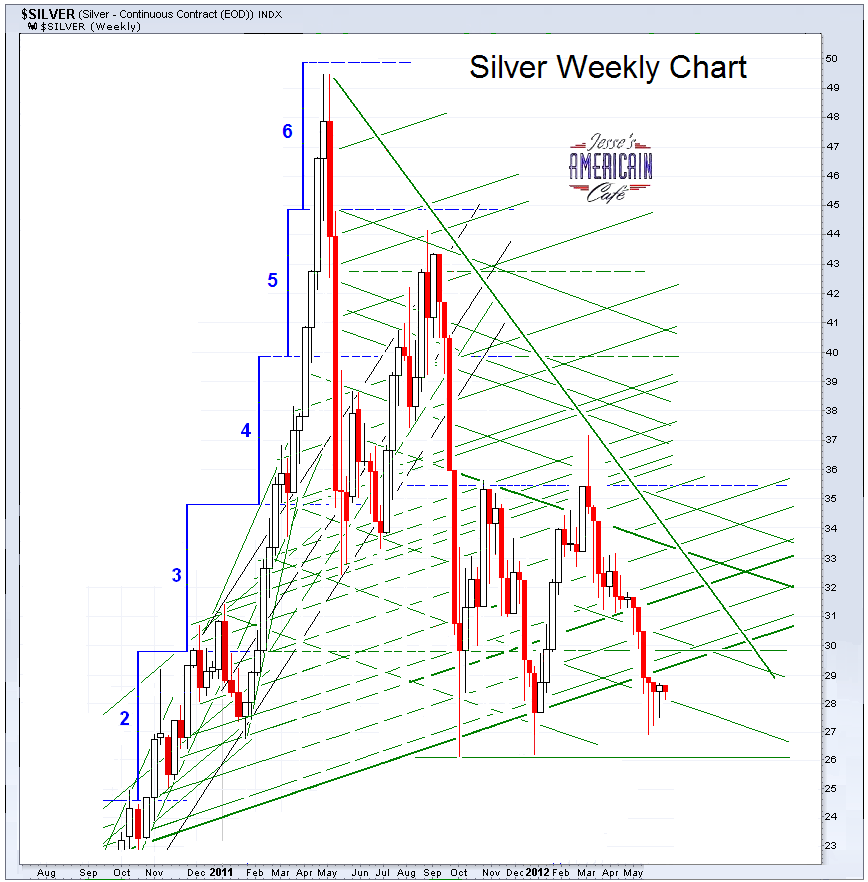
Gold Daily and Silver Weekly Charts - The Rolling Global Financial Crisis Intensifies


"Let me make it clear straight away – the lies, corruption, cowardice and greed of Spanish bankers and government officials is nothing special. What is happening in Spain now, reminds me of Northern Rock in the UK, Hypo in Germany and CountryWide in the US. So please do not think that I dislike Spain or of the ordinary people of Spain. The people I detest in Spain are the same people I detest in Britain and every country: The Cabal of corrupt Bankers and Political parasites.

Every country will have its moment in the spotlight. Italy is preparing in the wings as we speak. But today, on the Eurofiscal Corruption Contest, Spain is on stage.

It is the mantra of the main political parties and media across Europe, that the present crisis is the result of too many people taking on loans they could not afford. Neither the bankers nor the politicians, according to the accepted story, saw the crisis coming or could have seen it coming but have been engaged in heroic attempts to rescue us from a crisis of our own making. THIS IS NOT TRUE.

First, people did not ‘take’ loans they could not afford. The loans were ‘offered’ by bankers whose job it should have been to advise their clients on whether the loan was wise and sustainable. The bankers offered no such advice but instead pocketed the bonuses which came from selling as many loans as possible to all and sundry. So a more accurate summary of who is morally guilty, is that people accepted loans they should have known they would not be able to afford if ever the market turned down, but which were offered to them by professional bankers who assured them they would be fools not to get on the property ladder. Second, a vast number of the loans which have gone bad in Spain were not in fact ever made to ordinary people. They were made to developers and construction companies. It is those companies which have defaulted.

I am not saying ordinary citizens bear no responsibility. My concern is to stick a knife into the diseased carcass of Spanish Politics and bring to the surface the parasites who have gorged themselves on the flesh of Spain for decades and insist that their blame be recognized..."

Golem XIV, The Spanish Entry in the Eurofiscal Corruption Contest


1914
By Wilfrid Owen

War broke: and now the Winter of the world
With perishing great darkness closes in.
The foul tornado, centred at Berlin,
Is over all the width of Europe whirled,
Rending the sails of progress. Rent or furled
Are all Art's ensigns. Verse wails. Now begin
Famines of thought and feeling. Love's wine's thin.
The grain of human Autumn rots, down-hurled.

For after Spring had bloomed in early Greece,
And Summer blazed her glory out with Rome,
An Autumn softly fell, a harvest home,
A slow grand age, and rich with all increase.
But now, for us, wild Winter, and the need
Of sowings for new Spring, and blood for seed.


Austerity, so the young may die, to salve the Banks' and Politicians' pride.


SP 500 and NDX Futures Daily Charts - Edging Fitfully Towards Option Expiration


If you listened to the financial news today and the comments about Jamie Dimon's appearance before the Senate you would think that the financial crisis and bailouts had never occurred.

And that is what they call 'moral hazard' and why it will happen again. All of it.


Net Asset Value Premiums of Certain Precious Metal Trusts and Funds


A decided lack of euphoria, in keeping with a Greco-Spanish chill over all the markets.


Acemoglu and Robinson: Why Nations Fail


In a generally deferential and ineffective Congressional spectacle, some say minuet and I think kabuki dance, Jim DeMint's 'questioning' of Jamie Dimon, who responded to most serious questions with poker faced whoppers, today pushed me over the edge, and so putting the internet feed on mute, I thought I would take a moment to bring the study Why Nation's Fail by Acemoglu and Robinson to your attention.


"Countries differ in their economic success because of their different institutions, the rules influencing how the economy works, and the incentives that motivate people,” write Acemoglu and Robinson. Extractive institutions, whether feudalism in medieval Europe or the use of schoolchildren to harvest cotton in contemporary Uzbekistan, transfer wealth from the masses to elites.

In contrast, inclusive institutions—based on property rights, the rule of law, equal provision of public services, and free economic choices—create incentives for citizens to gain skills, make capital investments, and pursue technological innovation, all of which increase productivity and generate wealth. Economic institutions are themselves the products of political processes, which depend on political institutions. These can also be extractive, if they enable an elite to maintain its dominance over society, or inclusive, if many groups have access to the political process. Poverty is not an accident: “Poor countries are poor because those who have power make choices that create poverty.” Therefore, Acemoglu and Robinson argue, it is ultimately politics that matters.

The logic of extractive and inclusive institutions explains why growth is not foreordained. Where a cohesive elite can use its political dominance to get rich at the expense of ordinary people, it has no need for markets and free enterprise, which can create political competitors. In addition, because control of the state can be highly lucrative, infighting among contenders for power produces instability and violence. This vicious circle keeps societies poor.

In more fortunate countries, pluralistic political institutions prevent any one group from monopolizing resources for itself, while free markets empower a large class of people with an interest in defending the current system against absolutism. This virtuous circle, which first took form in seventeenth-century England, is the secret to economic growth."

James Kwak, Failure Is An Option, A Review of Why Nations Fail

As you know I have often said that in a sovereign fiat currency, inflation and deflation are a policy decision.

Acemoglu and Robinson take this premise a broad step further, and show through many historical examples that national success or failure, as one might define it in terms of the broadest happiness and success for the most people, is also the result largely of policy decisions.

Neither austerity or stimulus will be effective in restoring growth to the American economy. Most if not all of the pain of austerity will fall on the hapless victims and the disenfranchised innocent, while most of the profits of recovery through stimulus will flow to the one percent. No matter what strategy you may employ, it is difficult to be successful against a stacked deck in a rigged game.

The Banks must be restrained, and the financial system reformed, with balance restored to the economy, before there can be any sustained growth and recovery.


Why Nations Fail

I would tend to add to what Robinson has to say that extractive economic institutions tend to actively promote and fund extractive political movements, laws, public policy, and systems of both the left and the right. Even the subversion of effective government and a descent into near anarchy can serve the monied interests, because effective democratic government is a counterbalance against private power.

At their extremes, neither communism nor fascism nor corporate capitalism are much different, as they both become extractive for the benefit of a small elite at the expense and misery of the people.

12 June 2012

Charles Ferguson: Predator Nation, Global Predator Class


"Over the last thirty years, the United States has been taken over by an amoral financial oligarchy, and the American dream of opportunity, education, and upward mobility is now largely confined to the top few percent of the population. Federal policy is increasingly dictated by the wealthy, by the financial sector, and by powerful (though sometimes badly mismanaged) industries such as telecommunications, health care, automobiles, and energy. These policies are implemented and praised by these groups’ willing servants, namely the increasingly bought-and-paid-for leadership of America’s political parties, academia, and lobbying industry.

If allowed to continue, this process will turn the United States into a declining, unfair society with an impoverished, angry, uneducated population under the control of a small, ultrawealthy elite. Such a society would be not only immoral but also eventually unstable, dangerously ripe for religious and political extremism.

Thus far, both political parties have been remarkably clever and effective in concealing this new reality. In fact, the two parties have formed an innovative kind of cartel—an arrangement I have termed America’s political duopoly, which I analyze in detail below. Both parties lie about the fact that they have each sold out to the financial sector and the wealthy. So far both have largely gotten away with the lie, helped in part by the enormous amount of money now spent on deceptive, manipulative political advertising. But that can’t last indefinitely; Americans are getting angry, and even when they’re misguided or poorly informed, people have a deep, visceral sense that they’re being screwed...

So I’m not going to spend much time describing ways to regulate naked credit default swaps, improve accounting standards for off- balance-sheet entities, implement the Volcker rule, increase core capital, or measure bank leverage. Those are important things to do, but they are tactical questions, and relatively easy to manage if you have a healthy political system, economy, academic environment, and regulatory structure.

The real challenge is figuring out how the United States can regain control of its future from its new oligarchy and restore its position as a prosperous, fair, well-educated nation. For if we don’t, the current pattern of great concentration of wealth and power will worsen, and we may face the steady immiseration of most of the American population...

Before getting into the substance of these issues, I should perhaps make one comment about where I’m coming from. I’m not against business, or profits, or becoming wealthy. I have no problem with people becoming billionaires—if they got there by winning a fair race, if their accomplishments merit it, if they pay their fair share of taxes, and if they don’t corrupt their society...

But that’s not how most of the people mentioned in this book became wealthy. Most of them became wealthy by being well connected and crooked. And they are creating a society in which they can commit hugely damaging economic crimes with impunity, and in which only children of the wealthy have the opportunity to become successful.

That’s what I have a problem with. And I think most people agree with me."

Charles Ferguson, Predator Nation

This is not only an American phenomenon, but one deeply rooted in the Anglo-American banking cartel, and in the money centers and hidden wealth of Europe. Ferguson talks primarily of how the solution may come from the people of the US, but the true impulse for change may come from without, from the countries who have already been brutalized by the rise of the predator class.

See also this 2008 post from Le Café Américain , Predator Class and from 2010 Class Warfare and the Decline of the West.

Popular resistance against the decline of freedom and opportunity is often thwarted by the foolish self-interest of many who believe that they themselves have the ability to benefit from and become a part of the predator class, although they would never call it by that name. After all, they are successful, they have money and wealth, and they think they have the power to stand alone, but want more.

Weak and amoral people rationalize their service to what they come to realize, over time is objectively evil in a thousand different ways.  The most common is the expediency of a career, going along to get along.
"His success alone proved that I should subordinate myself to this man."
And frequently, if only in the back of their minds, is the thought that they too could be as gods. What they do not yet realize is that to the ubermensch they and their children are no different from the illegal immigrants and the poor, fit only for exploitation, who will do as they are told, until their time comes.  

This is the shock that was felt by the customers of MF Global when their money was brazenly and openly stolen. They were a part of the game, they were believers in the system, well educated, hard-working. But to the powerful insiders they were really just cockroaches, and another form of prey.

And not every psychopath chooses to use a knife.

"Psychopaths have a grandiose self-structure which demands a scornful and detached devaluation of others, in order to ward off their envy toward the good perceived in other people."

“He will choose you, disarm you with his words, and control you with his presence. He will delight you with his wit and his plans. He will show you a good time but you will always get the bill. He will smile and deceive you, and he will scare you with his eyes.

And when he is through with you, and he will be through with you, he will desert you and take with him your innocence and your pride."

Robert D. Hare, Without Conscience


"Do you think he is so unskillful in his craft, as to ask you openly and plainly to join him in his warfare against the truth? No; he offers you baits to tempt you. He promises you civil liberty; he promises you equality; he promises you trade and wealth; he promises you a remission of taxes; he promises you reform...

He shows you how to become as gods. Then he laughs and jokes with you, and gets intimate with you; he takes your hand, and gets his fingers between yours, and grasps them, and then you are his."

J.H.Newman, The Antichrist


Gold Daily and Silver Weekly Charts - Metals Move Higher With Stocks


There is a 'quad witch' in stocks this Friday so be prepared for some extra volatility.

Gold is approaching key intermediate downtrending resistance again.


SP 500 and NDX Futures Daily Reports - Muscling the Shorts Ahead of Quad Witch


As a reminder this Friday will be a 'quad witch' on the stock indices.

Also the Greek elections will be held this weekend. They may determine the stance of the Greek people towards the Euro bailout and austerity offers.

This could cause quite a bit of 'technical trade' and sheer muscling of price to meet the big players agendas.

This is the natural result of markets dominated by hot money and loose regulations for insiders.


Chris Whalen: Will Jamie Dimon Tell the Truth, Because He Hasn't Done So Yet


"Of all forms of tyranny the least attractive and the most vulgar is the tyranny of mere wealth, the tyranny of plutocracy."

John Pierpont Morgan

Oh you must mean the vaporized money...
Chris Whalen makes some interesting observations and cuts to the heart of the matter, although he sometimes falls into the morality of the income statement.

The reactions of the CNBC spokesmodels and Andrew Ross Sorkin are worth watching.

Still I give them credit for having these sorts of discussions at CNBC, as compared to Bloomberg TV which has become an extended, often arrogantly frivolous, infomercial bordering on propaganda for the one percent. At least the print version of Bloomberg maintains solid journalistic standards.

It is interesting that the argument keeps coming back to the defense that Wall Street firms 'write off big losses all the time.'

It is not so much the size of the balance sheet, but rather the leverage and risks that are stacked against those assets, and the likely outcomes of cascading losses in a deeply intertwined financial system.

The bank has come far from when its founder, J. P. Morgan, did business with a person based on their integrity and character, and not on the size of their balance sheet or cleverness of their accountants, lawyers, and attorneys.
Asked: "Is not commercial credit based primarily upon money or property?"
"No sir," replied Morgan. "The first thing is character."
"Before money or property?"
"Before money or anything else. Money cannot buy it...Because a man I do not trust could not get money from me on all the bonds in Christendom."

John Pierpont Morgan
We do not know if Jamie Dimon will tell the whole truth his testimony, but there is little doubt in my mind that he will at least partially hide behind the CEO defense, claiming ignorance of the situation which he helped to create and from which he profited enormously. He may apologize for it, but he will not own it. And it was his doing in order to circumvent the impending Volcker Rule, of this I have barely a doubt.

It seems that JPM was mispresenting and mispricing their risks, egregiously to the point of making false statements to the press, the public, and probably the regulators, and they were doing so with public funds and government guaranteed deposits in the pursuit of outsized income for their traders and management. And it may involve regulatory capture and accounting misrepresentations executed by offshoring portions of their trade book, and perhaps fraud.

There seems to be a pattern of behaviour here, of a firm taking very large positions in the markets and rationalizing them as 'hedges' in order to take undisclosed risks for short term profits and thereby presenting systemic risk.

This is precisely the genre of problems that led to the collapse of Lehman Brothers.

We ought not to forget that JPM was also sitting on over $600 million in stolen MF Global customer money for many months, and quietly returned it over a weekend not so long ago.

And that they have claimed that 'hedging' is the rationale for their enormously large and leveraged short positions in the silver market, although I doubt that the truth of that will ever be allowed to come to light with any consequence.

Have we learned nothing?

When a people declare that 'greed is good' is their overweening motto and principle of action, then they have already forsaken their liberty, and ensured themselves and their children nothing more than a miserable and despicable decline.

The Banks must be restrained, and the financial system reformed, with balance restored to the economy, before there can be any sustained growth and recovery.

11 June 2012

Gold Daily and Silver Weekly Charts - Metals Rise in a Flight to Safety - Refuse to Lose


“Yet while the rest of the populace was suffering, the rich just got richer. In 2009 and 2010, years in which millions were unable to find work, the top one percent reaped 93 percent of the 'recovery' income, and corporations are making more than they ever did. And the Republicans can still propose even further cuts in the taxes of 'job creators' whose only job creation has been for their own lawyers and lobbyists."

Garry Wills


"The terrible, cold, cruel part is Wall Street. Rivers of gold flow there from all over the earth, and death comes with it. There, as nowhere else, you feel a total absence of the spirit: herds of men who cannot count past three, herds more who cannot get past six, scorn for pure science and demoniacal respect for the present.

And the terrible thing is that the crowd that fills the Street believes that the world will always be the same, and that it is their duty to keep that huge machine running, day and night, forever."

Federico Garcia Lorca

It turned out to be a good day to be long bullion and short stocks if you ignored the price gyrations caused by obvious price manipulation and speculative excess fueled by hot money and loose regulations.

Greek elections which are on Sunday 17 June are overhanging the markets this week. The trade going into the weekend could be interesting.

If Spain takes the money from the ECB and uses it to bail out its banks, leaving the people with austerity and the debt payments, then the government will be on the path to self-destruction.

The economic recovery in Iceland looms large, where they rejected the banks' fraudulent legacy, and jailed two of the bank execs this week.

The Banks must be restrained, and the financial system reformed, with balance restored to the economy, before there can be any sustained growth and recovery.


"It is not the critic who counts; not the man who points out how the strong man stumbles, or where the doer of deeds could have done them better.

The credit belongs to the man who is actually in the arena, whose face is marred by dust and sweat and blood; who strives valiantly; who errs, who comes short again and again, because there is no effort without error and shortcoming; but who does actually strive to do the deeds; who knows great enthusiasms, the great devotions; who spends himself in a worthy cause; who at the best knows in the end the triumph of high achievement, and who at the worst, if he fails, at least fails while daring greatly, so that his place shall never be with those cold and timid souls who neither know victory nor defeat."

Theodore Roosevelt, The Man in the Arena,, Paris, April 23, 1910


The difference between a successful person and others is not a lack of strength, not a lack of knowledge, but rather a lack of will.”

Vince Lombardi

Never give in to fear. Refuse to lose.


SP 500 and NDX Futures Daily Charts - Rough Day for the Bulls, Tyranny of Money


"There have been tyrannical gods, and there is the God who makes us free.

Tyrant gods, nowadays, do not, as a rule, assume the names of gods. They prefer pseudonyms. But their tyranny remains the same."

Henri de Lubac

There was euphoria to the upside in the overnight futures as the Spain bailout cheered the markets.

The reality of the situation and the impending Greek elections chilled the markets during the day, as stock went out near their lows in a big reversal.

The hysteria and mood swings will become worse as the year goes on.


Caption Contest


Playing with the big buoys.

Ben 'Big Ones' Bernanke

The Fed has a printing press, but it takes a pair of these to use it.

Ben is always ready for the next tsunami.

Thanks for the loan Jamie!


What do you think?


08 June 2012

Gold Daily and Silver Weekly Charts - Monkey Shines


“What happened yesterday in the gold market was very interesting. One full hour before Bernanke's testimony, the bullion banks started selling. Over the next 4 hours, the bullion banks sold the equivalent of 515 metric tons of paper gold. This was in just 4 hours, and again, the selling started one hour before Bernanke’s testimony...

The real question here is, how could an entity begin selling such a massive amount of paper gold when there hadn’t been any news? (starting to sell before Bernanke's testimony)...

The bullion banks are ringing the register at both ends, while trying to extricate themselves from their short positions in the paper market. They are attempting to do this before transparency comes in to the market. They do not want a situation where the aggressive hedge funds actually get evidence that these bullion banks are naked short.

They are concerned that if it is discovered they are naked short gold and silver, those hedge funds will aggressively target those banks. This is what happened to JP Morgan, recently, when the London Whale got caught. As soon as Jamie Dimon was forced to admit a $2 billion loss, the sharks realized they were vulnerable and came in to attack. That has greatly magnified the size JP Morgan’s loss. The last thing powerful entities want to see is for this to occur in the gold and silver markets.”

London Trader at King World News

One has to consider information such as this as input to be compared to other things, since we cannot directly view what the unidentified source is specifically seeing.

However, having watched the tape in real time and looked at the changes in Open Interest, it seems to be a credible description of what happened.

It also tracks closely with my own view of the game which we are in.

So as a further word of caution, if you cannot bear irrational volatility, do not trade the paper gold and silver markets. Take your positions according to your investment plans and then sit and wait.

I am perhaps not so sanguine that an end to the manipulation will come anytime soon as the London Trader seems to imply. Or perhaps this is just how I interpret what he says.

While Bart Chilton and the CFTC promise change and reform, it seems unlikely to happen anytime soon, at least before the national elections.

Still, one never knows.  Change is in the wind.


SP 500 and NDX Futures Daily Charts - Looking For Mr. Goodbar


Spain is asking the ECB for 'help' tomorrow. The anticipation there help fuel some of the speculative games today.

Is this like asking for an invitation to one of Signor Berlusconi's bunga bunga parties?  I think it would be of the foremost importance to discuss all the specifics in advance.

So far the IMF and ECB are not helping resolve the situation.  One has to wonder what they are thinking.  

If you have read the paper on Sovereignty and globalisation by the Council on Foreign Relations president Haass which I had linked you recently, you may have some better idea of where this may be heading.

The Greek electons are on June 17th. Speculation will intensify as the date approaches, and the Greek people decide if they wish to accept the proposition on the table.

It looks like rough trade to me. Perhaps it would be best just to say 'no.'

I remain long bullion, having added on the dip the other day, but am also carrying some short stock index positions as a hedge again.


Chris Hedges: Resistance and Faith, Faith and Unbelief - Prague Spring 1968


“Each time a man stands for an ideal, or acts to improve the lot of others, or strikes out against injustice, he sends a tiny ripple of hope, and crossing each other from a million different centers of energy and daring, those ripples build a current which can sweep down the mightiest walls of oppression and resistance.”

Robert Francis Kennedy


"Even a purely moral act that has no hope of any immediate and visible political effect can gradually and indirectly, over time, gain in political significance."

Václav Havel, Letter to Alexander Dubček, August 1969

The impulse to freedom and democracy always seems weak and hopeless when matched against the forces of oppression, because aggressive oppression is always more single-minded, having already crushed internal dissent and perspective, and is generally better organized and equipped.

And yet even the greatest tyrannies have fallen, always. This is because they carry within themselves the seeds of their own renewal and return to balance, or utter destruction.

As in most human things, their greatest strength is also their greatest weakness, and it is their inability to master and evolve that strength, to reform and achieve sustainability, that brings them crashing down, every time. Their strength is their weakness, in its overreach and self-absorption.


Faith, Unbelief, and Their Fundamentalisms


The Locus of Intolerance and the Objectification of the Other


I am sure that Hedges would agree that, as a person, he is subject to the same impulses, the same tendencies, the same foibles, the same snares of pride, harsher moments and failures to love, that he descries so capably in their more extreme manifestations of the abuse of faith and humanness.

I would have liked to have seen a little more expansion of the continuum of unbelief to include the uncertainty of agnosticism versus the certainty of atheism, for I believe that to be a fateful threshhold which one crosses with their own 'leap of faith' as it were, that being the difference between 'I do not know' and I am certain enough to declare and commit myself, whether it be for faith or for unbelief. - Jesse

At Their Extremes, Most Belief Systems Become Indistinguishable From their Putative Opposites


I noticed today that I have never posted a memoir which I had intended about Prague, and my time as a forty year old 'student' at a symposium there when I was taking my MBA in 1991, a period of great change. I shall have to do that sometime. I thought I had done so already.

It was particularly meaningful to me because this is where my father's grandfather had been from many years ago. And of course it is a city with a great tradition of learning, manufacturing, and engineering.   And the 'hometown' of my great-grandfather, although all family traces seem to have been erased by time, and by the decisions of the great powers to hand the region over first to the Germans and then to the Soviets.

Coincidentally enough I am informed by readers via email that two organizations have blocked access to Le Café Américain of late: the government of mainland China, although I think that applies to all blogs and has been on and off for some time, and just recently Bank of America. Plus ça change, plus c'est la similar bureaucratic mentality.

'Prague Spring' 1968 - The 99 Percent
Marta Kubišová, Modlitba pro Martu , 1968

Let peace continue with this country.
Let wrath, envy, hate, fear and struggle vanish.
Now, when the lost reign over your affairs will return to you, people, it will return.

The cloud is slowly sailing away from the skies,
Everyone is reaping his own harvest.
Let my prayer speak to the hearts that are
Not burned by the times of bitterness like blooms by a late frost.

Let peace continue with this country.
Let wrath, envy, hate, fear and struggle vanish.
Now, when the lost reign over your affairs will return to you, people, it will return.

Let my prayer speak to the hearts that are
Not burned by the times of bitterness like blooms by a late frost.

Let peace continue with this country.
Let wrath, envy, hate, fear and struggle vanish.
Now, when the lost reign over your affairs will return to you, people, it will return.

Jan Palach Memorial, Wenceslas Square, Prague, 1989

07 June 2012

Gold Daily and Silver Weekly Chart - Providing Air Cover for Ben


Obvious, heavy-handed, and in no further need of comment.


SP 500 and NDX Futures Daily Charts


"Before now, I had never really understood how the 1930s could happen. Now I do. All one needs are fragile economies, a rigid monetary regime, intense debate over what must be done, widespread belief that suffering (for others - Jesse) is good, myopic politicians, an inability to co-operate and failure to stay ahead of events."

Martin Wolf, 5 June 2012

The fingers of the Anglo-Americans are pointing ironically at Europe, which will be blamed if there is another crash. But the same fate awaits them for essentially the same reasons that Martin Wolf outlines above.

Ben will continue to print money. There should be little doubt about this, no matter what dissembling or 'jawboning' he and his cronies engage in.


06 June 2012

Gold Daily and Silver Weekly Charts - The Fear


Gold was threatening to break out of the intermediate downtrend today but was smacked down rather hard just after the Fed beige book release.

The meme from the spokesmodels was that the economy is doing well enough so that no QE is needed for recovery, and this was implied by the Fed's observations.

I think there is fear and foreboding in Zombieland.


SP 500 and NDX Futures Daily Charts - Hogarth's The Cockpit


Today seemed a more 'technical trade' than anything else in equities, which were largely unscathed by the Fed Beige books as the demimonde informed us that the US can have a recovery without any more QE, making stocks cheap and gold dear.

Give it a week or a day.


The American Political Process In One Picture


"Money! It is money! Money! Money! Not ideas, nor principles, but money that reigns supreme in American politics."

Sen. Robert C. Byrd, March 20, 1997

Net Asset Value Premiums of Certain Precious Metal Trusts and Funds


I have my eye on 1320 on the SP 500 futures as a key resistance.

Gold is attempting to break out here.

05 June 2012

MF Global Hid Risk To Avoid Capital Requirements While FINRA Regulators Looked On


One of the common elements in most of the great financial debacles seems, at heart, to involve accounting fraud that is tolerated and excused by all those entrusted with the safeguarding of the public interest and the innocent.

What characterizes the modern financial system, and its vast influence on the fabric of society, the political process, and the dialogues of public policy is the power of easy money, obtained through the mispricing of risk and brazen fraud, to corrupt the corruptible in every station of life, from the press corps to the politicians to the professors.

Truth, honor and goodness are collateral damage when everything has its price. Greed and selfishness abound, and the 'best lack all conviction, while the worst are filled with passionate intensity.'

NY Times
MF Global Dodged Capital Requirements, Report Says
By AZAM AHMED and BEN PROTESS

Under pressure from regulators last summer to increase its capital cushion, MF Global moved some of its risky European debt holdings to an unregulated entity in an effort to avoid having to raise extra money, according to a new report. The revelation raises new questions about MF Global’s actions in its last months — in particular, how it responded to regulators. The brokerage firm had previously disclosed that it had met the capital requirements, but never mentioned that it had transferred some bonds rather than raising additional money.

The shift was detailed in a report by Louis J. Freeh, the trustee overseeing the bankruptcy of MF Global. The report is separate from the one issued Monday by James W. Giddens, the court-appointed trustee charged with recovering money for MF Global’s customers.

“This strategy allowed the MF Global Group to transfer the economic benefits and risks,” thus reducing the “regulatory capital requirements,” the report by Mr. Freeh said.

Shifting the bonds to an unregulated entity to avoid capital requirements is unusual at financial firms, corporate accounting specialists say. Regulators expressed concerns about the maneuver, although ultimately they did not block it. The Financial Industry Regulatory Authority (FINRA), Wall Street’s self-regulator, said it lacked jurisdiction to pursue the matter further.

It’s a shell game, and the problem is the regulators buy off on this stuff, and then when it implodes, they always look so stupid,” said Lynn E. Turner, the former chief accountant at the Securities and Exchange Commission. “Common sense says why would you accept these types of shenanigans..."

Read the rest here.

Gold Daily and Silver Weekly Charts - Stayin' Alive


The markets are waiting for the Greek elections, a resolution of some sort to the European situation, and the Fed.


"All I wanted was just what everybody else wants, you know, to be loved.

Every man I knew went to bed with Gilda-- and woke up with me."

Rita Hayworth


As a side note, this brought back some fond memories for me. SwissAir would sometimes feature an old movie like 'Singing in the Rain' or 'Casablanca' on their international flights.

One time I was flying on the night flight from New York to Zurich with a number of professional musicians on their way to perform at the Marlborough Jazz Festival.

We had a lively good time watching Rita Hayworth and drinking some liberal toasts to her dancing prowess. It was certainly a pleasant flight.


SP 500 and NDX Futures Daily Charts


Marking time more than anything else.

I recovered my computer platform from a catastrophic hardware failure.

Just one of those things.


Puzzled About QE? Watch the Adjusted Monetary Base


Quantitative easing is generally reflected in the expansion of the Monetary Base of the Federal Reserve Bank.

There could be instances wherein monetary expansion in the nature of QE could be done 'off balance sheet' in the manner of swaps, etc.

But in general, unless the monetary base starts contracting, not just stable, then QE is still in place. It can change to a form of 'qualitative easing' without affecting the overall nominal value of the base.


Are Stocks In a New Bear Market?


Maybe they will be, but the charts do not show that yet.

I prefer to use the Russell 2000 when determining such things, because the other indices are too narrow and subject to single sector vagaries and manipulation. This is especially true of the Dow Industrials and the NDX.

So far what we have seen is about a 50% retracement of the most recent rally leg.

One might also make the case that stocks have entered a trading range after the V bottom formed after the financial crisis.

But they could break down further from here.   Let's see what happens.


04 June 2012

Gold Daily and Silver Weekly Charts - Egan Jones Downgrades the UK


Intraday commentary here.

Egan Jones downgrades the sovereign debt of the UK after the bell to AA-.