20 March 2013

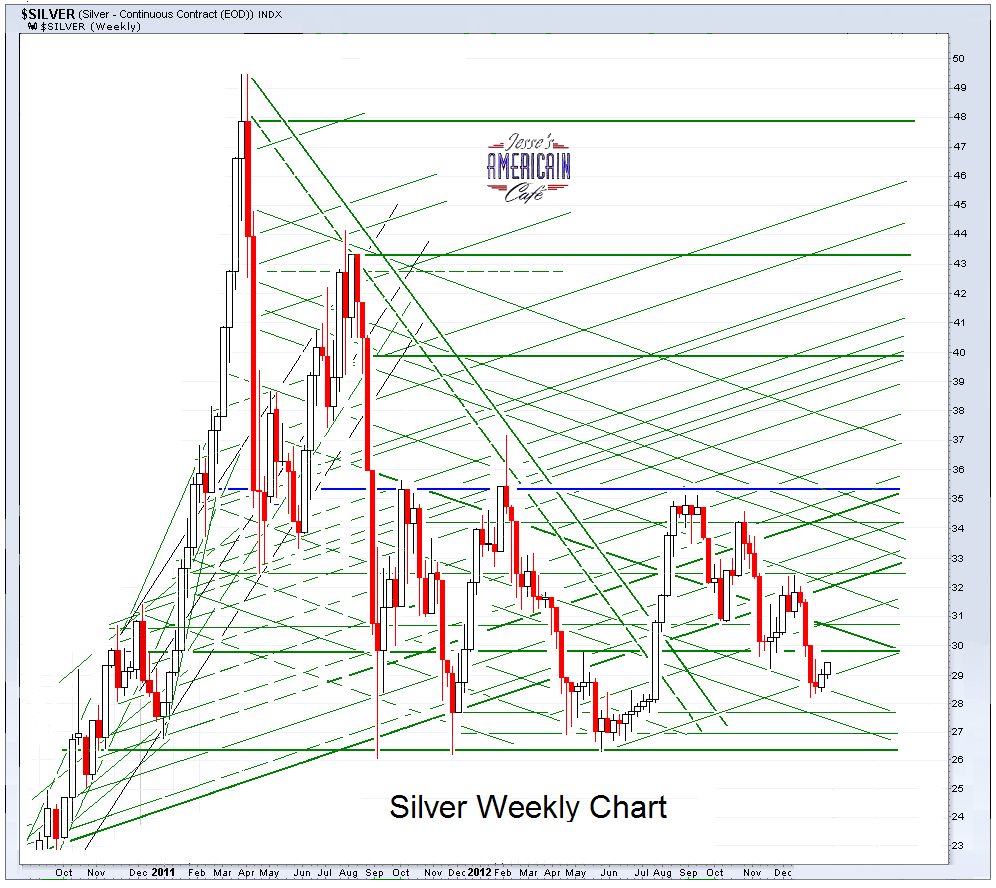
Gold Daily and Silver Weekly Charts


False confidence based on hubris is resurgent.

Benny pledged to print until whenever and that was enough.


SP 500 and NDX Futures Daily Charts - Hope Isn't the Only Thing That Floats


Benny pledged his troth to printing until whenever today, and this helped the market to run back and try to break out above our pivot point at 1550.

After the bell Oracle missed on sales and profits.


19 March 2013

Gold Daily and Silver Weekly Charts - New Zealand Goes Cyprus-Style, RBNZ Responds


"Here in New Zealand the Reserve Bank is moving to add an Open Bank Resolution Policy (OBR) to tools it could potentially use in the event of a bank failure.

The implementation of OBR would see all unsecured liabilities that rank equally among themselves, including deposits, having a portion frozen. The Reserve Bank says the OBR policy could save taxpayers' more than NZ$1 billion regardless of whether there is a bank failure or not.

However, Norman points out that if a bank fails under OBR, all depositors will have their savings reduced overnight to help fund the bank’s bail out."

Green Party Hits Out at NZ Government's Cyprus-Style Solution to Bank Failures

And the Reserve Bank of New Zealand responds:
"If their bank fails, depositors have always needed to understand that deposits are not guaranteed. What OBR does is facilitate a rapid and orderly resolution of a bank failure – it does not change the fact that depositors and other creditor funds are at risk...

The New Zealand Government has looked hard at deposit insurance schemes and concluded that they blunt the incentives for investors and banks to properly manage risks, and may even increase the chance of bank failure."

Reserve Bank of New Zealand, Open Bank Resolution, 20 March 2013

One understands that in the event of a bank failure, pain will be apportioned to the shareholders and depositors in New Zealand banks.  And it must certainly be an extraordinarily transparent financial system indeed so that depositors can properly assess risk, on a par with insiders. 

But one might ask, in the event of a failure, what is the penalty for the politicians, the banking management, and their regulators? 

Oh that's right, there are no banking failures permitted in New Zealand. So perhaps it is a moot question.  But it does seem that the people of New Zealand have some concerns and questions about this and, dare it be said, an imperfect confidence in their central bank?

Confidence, gentlemen, is the key. Oui?  

And so we pray for the best, but prepare for the worst.

"Those entrapped by the herd instinct are drowned in the deluges of history. But there are always the few who observe, reason, and take precautions, and thus escape the flood. For these few gold has been the asset of last resort."

Antony C. Sutton


SP 500 and NDX Futures Daily Charts - Euro Zone Up and Down


The market opened lower on fears of instability from Cyprus and the no vote on the depositor levy plan by their Parliament. It then bounced around based on a series of developments out of and statements out of Europe. It closed with modest losses on expectations that the Eurozone leadership would 'do something.'

I expect the Fed meeting but especially developments in Europe, to drive equity action for the rest of the week.


Modern Money: A Study In Confidence and Crisis


"Those who think there is little risk of a levy being imposed on other periphery members are missing the point. The seeds of doubt have been planted. As a saver facing zero yields on deposits and a potential haircut, why keep your savings in a bank? Sure it is convenient for electronic transactions, but individuals can adapt easily. As one of my more amusing colleagues put it, 'mattresses now hold a 10 per cent premium.'"

Ben Davies, Cyprus, Oh the Irony!


"Making small-scale savers pay is extremely dangerous. It will shake the trust of depositors across the Continent. Europe's citizens now have to fear for their money...

The Spaniards, Italians and Portuguese may not run to the banks today or tomorrow, but as soon as the crisis intensifies in a euro-zone country, the bank customers will remember Cyprus. They will withdraw their money and, by doing so, intensify the crisis."

Peter Bofinger, 'Europe's Citizens Now Have to Fear for Their Money,'  Der Spiegel, 18 March 2013

Modern money is a game of confidence, an arrangement based wholly on the perception of value founded in counterparty risk.

This sounds easy enough, but what is surprising is how few people really understand it. This is due to the illusion of the familiar.

We are so accustomed to using money in our daily lives that we give little thought to what it really is.  It seems solid, immutable, and lasting.  'As sound as a dollar.'

We forget that money, like much of society, is a man-made, artificial construction based on a series of agreements. Sometimes those agreements are based on implied force, such as punishment for breaking the laws. But by and large the enforcement is not equipped to deal with all but the outliers to a general compliance with the law. This is, of course, the basis of the power of civil disobedience, and why autocracies are so sensitive to any mass demonstrations of dissent.

The President of Cyprus, Nicos Anastasiades, recently elected from the conservative DISY party, blanched at the original bailout deal offered by the troika, the European Commission, the European Central Bank, and the International Monetary Fund, to assess a levy only on the non-guaranteed deposits in the troubled Greek banks, which are those deposits in excess of €100,000.

He proposed instead to limit the levy on large deposits to 9.9%, and to make up the difference by violating what had been the general guarantee in Europe by assessing a lesser amount, of about 6.7%, on the 'guaranteed deposits' of less than €100,000 by small savers.  That the troika did not blanch at the prospect of violating what had been a generally established EU policy to ensure bank stability speaks volumes about their cravenness.

The arrangement was made all the more clever by promising equity in the (worthless) banks in return for the levy, and perhaps even a guarantee of return based on 'future natural gas discoveries' which seem to be of much less value to the EU and the government.

This was one of their conditions for a €10 billion loan to the government under the European Stability Mechanism (ESM). The other involved the usual austerity measures, which are a favorite of the International Monetary Fund.

The austerity proposal had been revealed last November and include cuts in civil service salaries, social benefits, allowances and pensions and increases in VAT, tobacco, alcohol and fuel taxes, taxes on lottery winnings, property, and higher public health care charges.

The troika did not care about the details of the levy as long as the 'bail in' by depositor funds occurred. This was a sacrifice of a general European principle and was a serious policy error.

When this 'levy' on bank deposits was revealed over the weekend during a bank holiday, because it had to be submitted to a vote by the Cypriot Parliament, there was a general revulsion expressed amongst the markets and the people of Cyprus at such blatant misuse of the money power.

Monetary inflation, such as had been used in the US and UK, is more often used because so few people see their loss as blatantly as when the government simply confiscates 10 percent of their wealth on deposit. It is much easier done in smaller amounts, over longer periods of time. But one needs to have their own currency to do it.  These days monetary policy and inflation is merely the continuation of bank fraud and plunder by other means.

By the way, this is why I thought the 'platinum coin' of a notional and whimsical trillion dollars in value was such an awful, dangerously cynical idea. It exposed the farce of monetary inflation in too great an amount, in too short a period of time, in a way in which too many people would readily understand it.  And it therefore had the potential of fomenting a money panic.

Cyprus had been reasonably stable before the financial collapse, but was rocked by the Greek bond restructuring. What dealt a fatal blow was the impediment to borrowing because of a credit downgrade to BB+, which made the Cypriot bonds unacceptable as collateral to the ECB, and certainly not viable on the public markets.

And like many small, warm weather island nations, it's economy was overly dependent on tourism, retirement, and an outsized financial sector. Since Cyprus had been a British crown colony, its legal system resembles that of Britain, which still maintains significant military bases on the island, involving approximately 3,500 serving members.

Cyprus is in a bit of a box, because it really needs to leave the Eurozone and default on its obligations, and issue a currency of its own at a devaluation to the euro. But how would they recapitalize their banks, and what would the basis be for any reasonable valuation on this new currency?

If Cyprus owned gold reserves, or even forex reserves of some stable currency, they could make this the basis of their currency, while imposing capital controls. They could liquidate, nationalize if you will, the banks, and keep the depositors whole. Although the conversion to the new Cyprus currency would be a haircut of sorts, and likely impair their banking haven status.

Iceland was able to do something like this, and so was Russia for that matter, when they defaulted, devalued, and reissued the rouble back in the 1990's.

What would the Eurozone say if Cyprus forged a deal with Russia and provided them with military bases similar to the Sovereign Base Areas, currently occupied by the British, in return for a Russian bailout? Russia is a key debtholder and a major stakeholder in Cyprus. Their interests and presence must be dealt with, and carefully.

The question of Cyprus is important, not because it is a large and significant portion of the Eurozone economy. It is most certainly not, being much less than one percent of the total.

Rather, Cyprus is showing the fatal flaws in the conception of the Eurozone, and their single currency without real fiscal union, transfer payments, a common system of taxation, and a banker of last resort.

And it has also demonstrated the weakness of the guarantees by the bureaucrats, not only in Europe but elsewhere, when it comes to money. 

This is a lesson that every central banker around the world should keep in mind.  And the bureaucrats should remember that there is a step beyond which they may go, which will shatter the confidence of the people.  And once that confidence is broken, it is very hard to recover it.

There is one lesson I hope that the people of the world take away from this.  And that is to remember that a single currency is not possible without a complete union of monetary policy, and therefore a fiscal and political union that is complete and comprehensive.  Otherwise a powerful group will wield monetary policy for their own benefit, and the rest of the currency area be damned.

When the single world currency proponents come around again with their proposals, what they are really proposing is a one world government to be established in the ensuing crisis which their actions will eventually provoke.

And despite the consistent capping of the precious metal markets, it demonstrates that there is only one money of last resort, that provides for no counterparty risk.  And that is gold.  And to a lesser extent the reserve currency of the world, which for now is the dollar. 

It is confidence that sustains the integrity of a system based on counterparty risk,  and it is that confidence that supports modern money.  And where confidence declines, force is required.  And where both force and faith fail, a break in confidence happens, and hyperinflation ensues. Hyperinflation is not simply a very high level of inflation.

A hyperinflation is a break in confidence, a monetary panic.

And in what is certainly a bit of historic irony, the German people are once again flirting with bank failures and a hyperinflation.  But in this case it is because they, in their righteous indignation, are imposing the same kind of collective punishment, in terms and conditions of economic austerity and privation on others, that were imposed on them in post war reparation.  Oh the irony, indeed.

Spring is in the air.  Plus ça change, plus c'est la même chose.

Related: New Zealand Adopts 'Cyprus style' Levies to Protect Their Banks From Insolvency


18 March 2013

Gold Daily and Silver Weekly Charts - Pop Goes The Weasel - JPM Wins Silver Case Dismissal


As expected, JPM has won a dismissal of the civil price-fixing lawsuit.  What a surprise!

I found this piece called Cyprus, Oh the Irony! by Hinde Capital to be an interesting read.

Gold and silver had a modest advance, nothing as one might have expected given the extraordinary risks that remain in Europe and the international financial system.

Stocks even managed to rally today based on 'good homebuilder news' and a series of rumours about the Cyprus situation.

This was almost exactly as I had said it would happen. There is a definite market operation going on to inflate stocks and to cap the precious metals. The hedge funds have significant event exposure here, although it is hard to determine it without seeing all of the trades on their books.

So what next?

Spain had a 'bank holiday' today as well as Cyprus. While Cyprus' banks will remain closed until Thursday, the banks in Spain will reopen tomorrow and there are concerns about 'contagion' as depositors may choose to move their funds to safer waters.

So let's see what happens. I expect that the central banks will wish to paper over this problem and move back to a muddle through strategy in which an uneasy equilbrium is achieved through the continuing force of printing money. But events can get out of hand, and rather quickly at times.


SP 500 and NDX Futures Daily Charts - American Exceptionalism


The equity market operated pretty much as I had expected, with a few opportunities for playing the volatility.

There is a definite bid under the US equity markets led by the SP futures. Whether it can continue to shrug off risk and rally higher is an open question. Supposedly the impetus for the stock market recovery off the overnight lows was the 'good news' from the homebuilders.

VIX shot up to the 50 day moving average today, and I took some off the table from Friday.  I am still looking for some additional intraday swings as rumours abound.

I still believe that 1570 remains a target on the SP futures for the wiseguys. And they may get it, and more, if the global financial system can hold together. I think they are taking profits and managing the hand off to mom and pop and their pension funds and 401k's.


Cyprus Update - The Calm Before the Storm - One Europe?


I am sure you are aware of the events unfolding in Cyprus, at least if you follow the financial news and the internet.

The vote in the Cyprus Parliament has been postponed until Tuesday, most likely because the votes were not there to pass a resolution that was acceptable to the EU.

The bank holiday has been extended to Thursday, and it is doubtful they will reopen until the Parliament has sorted out a plan of action.  The shutting of the banks while the politicians wrangle over the details of the confiscation is not designed to heighten confidence.

As you may recall, the President of Cyprus, Nicos Anastasiades, a member of the conservative Democratic Rally (DISY) party, was elected in February of this year with about 58% of the vote. He is known as a blunt, chain-smoking 'strong man' with strong ties to the right wing politicians of Europe. Indeed, these connections and his promise of a solution favorable to Cyprus were strong factors in his recent electoral victory.

The extenuanting factors here are that Cyprus is viewed as a bellwether for Italy and Spain. There are many who would dispute this, and point to the particularities of the size and structure of the Cyprus banking sector. But there is a widespread perception that the heavy hand of Germany is running the EU these days, and prior pledges and principles cannot be trusted if the central rulers of the EU are willing to confiscate the insured deposits of private citizens, no matter how they try to rationalize it.

I tend to view this as the overall progress in the foregone drama of an inherently unstable European Union that has fallen into a financial plutocracy. Any actions they take now are merely delaying the inevitable. And the consequences for the global financial sector are profound.

The EU and the Fed may be able to paper over the problems and achieve an uneasy stability that could last a year or two, but without profound changes to the European financial arrangements that include transfer payments, a single currency spanning such diverse national economies is inherently unstable.  It is the child of the overreach of bureaucratic arrogance and economic fairy tales.

This *could* be a rather clever move to force at least a portion of Europe into a single political government of twelve or fifteen members, but I hate to give the plutocrats that much credit for planning. 

I know there is and has been talk for quite some time of dividing the world into five or six major spheres of political influence, including North America and a few South American client states, Europe, Russia, China, and Japan.  The particularities of southeast Asia and the Pacific are very much in play, along with the status of various economic colonies in the Third World including Africa.  India and Australia are major outliers.  The UK has been particularly troubled by its relatively minor role, and aspires to be the financial center and interface to the world for the rest of Europe.

Whether any of this happens or not is very much open to question.  But the establishment of a 'new order' in the world has quite a few globally powerful adherents who are willing to work for this in the long term.  It should be remembered that the fashions of 'centralization and decentralization' of power have their swings, seemingly like a natural ebb and flow over time,  quite similar to what we often see in the corporate world.

17 March 2013

SP 500 Futures - 'Tax On Deposits' Triggers Tremors in La La Land


"News of the tax triggered a run on cashpoints in Cyprus over the weekend. Monday is a bank holiday and measures need to be approved before banks reopen on Tuesday.

Cypriot President Nicos Anastasiades, a conservative elected just three weeks ago, said the tax on deposits was an alternative to a disorderly bankruptcy.

In a televised address, he said it was painful but "will eventually stabilize the economy and lead it to recovery."

Savers who lost money would be compensated by shares in commercial banks, with equity returns guaranteed by future revenues expected from natural gas discoveries, Anastasiades said.

Reuters, Cyprus Works On Tax Levy Deal To Get Bailout Approved

The futures are down 16+ points this evening, most likely on jitters over bank instability in the eurozone.

According to one of my friends, Dennis Gartman sent out the following:
"By now I suspect that most of you have heard the news from Cyrpus over the weekend, but just in case you’ve not the Cypriot government has chosen to confiscate money from any and all accounts at any and all banks in Cyprus to pay for its banking problems...

This is astounding, and the decision was… if not fully decided in Brussels… was approved by Brussels and Berlin and Paris et al. This is unlike anything I’ve heard in my 40+ years of being in the market. This is HUGE news; this is massively bearish news for the EUR; this is massively bullish news for gold and this is THE MOST IMPORTANT BUSINESS NEWS OF THE YEAR THUS FAR. Please believe me on this; this is Europe’s “Lehman” moment.

I shall be around all day tomorrow trying to figure out what has happened here and why, but if the EUR… which closed on Friday at 1.307… does not open below 1.2900 and then continue lower, and if gold, which closed on Friday at $1590/oz does not open above $1625 and head higher I will be truly, truly stunned."

Be prepared; Monday is going to be violent"
I had a couple of email messages after a post about the sacredness of trust in money and banking earlier today.  They implied that I had a misplaced sympathy for the crooked Russians, and the little people of Cyprus.

That post was not intended to be a moral message, although morality is certainly involved.  It is more of a practical matter. 

When your money system is based on trust, it is critically important to maintain appearances.  Simply reaching out and confiscating the insured savings of depositors is very bad form, especially when everyone knows you are doing it to support a rigged system that is run for the benefit of a fortunate few.

The sophisticates are fairly used to discussing the darker corners of injustice of the system in their own circles.  And they have become comfortable with it, as they are in viewing the victims of their greed as 'takers.'  I am sure that this played some part in the expedient decision to support the Eurocrony corporatist zone by simply stealing depositors' money, and deriding them as either crooks or hapless fools who 'must contribute.' 

 But what the cynical plutocrats do not realize is that most people still believe in the system, in rules and justice.  And it is this belief that sustains a system based on promises and guarantees and trust.

I am fairly certain that the financiers and central bankers will wish to shut down any incipient panic in the Euro banks. After all, the entire global reserve currency system is a confidence game.

Buying the SP futures and selling more paper gold and silver might do the trick.  And their talking heads will carry the message that this is much ado about nothing, and merely another buying opportunity.

They certainly have dipped into that bag of tricks many, many times in the recent past.  And personally I will be stunned if they do not make a determined effort to do it again.


With Regard to the Cyprus Bank Deposit Confiscations: Is Nothing Sacred?


Customer funds were long considered 'sacred' at brokerage firms, and were segregated from the proprietary operations of the company. And they were stolen at MF Global, and no one has been punished.

Bank deposits, protected by insurance and the guarantees of the government, were long considered 'sacred' at financial institutions. And they are being stolen in Cyprus as a matter of convenience to the crony capitalists in Europe, who are loathe to force the banks to take their losses.  And so they impose them on the people.

And this is what was done, and is still being done, in the US and the UK as well.  It is merely being done in a different form.

The Parliament of Cyprus will vote on this plan on Monday.

There are always various ways, and people, who will be willing to justify such theft. The banks were taking dirty Russian money, the people are lazy spendthrifts. This is always how it goes when the oligarchs steal to finance their gambling losses.  And in their insular arrogance they always go too far, provoke a reaction, and then act surprised.

As I wrote a few weeks ago:
Politicians from both sides of the aisle will swear pious oaths to protect and foster the well being of the middle class. They will say that their policies and proposals are all designed for its betterment. And yet the state of the middle class continues to dwindle into despair and disrepair. Why is this?

It is not because of the predominance of a right or left ideology, of taxation and deficits and austerity. It is not because of the re-emergence of a perversion of the gospel, in the predestination of prosperity. We have seen all this before. It is not because in our comfort we have lost the sense of the imperative of common cause.

It is because of the overwhelming corruption of power, and of the cynical amorality of thoroughly modern political managers who worship power and personal wealth as ends unto themselves. They distract the people with artificially divisive social issues and crises, while robbing them blind.

It is driven by the allure of the cartels, monopolies, and monied interests, and their corrupt political bargains. It is a child of the subornation of perjury on a massive scale. It is the unscrupulous servility to power of those who have sworn to uphold and protect the law. What is truth? Whatever suits us, whatever we say it is, by whoever has the power and the craft to define 'we.' It is not the triumph of evil so much as the absence of any sense of the good, of honor, honesty, and of simple common decency.

And it is marked by the daily subverting of the law as a matter of convenience and comfort to the insatiable few, and the cravenness of their enablers, driven by personal ambition, ignorance, and fear. It is the will to power, the elevation of the ascendant self and the system that supports it, above all else. Greed is good. Whatever works. And the enemy is all that is not the self, but that which is the other.

And where there is nothing sacred, the people perish.
Protect yourselves.  And do not look only to your wealth, but also to what is lasting.
"For what does it profit a man to gain the whole world, and lose his soul?"


15 March 2013

Gold Daily and Silver Weekly Charts - Shoving Paper Around the Plate


The hedge funds are on top of these precious metal markets and do not wish to let them up for air.

Gold is in one of those long consolidations we have seen in this bull market.  When it is ready to move again it is going to break out.

And it may take no prisoners from the bear camp when it does.


SP 500 and NDX Futures Daily Charts - Complacency Reigns


Fresh revelations and a bloody day of testimony about shenanigans at JPM had the punters buying the dip to finish the day about evens on the financials side and thereby the SP.

VIX continues to be remarkably low as the market quietly grinds higher and the dips get bought.

Have a pleasant weekend.


Financialization of Justice: SEC Settles Insider Trading Case With SAC Capital For $600 Million


Stevie Calls His Shot, Hits It Out of the Park

Breaking news per Bloomberg:

SEC settles with SAC Capital for $600 million over insider trading related to Mathew Martoma case.

Apparently Stevie Cohen's deposition really was that bad. But luckily he was able to monetize any criminal charges.

I think this is a bigger fine than Goldman paid for Abacus.   Of course SAC is not as systemically important as Goldman.

But that fine is less than Steve Cohen's reported personal compensation in 2005 and 2010 alone, according to the WSJ, which pegs it as a billion dollar paycheck each year for Steve.  His normal compensation is in the mere many hundreds of millions.

Steven A. Cohen, aka The Wizard of Great Neck, or Guru of Gruntal, is worth approximately $8.8 Billion as of March 2012.

Obama: Iran 'Year or So Away From Nuclear Weapon', US Will 'Use All Options'


While we are enjoying the diversion of watching Carl Levin go through the JPM witnesses like a wrecking ball, this particular story caught my eye.

As a reminder, Matt Taibbi is live-blogging the JPM testimony event and is providing colorful commentary. 

But meanwhile, the world muddles on...

ABC News
Obama: Iran a Year Away From Nuclear Weapon
By Devin Dwyer
March 15, 2013

In an interview with Israeli TV ahead of his visit to the region next week, President Obama says he believes Iran is "over a year or so" away from being able to develop a nuclear weapon and that the U.S. will use "all options" to stop it.

"Right now, we think it would take over a year or so for Iran to actually develop a nuclear weapon, but obviously we don't want to cut it too close," Obama told Israeli Channel 2.

"They are not yet at the point I think where they've made a fundamental decision to get right with the international community," he said, "but I do think that they're recognizing that there's a severe cost for them to continue on the path that they're on and that there's another door open."

Read the entire article here.

As they say about all real estate: location, location, location.


Greenspan: No Irrational Exuberance, Stocks 'Undervalued' - The Rake's Progress

 
“I recognise that there is a stock market bubble problem at this point, and I agree with Governor Lindsey that this is a problem that we should keep an eye on....We do have the possibility of raising major concerns by increasing margin requirements. I guarantee that if you want to get rid of the bubble, whatever it is, that will do it.”

Alan Greenspan, September 24, 1996 FOMC Minutes


"Where a bubble becomes so large as to pose a threat the entire economic system, the central bank may appropriately decide to use monetary policy to counteract a bubble, notwithstanding the effects that monetary tightening might have elsewhere in the economy.

But how do we know when irrational exuberance has unduly escalated asset values, which then become subject to unexpected and prolonged contractions as they have in Japan over the past decade? And how do we factor that assessment into monetary policy? We as central bankers need not be concerned if a collapsing financial asset bubble does not threaten to impair the real economy, its production, jobs, and price stability."

Alan Greenspan, December 5, 1996, Speech to the American Enterprise Institute


"American consumers might benefit if lenders provided greater mortgage product alternatives to the traditional fixed-rate mortgage. To the degree that households are driven by fears of payment shocks but are willing to manage their own interest rate risks, the traditional fixed-rate mortgage may be an expensive method of financing a home."

Alan Greenspan, February 23, 2004, Speech to Credit Union National Association


"Although a "bubble" in home prices for the nation as a whole does not appear likely, there do appear to be, at a minimum, signs of froth in some local markets where home prices seem to have risen to unsustainable levels...

The apparent froth in housing markets may have spilled over into mortgage markets...

Although we certainly cannot rule out home price declines, especially in some local markets, these declines, were they to occur, likely would not have substantial macroeconomic implications."

Alan Greenspan, June 9, 2005, Economic Outlook


"I was aware that the loosening of mortgage credit terms for subprime borrowers increased financial risk. But I believed then, as now, that the benefits of broadened home ownership are worth the risk."

Alan Greenspan, September 2007, The Age of Turbulence


"...the problem at its root is a flawed business model, and that business model is the product of a government regulatory decision to repeal Glass-Steagall administratively and legislatively, and to seek this tremendous concentration of power; and then the abuse of that power by the investment houses...

What we want to do is clean up the system and hold the individuals accountable, and that is what we have tried to do...But there was an understanding that if we were to seek criminal sanctions against either the institution or the most senior people of the institution, the practical impact in our regulatory environment would have been to destroy those institutions, and then structural reform would be meaningless...because the harm to our economy that would result from eliminating a Citigroup or a Merrill Lynch is enormous, and it's disproportionate to the remedy that we want.....

It was incredible. It was distressing to me how simple and outrageous it was. It wasn't so complicated that you said, "Wow, at least they're smart in the way they're doing it." It was simple. It was brazen. The evidence of it was overwhelming. It's just that it hadn't been revealed to the public, and that's why could get away with it...

Over the past decade we've wanted to deregulate, and we've said, "Let's get government out of the business of looking at these issues, and permit industry to control itself, because we can trust them." Maybe that's been a very good thing in some ways.

One of the things that is eminently clear from our investigation is that all the compliance departments, all the self-regulation is nothing. They watched it, but they did nothing. So we've got to think this through, and it's not only the financial community. There are a lot of sectors where we have said self-regulation is the answer. We've got to think about it."

Eliot Spitzer, The Wall Street Fix, March 16, 2003


"The vast majority of privately negotiated OTC contracts are settled in cash rather than through delivery.

Cash settlement typically is based on a rate or price in a highly liquid market with a very large or virtually unlimited deliverable supply, for example, LIBOR or the spot dollar-yen exchange rate.

To be sure, there are a limited number of OTC derivative contracts that apply to nonfinancial underlying assets. There is a significant business in oil-based derivatives, for example. But unlike farm crops, especially near the end of a crop season, private counterparties in oil contracts have virtually no ability to restrict the worldwide supply of this commodity. (Even OPEC has been less than successful over the years.)

Nor can private counterparties restrict supplies of gold, another commodity whose derivatives are often traded over-the-counter, where central banks stand ready to lease gold in increasing quantities should the price rise.

To be sure, a few, albeit growing, types of OTC contracts such as equity swaps and some credit derivatives have a limited deliverable supply. However, unlike crop futures, where failure to deliver has additional significant penalties, costs of failure to deliver in OTC derivatives are almost always limited to actual damages.

There is no reason to believe either equity swaps or credit derivatives can influence the price of the underlying assets any more than conventional securities trading does."

Alan Greenspan, July 24, 1998, Testimony on the Regulation of OTC Derivatives

Hubris has no shame.

CNN
Greenspan: No irrational exuberance, stocks undervalued
By Chris Isidore
March 15, 2013

NEW YORK (CNNMoney)
Former Federal Reserve Chairman Alan Greenspan said that even with record-high stock prices, investors don't need to worry about "irrational exuberance" this time.

In fact, his current view is that stocks are still "significantly undervalued."

Read the entire article here.

Related: Michael Hudson and Pierre Rinfret: The Myth of Alan Greenspan


14 March 2013

SP 500 Rally - Same Time Last Year


As you may recall, 2012 started out with a fairly steady stock market rally.

It was quite similar to the rally which we have seen so far this year.


The chart below shows how the rally ended in 2012.

It lasted until the end of March when it reached almost thirteen percent.

It chopped sideways through the month of April, and then gave up almost two thirds of its gains by the end of May.

Perhaps it will be different this time. Change you can believe in.


Gold Daily and Silver Weekly Charts - Stocks To Record Highs on Complacency


Gold held in rather well considering the new lows in the VIX and the new highs in stocks.

As a reminder, tomorrow is the March stock option expiration.


SP 500 and NDX Futures Daily Charts - 10th Rally Day, SP Nears Record - Complacency


Another new record high on the Dow Jones Industrials, as the SP 500 approaches its all time high set in 2007.

Bernanke is creating another asset bubble, once again in equities.

Check out the VIX. I bought some VIX as insurance. Tomorrow is stock option expiration for March.

I rolled my futures charts over to the June contract today. The new objective for the SP is in the 1565 to 1570 range.


13 March 2013

Gold Daily and Silver Weekly Charts


As a reminder this Friday is the option expiration for US equities.

Monday March 25 will be the option expiration for gold and silver on the Comex. This year's calendar is included below.

Today the miners were sold as the metals retreated a bit.


SP 500 and NDX Futures Daily Charts - Recurrent Complacency Into Option Expiration


VIX fell back as the Dow moved to another record high intraday led by IBM.

SP managed to rally back into the close, but the NDX continued to show a divergence.

As you know I have a chart objective of 1570 working on the March SP futures, which will be rolling over to June shortly, and the target will be about five points lower at 1565. June closed at 1550 today.

This Friday will be the March option expiration for stocks.


White Smoke Over the Vatican


Jorge Bergoglio of Argentina has been elected pope, Francis I.

Jorge Bergoglio was born in Buenos Aires, Argentina, one of the five children of an Italian railway worker and his wife. After studying at the seminary in Villa Devoto, he entered the Society of Jesus on March 11, 1958. Bergoglio obtained a licentiate in philosophy from the Colegio Máximo San José in San Miguel, and then taught literature and psychology at the Colegio de la Inmaculada in Santa Fe, and the Colegio del Salvador in Buenos Aires. He was ordained to the priesthood on December 13, 1969, by Archbishop Ramón José Castellano. He attended the Philosophical and Theological Faculty of San Miguel, a seminary in San Miguel. Bergoglio attained the position of novice master there and became professor of theology.

As Cardinal, Bergoglio became known for personal humility, doctrinal conservatism and a commitment to social justice. A simple lifestyle has contributed to his reputation for humility. He lives in a small apartment, rather than in the palatial bishop's residence. He gave up his chauffeured limousine in favor of public transportation, and he reportedly cooks his own meals.

His motto as a cardinal is 'miserando ateque eligendo' which is a phrase from the writings of Venerable Bede.
Vidit ergo Jesus publicanum, et quia miserando atque eligendo vidit, ait illi, Sequere me.


12 March 2013

Gold Daily and Silver Weekly Charts - The US Dollar: Keeping Up Appearances


Ron Paul: "I had a Federal Reserve Board Chairman testify before the committee that the gold standard had some merits but it was unnecessary because central bankers have now learned how to manage a Fiat currency in a manner in which it would mimic the gold standard. Would anybody care to comment about where the flaw is in that thinking?"

Mr. Lehrman: "I am anxious to comment on that, Dr. Paul. Under--and I must say Mr. Greenspan made the same insipid remark. Mr. Greenspan and Mr. Bernanke will have to then explain why it was that two of the greatest booms in American history, and two of the greatest panics and busts in American financial history, occurred under their 25-year watch..."

Mr. Grant: "The failure of AIG is so instructive in this respect. AIG, this immense insurance company with this ever so brilliant financial products group, didn't do one thing. It didn't mark its positions to market. Finally came the day of judgment and it argued with Goldman Sachs about what these things were worth, AIG said 100 cents on the dollar, Goldman Sachs said not close, Goldman Sachs won that debate and AIG failed.

As with AIG and Goldman Sachs, so it is today with the United States and its Asian trading partners. We never clear our trades. Our dollars go there, and they come right back here. We run twenty five consecutive years of debts on a current account and there will be for us, as there was for AIG, a moment in truth in which we must settle."

U.S. House of Representatives, Committee on Financial Services, Testimony of March 17, 2011

The US will settle, in paper dollars.  And if the payment is insufficient, they can always create more.

That is the long and short of it, and the sophistry of modern money.  Because the value of the money is self-referential, it is in essence a literal confidence game.  The dollar is worth what we say it is, and it is worth it because we say it, without regard to other opinions and considerations to the contrary. And as long as people believe this, or even pretend to believe this even if they don't but are afraid of the consequences of their disbelief, the dollar hegemony is secure.

Money is a matter of force and confidence; and when confidence wavers, force must provide. Force can take many forms, from persuasion to deception and even compulsion.

So the appearance of solidity and confidence must be maintained no matter what.   It must, as apparently Messrs. Greenspan and Bernanke have said, must 'mimic the gold standard.'  And they are right.  Caesar's wife must be above reproach, and the fiat dollar is the dowager queen of empire.

That is why the chat board gimmickry of the platinum coin was such a remarkably dangerous folly. Even given that money is a somewhat specialized area of study, it was shocking that a distinguished economist like Paul Krugman did not seem to understand it.  I could attribute that to a moment of political weakness. 

But the rest of the world did understand exactly what was happening, and held its breath.  Would the US dare to cynically impugn the basis of its debt, even by implication? 

Perhaps the greater question, such silliness as trillion dollar platinum coins aside, is how far the Anglo-American financial system is willing to go to keep up the appearance and dignity of a stable global reserve currency in the dollar, even while the dollar is being used and abused by the financiers like a 12th Avenue hooker?

I think you know that I believe that the paper metals markets are an accident waiting to happen, particularly with regard to silver.

It appears that the exchange and the regulators are managing the markets with reckless disregard for their soundness.

So let's see what happens.


SP 500 and NDX Futures Daily Charts - Quick Flip


We had a little backtracking today, but stocks bounced into the close.

VIX climbed a bit, and I took the highly levered bets off the table remarkably near its apogee. Thanks.  Every little bit helps. 

I have a balanced short riding just for grins, but it is greatly reduced. 

So what next. I still am thinking that the wiseguys will have a go at 1570 on the SP futures before this thing falls apart, but keeping the leverage under tight control at such a dodgy time is not so bad either.  To put it in a briefly pithy statement, these Wall Street jokers are barking mad, and Washington is living on their own planet.   Words do not quite capture how I feel about this.

The event risk here is enormous. These markets remind me of a big fat souffle, full of the air of HFT, QE, arrogance, and leverage. If someone slams the oven door it could go quite flat without much more provocation.


Kyle Bass On Japan and Two Key Slides


I was listening to Kyle Bass' forecast of what he sees as the coming financial collapse of Japan.  A link to that presentation at the Booth School is included below.

Here are two key charts that I obtained from Wikipedia that weigh on the economic situation in Japan.  They are a bit particular to that country.

Japan has a largely homogeneous population sharing a common racial heritage and language.  There is little immigration other than a few guest workers, and a shortage of natural resources.  It does have a strong store of intellectual human capital, a highly motivated and capable work force, and a remarkably strong central planning structure.  The public is unusually cohesive and oriented towards the common good. 

I think that although it is packed with facts, Kyle Bass's analysis is a little overly simplistic, and not completely fungible to other countries as he implies in the Q&A as indicated in the talk below. 

I am a little disappointed that Mr. Bass deals with the externalities through the numbers, but never discusses the structure of Japan's economy and the keiretsus, which is very important, and far from incidental.  He also gives a nod to Japanese culture and then dismisses it.  That also is an error, but it is a very common Western error, and he has plenty of company.  After all, inside every foreigner is a greedy, self-serving American style plutocrat just waiting to get out, right?

He also ignores the enormous private losses from the real estate bubble that were never realized, and were essentially buried by the industrial-financial combines together with a single party government of well-intentioned insiders.

He says that Japan is already in the zone of insolvency, and it is obvious that they will collapse.  I think that this is possible, but not inevitable.  If there ever was a case to be made for MMT,  or some sort of debt restructuring in the model of Iceland, another island nation, Japan might be it.  I suggest the latter might be more fruitful because of their dependency on natural resource imports.

Japan's strength, as always, is in what is not seen, not so readily apparent, to Western eyes. 

The primary obstacles to restructuring are the scarcity of natural resources which presumably must be imported, and the lack of population growth with immigration as a threat to racial homogeneity.  Available real estate and population density on an island are also key factors.  These are the classic scenario inputs that lead to colonial expansion which seems not to be a viable option at this time.

The comparisons to the US situation are overly glib and miss the key differences.  The solution for the US is growth, and it has all the options open that are so problematic for Japan.   

What the US lacks is a more public spirited policy making apparatus, one that is not captive to special interests.  It labors under the corruption of big money, and suffers from growing wealth inequality that is beginning to approach a third world oligarchy.  Japan has a GINI coefficient of 38, whereas the US has a coefficient of 45, and increasing.

I am not so much concerned for Japan, but for the tangled web of carry trades, derivatives, fraudulent misrepresentations, and leverage that is the Western financial system.  Japan would certainly be large enough to give it a stress test beyond the Fed's most rigorous scenarios. 

The financiers such as Kyle Bass might be more concerned about this, and not look so greedily at the situation as just another money making opportunity, if they were not so arrogantly sure of a US dollar bailout at any and all costs, even in the event of a major financial dislocation that begins abroad.

Here is a recent talk by Kyle Bass regarding 'The Coming Financial Crisis in Japan.'


Monetary Theory: Where Is the Flywheel and other Intellectual Ponderings and Squabbles


Money is power. And so like those other loci of power, politics, tribalism, and religion, the discussion can sometimes obscure rather than illuminate the facts and issues, such being the emotional state of people.

The discussion can sometimes become very heated, and very particular over the finer points, in a vacuum.   A system becomes rigorous and hardened by usage, and effete and elaborate the longer it is parked on the bench.

I am thinking of course of the recent case of Krugman v. Sachs. It tends to strike someone outside of professional economics as a nerdish slap fight.   If you are blissfully unaware of this, feel free to skim on to the next topic.

There are no quarrels so petty and yet so vicious as those in the faculty departments, precisely because there is so much and yet so little at stake.  It is where people who are essentially without the power to implement their ideas in the real world must leverage the power of their reputations.

I will not get into the specifics of this particular squabble, except to say that out of frustration Sachs was needlessly provocative in penning an op-ed in collaboration with a deficit hawk.  And Krugman has been similarly provocative, out of frustration, in answering objections to deficits by ardent austerians by saying things like 'deficits don't matter' in public forums. Yes, yes he modifies this in the footnotes. But he lowers himself to the level of economic luddites and that is a mistake.

This lowering of the discussion is an understandable outcome given the staged performances, little more than wrestling matches pitting talking head against sound bite adversary, that passes for information on the Sunday morning talking shows and the mainstream news.  It is the age of not of reason, but spectacle.

I suggest that the real reason that Krugman and Sachs are 'at each other' is because the standard bearer of the progressives is at best playing rope-a-dope, and at worst is little more than a cynical deal maker. I speak of course of Barack Obama, whose position is always hard to discern from the standpoint of principles if one watches what he does rather than what he says.  And I suggest that this is because he has few principles, rather than perhaps sentiments, that get in the way of his pursuit of the deal, and his own power. 

Now I turn to the curious situation of the Modern Monetary Theorists.

Let me state, unequivocally, that there is nothing new to be seen here. There are no new discoveries, there are no new wonderful theories that make things possible that were not possible before, in the manner of an invention like the transistor, atomic fission, or flight.

What is presented as 'new' is the notion that the state can simply print and distribute its own funds as needed, determined by it.  And in doing so there will be no serious consequences.

I am willing to suspend all other discussion and objections, and bring this down to the absolutely critical point in any monetary system. And that is, 'where is the flywheel?' Or for the less mechanically inclined, where is the constraint, the restraint, the governing factor, on expanding the money supply?

In the case of an external physical standard, like gold and silver, or a hard peg to another currency, that constraint is easily seen. The 'flywheel' that governs how fast the printing presses may go is the amount of gold and silver one can obtain, or the level of value of some other currency, that is hopefully stable but may not be.

One can expand the money supply beyond the metal supply, but only with a conscious and obvious devaluation of the units which each ounce of gold and silver represents.  Or one can cheat and lie, but that is another matter, and a facet of all human systems which lack transparency.

In the case of a debt based market system, the flywheel is the willingness of the market to take the government debt at some value which 'works' for the monetary authority's purposes.

It is undeniably true that Bernanke is gaming this mechanism in what is purported to be the short term by buying that debt, the government bonds, at non-market, artificial prices. And it shows up in the Fed's balance sheet, for all to see.

As I have pointed out at some length before, as long as the Fed has at least one Primary Dealer in on the scheme, the money machine can keep turning until the market is revulsed by the stated valuations, and the machine breaks down.

And this is by design.  It is the principle of 'lender of last resort.'  And it is supposedly what provides the Federal Reserve System more flexibility to address currency shocks than a hard external system.  That the Fed has caused those currency shocks by its own policy errors at times is another matter.

But at least I understand why the Fed and the board of governors are doing what they are doing now, and it is obvious what they are doing despite the enormous lengths to which some may go to say otherwise.  And since it requires the agreement of a number of different, somewhat independent parties, it may very well stop before it goes too far. 

So I would ask, where is the flywheel in Modern Monetary Theory, in which the government spends at much as it wishes, and simply issues the currency to 'cover' its expenditures?

And if the answer is the checks and balances of the Congressional appropriations process and the policy of the Treasury Department, you will understand if the general public runs screaming towards the exits, given our recent experience with the budgeting and spending levels.  Or if the answer is that it is 'in the cloud' and that a restraint is an old-fashioned concept that is no longer applicable, then we will know that as it stands it is another new era idea like efficient market theory.

So, with regard to Modern Monetary Theory, what acts as the restraining factor on the expansion of the money supply? Where is the flywheel?

Answer that honestly and straightforwardly in less than two paragraphs,  and it might be said that MMT at least has a system.  And if not, it is something that needs to be done to take it from sophistry, which dodges and changes as required by the turn of the debate, into the realm of a real system that can be examined and critiqued.