25 June 2013

Gold Daily and Silver Weekly Charts - Quiet on Option Expiration


The vampire squid (aka Goldman Sachs) came out yesterday and announced that gold is 'overvalued.'

It did not result in a big sell off as perhaps was intended, although the metals were under pressure for their Comex option expiration.

Registered gold held for delivery was down to a new recent low at 1.36 million ounces. Perhaps the Street wants to provoke another paper sell off to justify the release of more bullion from the GLD ETF.

With physical gold in short supply anything that triggers buying could ignite quite the short covering rally. I think the long stocks - short gold cross trade is getting a bit tired.

Let's see what happens.


SP 500 and NDX Futures Daily Charts - 'Better Than Expected' For 'Rally Tuesday'


The Consumer Confidence number from the Conference Board came in 'better than expected' as well as the volatile durable goods and new housing prices.

Interesting that good news was not interpreted negatively as it has been of late. Maybe that was because it is 'rally Tuesday' today.


NAV Premiums of Certain Precious Metal Trusts and Funds - Comex Option Expiry - Bazinga


Just another Comex option expiration.

There are two things that are fascinating at the moment.

The first is watching the declining inventory of registered gold at the Comex. Although keep in mind that there is a much larger store of eligible bullion there that could be switched to registered and available for sale at the right price.

And the second is the worldwide manhunt for Edward Snowden. It is fascinating, especially if you can watch it from some objective distance and see the propaganda campaign that goes with it.   Why is the great reformer possessed by an almost Nixonian desperation for secrecy?

Curiouser and curiouser.


The Search for Edward Snowden


The Daily Show Does the US Ratings Agencies


The Daily Show does the ratings agencies, CNBC, and the opera buffo of the financial markets.

The credibility trap doesn't explain everything, but it does cover quite a bit.
"It is difficult to get a man to understand something when his salary depends upon his not understanding it."

Upton Sinclair


h/t Matt Taibbi


24 June 2013

COMEX Registered Gold Inventory Drops to New Lows


Bullion offered as deliverable inventories at the COMEX has dropped to new lows.

As a reminder, tomorrow is option expiration for gold and silver.

This evening Harvey Organ notes that:
"Tonight, the Comex registered or dealer gold lowers in inventory to 1.359 million oz or 42.27 tonnes. This is still dangerously low. The total of all gold at the Comex rose sightly to 7.681 million oz or 238.9 tonnes of gold.

JPMorgan's customer inventory remains constant tonight at 141,197.86 oz or 4.39 tonnes. Its dealer inventory also remains constant at 408,709.033 oz but it still must settle upon contracts issued in the June delivery month which far exceeds its inventory.

The total of the three major gold bullion dealers (Scotia , HSBC and JPMorgan) in their  gold Comex dealer account registers only 27.76 tonnes of gold."


The Wall


"The best weapon of a dictatorship is secrecy, but the best weapon of a democracy should be the weapon of openness."

Niels Bohr


"Every thing secret degenerates, even the administration of justice; nothing is safe that does not show how it can bear discussion and publicity."

John Dalberg Lord Acton


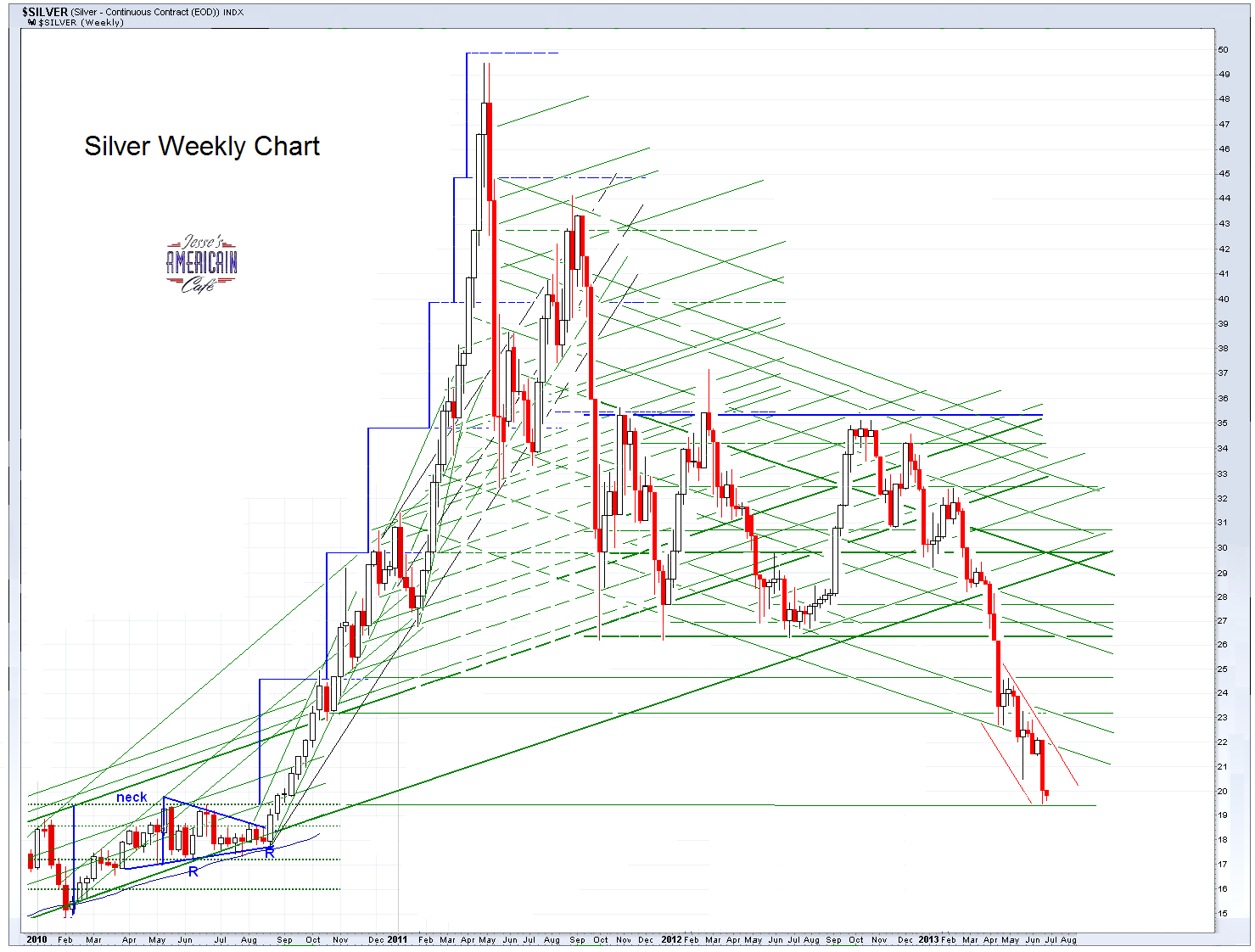
Gold Daily and Silver Weekly Charts - Option Expiration Tomorrow on the Comex


For those of you who are familiar with George Orwell's 1984, the histrionics about the search for arch-villain and espionage agent Edward Snowden reminds one of the search for the mythical enemy of the state in that book, Emmanuel Goldstein.

I will be curious to see what the equity market does, and how gold and silver go forward into the last few days of this delivery period with the existing inventory levels near record lows. 

As you know, when registered gold inventory has gotten to these record lows, it has marked an intermediate trend change within a month or so.

Speaking of contrary indicators, Dennis Gartman came out today and made some grunting noises about those unfortunates who own gold.  Dennis should know unfortunate, given the awesomely awful performance of the Gartman ETF (HAG.TO) which earlier this year went 'tits up' as they used to say in WW II.

For your convenience I have included the Comex calendar for the futures and for options below. 


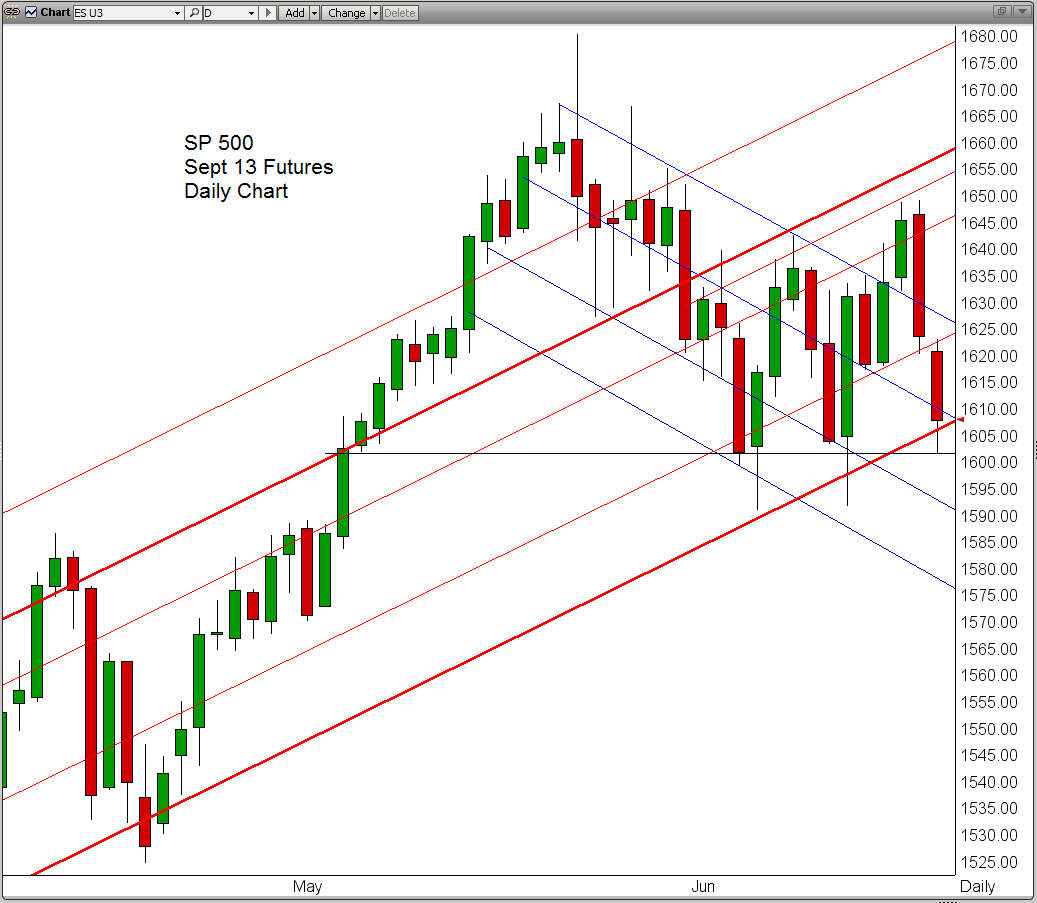
SP 500 and NDX Futures Daily Charts - A Fibonacci Cha-Chi


Intraday commentary on stocks here.

Richard Fisher made some remarks about 'feral hogs' testing the Fed's will in the market, and stocks rallied from there.

I thought it was a nice touch that he did so when stocks were almost precisely at the first key Fibonacci retracement level. Nice technical precision.

Stocks are appearing to try and find a footing after last weeks quadruple witching option expiration.


SP 500 Futures Intraday - You Can't Follow the Opera Without a Libretto


This is from my post earlier today at 11:17 AM.
"I may adjust my outlook if the September SP 500 futures do not hold at 1518 which is the 50% Fibonacci retracement level. Right now we are at 1553 which is about a 38.2% retracement from the highly controlled, almost straight line rally that began at the beginning of the year."
Here is what the futures market looks like now in the chart below.   This market is trading on the technicals. 

Technicals is sometimes a euphemism for calculated insider manipulation, as in a 'wash and rinse.' You convince the small investor to get in despite their fears at some higher price, and then one pulls the rug out from under them since the entire rally has been manufactured, and buy the same paper back on the cheap, thereby skinning them once again.

Some of this is herd instinct with the smaller traders, but the big dogs at the Banks and funds are setting the tone in this trade with all the passion of a McCormick reaper.

This is the norm for deregulated or under-regulated markets, a far cry from the 'efficient markets theory' which is a canard. This was standard operating procedure in the 1920's before reforms were introduced.

If you do not believe this happens, if you do not believe that traders signal each other of their intentions, if you do not know that the big trading desks watch the structure of the market as in who is holding what and then act on it,  if you do not understand that the financial sector is being recapitalized by looting the real economy,  then you may be either a shill for the house, witting or not, or one of the suckers at the table.
"It is difficult to get a man to understand something, when his salary depends on his not understanding it.”

Upton Sinclair
We may have more downside to the 50% retracement, and it could be more IF something real happens.  That means something real, something fundamental, and not a manufactured event off some mild Fed jawboning. 

But in my opinion everything that has occurred since Bernanke's non-statement last week has been the second act in this opera buffo known as the US financial markets. 


NAV Premiums of Certain Precious Metal Trusts and Funds


The disparity in premiums, albeit both still negative, between the Central trusts and the Sprott trusts is remarkable.

I think it can be attributed to the difference in their 'redeemability' for bullion.

The gold/silver ratio is now a bit over 65, showing that the markets are under some obvious and general liquidity stress, and as such, gold tends to offer a bit more 'safety.'

I am tending to view the selling in the equity markets as the effect of the Fed jawboning to let some of the air out of a growing asset bubble that was becoming overleveraged.

The professionals are using this as an opportunity to take the public and the real economy out for an old fashioned 'wash and rinse' in which they frighten people out of positions that up until recently they had been urging them to take.

There is money to be made in shorting, and then one buys the same assets all over again on the cheap. This is the fallacy of efficient market theory and the benefits of financialisation. It becomes, at its extremes of deregulation and moral hazard, little more than a wealth transferal scheme, which is a fancy word for a con game. And it can rise to and corrupt the highest levels of a society.

I may adjust my outlook if the September SP 500 futures do not hold at 1518 which is the 50% Fibonacci retracement level.  Right now we are at 1553 which is about a 38.2% retracement from the highly controlled, almost straight line rally that began at the beginning of the year.


23 June 2013

Glenn Greenwald Interviewed by David Gregory on 'Meet the Press' This Morning


Not the finest moment for the national mainstream media.

Please know that Glenn Greenwald is a regular writer for The Guardian newspaper, and has been reporting on certain policy issues for years. 

I found it repulsive that David Gregory could question Greenwald's right to the title of 'journalist,' preferring to label him a 'polemicist.' Is that because Greenwald was never a stand-in for Don Imus' morning talk show like David Gregory had been?

Where are the journalism schools in this time of official assault on their profession?

Gregory resorts to the bullyboy 'questioning' style in which statements and assumptions are first put forward as if they are true, to provoke a reaction of the person being questioned.  It is often saved for those whom the network views as undesirable, and in a weaker power position.

Television national broadcast media often resembles entertainment and infomercials moreso than straight journalism.    And it is little wonder why so many are turning to alternative sources for real news.
“The further a society drifts from the truth, the more it will hate those that speak it.”

George Orwell
This is like some bad version of The Hunger Games.


Here is a link to the complete show.

Obama's War On Whistleblowers - McClatchy


The Last Time the Feds Devalued the Dollar To Save the Banks


Here is a reprise of an article in which I take a closer look at the Gold Act of 1933 and the devaluation of the dollar against gold to recapitalize the banks.

As you may recall at the time the government withdrew gold from circulation it was the sovereign currency, and essentially 'owned' by the state, even while it was used by individuals as money.

This time gold has no official standing as money, and is considered private property, except perhaps for gold and silver Eagles which is a tenuous claim at best.

Therefore the government might be forced to use extraordinary and deceptive means to keep gold out of the hands of the people, and prepare the way for a revaluation of global currencies against gold is other ways.

Not all countries are on board with this, most notably China and India, although the RBI has been urging its people to substitute paper claims for actual bullion of late.

I do not think the US will go back to a gold standard.  However, I do think that there will be some inclusion of gold in the emerging replacement for the US dollar as the reserve currency for global trade.  I think it will be a basket of currencies and gold, perhaps silver. 

The revaluation of gold to the dollar would boost sovereign reserves significantly.  And I suspect that this move is being delayed while some countries are allowed to 'catch up' in their accumulation.

The Last Time the Feds Devalued the Dollar to Save the Banks
14 January 2009

We dipped once again into the Federal Reserve Bulletin Publication from June, 1934 to take a closer look at the growth of the monetary base, and found an interesting graphic that shows the accounting for the January 1934 devaluation of the dollar and the subsequent result on Bank Reserves in the Federal Reserve System.

As you will recall, the Gold Act, or more properly Executive Order 6102 of April 5, 1933, required Americans to surrender their gold coinage and certificates to the Federal Reserve Banks by May 1, 1933. There were no prosecutions for non-compliance except one benchmark case which was brought voluntarily by a person who wished to challenge the act in court.

After a substantial portion of the gold was turned in by US citizens and taken from their bank based safe deposit boxes, the government officially devalued the dollar from 20.67 to 35.00 per ounce in the Gold Reserve Act of January 31, 1934.

The proceeds from this devaluation were used to provide a significant boost to the Federal Reserve member bank positions as shown in the first chart below.

The inflation visited on the American people because of this action helped to take the CPI as it was then measured up 1200 basis points from about -8% to +4% by the end of 1933. To somewhat offset the monetary inflation the Fed also contracted the Monetary Base which served the nascent recovery in the real economy rather poorly and is viewed widely as one of a series of policy errors.

Considering that the actions did little for the employment situation this was painful medicine indeed to those who were dependent on wages.


Fortunately at the same time FDR was initiating the New Deal programs which, despite continual opposition from a Republican minority in Congress, managed to provide a small measure of relief for the 20+% public that was suffering from unemployment and wage stagnation.

People ask frequently "Will the government seize gold again?"

While there is no certainty involved in anything if a government begins to overturn the law and seize private property, one has to ask for the context and details first to understand what happened and why, to understand the precedent.

Technically, the government did not engage in a pure seize of private property, since at that time the US was on the gold standard, and much of the gold holdings of US citizens were in the form of gold coinage and certificates.

Governments always make the case that the currency is their property and that the user is merely holding it as a medium of exchange. The foundation of the argument was that the government required to recall its gold to strengthen the backing of the US dollar against the net outflows of gold for international trade. The devaluation helped with this as well, since dollars brought less gold for trade balances.

People also ask, "Why didn't the government just revalue the dollar without trying to recall all the gold from the American public?"

The answer would seem to be that this would have been more just, more equitable recompense for the public. The Treasury could have purchased gold from the public to support its foreign trade needs.

But it would have left much less liquidity for the banks.

One can make a better case that the recall of the gold, with the subsequent revaluation to benefit a small segment of the population in the Banks, was a form of seizure of wealth without due compensation. Hence the lack of active prosecutions.

So, will the government take back gold again to save the banks by devaluing the dollar?

Highly unlikely, because they not only do not need to this, since the dollar is no longer backed by gold, and is a form of secular property except perhaps for gold eagles, but they do not have to, because they are devaluing the dollar already to save the banks.

This time the confiscation of wealth to save the banks is called TARP. (and subsequently QE - Jesse)

If one thinks about it, US Dollars are being created and provided directly to the banks to boost their free reserves significantly, at a scale comparable and beyond to 1933-34.

The confiscation of wealth is being spread among all holders of US dollars and dollar assets, foreign and domestic, in the more subtle form of monetary inflation.

Granted, the government must be more opaque to mask their actions in order to sustain confidence in the dollar while the devaluation occurs, but this is exactly what is happening, and all that is required to happen in a fiat regime.

There is no need to seize widely held exogenous commodities like gold and oil, but merely dampen any bellwether signals that a significant devaluation of the dollar is once gain being perpetrated on the American people in order to save the banks.

Its fascinating to look carefully at this next chart below.


First, notice the big drop in gold in circulation of 9.8 million ounces, or roughly 36% of the measured inventory at the end of 1932. Think someone was front-running the dollar devaluation? We suspect that the order went out to start pulling in the gold stock to the banks.

The reduction in gold in circulation AFTER the announcement of the Gold Act in April would be about 3.9 million ounces, or roughly 22% of the gold remaining in circulation in March 1933.

Considering that all gold coinage held by banks in the vaults was automatically seized, the voluntary compliance rate is not all that impressive. We are not sure how much of this was being held in overseas hands by non-US entities.

But beyond a doubt, there was a unjust, if not illegal, seizure of wealth by requiring citizen to turn in their gold to the banks, which was then revalued at the beginning of 1934 by 69% from 20.67 to 35 dollars.

It would have been much more equitable to devalue the dollar and to change the basis for dollar/gold first, before requiring private citizens to surrender their holdings. But of course, this would have lessened the liquidity available for direct infusion into the Federal Reserve banks.

22 June 2013

What Kind of Fools Are Buying Gold?


On the whole, the world's central banks are now net buyers of gold, and have been for some time, after being net sellers for over twenty years.

Russia is one example.

Why do you think they are buying it?   They don't understand money?

They don't know what they, and some of their associated central banks, are planning to do to recapitalize the deteriorating global financial system and dollar reserve trade regime?

Did they forget to watch CNBC to find out what they really ought to be doing?

I hear that J P Morgan has stealthily gone net long gold now after beating down the price.   Would having the biggest banks go long gold and then letting it be revalued higher be one way to recapitalize them?  It seems as though recapitalizing them through insider information is the mode du jour.

Silly idea huh?  Well that is what the did in 1933.  They took the gold out of official circulation, and out of the hands of the people, and then revalued it significantly higher, and used it to recapitalize the remaining banks after purging the insolvent banks during a bank holiday.

The only ones who seem to be saying that gold is not a good investment are the Anglo-American banking cartel and their enablers and supporters. They wish to maintain the confidence, and the buying of their paper which they are selling.   But who knows what they are doing for themselves in private. 

Such strange times. Such deception and disappointment.  One can only wonder.


Obama Discussed During Leader's Questions in Dublin - Never Cross An Irish Woman


As a general rule of thumb, never cross an Irish woman.

And if her eyes narrow and start flashing, head for the pub.


21 June 2013

Gold Daily and Silver Weekly Charts


Unless markets collapse over all in a rush to liquidity I think gold and silver are both oversold short term and will likely find a footing here.

Next week is an option expiration for gold and silver on the COMEX.

I am waiting to see how the physical selling numbers come in. That is the most important thing to me as we work through a delivery period with short supplies.

In my mind this sell off was a just another paper based phenomenon enabled by slack regulation by the CFTC.

I would feel more confident if the metals can break up through their 50 day moving averages.

Today on Bloomberg Mr. Laszlo Birinyi said that 'gold is our biggest short.'  

I hear the commercial hedgers are near record lows on shorts.  

Let's see what happens.


SP 500 and NDX Futures Daily Charts - Ranging Day for the Quad Witch


Today was a ranging day that closed mixed.

As a reminder, today was the quadruple witch for June. 

Good luck for those trading options in this mess.

Have a pleasant weekend.


COMEX Gold and Silver Futures Product Calendars for the Remainder of 2013


20 June 2013

Remembering the Forgotten: the Weak, the Infirm, the Dispossessed, the Elderly, the Other


"The greed of gain has no time or limit to its capaciousness. Its one object is to produce and consume. It has pity neither for beautiful nature nor for living human beings.

It is ruthlessly ready without a moment's hesitation to crush beauty and life."

Rabindranath Tagore


“The vast majority of the race, whether savage or civilized, are secretly kind-hearted and shrink from inflicting pain, but in the presence of the aggressive and pitiless minority, they don't dare to assert themselves.”

Mark Twain


The Case of Carrie Buck
“It is worth remembering one of the important lessons of the Buck story: a small number of zealous advocates can have an impact on the law that defies both science and conventional wisdom.”

Paul A. Lombardo, Three Generations, No Imbeciles: Eugenics, the Supreme Court, and Buck v. Bell


“I have studied with great interest the laws of several American states concerning prevention of reproduction by people whose progeny would, in all probability, be of no value or be injurious to the racial stock.”

Adolf Hitler


Übermenschen: The One Percent

"The essential characteristic of a good and healthy ruling elite, however, is that it views itself not as a function of the monarchy or the commonwealth, but as its very meaning and highest justification, and that it therefore accepts with a good conscience the sacrifice of untold human beings who, for its sake, must be reduced and lowered to incomplete human beings, to slaves, to instruments.

Their fundamental belief simply has to be that society must not exist for society's sake, but only as the foundation and scaffolding on which the best type of being is able to raise itself to its higher task and to a higher state of being..."

Friedrich Nietzsche


“The notion that persons should be safe from extermination as long as they do not commit willful murder, or levy war against the Crown, or kidnap, or throw vitriol, is not only to limit social responsibility unnecessarily, and to privilege the large range of intolerable misconduct that lies outside them, but to divert attention from the essential justification for extermination, which is always incorrigible social incompatibility and nothing else."

George Bernard Shaw


“Of all the problems which will have to be faced in the future, in my opinion, the most difficult will be those concerning the treatment of the inferior races of mankind.”

Leonard Darwin


"On Wall Street he and a few others—how many?—three hundred, four hundred, five hundred?—had become precisely that ... Masters of the Universe."

Tom Wolfe, The Bonfire of the Vanities


"As flies to wanton boys are we to the gods.
They kill us for their sport."

William Shakespeare, King Lear


"If you pour yourself out for the hungry, and satisfy the needs of the afflicted, then your light will rise in the darkness, and your gloom will become like the noon day sun."

Is 58:10


"Gentleness is everywhere in daily life, a sign that faith rules through ordinary things...

Even in a time of elephantine vanity and greed, one never has to look far to see the campfires of gentle people. Lacking any other purpose in life, it would be good enough to live for their sake."

Garrison Keillor

Note:  This marks the 5,000th post on this site.


COMEX Options Expiration Schedule For 2013


Gold Daily and Silver Weekly Charts - Cavalcade of Policy Errors


The hit on the metals began in the quiet hours overnight, with the dumping of contracts in earnest.

Today was the fait accompli.

I don't need to tell you what I did.

Let's see how we close out the week.

Tonight the CME hiked gold margins by 25%.

As a reminder, next Tuesday June 25 is options expiration for gold and silver on the Comex.

The clip below is Central Bankers Implementing Monetary Policy: Scenes from a Currency War


SP 500 and NDX Futures Daily Charts - Correctamundo


Market is correcting as the hot money takes the public through the rinse cycle.


Pictures From a Monetization


The Fed is printing money. Or perhaps more properly, monetizing debt, both public and private, but not efficiently or effectively from the perspective of the broader economy. That money, sometimes euphemistically called liquidity, is flowing directly into the financial system through the Banks as a matter of public policy.

It is not unlike sending aid to a third world country, where it is seized by small groups of powerful warlords for their own use and purposes, with them deciding how much will reach the people.

It is not even sophisticated math.  Look at the first chart. It is simple arithmetic.

Granted, the printing is not yet showing up as a pure monetary inflation, but primarily as asset bubbles in financial paper and selective items subject to secular monopoly market and speculative pressure: certain categories of consumer good, medicine, health care, financial fees, perks and bonuses, high end housing and collectibles, and political contributions by large organizations and the one percent for example.

That is because of the 'trickle down' approach of money distribution which the Fed, and the their partners in the government, are pursuing. It manifests in the declining velocity of money, slack aggregate demand, and the stagnant median wage. It has some of the appearance of financial feudalism in which capital substitutes for land.

The games being played in the markets are apparent, heavy-handed, and beneath contempt, operating under the rationale of a 'necessary perception management.' Necessary for whom? It is officially sanctioned theft, pure and simple, however one wishes to rationalize it. The 'new normal' is really the new awful, with a decidedly oligarchic taint.

Please be aware that all the two line charts below are using two scales, one on the left for monetary base and one on the right for the other.  The purpose here was to show how the monetary base compares in change, even if the change is not linear, or one for one.

The Fed will not stop expanding its monetary base anytime soon.  The economy is on life support.

They can monetize all the private and public debt that they can, but it will not have a positive effect until that money reaches the real economy.  For now it is flowing heavily to support a corrupt financial system that has not been reformed, to sustain speculation, and to further enrich those who made outsized gains during the credit bubble.

The government is as culpable and more than the Fed in this.  This applies to the Congress, the Administration, and the regulators. 

Related: Money Supply: A Primer

There are a number of ways to repair the damage to the real economy and get it growing again.  One way NOT to do it is to look at the landscape through the eyes of the trader or the speculator, and those who serve the financial interests.  For the most part they are self-absorbed and blinded by their predatory instincts.They are not creators of real wealth.  And they tend to distort the vital avenues of economic activity and discourse.

Charles Ferguson, Larry Summers and the Subversion of Economics

The ascent to power of the financiers, facilitated by the Clintons in the 1990's, is at the root of the problems of the day.  But to be fair, the last three Presidents and the Congress are all a disgrace.  And I see little hope on the horizon except for a few points of isolated light amidst a general erosion of stewardship.

My concern is that as the situation becomes worse, the elite will tend to punish the innocent and the weak.  This has been their response so far and in a broader swath of western countries than one might have otherwise imagined.  It may get so bad, so out of hand, that I can even imagine calls for a 'financial war crimes' trial some day, or worse. Probably worse, since these fellows are shameless, abusers of oaths, and masters of deceit.

So this will probably not end well.  But it will end.


Taibbi: The Last Mystery of the Financial Crisis


Again, how ironic that the truth is coming out, slowly, but certainly not in the mainstream media, which is covering itself in shame.

The financial crisis was not something that just happened. It was nothing like an act of God.

It was a despicable fraud perpetrated by the biggest Banks, and their enablers, over a long period of time.

And many are complicit in the coverup. It is the credibility trap.

The Last Mystery of the Financial Crisis
It's long been suspected that ratings agencies like Moody's and Standard & Poor's helped trigger the meltdown. A new trove of embarrassing documents shows how they did it
by Matt Taibbi
JUNE 19, 2013

What about the ratings agencies?

That's what "they" always say about the financial crisis and the teeming rat's nest of corruption it left behind. Everybody else got plenty of blame: the greed-fattened banks, the sleeping regulators, the unscrupulous mortgage hucksters like spray-tanned Countrywide ex-CEO Angelo Mozilo.

But what about the ratings agencies? Isn't it true that almost none of the fraud that's swallowed Wall Street in the past decade could have taken place without companies like Moody's and Standard & Poor's rubber-stamping it? Aren't they guilty, too?

Man, are they ever. And a lot more than even the least generous of us suspected.

Thanks to a mountain of evidence gathered for a pair of major lawsuits, documents that for the most part have never been seen by the general public, we now know that the nation's two top ratings companies, Moody's and S&P, have for many years been shameless tools for the banks, willing to give just about anything a high rating in exchange for cash.

In incriminating e-mail after incriminating e-mail, executives and analysts from these companies are caught admitting their entire business model is crooked.

"Lord help our fucking scam . . . this has to be the stupidest place I have worked at," writes one Standard & Poor's executive. "As you know, I had difficulties explaining 'HOW' we got to those numbers since there is no science behind it," confesses a high-ranking S&P analyst. "If we are just going to make it up in order to rate deals, then quants [quantitative analysts] are of precious little value," complains another senior S&P man. "Let's hope we are all wealthy and retired by the time this house of card[s] falters," ruminates one more.

Ratings agencies are the glue that ostensibly holds the entire financial industry together. These gigantic companies – also known as Nationally Recognized Statistical Rating Organizations, or NRSROs – have teams of examiners who analyze companies, cities, towns, countries, mortgage borrowers, anybody or anything that takes on debt or creates an investment vehicle.

Their primary function is to help define what's safe to buy, and what isn't. A triple-A rating is to the financial world what the USDA seal of approval is to a meat-eater, or virginity is to a Catholic. It's supposed to be sacrosanct, inviolable: According to Moody's own reports, AAA investments "should survive the equivalent of the U.S. Great Depression."

It's not a stretch to say the whole financial industry revolves around the compass point of the absolutely safe AAA rating. But the financial crisis happened because AAA ratings stopped being something that had to be earned and turned into something that could be paid for.

That this happened is even more amazing because these companies naturally have powerful leverage over their clients, as they are part of a quasi-protected industry that enjoys massive de facto state subsidies. Largely that's because government agencies like the Securities and Exchange Commission often force private companies to fulfill regulatory requirements by retaining or keeping in reserve certain fixed quantities of assets – bonds, securities, whatever – that have been rated highly by a "Nationally Recognized" ratings agency, like the "Big Three" of Moody's, S&P and Fitch. So while they're not quite part of the official regulatory infrastructure, they might as well be...

Read the rest of this article here.

US Equity Futures Intra-Day Look


Here is the picture in equities.

As for gold and silver, the selling of thousands of contracts in quiet hours with the intent of driving the price lower is obvious, and there for all to see.

Someone is trying to free up bullion from the ETFs. But someone, perhaps another related party, is also making a statement.


19 June 2013

Gold Daily and Silver Weekly Charts - Pretty Much as Expected, With a Twist


"There is something on earth greater than arbitrary or despotic power. The lightning has its power, and the whirlwind has its power, and the earthquake has its power; but there is something among men more capable of shaking despotic thrones than lightning, whirlwind, or earthquake, and that is, the excited and aroused indignation of the whole civilized world."

Daniel Webster


"In the realm of economics, price controls are designed to constrain volatility on the grounds that stable prices are a good thing. But although these controls might work in some rare situations, the long-term effect of any such system is an eventual and extremely costly blowup whose cleanup costs can far exceed the benefits accrued.

The risks of a dictatorship, no matter how seemingly stable, are no different, in the long run, from those of an artificially controlled price."

Nassim Taleb, The Black Rose of Cairo, Foreign Affairs v.90 iss 3

In the best of times, the market is often a short term indicator of itself and its own internals, and little else.  Although it generally maintains some connection with the underlying reality of what it is intended to represent.  It is over the longer term that value is properly discovered and priced, if allowed to proceed without undue interference.

In times like these with genuine investors in short supply, and traders and automated programs gaming nearly everything based on internals, one has to be careful not to read too much into daily moves in market price.  That is a sad artifact of a poorly regulated market, and especially of one that is being manipulated by some temporary, albeit powerful, force.

There was nothing unexpected in what Bernanke or the Fed had said. What surprised me was the depth of the stock sell off AND the fact that while stocks were falling, VIX was falling as well. Although VIX did come back a bit into the close. Traders are certainly petrified aren't they. Not.

I hear a thin crowd turned up to hear Obama speak in Berlin today, as compared to the adoring masses that turned out for his last speech there. And that approval by the people of the Congress is hovering around 10 percent.

Is the bloom off the rose? O rose thou art sick.

Let's see what tomorrow brings. But there was nothing in what Bernanke said today that leads me to conclude that things are improving significantly in the economy AND the Fed will end its highly accommodative monetary posture anytime soon.    But I also doubt we will see efficient and honest markets in that time horizon either.