The bullion banks are trying to make 'a goal line stand.'

"Evil when we are in its power is not felt as evil but as a necessity, or even a duty. As soon as we do evil, the evil appears as a sort of duty. Once a certain class of people has been placed by the authorities outside the ranks of those whose life has value, then nothing comes more naturally to men than murder. As soon as men know they that they can kill without fear of punishment or blame, they kill; or at least they encourage killers with approving smiles."
Simone Weil, 1947
US equities went out of the second quarter on new lows.
There was a surprising amount of tape painting in individual stocks, that was almost funny at times. It is hard to hide behind the tape in these thin markets. I suppose that if I were fund manager carrying a large short position, I might want to artificially drive the price down to make things look better as I closed my books on the quarter.
The junior miners in particular are a real hoot to watch with their wide spreads, large short interests, openly aggressive naked short selling, and thin volumes. It takes a special kind of masochism to trade anything on the pink sheets, much less Canadian listed stocks.
Unemployment report out tomorrow, after which time the adults will be heading out to the Hamptons for the long holiday weekend, leaving the underclass of traders in charge with strict instructions and most likely a short leash.
The Non-Farm Payrolls report will be out on Friday, July 2. The consensus is for a loss of 100,000 jobs. The ADP report came in this week with a gain of 13,000 jobs, which was well below expectations of 61,000. A recovery in the US economy is an illusion.
It is typical Wall Street arrogance when they say that 'no one will be there to even hear the number, much less trade it.' As I recall, Asia and Europe will be open for business on Friday and Monday. But some might imagine them to be junior traders, taking their orders and queues from New York and London as well.
I am still running the long gold / short stocks hedge, with the add of a slight short in the long Bond which is probably anticapatory of a decline in July unless we get another leg down in equities that has legs.
Before he rediscovered his self interest, ignoring the outrageous financial frauds perpetrated by his own ratings agency, Warren Buffett famously said, “There’s class warfare, all right, but it’s my class, the rich class, that’s making war, and we’re winning.”
I find it remarkable that there is so little meaningful discussion of this in mainstream circles. Well perhaps not, considering that most of them are now owned by a few major corporations.
The key to stopping this theft of your freedom is purging the political system of the corruption of paid influence, campaign contributions by non-persons like corporations, special interest groups, and unions, the breaking up of the media conglomerates that seek to control the news, and the implementation of a system of sound money for international trade at least, using a standard that resists the manipulation of the financial system as outlined in Hugo Salinas-Price's quietly brilliant and remarkably insightful essay, Gold Standard: Protector and Generator of Jobs.
The powers that be will fight reform every step of the way, using propaganda and your prejudices and emotions against you. The best way to conquer a people is to persuade them to enslave themselves using slogans and simplistic views of the world that play on their fears and hatreds. The neo-liberal economic fraud that was scripted by the monied interests is played out daily to vast audiences using actors and actresses masquerading as politicians, analysts, and commentators.
I receive at least ten emails per day from the self-enslaving, sadly to say mostly older men like myself, that repeat the slogans and urban myths like faithful party members, seasoned with hateful prejudice and mindless propaganda, so I know that the influence peddlers and indoctrinators are doing a good job of it, subverting the middle class.
It is a little remembered fact that the greatest boost in support for the rise of the National Socialist party came not from the underclasses which had always been a minority player on the political stage, but from the more influential professional class, the petit-bourgeois: doctors, dentists, accountants, shop owners, and small business owners. They added their force to the earliest supporters , the industrialists and the monied interests, the bankers and the industrialists.
This is how the National Socialists were able to so easily co-opt the medical profession and educated classes into the early horrors of euthanasia, sterilization, and then finally extermination of whole categories of 'undesirables.' The middle class thought they could ride the wave, the will to power, in their greed and hate and revenge, but they soon learned that madness has no master, consuming all with fire.
This is how your freedom, your wealth, will be taken from you and your children, their futures devastated. So it is something with which you might wish to be familiar, so you can at least explain it to them when they are homeless in the land their forefathers gave you.
"For we wrestle not against flesh and blood, but against principalities, against powers, against the rulers of the darkness of this world, against spiritual wickedness in high places." Ephesians 6:12Here is a recent essay by Professor Ismael Hossein-zadeh that is worth reading.
"Never before has so much debt been imposed on so many people by so few financial operatives--operatives who work from Wall Street, the largest casino in history, and a handful of its junior counterparts around the world, especially Europe.
External sovereign debt, as well as occasional default on such debt, is not unprecedented [1]. What is rather unique in the case of the current global sovereign debt is that it is largely private debt billed as public debt; that is, debt that was accumulated by financial speculators and, then, offloaded onto governments to be paid by taxpayers as national debt. Having thus bailed out the insolvent banksters, many governments have now become insolvent or nearly insolvent themselves, and are asking the public to skimp on their bread and butter in order to service the debt that is not their responsibility.
After transferring trillions of dollars of bad debt or toxic assets from the books of financial speculators to those of governments, global financial moguls, their representatives in the State apparatus and corporate media are now blaming social spending (in effect, the people) as responsible for debt and deficit!
President Obama's recent motto of "fiscal responsibility" and his frequent grumbles about "out of control government spending" are reflections of this insidious strategy of blaming victims for the crimes of perpetrators. They also reflect the fact that the powerful financial interests that received trillions of taxpayers' dollars, which saved them from bankruptcy, are now dictating debt-collecting strategies through which governments can recoup those dollars from taxpayers. In effect, governments and multilateral institutions such as the IMF are acting as bailiffs or tax collectors on behalf of banksters and other financial wizards.
Not only is this unfair (it is, indeed, tantamount to robbery, and therefore criminal), it is also recessionary as it can increase unemployment and undermine economic growth. It is reminiscent of President Herbert Hoover's notorious economic policy of cutting spending during a recession, a contractionary fiscal policy that is bound to worsen the recession. It is, indeed, a recipe for a vicious circle of debt and depression: as spending is cut to pay debt, the economy and (therefore) tax revenues will shrink, which would then increase debt and deficit, and call for more spending cuts.
Spending on national infrastructure, both physical (such as roads and schools) and social infrastructure (such as health and education) is key to the long-term socioeconomic developments. Cutting public spending to pay for the sins of Wall Street gamblers is bound to undermine the long-term health of a society in terms of productivity enhancement and sustained growth.
But the powerful financial interests and their debt collectors seem to be more interested in collecting debt claims than investing in economic recovery, job creation or long-term socioeconomic development. Like most debt-collecting agencies, the IMF and the states serving as banksters' bailiffs through their austerity programs may shed a few crocodile tears in sympathy with the victims' of their belt-tightening policies; but, again like any other debt-collecting agents, they seem to be saying: "sorry for the loss of your job or your house, but debt must be collected--regardless."
A most outrageous aspect of the debt burden that is placed on the taxpayers' shoulders since 2008 is that most of the underlying debt claims are fictitious and illegitimate: they are largely due to manipulated asset price bubbles, dubious or illegal financial speculations, and scandalous conversion of financial gamblers' losses into public liability.
As noted earlier, onerous austerity measures to force the public to pay the largely fraudulent external debt is not new. Benignly calling such oppressive measures "Structural Adjustment Programs," the International Monetary Fund and the World Bank have for decades imposed them on many less developed countries to collect debt on behalf of international financial titans.
To "help" the indebted nations craft debt-servicing arrangements with external creditors, the IMF imposed severe conditions on the way they managed their economies--just as it is now imposing (in collaboration with the European and American bankers) those austerity policies on the debtor nations in Europe. The primary purpose of such restrictive conditions is to divert or transfer national resources from domestic use to external creditors. These include not only belt-tightening measures to cut social spending and/or raise taxes, but also selling-off public enterprises, national industries, and future tax revenues.
Calling such fire-sale privatization deals "briberization," the ex-World Bank chief economist Joseph Stiglitz revealed (in an interview with the renowned investigative reporter Greg Palast) how finance ministers and other bureaucratic authorities in the debtor countries often carried out the Bank's demand to sell off their electricity, water, transportation and communication companies in return for some apparently irresistible sweetener. "You could see their eyes widen" at the prospect of 10% commissions paid to Swiss bank accounts for simply shaving a few billions off the sale price of national assets..."
Ismael Hossein-zadeh, The Vicious Circle of Debt and Depression: It Is a Class War
Never waste a crisis.
By the way, I learned yesterday that my site is now banned in mainland China with a few exceptions. I saw a short list of blogs that were banned, and those that were not, and it was telling an interesting story. As Bill Gates said, the PRC are his kind of capitalists.
MEDIA ADVISORY
COUNCIL ON FOREIGN RELATIONS
-----------------------------------------------------
Benjamin Netanyahu's Meeting with President Obama
President Barack Obama and Israeli Prime Minister Benjamin Netanyahu will meet in Washington on July 6 to discuss the Gaza blockade and the U.S.-Israeli relationship. CFR's new fellow Robert Danin will discuss the implications of the prime minister's visit in a media conference call.
Date: Thursday, July 1, 2010
Call Time: 3:00 p.m. - 4:00 p.m. ET
Dial-in Information:
U.S. callers: 1.800.351.6805
International callers: 1.334.323.7224
Passcode: ISRAEL
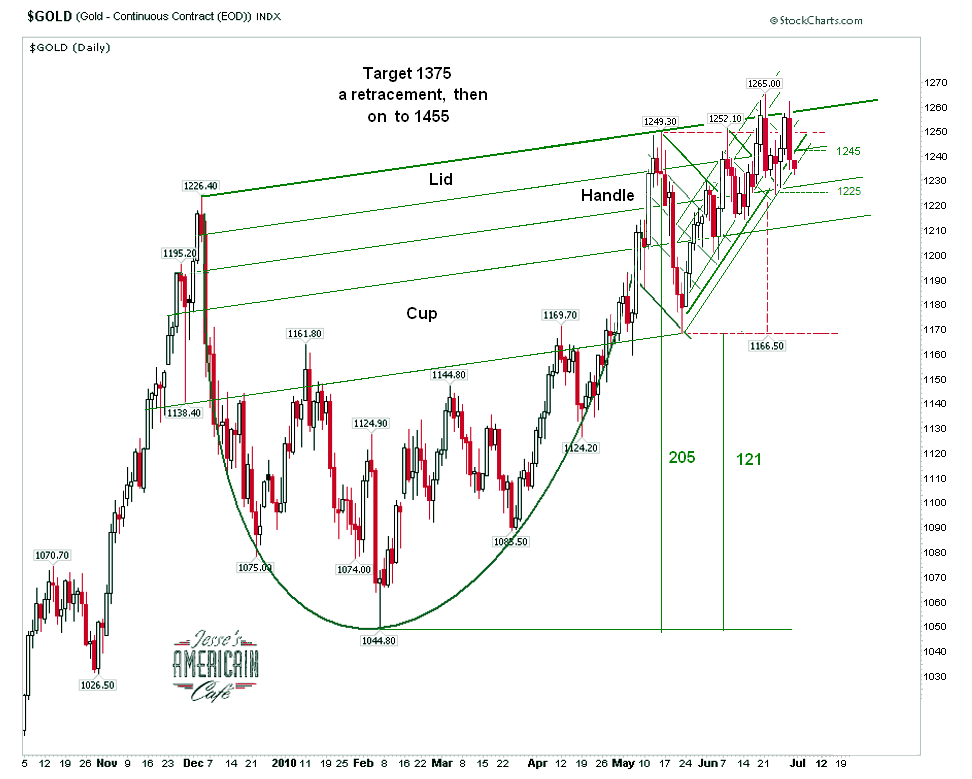
Although the gold bulls took a severe 'gut check' today, the cup and handle formation ultimately proved too powerful for the bears and bullion banks to break. It is an epic struggle, with much broader, perhaps even historic, implications than most of us can now realize, being too close to the event to see its true dimensions.
The weekly chart shows that gold is in a bull market. Anyone who does not acknowledge this, especially any metals analysts, are talking their books and private agendas. I can think of no other profession that allows for such blatant deceptions as the US financial sector.
The hysteria that accompanies every minor, albeit somewhat sharp, pullback in the price of gold borders on the ridiculous. It is often a 'psych job' by hedge funds, and unfortunately a mass of the deluded who simply do not understand currency markets and money. They think they do, but they don't, and in this case a little knowledge is a dangerous thing for their accounts.
Gold is a counter trade to currency risks. Monetary inflation is only one example of that risk. So the simplistic model is bewildered when gold rockets in the face of deflation caused by credit destruction and weak aggregate demand. What it fails to account for is the dramatic deterioration in the backing for the currency due to the corrosive decay of its underlying assets, the degraded ability to tax and service debt, and the actual assets held by the central bank.
And this is why at times some governments seek to control rival currencies such as gold. It is the economic equivalent of rolling back the odometer, or putting sawdust in the crankcase of a car which you wish to sell to the unsuspecting. It is a means to a control fraud, the deliberate hiding of the dilution of your currency to support a set of political and personal objectives. And this is why the citizenry, if they are wise, will insist on transparency in the metals markets and the asset holdings of their country.
The miners are doing reasonably well all things considered, but may not stand up well IF there is a sell off in the general equity markets.
You may as well hear it all now, because in the event of war, the truth will be the first victim.
SP 500 September Futures Daily Chart
At least a dead cat bounce after a drop such as this to key support. But heading into a holiday weekend with an important non-Farm Payrolls Report and wavering confidence, anything can happen after that.
The SP 500 Cash Weekly Chart give a better perspective on how important a test of support the market is facing.
VIX is approaching levels where one would either expect the market to stabilize and begin to recover its footing, or quickly break down and fall apart. 
The Nasdaq Composite is in the same situation, so it is clearly a macroeconomic statement, and not something particular to one index.
This is likely to be the spin:
The problem is not that an irresponsible Fed and a corrupt Congress ruined the US dollar through a failure in stewardship, crony capitalism, and a series of control frauds culminating in a financial collapse that caused great harm to other countries, particularly in Europe. The dollar is a 'victim' of the evil empire that is jealous of our success and who hates freedom. (Let me have some 'freedom dressing' on my sandwich, please.) Markets are only useful when they do what we wish them to do, when they support our agenda and serve our will to power. The rest of the world is required to obey our enlightened rule, and serve their proper roles in the New World Order."
I am not quite sure where Rickards is coming from on this, but read the entire paper and judge for yourselves. What seems ironic is that the US has been the dominant user of economic warfare, economic hitmen if you will, since WW II. For example, US Banks Financing Mexican Drug Cartels. This is in part the natural outcome of its being the clear financial superpower, supplanting the City of London and the British Empire of private corporations against which the US had itself rebelled successfully, an event which it will commemorate in a few days on 4 July. But it has also gotten much worse in the past twenty years because of the erosion of regulation and the capture and corruption of key political processes.
You should also be aware that one of the financials bestsellers in mainland China is a book, with a recently published sequel, titled 'Currency Wars.' The author is said to fall into the old memes of scheming international bankers, which has been used by some to issue a blanket condemnation and discredit his premise in the West. I confess I have not read it, since it is not available in translation. What is most important is that the book has a wide readership and influence in the Chinese intelligentsia.
"Worse even than the long, slow grind along the bottom described in the foregoing section is a sudden catastrophic collapse. In that context, the greatest threat to U.S. national security is the destruction of the U.S. dollar as an international medium of exchange. By destruction we do not mean total elimination but rather a devaluation of 50 percent or more versus broad-based indices of purchasing power for goods, services, and commodities and the dollar’s displacement globally by a more widely accepted medium.
The intention of Central Bank of Russia would be to cause a 50 percent overnight devaluation of the U.S. dollar and displace the U.S. dollar as the leading global reserve currency. The expected market value of gold resulting from this exchange offer is $4,000 per ounce, i.e., the market clearing price for gold as money on a one-for-one basis. Russia could begin buying gold “at the market” (i.e., perhaps $1,000 per ounce initially); however, over time its persistent buying would push gold-as-money to the clearing price of $4,000 per ounce. However, gold selling would stop long before Russia was out of cash as market participants came to realize that they preferred holding gold at the new higher dollar-denominated level. Gold will actually be constant, e.g., at one ounce = 25 barrels of oil; it is the dollar that depreciates.
Another important concept is the idea of setting the global price by using the marginal price. Russia does not have to buy all the gold in the world. It just has to buy the marginal ounce and credibly stand ready to buy more. At that point, all of the gold in the world will reprice automatically to the level offered by the highest bidder, i.e., Russia.
Basically, the mechanism is to switch the numeraire from dollars to gold; then things start to look different and the dollar looks like just another repudiated currency as happened in Weimar and Zimbabwe. Russia's paper losses on its dollar securities are more than compensated for by (a) getting paid in gold for its oil, (b) the increase in the value of its gold holdings (in dollars), and (c) watching the dollar collapse worldwide."
Jim Rickards, Economics and Financial Attacks
The June Non-Farm Payrolls Report will be released on Friday, July 2. Tomorrow June 30 is the end of the quarter.
The 234th anniversary of the US Declaration of Independence is this weekend.
"I am well aware of the toil and blood and treasure it will cost us to maintain this declaration, and support and defend these states. Yet through all the gloom I see the rays of ravishing light and glory. I can see that the end is worth all the means. This is our day of deliverance." John AdamsThe equity market feels somewhat artificial, if not contrived. Indeed, I think we are in a period of intensified disinformation running ahead of the fog of war, whether it is between countries, or classes, or both. It is customary to neutralize pre-emptively the moral standing of the friends and allies of something which you intend to attack and destroy.

"t comes as a surprise to many people that, despite the fiasco at Citigroup (C) and his role in causing the subprime mess (See "The Subprime Three: Rubin, Summers and Greenspan," The Institutional Risk Analyst, April 28, 2008), Rubin remains inside the circle at the White House. Nearly two decades after first migrating to Washington, he apparently is still calling the shots of U.S. financial and economic policy with the full support of President Barrack Obama. Working through his favorite marionettes, Treasury Secretary Tim Geithner and Economic Policy Czar Larry Summers, most recently Rubin managed the defense of Wall Street following the great crisis. No matter what Secretary Geithner says or when he says it in public, you can be sure that those utterances have the full knowledge and approval of his handler Larry Summers and their common political owner and sponsor, Robert Rubin.
A modern day colossus, Rubin effortlessly bestrides the worlds of political and finance, and mostly without leaving a trail of slime that often betrays the average political operator. Rubin stood at the right hand of Alan Greenspan on the famous February 1999 Time cover entitled: "The Committee to Save the World." Not an entrepreneur like Pierpont Morgan, Rubin is a mixture of banker, politician and global technocrat, a super fixer of sorts, but with a proper sense for public-private partnership. Case in point: The famous letter from Rubin to Goldman Sachs clients when he first went to the Clinton White House saying that just because he was in Washington didn't mean he wouldn't be looking after them...
The end result of financial reform is inconvenience for the financial services industry and more expense for the taxpayer and the consumer. But it should be noted that, once again, Wall Street has managed to blunt the worst effects of public anger at the industry's collective malfeasance. The banks can now start to focus their financial firepower on winning back hearts and minds on Capitol Hill. All it takes is money.
Notwithstanding anything said or done by the Congress this year, operating through trained surrogates such as Geithner, Summers and others, Robert Rubin is still pulling the economic and financial strings in Washington. The fact that there is a Democrat in the White House almost does not seem to matter. President Obama arguably has a subordinate position to Rubin because of considerations of money. If you differ, then ask yourself if Barack Obama could seek the presidency in 2012 without the support of Bob Rubin and the folks at Goldman Sachs. Case closed.
For America's creditors and allies, the key question is whether the Democrats around Rubin are willing to embrace fiscal discipline at a time when deflation in the US is accelerating. That roaring sound you hear is the approaching waterfall of the double dip. With the US at the moment eschewing anything remotely like fiscal restraint and the rest of the world going in the opposite direction, to us the next crisis probably involves U.S. interest rates and the dollar.
Judging by Rubin's performance in the past, when he talked first of a strong dollar, then a weak dollar policy, and fudged the issue regarding fiscal deficits, we could be in for quite a ride. But at some point the Obama Administration should acknowledge that this particular former CEO of Goldman Sachs is still driving the policy bus. If the Republicans are in control of the Congress come next January, maybe they should subpoena Rubin to appear periodically. At least then we all can hear directly to the person who is actually making national economic policy."
The World According to Robert Rubin, Chris Whalen, IRA
Apparently I am not alone in concluding that significant financial reform, including the restructuring of the financial sector to serve, rather than to tax and depress, the real economy is a vital necessity and an integral part of the recovery process.
This is not to say that the BIS General Manager and I would agree on all the details of the program. But it does speak to the notion that the size and structure of the financial sector was a contributing cause of the financial collapse, rather than an innocent bystander to some improbable accident or act of God.
So if one believes this, that the financial sector had become an integral part of the problem, it becomes rather obvious to conclude that policies based on simplistic slogans like 'less debt' or 'more spending' alone are not going to be effective in changing a systemic distortion that was over twenty years in the making, involving an orgy of moral hazard, financial fraud, and regulatory capture that became the cornerstone of the developed nations' economies.
Indeed from my vantage point, it appears that the various policy proposals being discussed are indicative of special interest groups arguing over a dying man as they consider how best to strip the corpse.
My own concern is that the various parties, being in a feeding frenzy of self-interest, will ignore the warning signs of public dissatisfaction and fading confidence, until it is too late to pursue conventional methods of reforming the system.
"Let me conclude. The lingering structural deficiencies in the financial sector and the longer-term drawbacks of very expansionary macroeconomic policies continue to put enormous demands on our ability to steer the best course through hazardous terrain.You may read the General Manager's entire speech here.
When markets and the public start to lose confidence, it is an illusion to suppose that delaying the adoption of the policies we know are needed would smooth the adjustment process. We cannot wait for the resumption of strong growth to begin the process of policy correction. In particular, delaying fiscal policy adjustment would only risk renewed financial volatility, market disruptions and funding stress. A much better strategy is to set out credible front-loaded actions for meaningful fiscal adjustment and for restructuring the financial system.
International cooperation is particularly important at the current difficult juncture, when confidence is fragile. In particular, finalising international agreements on regulatory reform on schedule will send the right signal - not only to financial markets but also to the public at large. The time has come to agree on major practical reforms to substantially increase the resilience of the financial industry. These reforms, combined with policies of fiscal adjustment and efforts to restructure the financial industry, will go a long way to putting the financial crisis behind us. We must seize this opportunity."
Jaime Caruana, General Manager of the BIS, on the occasion of the Bank's Annual General Meeting, Basel, 28 June 2010.