31 July 2011

US Debt Limit and Debt Versus Gold in US Dollars


Let's see, when might we expect the price of gold in dollars to stop going higher?

Chart from sharelynx, and a h/t to my brother Steve.

It would be interesting to see this correlated to Debt/GDP or Broad Money Supply/GDP, but this gets the point across.


This is your country on oxycontin. Get used to it. h/t Ilene.


29 July 2011

The Great Recession in the US Is Worse Than We Were Previously Told


With all the hoo-hah over the deficit fandango, relatively little attention was paid to the latest GDP number and the prior revisions to growth.

The US needs to get serious about jobs creation and median wage growth. Austerity does not facilitate growth, despite the corporatist spin to the contrary.

The problem with the first stimulus package was that it was too heavily weighted to tax cuts and efforts to promote consumption, and not programs to stimulate domestic jobs growth.

Cutting taxes, including capital gains taxes, does not promote growth. Reducing government in and of itself does not promote growth. These are fallacies that continue to hurt the country.

To accomplish its goals, the US must prioritize its spending away from financial and military adventurism, and let go of the false theories of efficient markets and trickle down growth.

That will be difficult given the current structure of the country's leadership and the embedded nature of its crony capitalism.

Consumer Metrics Institute
Lakewood, Colorado
July 29, 2011

BEA Reports 1Q-2011 and "Great Recession" Far Worse Than We Were Previously Told

Included in the BEA's first ("Advance") estimate of second quarter 2011 GDP were significant downward revisions to previously published data, some of it dating back to 2003. Astonishingly, the BEA even substantially cut their annualized GDP growth rate for the quarter that they "finalized" just 35 days ago -- from an already disappointing 1.92% to only 0.36%, lopping over 81% off of the month-old published growth rate before the ink had completely dried on the "final" in their headline number. And as bad as the reduced 0.36% total annualized GDP growth was, the "Real Final Sales of Domestic Product" for the first quarter of 2011 was even lower, at a microscopic 0.04%.

And the revisions to the worst quarters of the "Great Recession" were even more depressing, with 4Q-2008 pushed down an additional 2.12% to an annualized "growth" rate of -8.90%. The first quarter of 2009 was similarly downgraded, dropping another 1.78% to a devilishly low -6.66% "growth" rate. And the cumulative decline from 4Q-2007 "peak" to 2Q-2009 "trough" in real GDP was revised downward nearly 50 basis points to -5.14%, now officially over halfway to the technical definition of a full fledged depression.

One of the consequences of the above revisions to history is that the BEA headline "Advance" estimate of second quarter GDP annualized growth rate (1.29%) is magically some 0.93% higher than the freshly re-minted growth rate for the first quarter. From a headline perspective, that makes for a far better report than the 0.63% drop from the previously published 1Q-2011 number -- since otherwise the new 2Q-2011 numbers would be showing an ongoing weakening of the economy.

Unfortunately, meaningful quarter-to-quarter comparisons are nearly impossible in light of the moving target provided by the revisions. But among the notable items are:

-- Aggregate consumer expenditures for goods was contracting during the second quarter, with annualized demand for durable goods dropping 4.4% during the quarter -- into the ballpark of the numbers we have measured here at the Consumer Metrics Institute. This decline was enough to shave 0.35% off of the overall GDP (with just automotive goods removing 0.65% from the annualized GDP growth rate).

-- The drag on the GDP from governmental cutbacks purportedly moderated by a full percent, improving to a -0.23% drag from a revised -1.23% impact in the first quarter. This reversal may be the result of either the waning effect of expiring stimuli or overly optimistic BEA "place-holders" while more data gets collected. Many state and local public sector employees would be shocked to learn that real-world governmental downsizing has moderated.

-- Net foreign trade added 0.58% to the GDP growth rate after subtracting 0.34% during 1Q-2011 (a 0.92% positive swing) -- all in spite of oil prices reaching recent peaks at the end of April. Anomalies in imports caused by tsunami suppressed trade with Japan may have been the culprit here, since the growth rate in exports (and their contribution to the overall GDP growth) actually dropped quarter-over-quarter. Imports reportedly pulled overall GDP down by only 0.23%, after subtracting 1.35% from the revised figures for the prior quarter.

-- Commercial Fixed Investments contributed 0.69% (over half) of the reported annualized growth, up over 50 basis points from the revised contribution for the first quarter. Inventory building contributed an additional 0.18% to the growth rate, although that number is only about half of the boost provided in the revised 1Q-2011 data. These are the only two really positive signs for the economy contained in the report.

-- Working backwards from the data, the BEA effectively used an aggregate annualized inflation rate of somewhere near 2.39% to "deflate" their top-line total nominal data into the "real" data used for their headline numbers. This was after raising the aggregate deflater effectively used for the first quarter to somewhere near an annualized 2.72% rate -- indicating that the BEA believes that (for the purposes of their headline number) inflation moderated somewhat during the second quarter. They wrote in their July 29 press release that:

"The price index for gross domestic purchases, which measures prices paid by U.S. residents, increased 3.2 percent in the second quarter, compared with an increase of 4.0 percent in the first. Excluding food and energy prices, the price index for gross domestic purchases increased 2.6 percent in the second quarter, compared with an increase of 2.4 percent in the first."

We understand that the aggregate "deflater" has to use numbers appropriate to the individual line items being deflated, including producer price inflation data and foreign exchange inflation rates (although 2.39% might be modest for most of those as well). But if the unadjusted trailing 12 month price changes in CPI-U (3.6%) recorded by the Bureau of Labor Statistics (the official source of U.S. Government inflation data) is used to "deflate" the nominal data, the actual "real" growth rate for the second quarter drops to 0.011% (slightly over 1 basis point), which the BEA would normally round to zero. It is likely that the entire reported growth rate for the second quarter is actually an artifact of under-recognized systemic inflation.


The Numbers (as Revised)

As a quick reminder, the classic definition of the GDP can be summarized with the following equation:


GDP = private consumption + gross private investment + government spending + (exports − imports)


or, as it is commonly expressed in algebraic shorthand:


GDP = C + I + G + (X-M)


For the first quarter of 2011 the values for that equation (total dollars, percentage of the total GDP, and contribution to the final percentage growth number) are as follows:


GDP Components Table

Total GDP=C+I+G+(X-M)
Annual $ (trillions)$15.0=$10.7+$1.9+$3.0+$-0.6
% of GDP100.0%=71.0%+12.7%+20.2%+-3.9%
Contribution to GDP Growth %1.29%=0.07%+0.87%+-0.23%+0.58%


The quarter-to-quarter changes in the contributions that various components make to the overall GDP can be best understood from the table below, which breaks out the component contributions in more detail and over time. In the table we have split the "C" component into goods and services, split the "I" component into fixed investment and inventories, separated exports from imports, added a line for the BEA's "Real Finals Sales of Domestic Product" and listed the quarters in columns with the most current to the left (please note that nearly all of the numbers below for earlier quarters are changed from our previous commentary tables):


Quarterly Changes in % Contributions to GDP

2Q-20111Q-20114Q-20103Q-20102Q-20101Q-20104Q-20093Q-20092Q-20091Q-2009
Total GDP Growth1.29%0.36%2.36%2.50%3.79%3.94%3.81%1.69%-0.69%-6.66%
Consumer Goods-0.33%1.10%1.87%1.09%0.87%1.45%0.12%1.70%-0.52%0.05%
Consumer Services0.40%0.36%0.61%0.75%1.18%0.47%0.21%-0.04%-0.76%-1.07%
Fixed Investment0.69%0.15%0.88%0.28%2.12%0.15%-0.42%0.13%-2.26%-5.09%
Inventories0.18%0.32%-1.79%0.86%0.79%3.10%3.93%0.21%-0.58%-2.66%
Government-0.23%-1.23%-0.58%0.20%0.77%-0.26%-0.18%0.28%1.21%-0.33%
Exports0.81%1.01%0.98%1.21%1.19%0.86%2.51%1.49%-0.02%-3.82%
Imports-0.23%-1.35%0.39%-1.89%-3.13%-1.83%-2.36%-2.08%2.24%6.26%
Real Final Sales1.11%0.04%4.15%1.64%3.00%0.84%-0.12%1.48%-0.11%-4.00%


Summary

For the most part the "Advance" GDP report for the second quarter is positive only in comparison to newly re-worked numbers for the first quarter:

-- The good news is that commercial investment appears to be improving and inventories are no longer growing at the previously unsustainable rate.

-- But the bad news is that consumer spending on durable goods fell substantially during the quarter, dropping quarter-over-quarter by 4.4%.

-- Some of the other favorable data, including foreign trade, are likely the result of one-time anomalies (e.g., tsunami suppressed imports).

-- The "deflater" used to translate the nominal data into "real" data continues to suffer from credibility issues, and it may be the entire source of the reported growth.

The Real Problem

The greatest problems in the report, however, were the massive revisions to past history -- including the very recent past. For both the first quarter of 2011 and the worst quarters of the "Great Recession" those revisions were substantial enough to raise questions about the reliability of any of the recently reported BEA data:

-- Data published as recently as 35 days prior had growth rates slashed by over 80%.

-- The worst quarter of the "Great Recession" was revised downward by over 2%, with the annualized "growth" rate now reported to be a horrific -8.9%. And the "peak" to "trough" decline in real GDP for the "Great Recession" is now recognized to be over 5%, halfway to the clinical definition of a full depression.

We have been concerned for some time about the timeliness of the BEA's data, particularly given how much the nature and dynamics of the economy have changed since Wesley Mitchell initially developed the data collection methodologies in 1937. These past revisions, however, lead us to believe that the problems run far deeper -- as demonstrated by a quarter that is now over 2 years old being just now revised downward by an additional 2%. This begs two simple questions:

-- At what point in time can we trust any of the data contained in these reports?

-- How can any of the current data be used to create meaningful Federal monetary or fiscal decisions?

We wonder what Mr. Bernanke thought when told that 80% of his "relatively slow recovery" during the first quarter had just vaporized ...

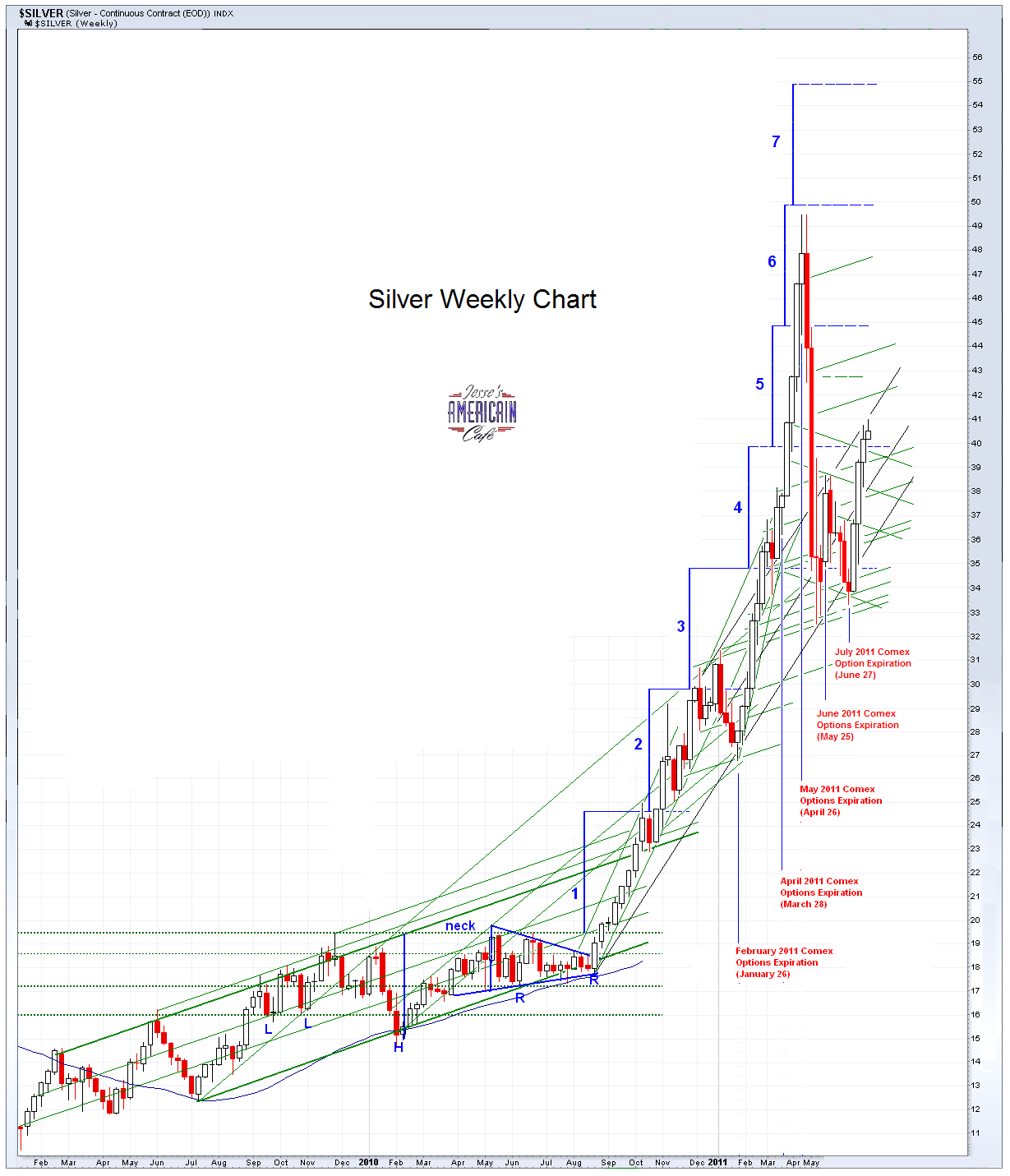
Gold Daily and Silver Weekly Charts - Enjoy the Show - Reichstag Fire Or Punch and Judy?


Nothing like a crisis to make the masses more pliable for an offer they think they cannot refuse. Never waste a crisis, and if you don't have one, make one.

The Banks and their posse continued to stand on gold and silver today against the market correlations. Fairly typical post option expiration action if you can call anything typical in these times of national madness. The madness of course is to hand over the management of your life savings and your living standards to such corrupt, self-centered nincompoops.

I think we will see a contrived slither out of this budget impasse, early next week, maybe pre-announced Sunday evening, so the can kicked over to a 'blue ribbon council' that can address the nation's business without directly involving the public or their elected representatives. And the Banks and their delegates may make you an offer you cannot refuse, again.  It smells like TARP in here.

"With only 2% of the money in circulation being in gold and silver, John Law reasoned that financial stability could only be restored if the amount of paper, shares and money, was reduced and the value of [precious metal] coins was increased.
Accordingly, over a period of weeks thousands of livre notes and share certificates were publicly burnt. But confidence in paper had been lost. Every smoldering bonfire sapped the credibility of paper, and the press for coins grew more insistent.”

Janet Gleeson

I especially like the above quote by the way, because it shows that John Law's common sense reasoning held that a dramatic decrease in money supply, a 'monetary deflation' if you will, would increase the value of the currency, even when its underlying value, all the things that make it worthwhile in the eyes of the market, continued to deteriorate at a much greater rate than he could burn them.


It's Midnight. Do You Know Where Your Reserve Currency Is?


National Madness
Gilbert Keith Chesterton

"This slow and awful self-hypnotism of error is a process that can occur not only with individuals, but also with whole societies. It is hard to pick out and prove; that is why it is hard to cure. But this mental degeneration may be brought to one test, which I truly believe to be a real test.

A nation is not going mad when it does extravagant things, so long as it does them in an extravagant spirit. But whenever we see things done wildly, but taken tamely, then the State is growing insane...

I should, in other words, think the world a little mad if the [wild] incident, were received in silence. Now things every bit as wild as this are being received in silence every day.... For madness is a passive as well as an active state: it is a paralysis, a refusal of the nerves to respond to the normal stimuli, as well as an unnatural stimulation. There are commonwealths, plainly to be distinguished here and there in history, which pass from prosperity to squalor or from glory to insignificance, or from freedom to slavery, not only in silence, but with serenity.

The face still smiles while the limbs, literally and loathsomely are dropping from the body. These are peoples that have lost the power of astonishment at their own actions. When they give birth to a fantastic fashion or a foolish law, they do not start or stare at the monster they have brought forth. They have grown used to their own unreason; chaos is their cosmos; and the whirlwind is the breath of their nostrils.

These nations are really in danger of going off their heads en masse; of becoming one vast vision of imbecility, with toppling cities and crazy country-sides, all dotted with industrious lunatics.... "

See you Sunday evening.

SP 500 and NDX Futures Daily Charts - A Whiff of TARP in the Air - VIX


There will be no sustained recovery until the banks are restrained, and the financial system is reformed.

VIX spiked and the traders are edgy, but there remains a widespread belief in a cynical resolution.  I have a suspicion that the US is being brought to a crisis so that the bankers, through their political proxies in Washington, may make the people another offer which they cannot refuse.

In other words, there is 'a whiff of TARP in the air.'

I had to chuckle again a bit as the pampered princes and princesses on Bloomberg were puzzled by the weak GDP number this morning in the light of 22 percent rises in corporate profits.

If something looks too good to be true, guess what. But what else would one expect in a system of lax regulation, crony capitalism, massive corporate tax evasion, corrupt regulators and ratings agencies, and widespread accounting fraud?

"That brings us to the final outcome of this debacle. A radical campaign to reshape popular opinion recognized the seductive potential of the appealing phrase "free markets." Powerful business interests, largely captured regulators and officials, and a lapdog media took up this amorphous, malleable idea and made it a Trojan horse for a three-decade-long campaign to tear down the rules that constrained the finance sector. The result has been a massive transfer of wealth, with its centerpiece the greatest theft from the public purse in history.

This campaign has been far too consistent and calculated to brand it with the traditional label "spin". This manipulation of public perception can only be called propaganda. Only when we, the public, are able to call the underlying realities by their proper names—extortion, looting, capture, propaganda—can we begin to root them out."

Yves Smith, Econned


28 July 2011

Gold Daily and Silver Weekly Charts - The Collapse of the US Dollar Against Silver


“I have not sold any gold, I have bought more gold. If gold goes down I'll buy more. The price of gold is going to go much, much higher over the next decade.”

Jimmy Rogers

I suspect that the capping on gold and silver will continue into the month end tomorrow, and quite likely into some resolution of the debt ceiling discussions which will probably occur next week. They might not, and that will indeed be interesting. The Mad Hatter and his Merry Pranksters think that a 'little default' might be a good thing to make the country more malleable to their non-negotiable demands.

On a deal, the first impulse will be for stocks to rally sharply and the metals get beaten, in the usual 'risk on' trade. However, depending on the resolution of the debt ceiling, when people think of it after they have had their jollies in the first reaction, they may realize that absolutely nothing has really been fixed. The US financial system will still be corrupt and broken, and the politicians have openly stopped caring about the voting public and their opinions, in their desire to put on the corporate feedbag.

Speaking of broken systems, I am featuring worthless currencies on the sidebar this week. And one I am highlighting below, the famous US Continental Dollar, and a chart showing how it was devalued in comparison to silver, until it was finally withdrawn in 1781. Roughly two zeros were knocked off it.

I was discussing this with a friend and they said, 'Well of course, but these currency failures are the result of unfunded war debts. It is not the same in the US now.'

It's not? The US debt crisis is directly attributable to unpaid war debts, both class war and military conflicts in the famous global war on terror and on the middle class. They'll never learn.

Bon voyage, Bucky.


SP 500 and NDX Futures Daily Charts


The early gains fall apart, as Wall Street grows increasingly 'nervy' over the House Republicans increasinly awkward looking actions on the debt ceiling. They are bending over backwards to impress a minority element in their Party.

No I am not talking about the Tea Party. I am talking about the big money corporatists, who write the politicians' pay checks. The Tea Party are hapless tools and cannon fodder for these folks, but they just don't realize it yet.

You cannot have a recovery until your reform the financial system. The white collar criminal class does not know how to say 'enough.' Their greed is obsessive - compulsive, not rational.


27 July 2011

Gold Daily and Silver Weekly Charts - La Douleur du Monde


I had to chuckle a little today as the corporate spokesmodels on Bloomberg were reviewing the day's trade, and noted the slump in gold with the VIX spiking and stocks slumping, as out of character. 'Duh, what's up with that?' was the most insightful comment of the day.

So, we have had round one of the post option expiry 'gut check' which I had suggested would occur. It was a little more intense than the chart might suggest, because ordinarily gold would have been rallying hard up to the 1650 level on a day like today.  But that was not in the cards as dealt from the bottom of the deck.

So what next? I think gold and silver will consolidate and chop around until the deficit discussion is resolved, one way or the other. And I am still in a very defensive position against a correction because we have come far and fast, and the Wall Street wiseguys just do not have the goods to cover their bets, so they have to continue running their bluffs.

La Douleur back-kissed the key trendline it had just broken, so no strong clue there yet. It still is in a position to rally short term and retake the upper end of the trend. A lot of this depends on short term policy decisions in the States.

But in the long run, paper will deteriorate, because it has nowhere else to go. The end game for the eggheads is a worldwide central bank setting fiscal policy and dictating values under the direction of a few senior pigmen. I don't think they will get it, or at least just yet.


SP 500 and NDX Futures Daily Charts - Life in Times of War


"State-sponsored [financial] terrorism is the systematic use of [economic] violence to create a general climate of fear in a population and thereby to bring about particular political objectives. It is employed by governments, or more often by extremist factions within governments, against that government’s citizens, against factions within the government, or against foreign governments or groups.”

Encyclopaedia Britannica

Wall Street was strapping on its dynamite duds today, preparating to bring a little more pressure to bear on the deficit reduction talks. Give us what we want or we will a) crash the economy b) move our jobs to the Cayman Islands c) stop contributing enormous sums to fund political campaigns d) all of the above.

And the major players are in intense meetings with the principals, from both the financial demimonde (ratings agencies) and the political swamps (congressman on payroll), getting briefed on what will actually happen so they can maximize their returns.

Just another day in the 'hood with the hoods.

What you see is not what you get.


Time to Take the Nuclear Option in the Deficit Discussions? Not Very Likely


In all this excitement, no one seems to remember that the President unilaterally refused to play the Bush tax cut card back in June. At least in public. I suspect strongly that the deals are being made behind the scenes, and much of what passes in public is for show, and political diversions.

The tax cuts expire in 2012. They offered an excellent bargaining chip, and one of the key drivers, along with the two unfunded discretionary wars and the out of control financial sector, of the current financial crisis that took the US from surplus to crisis in roughly ten years. If you were going to use that chip, the time to have done it was now, and not in an election year.  And in a budget crisis not using it looks to be highly ideological if not mildly insane.

Obama is either a well-prepared Manchurian candidate for the monied interests, something I am not dismissing, or playing chess on a multi-dimensional board that I still do not quite understand, something which I am also not willing to dismiss completely just yet, but it does not look very likely.  He could also be a haplessly inept idiot at the mercy of his advisors, but I doubt that very much now. 

Bush was easy to read, as was Clinton, at least after the few two years. Obama is a bit harder, but perhaps that is by intent. Good or ill, I cannot yet tell. He keeps getting the benefit of the doubt, but as I said on his 100th day in the Presidency, that time is over and done.

No matter the motives, actions speak louder than words, and at the end of the day, he is a disaster, a betrayer to his supporters, a decidedly ineffective and uninspiring leader, a faux reformer, and likely to go down in history as one of the great unrealized moments in greatness, like Jimmy Carter or even worse, Andrew Johnson.  And that is a shame, because it was entirely avoidable.

But for all those smug "I told you so's"  out there, Obama is still probably better than having the Alaskan reality show star a shaky heartbeat away from the presidency, a truly frightening prospect that most people forget. McCain flamed out and sold out before his moment came, and I suspect it was because he had no other choice in a crony corporatist party that rules its members by threat and decree.  Lack of dissent does not always imply a unanimity of thinking.

The door may be open for a viable third party movement in 2012.  I would even welcome a primary challenger from the Democrats, in the manner of Robert Kennedy and Lyndon Johnson.  But where is there any US politicians of that character, that level of leadership?

You may also wish to read The Weirdness of the Ten Year Deficit Reduction Discussion by James Kwak.

The Baseline Scenario
Two Can Play
By James Kwak
26 July 2011

Quick, what was the greatest conservative accomplishment of the George W. Bush presidency? It wasn’t Medicare Part D: that was a clever way to steal a Democratic issue and pass it in a form that was friendly to the pharmaceutical industry. It wasn’t Roberts and Alito: yes, they are young and conservative, but the majority is still only 5-4. It wasn’t Social Security privatization: that didn’t happen. Iraq? Getting political support to invade Iraq was a major coup, but everything went downhill from there.

The answer is obvious: the tax cuts of 2001 and 2003. Together, they were a wish list of conservative tax policy: a reduction in the top marginal income tax rate from 39.1 percent to 35 percent; a reduction in the top rates for capital gains and dividends to 15 percent; much higher contribution limits for tax-preferred retirement accounts (meaning that if you have enough money to save, you can shield more of it from taxes); and eventual elimination of the estate tax. In total, when fully phased in, the Bush-era tax cuts sliced almost 3 percent of GDP out of federal government revenues.*

And most of that money stayed in the pockets of the wealthy. According to the Tax Policy Center, 65 percent of the dollar value of the tax cuts (in 2010, once the 2001 and 2003 tax cuts were phased in) went to the top income quintile, and a staggering 20 percent — that’s tens of billions of dollars — went to the top 0.1 percent. Even if you look at the impact in percentage terms, the rich still took home more than their share: after-tax income went up by 0.7 percent for the bottom quintile, 2.5-2.6 percent for the middle three quintiles, 4.0 percent for the top quintile, and 8.2 percent for the top 0.1 percent.

Everyone knows all that already. Who cares? The point today is that President Obama can make this epic conservative victory vanish by snapping his fingers. He can say, “I promise to veto any bill that extends any of the tax cuts.” (Or, if he prefers, he can say, “I promise to veto any bill that extends any of the tax cuts, except the income tax rate reductions for the ‘middle class.’”)

Why would he do such a thing? Think about where the debt ceiling negotiations are today. The House Republicans are effectively holding the financial system and the economy hostage, demanding a massive, spending-cuts-only deficit reduction package. What makes this a smart move (where “smart” is defined solely in terms of likelihood of winning, not the risk being taken) is that if they can force Obama to choose between (a) raising the debt ceiling on their terms and (b) not raising it at all, he is going to choose (a). Even if he would be better off politically letting the government default and blaming it on the Republicans, no one thinks he would actually let it happen.**

Well, Obama has a hostage, too, if he wants to use it: the Bush tax cuts. From the Republicans’ position, just thinking about themselves and what they want (not about the country as a whole), are a few trillion in spending cuts over ten years — averaging something like 1.5 percent of GDP — worth giving up the greatest accomplishment of the entire conservative revolution?

Now, I’m not enough of a political strategist to know exactly how this would play out. For Obama to use the threat, he has to be willing to go through with it. That means mutual assured destruction: the Republicans insist on $3 trillion in spending cuts as the price to pay for raising the debt ceiling; Obama agrees in order to prevent default; and then Obama lets $3-4 trillion in tax cuts expire. Politically, it means being willing to argue in 2012 that letting the tax cuts expire was the right thing for the country. But that’s not an impossible case. Back in 2001, every aspect of the tax cuts was unpopular, other than the fact that they were tax cuts. (See Hacker and Pierson, Off Center, pp. 50-51.) Alternatively, Obama could propose a bill that extends just the “middle class” tax cuts on a take-it-or-leave-it basis.

As I said, I can’t tell you what the political percentages are. But it seems to me there has to be some leverage here that Obama can use — if he wants to.

* In the January 2007 Budget and Economic Outlook, the total 2017 cost of extending all the tax cuts, in addition to but not including patching the AMT, was projected to be $616 billion (Table 1-5), or 2.9 percent of GDP. I chose the 2007 projection because (a) it goes out to 2017, which is when some tax cuts were scheduled to expire and (b) it is before 2008, when the tax cuts to stimulate the economy began.

** What makes it a somewhat less smart move is that, with the Senate in the hands of the Democrats, the Republicans have no clear way of forcing Obama to sign or veto their deficit reduction bill. If the two houses can’t agree on a plan, Obama can avoid having to make the choice (and the end of the world will be Congress’s fault).


Obama Gives in to GOP on Bush Tax Cuts, and More
By Thomas Hartmann
Tuesday 28 June 2011

Yesterday – Senator Bernie Sander wrote a letter to President Obama telling him not to give in to Republican demands in the debt limit negotiations – and to fight for “shared sacrifice” by taxing millionaires and billionaires along with any new spending cuts. Unfortunately – the President didn’t get the message and the White House stated yesterday that the President is taking repealing the Bush tax cuts for millionaires and billionaires off the table. Which leaves mostly spending cuts targeting working families still on the table. Looks like America's oligarchs - and the Republican Party they own - win again."

The corporatist strategy has been to give generous tax cuts to the wealthy, spend money like drunken sailors on things that benefit the monied interests, and then declare a budget crisis and take the difference out of the hides of the middle class, the weak, and the elderly. So far Obama is following the same playbook, with a little dusting of compassionate sounding hoo-hah.


SP 500 Intraday - a Brief Apologia of Sorts


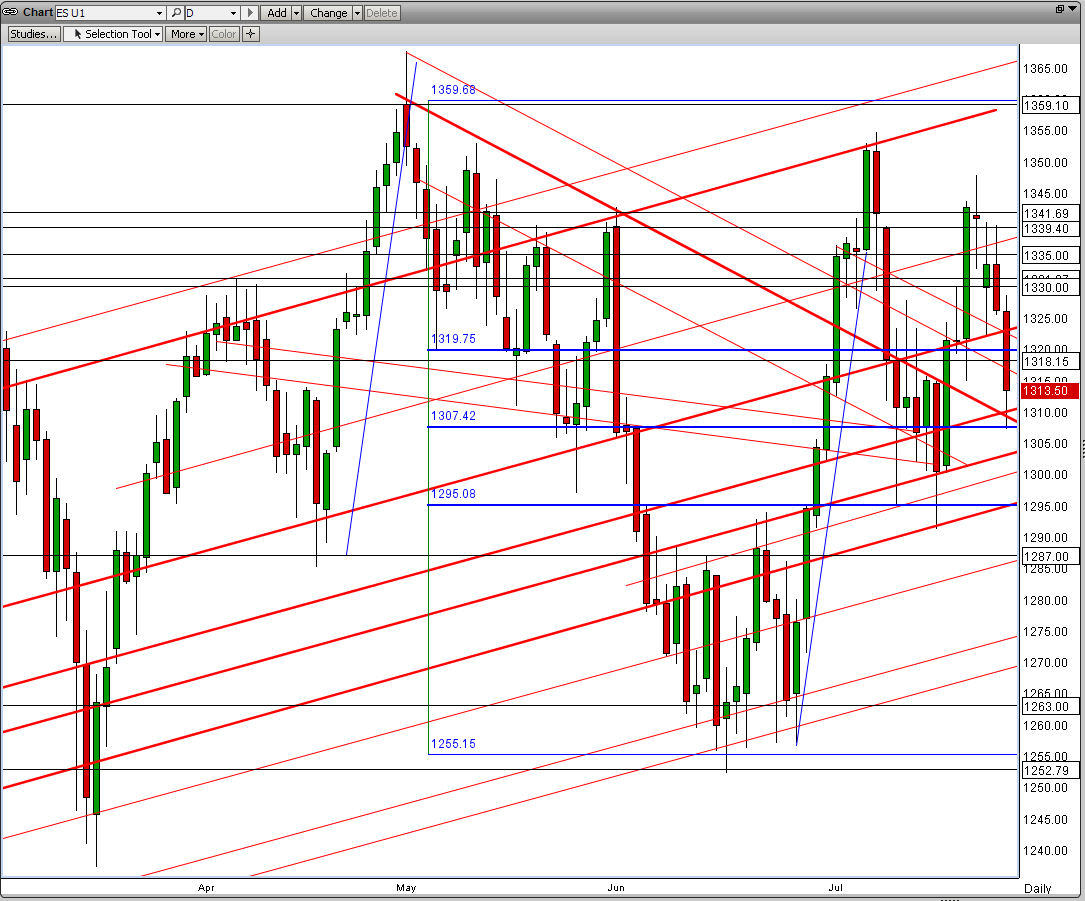
Stock futures fell to the familiar key support around 1307. The same principles on this chart still apply. 1295 is very important and below 1290 is an area very near to the edge of the cliff.

I am sitting largely in cash now this morning for the short term. I wanted to distance myself from the market, and provide an opportunity to think more about the current situation. Taking profits seemed like the right thing to do.

If you give people blanks, they sometimes fill them in as they will. And so I was reflecting on some email exchanges of the past several weeks. I do not have a comments section here, because I do not have the time or energy to moderate it. I did that once for a friend and it put me off it forever. But I do have an active email and take comments on it all day long. I moderate the frivolous and ugly with a spam filter lately and it seems to be working well.

Why do I put forward these thoughts? Why don't I charge for it, or take ads? Why don't I do interviews and speak at rallies, and direct a group of followers to promote messages in comments and 'pile on' to those who do not agree with us?

As I recently answered to a fellow blogger, because I do not need the money. So why bind myself to some agenda, even if a little, by taking it? I give out of the excess and abundance given to me. Yes, there are definite sacrifices and self-limitations, and they extend to family. And that is sometimes a cause for unease. But the necessities are covered.

Why do I witness to my beliefs, and alienate some worldly and influential people, and even believers with different viewpoints and prejudices, and incur the consequences of diminished opportunity? It limits the acceptability of my message in many sites and areas. You might be surprised, but it does. And it hurts. And the ability to see the ugliness for which people can be capable is discouraging. But then there are the consolations that seem to come, as they are most needed, from the most unexpected sources, the kind word, the occasional graciousness of the spirit.

This is not some incidental thing, it is what I am, it defines me. I am not my own, to do as I will. I owe a triple allegiance to the truth and what is most human, the very pinnacle of existence, by creation, by redemption, and by continuation. If I do not do good when there is a price to be paid that is in reality very slight as these things go, how could I expect to pay the price when the stakes are high?

What is it that I want? I don't want anything. This is why I shun the spotlight. I want neither money nor followers, nor recognition or fame. I want to be a simple, honorable man. Husband and father. And that is work enough for anyone.

What makes me think I can know the Truth? Why do I sound so much like a leftist lately? By the way, I find that particularly ironic, since I am a life long pragmatic conservative in the tradition of Edmund Burke, with a tinge of the libertarian.  It just shows how far things have shifted from center.

I have a scientific mind, so I do not proceed from the assumption that I know the truth in this world, as truth is a never ending journey, a way of life that one never reaches until the very end of this world. So I start at the bottom and slowly, carefully, work up from there, taking things where they lead me, constantly reviewing the landscape, continuously learning, pursuing an ever-retreating horizon, with the occasional view from the peaks.

If I have any fear, if there is any recurrent theme in my energy and my prayer, it is not to mislead people and myself, even unintentionally. I not only do not seek to promote a point of view with the misuse of facts, I beat my own conclusions bloody, almost every day, looking for any weakness and misapprehension, constantly absorbing new data and ideas. I expose myself to a wide variety of thoughts and opinions, almost to exhaustion.

Forecasting the future here is exceptionally difficult because there are so many exogenous, and yet outcome critical, variables. There are powerful forces promoting certain ends for their own benefit, but there are other forces working against them. It is a conflict, and the fronts are not always easily seen through the fog of war.

And so even at best, I know I am not and cannot always be right, so it is never an easy place to be thinking, wrestling with the uncertain and taking its measure, much less acting upon it. But this is where I am, and must be. Going forward, one step at a time, in fear and trembling at my own weakness and insufficiency.

When my site was improbably recognized as among the ten most influential by some very kind people, links to pieces on my site dropped off a cliff. Those in the blogosphere probably figured that since I was already 'successful' that there was no need to encourage it, since I was no longer a colleague, but the competition. There is only one competition that counts in these times, and that is to stand for goodness and justice in a terrible class and currency war.

And I also continued to strike out on a line of thinking that people in the financial world and the fortunate may not favor. And so it is not popular. If you want to be popular, tell people what they wish to hear, not what they may need to hear. And the greater a person becomes in the favor of the world, the less tolerant they are of contradiction. Good fortune and wealth can be a terrible trap, the most ponderous of burdens, because we are so unwilling to let go of them, even a little, as they drag us down into the abyss.

And so the temptation to change my approach, to post hysterical (and not just hysterically funny) headlines and pieces that are misleading, to fan the flames of passion and prejudice become high. I can understand that. Isolation is no picnic, and the crowd has its allure. Everyone desires to be liked. I am human.

And it is because I seek to be truly human that I cannot be otherwise. People seem to have lost their sense, their voice, of humanity. How can I remain silent, when good and innocent people become prey? Who am I to do this, why me?

I do not seek this. At times I wish to run away, to hide in my library or the kitchen, rather than be taken where I do not wish to go. I came to the study of money for a blessing, but I have found a work. And I cannot leave it, because this is where I am meant to be. And so I am here.


Rosenberg's Seven Point Plan for Recession Investing


Here is something that may be of interest from David Rosenberg of Gluskin Sheff as reported by CNBC.

I lean on this a bit, unwilling and unable as I am to give investment advice on the particulars. And like most general advice, it is certainly not tailored to one's particulars, which is all important.

I should add that this is targeted to a recession. And if you believe we are in for a recession, this may work.  If we experience a more singular, unusual event, something other than recession, with features of a currency collapse, some portions of this portfolio will perform very badly.

Bonds and bond funds in particular tend to get decimated in times of rising interest rates and/or high inflation. Income is of little use unless the principal is protected.

And yet it is also good to remember that Japan lost its AAA rating in 2002, and its bonds continued on as rates fell. Is the US going to go the way of Japan? There are some very important differences, and after all, it is largely a policy choice. Choose deflation and austerity but without the safety nets for the people, and within ten years your house will burn.

It should be pointed out that finding legitimate investments in some of these general categories is no simple trick.

Personally I still like gold, and to a lesser extent silver, for a relatively safe portfolio of my own. At some point mining stocks with low debt and high dividends may be among the best investments. But I also like portfolio theory in its diversification feature. Never bet the ranch on any one thing unless you are uniquely positioned in terms of knowledge.

A more general theme that is not mentioned, but might be implied, is self-sufficiency, to the extent that such a thing is possible in our interconnected world. No man is an island, or can they be.

1) Focusing on yield, particularly on “high-quality corporates” though he allows for the inclusion of what others might call “junk” bonds from companies with “A-type” balance sheets and “BB-like yields.”

2) Stocks that provide reliable dividends including preferred shares.

3) Whether in stocks or bonds, focusing on companies that have low debt-to-equity ratios, high liquid asset ratios and good balance sheets without heavy debt.

4) Hard assets such as oil and gas royalties and real estate investment trusts, with a focus on income stream.

5) Sectors or companies that have “low fixed costs, high variable costs, high barriers to entry/some sort of oligopolistic features, a relatively high level of demand inelasticity” including utilities, consumer staples and health care.

6) Alternative assets that are “not reliant on rising equity markets and where volatility can be used to its advantage.”

7) Precious metals. Specifically, he says gold as compared to mining output, the Fed’s balance sheet and money supply all indicate that it is far from a bubble, and in fact could rise to $3,000 before it becomes overvalued.

Peter Warburton's financial disaster investment portfolio.
The search is on for the perfect hedge

What would be the ideal characteristics of such a numéraire? First, it would be in fixed physical supply. Second, it would be resistant to weather-related influences. Third, its ownership would be diffuse, rendering futile any attempt to restrict supply through a non-competitive structure. Fourth, it must be freely tradable. Fifth, there would be no futures or options markets attached to it.

Finally, I list some of the candidates, in no particular order. Each seems promising, yet none of them seems to me to satisfy fully all five of the requirements above.
Arable land with a dependable climate

Oil-refining capacity

Electricity generating capacity

Water-treatment capacity

Drinking water, bottled or piped

Coastal access, harbours and ports

Palladium/platinum/diamonds

Real estate in long-standing, distinctive locations

Antiques, fine art, stamps and coins

Commodities without futures and options markets
Could these be the winning investments of the early years of the 21st century?

I should add that I think that "Antiques, fine art, stamps and [collectible] coins" are rather awful investments in most times of distress. They do perform well in times of rising inflation without systemic disruption, but can be remarkably illiquid, and are probably the domain for the specialist collector for whom investment is a secondary concern.

For the most part collectibles are not suitable for 95+ percent of the people. Like most investments that can offer some examples with spectacular gains, the risks are commensurately high and heavily weighted to non-insiders. Bullion makes much more sense than collectible coins for a disaster hedge.

If one reads Adam Fergusson's book, When Money Dies, you can see that in the Weimar experience, people traded their antique furniture for turnips. I like liquidity, portability, and wide acceptance. Gold and silver may become the ultimate hedge if their ownership becomes more widespread and therefore more freely traded hand to hand, and they do not become official money standards, with prices and ownership terms set firmly by government.

26 July 2011

Monetary Aggregates - Dude, Where's My Deflation? Better Yet, My Job, Savings, Economy?


Plenty of money printing, and therefore money supply growth, but little of it is from organic expansion. Printing money in low growth environments creates asset bubbles and a top down wealth effect for the upper crust. It also facilitates speculation and fuels soft frauds.

The US economy is a broken machine, burdened by an oversized financial sector and policy failures abounding in taxation, trade, and regulation.

Unfortunately the governance failures have their roots in crony capitalism and a variety of white collar crimes, disinformation campaigns, and public ignorance, so they are going to be difficult to surmount.

The recurrence of evil, whether it be in physical or economic privation, never fails to surprise one with its lack of originality, if not its sheer banality. It is rarely elegant or complex, but merely dull and ignorant, a brutish force, self-centered, animalistic, and cruel. Beneath the surface the madness lurks, in dark places and hardened hearts, awaiting its hour to rise once again.

"The receptivity of the masses to information is very limited, their intelligence is small, but their power of forgetting is enormous. In consequence of these facts, all effective propaganda must be limited to a very few points and must repeat these until the lowest member of the public understands what you want him to understand by your slogans...The law of selection justifies this incessant struggle, by allowing the survival of the fittest. Christianity is a rebellion against natural law, a protest against nature. Taken to its logical extreme, Christianity would mean the systematic cultivation of the human failure."

Adolf Hitler


Gold Daily and Silver Weekly Charts - La Douleur du Monde - Option Expiry Fizzle?


Although there were some efforts to push down price in the thin hours, the debt ceiling showdown has a bid under the metals, so most of the action was in capping the price to keep it manageable. So what next, declare victory and go home?

When Comex options expire, the holder receives an active long or short position in the contract the next day. And so we will have quite a few new futures contracts issued tomorrow given the number of 'in the money' calls.

The buyer of an option on a future contract is taking limited risk. Conversion to the actual futures contract itself, however, leaves the owner with substantial downside risk, so that holder often places a 'stop loss order'.

The Street crawlers can see those stops and their clustering and will often test that number and give the newbies a 'gut check' to see how serious they are.

But against that is the debt ceiling drama, so it might be quite quick unless there is some news being spread, even if it is only behind the scenes. There is quite a bit of that leakage going on in Washington these days.

The Dollar took a bit of a dive today, but is still above the critical support levels.

The actual mechanics of the debt ceiling timing are a bit more complex than many believe. Technically the Treasury can muddle along until August 15 I think given the need for new funding issuance, although the Credit Rating cartel has the power to rattle their pens and frighten everyone. But these things tend to involve anti-climactic moments and a dragging on. So timing is tough.

Certainly a deal or delay will be sought for Sunday evening before the Asian open. It is going to be a tough trade to decide how to go into the weekend.


SP 500 and NDX Futures Daily Charts - VIX Calm Despite Lies and Hysteria


I think the toughest trade might be to decide what to carry into the weekend.

I can't recall this amount of bare faced lying and misleadingly hysterical headlines in quite some time. Well, that's a currency and class war for you.


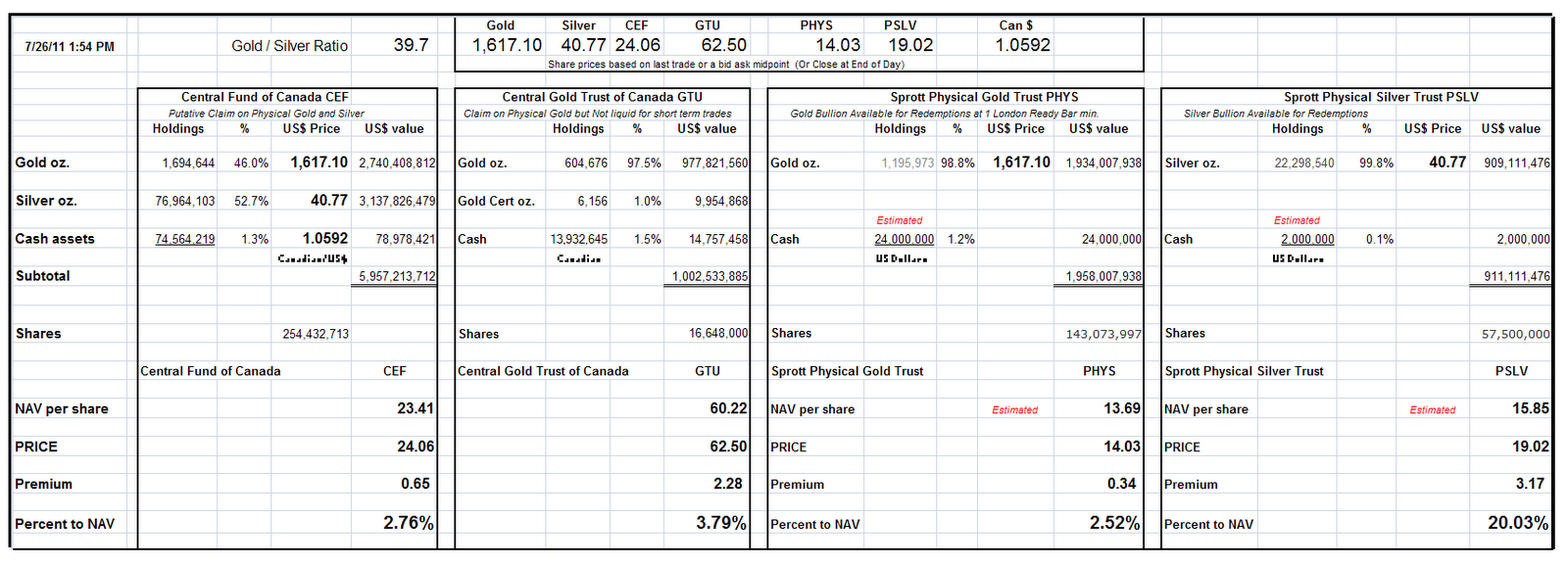
Net Asset Value of Certain Precious Metal Trusts and Funds


PSLV is carrying such a large premium, and is so low on cash holdings indicating a secondary offering may be coming, that I would not buy it now personally at this price in lieu of other ways to play silver for a trade, without the intention of taking physical delivery at some point.

Additionally I would never own GLD or SLV except for the most cynical day trade, if then. But that is a preference.


The US 'Debt Crisis' in One Picture


And the O-Man can be Aunty.

“Great occasions do not make heroes or cowards; they simply unveil them to the eyes of men. Silently and imperceptibly, as we wake or sleep, we grow strong or weak; and at last some crisis shows what we have become."

Brooke Foss Westcott


25 July 2011

Gold Daily and Silver Weekly Charts


Gold and silver look particularly good in times of thuggery, deception, and the willful arbitrariness of the powerful to promote their own interests, the public be damned.

However, the markets are still clearly signalling that they believe that cooler heads will prevail, and there will be a fresh opportunity to game the market and steal from the many.

The US made a tragic mistake in not pursuing real reform earlier on, and speaking out for it forcefully when they had the momentum and opportunity. Co-opting the reform movement and turning it into a tool of the monied interests was a stroke of genius.

The best lack all conviction, while the worst are filled with passionate intensity.

Tomorrow is option expiration on the Comex. I hear that there are quite a few call options open around the 1600 strike. So we would expect the price of gold to get hammered down below 1600 sometime this week.

When options are in the money, they are converted into open futures contracts. So there may be a lot of new holders of futures contracts who get a stiff gut check on Wednesday through Friday, if it does not come tomorrow.

"When you spread out your hands in prayer, I will hide my eyes from you; even if you offer many prayers, I will not listen. Your hands are reddened with blood; wash and make yourselves clean. Take your evil out of my sight. Stop doing wrong, learn to do right. Seek justice, encourage the oppressed...

See how the faithful city has become a harlot. She once was full of justice; righteousness used to dwell in her, but now it is filled with destroyers. The silver of your goodness has become waste, the wine of your virtue is diluted. Your rulers are rebels, companions of thieves; they love bribes and seek after gifts...

My kingdom will be restored by justice; those who repent will be reborn. Those who desert the Lord will be consumed by shame, but rebels and sinners will be cast out into the void, forever."

Isaiah 1:15-29


SP 500 and NDX Futures Daily Charts


Great drama in Washington. Does anyone recall that there was a budget surplus in Washington not ten years ago? What transpired to change that is unfunded wars on two fronts, and tax cuts for the wealthy to promote growth in support of a trickle down economic theory that is a hoax. And of course the financial crisis from the banking bubble and the decline in employment and associated tax revenues.

The markets are signalling that they do not think the US will default. But as the week progresses, and if nothing changes, look for a possible flash crash to signal to Washington that their apparent nonchalance is misplaced.

They could accidentally stumble over the cliff, and there are some large financial firms and powerful people that would welcome this.

Speaking of tumbling over a cliff, Netflix is getting hammered after the bell on a brief glimpse of reality in their quarterly financial report. I spent years as a product manager, doing all the planning, operations and pricing. When I saw their new pricing proposal I assumed that they were planning on exiting the DVD business for some cost based strategic reason. If this is not the case, someone should lose their job.

If I were ever to give any advice to a leader in troubled times it is this:
"I am a firm believer in the people. If given the truth, they can be depended upon to meet any national crisis. The great point is to bring them the real facts."

Abraham Lincoln
For all his eloquence and presence, Obama is one of the more timid and abstract communicators I have seen. And this makes people suspicious of him. It makes it appear that he has something to hide. Does he even know how to use a visual aid like a chart? He needs to stop being overwhelmed by the spin in his message, and start using it to convey real information and thereby make his case. There are a few intelligent people out there, but he is losing them quickly.


Some Discussion on the Manufactured US Debt Crisis


I think this is an interesting discussion and worth a listen.

I agree with quite a bit of it.  I could be wrong, but I do not think that the Obama Administration has willfully passed up a few convenient ways to circumvent this debt ceiling impasse, two of which were relatively doable, and the last being a 'little more radical.'   I looked into each one and they all appeared to be risky and improbable of success.

Invoking the 14th Amendment to nullify the debt ceiling would undoubtedly provoke a Constitutional challenge by the Republicans. It would go to the Supreme Court and would likely be overruled there after generating considerable uncertainty, given the current makeup of the court. The debt ceiling has been in place for a long time, since 1917 as I recall, and it would not be easily dispensed. I do think it is a bad law, and should be nullified, but by legislation, not by the judiciary and not in a crisis of this sort.

Selectively defaulting on Treasury debt being held by the Fed is also probably a non-starter because the ratings agencies have said that this would be considered a default, and would trigger a CDS event. Selectively defaulting even if the Fed agreed would be a far-reaching event.  I did consider some action by the Fed to write off the debt on its own accord, but I don't see that happening as it would appear to be overtly partisan.  This is more an artificial political fight than a genuine financial crisis.  If you don't understand this, you are not understanding the ebb and flow of the drama.

As for the third alternative, slightly more complex, it involves the Mint creating a falsely valued asset, like a trillion dollar platinum coin, and selling it to the Fed at face value. The Constitutionality of this would also be challenged, as it would be a form of fraud and pure money printing.   I think it is much more awkward than having the Fed just buy more Treasury debt in the open market and send the interest back to Washington, ex expenses, which they already do.  But that does not help with the debt ceiling. 

There is a possibility that Obama could resort to Executive Order after the deficit ceiling deadline passes, but that would be a very clumsy political maneuver.  It will be interesting to see if the CDS are triggered, in which case the government may have to nationalise some of the banks.  Hardly a desirable outcome.

So I don't see a viable solution in any of these three suggestions, and view them as being clever, without being practical.  Just as political people rarely understand the finer points of economics, so the economists rarely understand the finer points of Washington politics. 

I hasten to add at this point that Yves is far more knowledgeable in the financial area than I am, and I have the utmost respect for her.  She has knowledge and integrity, which are rare commodities to find in combination these days.   I do not want this to be viewed as a criticism in general, but it is an important point since some do believe in these alternatives, and they did seem to play into some of her later thinking.  Yves has probably forgotten more about finance than I know, and her book is an absolute gem and a must read. 

I struggle with the question of Obama's motives, that he always wanted to cut entitlements. I don't agree with this based on what I have seen, although it is difficult to assess someone's motives. I think this theory is weakened because there really is not any 'easy way out' yet shown, and the House Republicans are hardly allies of Obama. In fact, they have shown a determination to make this a political event, and to stretch it out if possible into the 2012 elections.

I cannot imagine that he wants this, and if anything has been bending over backwards to try and avoid it. He is a compromiser, non-confrontational, and although one would like to think that there is a method to his madness, and there may well be, in fact we just don't know what his motives are.  I suspected he was positioning the Republicans to take the blame, but the excesses and extortion are their own.  Like Clinton, he is trying to force them to eat the consequences of their actions.  Hence the exaggerated gestures of compromise to look reasonable.  He could be sincere, but since politicians rarely are I would not count on it.

The Republican right and the financiers are indeed looking like extortionists, as they mention in this video, and setting up opportunities to threaten the operational integrity of the country in order to get their way, in support of ideas not accepted by the majority of the people. They can obstruct, they can use the threat of damage, but they cannot win by normal means because they are a minority. But since they are an ideological minority they are willing to use methods not usually considered appropriate, and that are dangerous and potentially destructive.  

This debt ceiling 'crisis' is not an aberration but a recognizable modus operandi from the new Right's playbook, cutting taxes for the wealthy, and then declaring a financial crisis,  and seeking to gut social and popular policies and laws and organizations which the monied interests oppose. It is using crisis to circumvent the political process. This is being done at the state level in Wisconsin and New Jersey, for example.

I was involved with politics on the periphery, and did some work in Washington years ago.  I don't have any inside knowledge or insights anymore, but I like to think I am seasoned enough to figure out what is going on. And I don't think it is honorable or in the best interests of the country.


24 July 2011

SP 500 and Gold Futures On Sunday Evening


The apparent lack of a viable debt deal sent stocks dropping and gold soaring in Sunday evening NY trade. 

Gold needs to break out from here, or risk a correction back down to support. The reverse is the story for broad equities.

Notice how the SP futures dropped right down to key support at 1322, to mark it firmly. While stocks remain above the 1320 level, Wall Street does not seriously believe that a budget impasse will prevail.

If stocks break down below 1300 we could be in for a Nantucket sleigh ride on the world market.  And below 1290 it might be time to head for the exits.

I thought all along that the teenage drama queens in Washington would take this into last minute sturm and drang to impress their constituents that they are major players with serious concerns and must be appreciated.

The financiers like to create crises when they wish to get their way. It is always a mistake to give in, since it just encourages them for the future.

As a reminder it is Comex option expiry this week.


Memento Mori: Remember That You Are a Mortal Man


It is said that during the Roman Triumph, in which a great hero was recognized by a procession through the city, generally for a military victory, a slave was positioned behind them, whispering in their ear:
"Memento mori,"  roughly speaking  'Remember that thou art a man.'
As you may recall, Rome had become a Republic, after the overthrow of its monarchy, and enjoyed a period of Hellenistic influence, both in science and philosophy.

In its decline into the reign of the imperial, god-like emperors and their increasingly idiot and sociopathic successors and sons, the elite became utterly distinct from the people by self-decree. 'They would become as gods' is a hallmark of an empire on the road to decline and decay, repeatedly endlessly through history.  It is the logical end of the will to power, in which none will be served but oneself, with power as an obsessive distortion of self-preservation and ego.

Death is the great leveler, and the balancer of the scales of fortune.

Perhaps a member of the middle class can whisper this to the financiers and the politicians, those newly made masters of the universe, as they bask in their moments of power and triumph, and forget their commonality with the people.

Better to have someone whisper in your ear, than succumb to the excess of self-delusion and have the crowd cut it off with your head.  But madness has no discourse with logic.


Roman Art: Memento mori, a philosophical theme the Hellenistic period, an allegory of death that has rebalanced and weighs the same as all people regardless of their wealth and social status, with symbols of Life and Death.
Mosaic from Pompeii. 2nd style. Sun 47×41 cm Museo Archeologico Nazionale, Naples