19 April 2013

CBC Documentary: The Secret World of Gold


Here is the CBC Documentary from this week, presented in three parts.

In Part Three they present Andrew Maguire and his activities in calling attention to manipulation in the silver market.

I could be surprised, but I expect nothing to be done for all the same reasons that Jeff Sachs cites in his talk to the Philadelphia Fed banking conference about the pathological environment on Wall Street, and how a docile President, Congress and regulators will say or do nothing about it.

I think they will, but only after something blows up so badly that they cannot keep hiding it and kicking it down the road. I cannot hardly blame them. And this does not speak to the situation in London and especially Berlin.

I am however seeing more indications that we are getting closer to a tipping point. And when and if it does break it could break rather quickly, with the exchanges closed or on holiday. There is a desperation in the air amongst the financerati and their loyal manservants.

So have a care when swimming in opaque waters that are subject to rip tides.


h/t To the TFerguson crowd for putting this up on Youtube and to SilverSaito for making me aware of it.

Chinese Gold and Silver Exchange Has 'Almost Run Out of Available Gold Bullion' Awaits Imports


Hong Kong's century old Chinese Gold and Silver Exchange has reportedly almost run out of gold bullion at these price levels and is waiting for imports to come on Wednesday of next week from Switzerland and London. This information is from an April 19th interview.

Apparently they are not able to source from within their region which is a bit of a surprise since China is a major gold and silver producer.  Gold seems to be moving from West to East.

Why aren't they also going to New York for available bullion supply at the Comex?  

The Hong Kong Gold and Silver market seems to be more of what is called a 'bullion market' rather than a paper speculative market dealing in highly leveraged position trading with only small amounts of actual metal changing hands.
"The Chinese Gold and Silver Exchange Society operates in Hong Kong as a registered society. At present, we have 171 member firms which are sole proprietorships, partnerships or limited companies. Among these 171 firms, 30 are bullion group members. Bullion group members who want to manufacture good delivery bars may apply for the qualification of accredited refineries. Upon accreditation, these member firms may produce 99% fineness 5-tael gold bullions and 999.9% 1-kg gold bullions for delivery on the Exchange. The bullions they produce also circulate widely in the open market."
Please see the attached interview from Bloomberg Asia with the President of the exchange.

I do not want to make too much of this as it may be temporary. And since this is a metals exchange rather than a derivatives market a shortage of metal is not a default. A default is a paper promise to deliver that fails.

But it seems to call into question, if not shoot all to hell, the theory that the precipitous decline in the price of gold marked by the dumping of huge numbers of contracts into quiet markets was based on market fundamentals rather than brazen naked short selling and highly leveraged speculation in the London and especially New York markets, which both deliver only a fraction of the metals volumes which are traded on their exchanges.

And still hardly anyone is talking about the dog that didn't bark, and that is silver.


h/t to Delray and Liberty Mike

Sorry but I do not have any way to turn off the autoplay feature with the Bloomberg player. You will have to pause it yourself.

David Cay Johnston: On Crony Capitalism, Control Frauds, and the Gods of Greed and Power


David Cay Johnston is an investigative journalist and author, a specialist in economics and tax issues, and winner of a 2001 Pulitzer Prize.

Since 2009 he has been a Distinguished Visiting Lecturer who teaches the tax, property and regulatory law of the ancient world at Syracuse University College of Law and Whitman School of Management.

Why have you never heard of David Cay Johnston or his ideas before? Why is he almost never interviewed on the mainstream media.

Because in times of general deception, telling the truth is a revolutionary act. And we are in those times, and are caught in a credibility trap.

It is not the same as a coup d'état, but has many of the same appearances and characteristics.

It is the convergence of like minded kleptocrats and the amoral careerists who support whatever status quo that happens to exist. It is the banality of the willing functionary and the bureaucrat, and the inability of a moral center to withstand it.  

Neither austerity or stimulus will work until there is meaningful reform.


18 April 2013

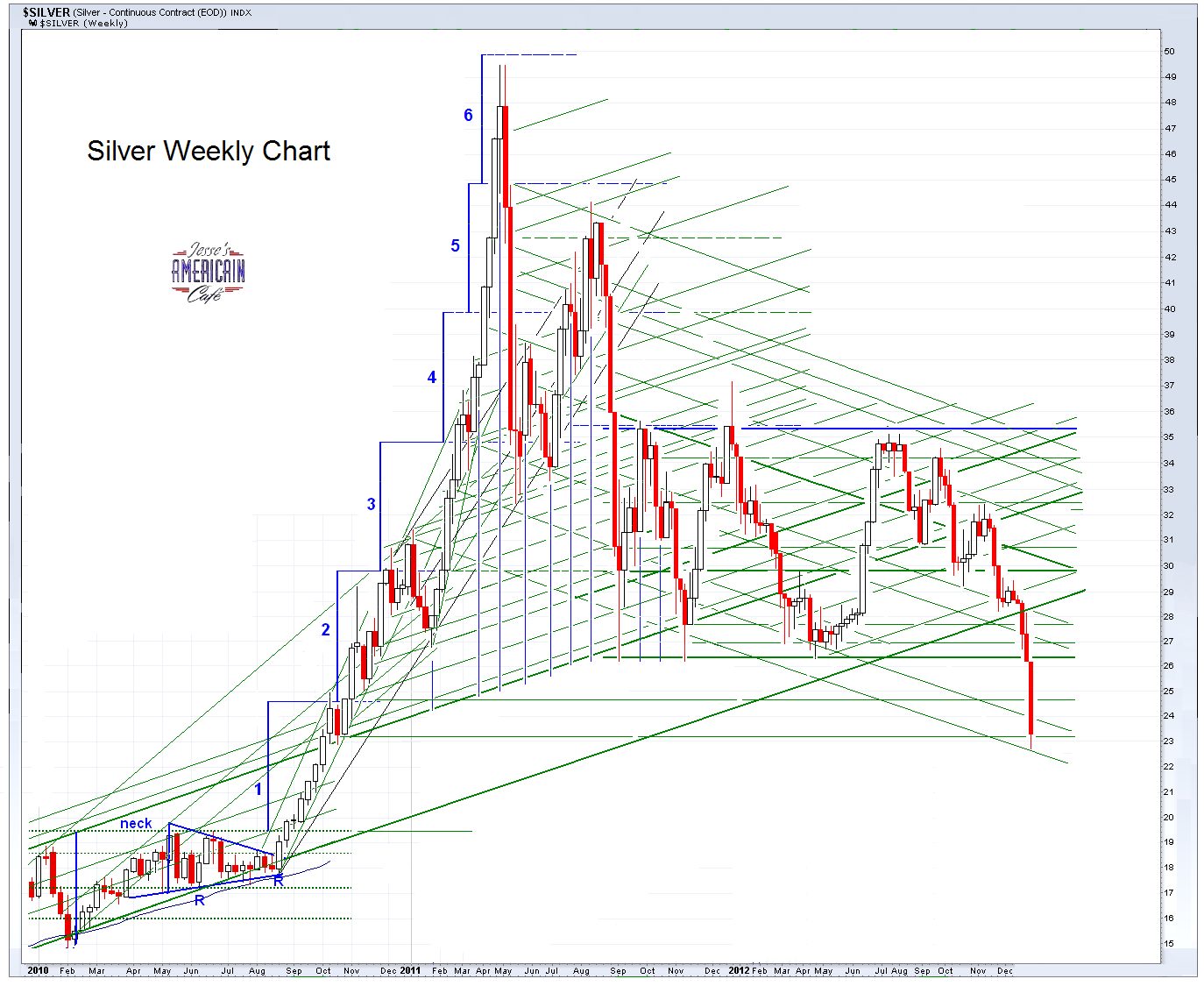
Gold Daily and Silver Weekly Charts - 'Orchestrated Panic'


"Oh what a tangled web we weave,
When first we practise to deceive."

Sir Walter Scott

Intraday commentary here and here.

In particular listen to what Jeff Sachs has to say.  If you do nothing else, listen to what this man has to say. 

John Brimelow calls the most recent action in the metals markets an 'orchestrated panic.'

And it may not be over. The underlying causes for this, besides the usual opportunity for looting, most likely remain.   The system is failing and the masters of the universe are afraid.

As a reminder, next week on the 25th is the precious metals option expiration on the Comex.

I thought it was interesting that the IMF Has Told the UK To Rethink Austerity.  Oops.

Lars Schall has a very good interview with Norbert Haering:  Money Lies Disguise Banking Truths.

And to everyone's delight the DharmaDude has a new piece out, Unklung Goldenfreude.   He gives Herr Krugman a light spanking with his own words.  Where is Mademoiselle Le Moderateur?

And finally Denver Dave serves up a piece on The Law of Unintended Consequences.

Russia is running the G20 this year.  They have scheduled a conference in May titled Global Finance in Transition.  An intriguing title, and yet so few have heard of it.  The BRICs are not happy campers.
On May 7-8, 2013, Istanbul (Turkey) will host the Global Finance in Transition conference. The event is organized by the Central Bank of the Republic of Turkey jointly with the Reinventing Bretton Woods Committee and the Russian Ministry of Finance.

Representatives of G20 finance ministries and central banks, international organizations, research institutions and businesses will take part in the conference. Head of Turkey's Central Bank Erdem Basci, Deputy Minister of Finance of Russia Sergei Storchak and Executive Director for the Reinventing Bretton Woods Committee Marc Uzan will give the opening remarks at the conference.

Five panel discussions are planned as part of the event. They will cover the international financial architecture, in particular, changes in the flow of global investments, local bond markets and growth in emerging economies, incentives and determinants of investment and other issues. In addition it is expected that new instruments and incentives for making the global financial system safer will be suggested during the forum

Change occurs slowly, and greatest changes occur very slowly and almost imperceptibly.  Until they make themselves known that is, and then it is like lightning flashing across the sky.


SP 500 and NDX Futures Daily Charts - Edgy Trade Today, Option Expiration Tomorrow


The trade today was quiet but 'edgy.'

Option expiration tomorrow.

Prices are down to diagonal trendline from the beginning of the rally.

The economic news is not encouraging unless one wears rose-coloured glasses.  Or is hiding their head in some anatomically improbable place.  Or wearing an anatomically improbable hat.

There is no recovery.  There is no reform.  There is no leadership. 


Jeff Sachs: The Pathological Environment on Wall Street (and in Washington, London, and Berlin)


"But there is a sort of  'Ok guys, you're mad, but how are you going to stop me' mentality at the top."

Robert Johnson, Audacious Oligarchy

Thanks to Bill Still for making this available on the web, and thanks to several people who sent it to me.

It is remarkably similar to something I wrote earlier today, but I am certainly not the only one.  Reform and the lack thereof is the 800 pound gorilla in the room.

Sachs certainly livened up a clubby conference of complacent financerati in the Pennsylvania Room at the Federal Reserve Bank of Philadelphia. The topic is "Fixing the Banking System for Good."  It is not so much what Jeff Sachs said alone, but also how out of touch with reality that group of people may be.

I find this interesting because just today Mary Jo White, the new head of the SEC, has indicated that their policy would be to 'move along' and not look at the financial crisis any longer.

This will continue until there is a problem too large to hide, and the confidence breaks. And then good luck controlling the reaction in the global markets. 

But for now they don't care, because they are operating within hermetically sealed capsules of personal privilege, and are locked into an odd form of group think and willful denial which I call the credibility trap.   In times of general deceit, telling the truth becomes a revolutionary act. 

And it is killing the economic recovery. 

And for now, anyone who speaks out, who speaks the truth, is ignored, ridiculed, marginalized, and threatened sometimes subtly and sometimes not, and generally isolated because no one will stand up with them. 

Neither austerity or stimulus will work until there is genuine reform. 

Don't forget that the CBC's documentary on the precious metals market is on this evening.  I will post a link with the commentary later, and will link to a video when it becomes available.

There is a strong push for change, and an even greater resistance from those whose paychecks and allegiances require them to oppose it.  This generally makes for an interesting episode in history.

Listen to this carefully


Thank you to Janet Tavakoli for this:
"I believe we have a crisis of values that is extremely deep, because the regulations and the legal structured need reform. But I meet a lot of these people on Wall Street on a regular basis right now. I'm going to put it very bluntly. I regard the moral environment as pathological. And I'm talking about the human interactions that I have. I've not seen anything like this, not felt it so palpably.

These people are out to make billions of dollars and nothing should stop them from that. They have no responsibility to pay taxes, they have no responsibility to their clients, they have no responsibility to people... counterparties in transactions. They are tough, greedy, aggressive, and feel absolutely out of control, in a quite literal sense. And they have gamed the system to a remarkable extent and they have a docile president, a docile White House and a docile regulatory system that absolutely can't find its voice. It's terrified of these companies.

If you look at the campaign contributions, which I happened to do yesterday for another purpose, the financial markets are the number one campaign contributors in the U.S. system now. We have a corrupt politics to the core, I'm afraid to say... both parties are up to their necks in this.

... But what it's led to is this sense of impunity that is really stunning and you feel it on the individual level right now. And it's very very unhealthy, I have waited for four years... five years now to see one figure on Wall Street speak in a moral language. And I've have not seen it once. And that is shocking to me. And if they won't, I've waited for a judge, for our president, for somebody, and it hasn't happened. And by the way it's not gonna happen any time soon, it seems.


SP 500 Futures Daily Charts Intraday - Option Expiration Tomorrow


Here is a picture of where the June SP 500 futures stand on a daily chart.

They are obviously at key support.

As a reminder, tomorrow is an option expiration in US stocks.

I think the option market is something best left for professionals because of the mispricing of risk.

And that goes double for options on the Comex, and even the futures contracts there for that matter. 

As a reminder, the 25th will be a Comex option expiration in the precious metals.

There are not too many things of which I am sure.  But one thing I am certain of is that if the SP 500 futures market were subjected to a bear raid in which tens of thousands of contracts were dumped into a quiet, non-event-driven market, the exchange and its traders would be up in arms, and the regulators would be getting phone calls at home about it.

Unless, that is, enough trading houses and traders were in on it. And the regulators were obliged to look the other way out of professional courtesy. This happens more often than you might care to believe these days. It is reminiscent of the markets of the late 1920's.

This strategy of moving markets is well known, and goes by the moniker, the Dr. Evil strategy.  Click on the links and read more about it.

Citi Fined for Euro Bond Trades By British Regulator; Italy Indicts Citi Traders; Citi Haunted by Dr. Evil Trades in Europe; Citi Agrees to Pay 14m in Bond Scandal

It is how some marginally talented but especially well connected people beat the market, go to the best schools, and get piles of unaccountable wealth.   And the career minded go along to get along. The best market operations and control frauds are rarely investigated and always denied because they are inclusive enough, and well executed.

Unless of course a single party gets out of line and hurts some other 'major players' who complain about it.  And then there is a real investigation of sorts, like the London Whale, which is quickly smoothed over.

And this does not even begin to touch on the culture of the elite, the insider trading where favors and secrets are the currency of the well connected.  This has always been the case of course, but at times it becomes so bad that it leads to dysfunction in politics and in markets, and is corrosive to the society at large.  And it may go on until it gets so bad that there is an inescapable problem, and attempts to cover it up so that 'confidence' does not break. 

This becomes a vicious cycle, which is the opposite of the virtuous cycle.  It leads to stagnation and disorder.

Charts can only tell a part of the story.  If charting systems really 'worked' the people who had them would become so rich that you would never hear about them.  I have looked at all of them.  The only techniques that work at a high percentage are the ones that rely on asymmetric information flows, and the ability to act in the market with foreknowledge and the power of size. 

One needs to look at the market structure, the volumes, and who is buying and who is selling as best they can.  The lack of transparency is a great weakness in most market systems, and especially in markets that are also lightly regulated and tainted with insider dealing and technical trading gimmickry. 

Transparency is the disinfectant to fraud.  And that is why it is avoided at all costs.

And I still cannot quite understand why no one is talking about what has happened in silver.  It's the dog that doesn't bark.


17 April 2013

Risk: It's Not Just a Board Game


World Production of Silver and Gold Ratio


This is from my friend Gary at nowandfutures.com.

He carries some of the best charts around.


Gold Daily and Silver Weekly Charts - And Most Importantly Why?


Stocks were weak today, and volatility was up as the market was on edge.

There was bad news and a guiding down from the tech sector today.

The miners got hammered again, hit by the double blow of a sell in stocks and weakness in the metals after the recent 'flash crash.'

There is intraday commentary here that I suggest that you read.

In it I lay out the general reasons why such an historic decline would occur drawing on all the data I can find.

I do not believe that this was just a liquidation by some pension funds. I do not believe for a minute that the fundamentals have changed, not with competitive devaluations in the currencies going on.

So now we look for other possibilities. Those could be grouped loosely into systemic and incidental.

Systemic can be some general liquidation event which is not likely given the performance of other asset classes like stocks. I have had an eye on the carry trades like yen, but I am not seeing that yet. Obviously selling begets selling as margin calls occur, but that did not start this.

So, are the central banks pounding the metals and select commodities to lessen a shock when a major player makes an announcement? Eyes on Europe, which could be restructuring the membership of the Eurozone, or adopting some monetary policy in the manner of Japan for example.

For the non-systemic we look for particular incidents. Did some major entity go to either the Comex or the LBMA and demand delivery of their bullion? We know that both of those institutions are highly leveraged without knowing the exact number. We also know that supply is tight. 

A major request for delivery could set up a cascade of defaults, and involve the derivatives markets, where JPM holds rather large positions in gold and silver. This data is released quarterly by the OCC, of recent notoriety for overlooking irregularities by its banking clients in the foreclosures scandal.

A fellow from the GLD gold trust was on financial television around the close of trade, and in addition to the annoyingly snarky questions put forward by the spokesmodels about gold, he did in fact plainly state that GLD holds its bullion with HSBC in London, in LBMA ready bars. 

And he went on to say that the policy of GLD is not to smooth their inventory using hedging, but to maintain their inventory roughly 1 to 1 of allocated gold with respect to tracking the gold price.  So, it seems very likely that GLD was selling a lot of bullion in London and it is LBMA ready.  And it is their policy to just move the bullion within the vault from one owner to another.  So if the LBMA needed some bullion quickly, they would tend to get it from GLD or a bullion bank, and not from the Comex where the bars are of a different size and specification. 

As an aside, several people have said, "Oh Jesse are you so naïve to think GLD has any gold?"  And the answer is, yes I do.  For GLD not to have ANY gold would be insane.  Even a blatant Ponzi scheme has to keep cash on hand to cover redemptions.  The first time they default is the last. 

I just don't know exactly how much GLD has, and whether it is 1 to 1 or not.  I don't think there are any auditor reports that I can go to and look at their allocated inventory bar for bar, and say, "This is exactly how much they have."   But I am sure they do have some amount.   I find it hard to imagine how they maintain their ratios in such volatility without resorting to hedges and leasing.  But they say that they do. 

I am trying to eliminate the least likely things, and highlight those that remain more probable. This way I can have some rough models with which to evaluate new data as it becomes available, and adjust the probabilities accordingly.  If you want to do in possibilities without constraint or likelihood, then have fund making a long list that gains you nothing.

As an aside, this is one of the ways I used to find and diagnose difficult trouble in major communications systems where there was a problem, but the cause was not readily identifiable, and all the usual suspects had failed so it bubbled up to the fifth tier support guy. 

Slowly, carefully, sorting and categorizing the data. Assuming little, testing everything, all the while looking for the major systemic pivot points that would provide the ability to eliminate some possibilties. The major problem in this case of course is that the data is often hidden, and willfully.

I think it is more and more obvious to me that we are still just children playing on a beach, on the shores of a vast ocean of the unknown and the unknowable.

That was Newton who said that, and I am leaning on him.  Newton was so intelligent that he was smart enough to realize who he was, and what he did not know.  And that is the beginning of wisdom, to see so far that you can look back and see yourself as you are, and your place in things, as if from a great distance.
“I do not know what I may appear to the world, but to myself I seem to have been only like a boy playing on the sea-shore, and diverting myself in now and then finding a smoother pebble or a prettier shell than ordinary, whilst the great ocean of truth lay all undiscovered before me...If I have seen further it is by standing on the shoulders of giants.

Gravity explains the motions of the planets, but it cannot explain who sets the planets in motion."

Isaac Newton

This from one of the greatest minds in modern history.

Have a pleasant evening.


SP 500 and NDX Futures Daily Charts - Volatility Up


Volatility spike today. There are jitters on the tape, but no substantial  volume on the selling.

More alarms in Washington over letters, and some aftershocks in Boston.

Next move needs to be up to carry the bulls into option expiration this Friday.


Net Asset Value Premiums of Certain Precious Metal Trusts and Funds - Gold/Silver Ratio Is 59


Premiums are all negative, and the gold/silver ratio is around 59.

It is hard to draw conclusions in this type of volatile market action so let's file this one away for future reference.

The mining sector is really taking it on the chin today with metals slack and stocks sharply lower.

I have exited many of the miners over the past few days and trimmed back awaiting to see what comes next.  This is in the trading account only.


How the Gold Market Was Crashed - But Most Importantly, Why? Leveraged Default? And Silver?


Many are still sorting through the data to try and figure out what happened, but it is hard to look at the available data and the market action and conclude that the recent 'flash crash' in gold was anything but a calculated takedown.

Some big players had been trying to work the market price of bullion down in stair step fashion for some time.  Their tracks on the tape were big enough to be hard to miss, and any number of people who watch the market structure as it develops were seeing them, and a few were reporting what they saw.

But it just wasn't enough.  The pressures were building, and something had to be done. 

A plan for a market operation to relieve the pressure was made, and then executed ahead of the upcoming option expiration on the Comex on April 25th.  The word was quietly spread so the important monied interests would not make a fuss about losses when the time came, as in the case of MF Global and Cyprus.

And then Goldman gave the signal to the market with their 'short gold' call.

As I said at the time, I was not sure if this was done to try and avert a disaster, or to cover up some longer term corruption. Or perhaps a bit of both.  Motives are never easy to discern where leverage and opaque trading pools are involved.

This could be in advance of a major announcement out of Europe with regard to the Eurozone and also their monetary policy following along the lines of Japan.  Perhaps it is even something regarding US policy.  Obviously one has to have an open mind about that.

But there were persistent rumours of a potential default situation at both the LBMA and the Comex. Well, one has to take those with a skeptical eye.  But there are some data that point to the LBMA in particular, although the drawdown of bullion from the two exchanges could have been more general. 

Linked just below is a report that includes more data and it well worth reading. It tends to concentrate on the Comex.

How the Gold Market Was Crashed.

It seems that the word has gone out to the media and the stories are being spun to protect the system.   And the parrots dutifully pick up the chatter, without knowing why.

The story being spun that there was a speculative excess in gold being held by pension funds that panicked.   Foolish people, outsiders really, got over their heads and caused this regrettable incident.

There is probably a grain of truth in that, but I think it is more likely that they were forced out of their positions by a market operation designed to do just that.  And market insider knew exactly what they were holding.

Price declines caused by legitimate selling and panicked longs are not marked by increasing open interest. That is the hallmark of short selling with a purpose.

This is a big deal, and it was writ large across the media.  And that suggests that there is an equally big problem that had to be dealt with quickly and brutally.  Ordinarily market operations are more adept and protracted.

Something was close to breaking, and it most likely still is. 

And if it broke, it would prove to be embarrassing to quite a few very important people.  At least, that is what this situation suggests to me. 

Even the endlessly levitating stock markets seem a bit 'edgy' with a tension on the tape.

I cannot possibly know what is at the root of this.  Can't find Germany's gold, and can't buy enough at the LBMA to deliver it, because the market is leveraged 100 to 1?

Maybe not that but something of that magnitude.  A major TBTF tottering on the brink of a derivatives domino collapse? There are rumours out of Switzerland about Italy and France.

Most eyes are on the States, but how quickly we forget that ABN/Amro declared a force majeure and stopped all physical delivery of bullion, forcing settlement in cash.  The soft default of a major bullion bank is no joke, especially when it appears they could not obtain suitable goods at any price

This tends to point towards problems in Europe and the LBMA.  And one of the big sources of LBMA 400 oz. qualified gold is the big SPDR Gold ETF, GLD which is stored by HSBC in London.  I have included a chart of who tends to use 400 oz. bars below.  The COMEX does not.

As you may recall, Andrew Maguire reported early on that there were indications of problems on the LBMA with regard to gold inventory.  It is said to be leveraged 100 to 1.

“Entities went to the LBMA and said, ‘We don’t trust anybody anymore. We want our physical metal.’ They were told they would be cash settled instead by a bullion bank. The Western governments have been trying to plug holes, and the reason for it has to do with the default that was taking place at the LBMA.

This is why this smash has been orchestrated because of the run that has been taking place on physical metal. So Western governments had to do this because of an imminent run on the unallocated LBMA system. The LBMA bullion banks had become so mismatched at one point on their trading positions vs real world demand that they had to orchestrate this smash."
The 'entities' in question are again just rumour, but they are most likely to be from the Mideast or Asia.    They could be a central bank, or even an ETF for that matter.  But the size was said to have been substantial, and untenable for withdrawal without a severe market disruption given the leverage on which the LBMA operates.  100 to 1 leverage is no joke when the drawdown is physical and available supplies are tight.

If you have not picked it up, the implication in this theory is that the big price declines allowed some non-allocated repositories, like GLD for example, to disgorge delivery ready bullion to the LBMA for delivery to the entity that had demanded delivery.

And something like this might not be a singular event.  People talk, and if one entity got nervous and took delivery that information cannot be kept from other sizable players in the same circles.  And so others step up and ask, and there is the threat of a run.  And it could be happening in more than one place, ie not just the LBMA.  Hence the decline in inventories at the Comex referenced above.

JP Morgan holds enormous derivatives positions in the precious metals not reported anywhere in detail except occasionally in the OCC report.  If something were to perturb the markets, it would almost certainly affect them. 

And recall that the outrageous excesses of the 'London Whale' were not uncovered by regulators, but rather by market participants who reported JPM to be distorting the market because of the size of their position.  And the OCC is having a bit of recent notoriety from overlooking irregularities (some say crimes) to protect the banks.  So keep that in mind.

Changing the subject, if you wish to get a bit more baroque, gold may have been a necessary misdirection with the real target being silver, which hardly anyone is talking about, even the house economists and spokesmodels for the status quo. 

Keep an eye on stocks and the markets.  The big money always moves first, because they get to know what is happening first.

But I have to remind you, your guess is as good as mine.   It is an opaque market, and it has gotten worse and not better, despite all the show of 'reform.'

When the tide goes out, you not only get to see who is naked, you see who they are naked with.  And so the smokescreens go up.

I suspect that this is going to get ugly.


Related: Update to the Update: The Attack On Gold - Paul Craig Roberts (this gets more into the general government-business-as-usual theory rather than something that was incidentally related, ie a major impending default.  As I pointed out I think those sort of antics tend to be a more elegantly executed and gradual.  The recent gold/silver smack down was sheer brute force.  Could have been shock and awe but it really was over the top and probably called far too much attention to itself to have been a 'policy thing.')

William K. Black On the US Financial System


“The U.S. banking system is absolutely primed for the next meltdown.

There is pervasive fraud at the most reputable banks. 

The U.S. financial system is sick, and we still have the fundamental dynamic of a regulatory race to the bottom.”


This is from Greg Hunter's USAWatchdog.

16 April 2013

NPR: Congress Quietly 'Overhauls' Law Against Congressional Insider Trading


"Small wonder that confidence languishes, for it thrives only on honesty, on honor, on the sacredness of obligations, on faithful protection, on unselfish performance; without them it cannot live."

Franklin D. Roosevelt, First Inaugural Address, March 4, 1933

Who says that the Congress cannot act quickly and in a bipartisan manner in order to pass laws.

As I recall the original reform was called the STOCK (Stop Trading on Congressional Knowledge Act) Act. It was in response to the public outrage over a news story that exposed the insider trading business in Congress.

At the time the MF Global story was also breaking and there was concern that the people might lose confidence in the financial markets.

Well, the elections are over, and the law was about to take effect, so...

NPR
How Congress Quietly Overhauled Its Insider-Trading Law
by Tamara Keith
April 16, 2013


The legislative process on Capitol Hill is often slow and grinding. There are committee hearings, filibuster threats and hours of floor debate. But sometimes, when Congress really wants to get something done, it can move blindingly fast.

That's what happened when Congress moved to undo large parts of a popular law known as the STOCK Act last week.

A year ago, President Obama signed the Stop Trading on Congressional Knowledge Act into law at a celebratory ceremony attended by a bipartisan cast of lawmakers.

"I want to thank all the members of Congress who came together and worked to get this done," he said.

The law wouldn't just outlaw trading on nonpublic information by members of Congress, the executive branch and their staffs. It would greatly expand financial disclosures and make all of the data searchable so insider trading and conflicts of interest would be easier to detect.

But on Monday, when the president signed a bill reversing big pieces of the law, the emailed announcement was one sentence long. There was no fanfare last week either, when the Senate and then the House passed the bill in largely empty chambers using a fast-track procedure known as unanimous consent.

In the House, Majority Leader Eric Cantor, R-Va., shepherded the bill through. It was Friday afternoon at 12:52. Many members had already left for the weekend or were on their way out. The whole process took only 30 seconds. There was no debate...

Read the entire story and listen to the audio portion here.

Here is what DemocracyNow had to say:
Obama Signs Bill Gutting Transparency Provisions in Insider Trading Law

President Obama has signed into law a measure critics say guts key transparency provisions from a law designed to combat insider trading by members of Congress. The new bill repeals a requirement in the Stop Trading on Congressional Knowledge Act that high-level federal officials disclose financial information online.

But, according to the Center for Responsive Politics, it also removes requirements for the searchable and electronic filing of information related to potential conflicts of interest by the president, vice president, Congress and other officials.

On its website OpenSecrets.org, the Center wrote: "Without the provisions, the STOCK act is made toothless. Insider trading by members of Congress and federal employees is still prohibited, but the ability of watchdog groups to verify that Congress is following its own rules is severely limited because these records could still be filed on paper — an unacceptably outdated practice that limits the public’s access."

Here is a story on the same overhaul from The Hill.

Jonathan Weil also wrote a story on Bloomberg saying that all this concern over insider trading was overdone and that Chuck Grassley does not understand what he is talking about. I found it to be interesting. 

I think this story may be relevant. Stock Surge Linked to Lobbyist

Washington is corrupt, and Obama is no reformer.

Gold Daily and Silver Weekly Charts - Change Is Coming


“First you destroy those who create value. Then you destroy those who know what values are, and who also know that those who have already been destroyed were in fact the creators of value.

But real barbarism begins when no one can judge or know that what they are doing is barbaric."

Ryszard Kapuściński

Intraday commentary about gold here, What Does the Recent Decline in Gold's Price 'Prove?'

Well I think we can stipulate that if you give the Banks enough money and regulatory leeway, they will be able to have a good time with almost any market. But there is a bit more in there than that, and you might wish to give it a read.

I will caution everyone that I obviously do not know what the future will bring, and that, within the context of a currency war and a post credit bubble adjustment which I very much believe is underway, markets are going to remain difficult if not treacherous.  So leverage is best left for professionals.  The lack of transparency and market reform is appalling.

One thing that puzzles me when discussing this subject with American economists and financial pundits who have been expounding on the decline in gold, and those who may choose to buy gold and silver for their portfolios, in some fairly over the top terms complete with name-calling.  And drawing some fairly dodgy but broadly sweeping economic conclusions from it in the process.

Do they realize that quite a few people also buy Swiss francs and other currencies for many of the same reasons like portfolio diversity that people might also buy gold and silver?    And they are often the same people?

And their motivation in making such a purchase is not a hatred of the Democratic Party?  It may be a vote of 'no confidence' in monetary policy of a particular central bank, motivated in part by the negative real interest rates for example.  And it might reflect concern about scandals and corruption too, but that is more of a practical than political matter. 

Unless of course you are a creature of the central bank and its subsidiaries who can admit no error and allow no questions.

Do they realize yet that the world's central bankers are now net buyers of gold?  Are the Chinese and Russians closet Republicans?

Do they have any idea of what is happening outside of the clubby enclaves of the Washington-New York metroplex, the Hamptons, and the City of London?

Do they understand what is happening in the global currency markets and the way in which they are evolving?  I see little evidence of that.  They are stuck on some fairly narrow self-interests and issues.

Do they look for anything beyond their comfortably entrenched place in the status quo or does this bring too much fear and even desperation?  Its a common problem for many, but few see it in themselves.  But they are quick to point to it in others.

I think that quite a few economists and pundits might be in for yet another rude surprise (again) in the not all that distant future, because it looks like a sea-change is coming, slowly but surely.


SP 500 and NDX Futures Daily Charts - Complacency Is Resurgent, Stocks as the New 'Safe Haven'


As they are saying on the financial networks today, stocks are 'unbeatable' and every dip will be bought.

Don't be left on the sidelines.

Or as incredulous as it may seem unless you mention Jeremy Siegel's name, this recent decline in the metals show that commodities are now unsafe, and people should seek safety in stocks.

This reminds me of the same sort of things we were hearing in 2007.

Well, let's see what happens.


Market Manipulation, News, and Leverage


This piece on leverage and market manipulation came out a few weeks ago. Philip Byrne reminded me about it, and he is right.

Using leverage in these markets is a dangerous strategy.

I was also reminded of this because of the recent 'leak' of the FOMC minutes by the Fed that demonstrated that they had a 'preferred recipients' list who receive the information ahead of the markets, although normally not by a day.

And I think one might suspect and assume that there is more ad hoc leaking going on than the Fed would care to admit, and other key data points as well, especially from non-governmental sources.

So using leverage as an outsider is double deadly in a thin market based largely on policy and artificial flows of hot money.   In this case he had been speaking about shorting stocks with leverage in the stock market.  But he  draws the same lesson for levered long positions in commodities.

I also have to chuckle a little.  Some of the financial networks are pitching stocks heavily as a 'safe investment' now that commodities like gold have been proven to be unreliable.  And they are trotting out the usual suspects to make the pitch.

I will never forget how former Fed Governor Wayne Angell remarked that 'the Fed will drive people out of their savings and money market funds and into stocks.'  This on a financial network in 2004, and it worked; people piled into financial assets and a housing bubble, with Greenspan himself as cheerleader.  And they got slaughtered in the 2008 market crash. 

Nicely done.  And now its come on back in suckers for another handoff.  Take your money out of the banks and commodities and pile into stocks, which have already been run up on some record thin volumes.   Its a safe haven!

This is from Phil Byrne:
"The best thing about yesterday is that the Fed gave us a glimpse of the future. Those people who owned gold with leverage were waiting to have their throats cut – almost begging for it.. The best part is that this market operation has created instability where they once had stability. Nobody will take a levered position against them anymore – not on the stocks short side and not on the levered long gold side.

Here’s what I wrote to clients a couple of weeks ago:

Market Manipulation

The price of gold is a good segue into explaining how the markets are being manipulated.

Anyone who has read about the Japanese martial art known as Judo knows that the basic tenet of the art is to use the attackers leverage against him. Instead of picking up one’s opponent and throwing them down, Judo experts redirect the force created in their opponent’s attacks to knock them down. It’s the same in the markets.

We’re not the only investment firm that understands the problems in our economy and markets. Since 2008, a lot of work has been done to understand the problems in the world and this work has led to bets on the market – oftentimes with leverage such as selling short a stock, buying a put option, or borrowing money and buying gold.

Whenever investors use leverage, they leave themselves vulnerable because leverage turns small losses into big losses – it’s the reason why Lehman Brothers is no longer around. Knowing this, the Fed and its agents wait for these traders to place leveraged bets, and then the Fed’s agents forcefully take the other side of the trade. This is why we include charts of the VIX – they represent leveraged option trades.

A year ago, US corporate earnings growth was slowing meaningfully, Japan was recovering from a nuclear disaster worse than Chernobyl – one that continues to get worse – and at the same time, southern Europe was at the point where nobody would buy their debt and traders were making extreme bets against European markets and the European currency.

All it took was a promise by Europe’s central bank to “do whatever it takes” to prevent bankruptcy and the markets reversed in a huge way. Anyone betting against the European central bank incurred heavy losses. Later in the year, the Fed, then the Bank of Japan did the same thing with similar rallies.

The market has figured out this strategy which is why nobody is willing to bet against the world’s central banks in a meaningful way any longer. It’s the reason why markets are going up despite the tremors we face such as Cyprus, Italy, Spain, Portugal, North Korea, China, Japan, Argentina, and economic stagnation in the US.

Without speculators to crush, the Fed’s ability to keep the markets moving higher is seriously compromised.

Gold was the final bet against the Fed – they’ve won and by winning, they’ve lost!"

Philip M. Byrne, CFA
Chief Investment Officer
GeoVest Advisors Inc.


What Does the Recent Fall in the Price of Gold 'Prove?'


"And this means that it is deeply, deeply wrong to think of rising gold prices when bond yields are low as some kind of symptom of monetary excess."

Paul Krugman, 10 September 2011

So don't think of gold as an indicator of monetary excess when it is going up,  but when it is going down it can be used to prove your hypothesis of a lack of excess, as PK does in the new article cited below. 

But there is some wiggle room between excess and hyperinflation, and degrees of excess, and I would agree if the argument he presented was well reasoned and well tempered, which is it not.  It is just over the top, playing to the crowd. Well, that's show biz, and perception management.

I really would have preferred not to reference this article below, but I am afraid I must because it establishes one important point. It does not have much else to recommend it.  And I have decided to avoid most other articles like this that deal in 'goldbuggery.'  You know where I tend to place my focus, and name calling is what one does when their arguments are insubstantial.  And then it becomes de rigueur on both sides, and thought fails. No need to add to the hysteria.

In taking his victory lap for his economic theory in this manner, Mr. Krugman endorses the ability of gold to predict monetary dislocation and policy error. I would also add that it is a strong indicator of real interest rates.  When they are negative they are good for gold, and when they offer a fair return, they are not.  This is without regard to the nominal level of inflation, Paul.  But you knew that, or ought to have known that.  But the key takeaway is that Krugman admits that gold does matter, and he watches it.  And will use it in his data when it serves his purposes.

I think that is important. He would likely dodge this and say that it does not matter, but merely shows that some people believe that it does and therefore they buy it. When one deals in otherworldly economic models, they can make them do almost anything. The thing that economics does best is rationalizing as you wish after the fact.  There is a paper, by the way, about Gibson's Paradox by Larry Summers that PK can read if he wishes to see a more 'wonkish' linkage.  Oh that's right, he caught up with that in 2011.

But I guess it is ok to use it as an indicator that all is well on the monetary front when it is going down, as he does today.

I will take an aside, and say that the claims that monetization are not yet causing inflation proves nothing. All that proves is that one can give wheelbarrows of money to their friends to prop up their bad debts, as long as the friends keep the money in their own bank and trading accounts.  The first result will be bubbles in financial assets, and the accumulation of wealth in a narrow segment of the target population. 

But I do think that we have passed from the phase where gold is irrelevant and can be ignored, to the point where even 'very serious people' must take it seriously, and deal with it in some manner,  with fear and ridicule.

Open interest generally does not RISE when prices are falling, and people are fleeing away from a particular investment vehicle, especially a commodity. When a 'long' position sells, it closes, and open interest, or the number of contracts, goes down. Open interest increases on falling prices when short selling is pressing a market lower against a steady demand from legitimate investment. But that is a detail, and not in his models.

As you know I only became interested in gold because of my study of currencies back in the 1990s.  And I do not favor a return to a gold standard, although it is painfully obvious that the existing monetary arrangement for trade based on the dollar is as unstable as is the euro in Europe, and for many of the same reasons.  The dollar regime has simply lasted longer, for some of its own scale and reasons. 

And I do not favor austerity as a policy, and believe in the efficacy of stimulus when applied effectively and directly to a demand/employment condition of deadlock or stagnation brought on by a credit bubble collapse as we are in now.   I am what would be called a 'progressive.' 

But all the stimulus one can muster will not repair a system that is still broken and corrupt.  It is like sending aid to some third world nation where it is diverted by the ruling warlords from ever reaching the people, save for some crumbs.  And Paul Krugman, in his zeal for his cause, seems to miss this. 

That is the FDR model, applying stimulus directly to creating jobs and increasing the median wage while reforming the system. And that is most certainly not what we have today.  We are bailing out the banks while allowing their abuses to go unpunished, and the system to be substantially unreformed, for the sake of  'the system,' or more properly the status quo.  And the status quo is quite happy with things as they are, because they are gettin' paid as they say in the vernacular.

I have said for quite some time that the outcome I see from this mistaken policy is stagflation, or as some may choose to call it, the new normal.  It is the price that the public must pay to sustain a system of corporatism, historic inequality, and injustice.

Repressing dissent like the Occupy Movement, limiting people's investment options, and managing perceptions will only go so far.  One needs an exit strategy from a period of sustained and pervasive policy error and corruption.  And that must include real reform and change.  The new normal is not self-sustaining, but is an unnatural equilibrium that must be maintained by force, economic and otherwise. 

Once again, a plea for civility. The future will be what it will be. And all the name calling and repression, financial or otherwise, all the violent language on both sides will only make things worse. 

Chris Hedges is right on some critical things.  This is tied in with the death of the liberal class as an effective bulwark against the rapaciousness and lawlessness of corporation and those who serve their interests, the rise of extremism, and the decline of the individual overshadowed by the rise of the state.   In the parlance of the 1960's,  the liberal class has 'sold out.'  The price varies.

When the tide goes out you not only see who is naked, you see who they are naked with.

Willfulness can take many forms, whether it be a personal desire for riches, or power, or just to be 'right' at any cost, even through control frauds.   It is when those desires override conscience and justice that things begin to go horribly wrong.  It teaches by example, it is contagious, and it breeds.

So the only thing that this recent episode in the metals markets proves is that if you give the Banks enough money and regulatory latitude they can bend the markets to their will. And we already knew that. What is going on in the precious metals markets is apparent to those who look at the trading patterns, the volumes, and the open interest.

The only thing that is lacking is the exact reason, the motive for this, the disaster that has been averted, or the corruption and decay that is being concealed.

Markets are based to a large part on confidence. And when confidence breaks it is hard to get it back. And these jokers on Wall Street are stretching it to the limit, whether they realize it or not.

Gold Does Not Glitter
By Paul Krugman
April 15, 2013

So, the slide in gold has turned into a rout. As Joe Weisenthal says, this should be seen as really good news, because it offers strong evidence that the goldbug/inflationista view of the world — which says that we need to stop all efforts at monetary and fiscal stimulus lest we turn into Weimar — is, in fact, all wrong.

But Joe is, I think, deluding himself if he imagines that this will make any difference. After all, the inflationista view of the world has been repeatedly, devastatingly wrong on many fronts — interest rates, inflation, the effects of austerity. Has anyone other than Narayana Kocherlakota (who deserves big props for intellectual flexibility) actually changed his or her mind in response?

In fact, by and large the goldbug response to each failed prediction has been to claim that evil government officials are hiding the truth. Interest rates are low? That’s because the Fed is suppressing them. How can it do that, year after year, without causing runaway inflation? Oh, actually we have runaway inflation, but the BLS is faking the numbers (and independent measures, like the Billion Prices Index, are part of the plot).

Read the entire article here.

15 April 2013

Gold Daily and Silver Weekly Charts - Brutal Sell Off


What is going on in the precious metals markets is apparent to those who look at the trading patterns, the volumes, and the open interest.

The only thing that is lacking is the exact reason, the motive for this, the disaster that has been averted, or the corruption and decay that is being concealed. 

The trading gains are the pay for the hired hands.