All eyes are on the Greek referendum after the bell, and on the FOMC decision tomorrow which is likely to provide some hint on the Fed's stance on continuing monetary stimulus.
A nice move in the metals today, and a bit of a catch up move from the related products like mining companies.
The Greek vote of confidence on the government should be announced after the bell, around midnight Greece time, and 5 PM EDT. This could move the markets ahead of the FOMC announcement tomorrow.
A Bloomberg poll of economists suggests that Bernanke will not end his stimulus program at the end of June, but perhaps change the appearance of it.
A special thank you to the many who send in helpful links and suggestions, often on a daily basis: Bill and Andrew, Malcolm and Michael, Dominique, Ursel, Craig, Jim, Janet, Don, Don Gerardo, Erik, Steve, Srinath, Shino, Chris, Rodd, Wis, Bob, Mikel, Blondie, Dave, Thomas, Tim, Joel, Richard, Lenny, Gary, Rob, Normand, Pierre, Stacy, DaveK, Peter, Max, Philip, Michel, Pandu, Prem, Bryan, Toby, Gwein, Nick, Larry, Petra, Harvey, Adrian, Warren, Francesco, Gonzo, Kohei, Kuzo, Bruce, Sookie's CouponGuy, Sean, James, Jimmy, Toby, Scott, Philippe, Gregory, Pete, Hugo, Ilene, and all the rest. I do not generally give hat tips, but these patrons stand out almost daily.
And of course, props to my unofficial editor Larry S. who helps tremendously by catching even the typos, awkward phrasing, and even the few malapropisms that 'escape my eye.' Sometimes I am on the run, and well, you know how that goes. As they say in central Europe, 'old age is no joke.' And sometimes this effort makes me feel old beyond my 59 years. lol.
Gold and silver were 'stepped on' several times during the day, as the usual antics that accompany a major FOMC meeting have already begun. Since the Fed is expected to say something about the son of QE2, we should expect the powers that be to step on gold rallies to help buttress confidence in paper.
There was a minor to-do on the weekend as the long expected changes in high leverage off exchange trading began to become visible in the markets, with a couple of dealers curtailing paper trading in the metals. I view this as of little consequence, and perhaps bullish because it is the paper market that is used to manipulate the price of the metals lower, although not so much effect because the ruling is only for retail traders, and not the big commercials.
The news events this week will be any developments in the Greek sovereign debt situation, the FOMC decision on Wednesday (two day meeting) that may very well give the markets some insights into the nature of what will follow QE2, and of course the Russell 2000 rebalancing on Friday which may drive specific stocks as they move on and off the list.
Today was one of the lightest stock volume days of the year, so any moves may have an exaggerated affect on short term prices.
By means of disclosure I have a very small trading position in this company, and as a caution I have to advise that it is highly volatile. As such I do not possess a profound knowledge of their operations. I do not like to mention individual companies at all, but it is difficult to reference a share buyback otherwise.
I tend to trade actively in the miners, and hold bullion, so I may not have this position for long even at the end of the week. This is in no way any endorsement of this company or any suggestion about its future performance.
I would expect other companies with the appropriate cash flows and positions to employ this type of relief from the short selling that has been plaguing them, as well as the headwinds of the recent stock market decline. But the divergence between miners and metals predates the stock market correction.
This might also be a period of acquisition and consolidation as we had seen in the Canadian juniors as oil made its moves higher.
The countervailing trend of course is the stock market weakness which weighs on all equities to varying degrees. A stock market 'crash' would hit the miners rather badly.
Generally I prefer to own bullion for the long term, rather than taking a leveraged play in the miners which are unsuitable for investment purposes for the average portfolio due to the risks which must be taken into account.
If you speculate with leverage, the odds are very high that you will lose money. I don't think I can state it more plainly than that.
SILVERCORP ANNOUNCES SHARE REPURCHASE PROGRAM
VANCOUVER, British Columbia – June 17, 2011 – Silvercorp Metals Inc. ("Silvercorp" or the "Company") intends to commence a Normal Course Issuer Bid to acquire up to 10 million common shares from June 29, 2011 to June 28, 2012, representing 5.7% of the Company's 175,047,941 common shares currently issued and outstanding. The Company is taking this action because it believes that prevailing market conditions have resulted in Silvercorp's shares being undervalued relative to the immediate and long term value of Silvercorp's portfolio of producing and development properties in China and Canada.
Purchases will be made at the discretion of the Directors at prevailing market prices, through the facilities of the TSX and/or the New York Stock Exchange (NYSE) in compliance with regulatory requirements. There can be no assurance as to the precise number of shares that will be repurchased under the share repurchase program. Silvercorp may discontinue its purchases at any time, subject to compliance with applicable regulatory requirements. The Company intends to hold all shares acquired under the issuer bid for cancellation. The Normal Course Issuer Bid is subject to regulatory approval.
Directors and senior officers of the Company are not aware of any previously undisclosed material changes or plans or proposals for material changes in the affairs of the Company, nor do any of them have the present intention to sell shares of the Company during the Normal Course Issuer Bid.
As part of the reform of derivatives, Dodd-Frank is seeking to prohibit Over the Counter (meaning non-exchange) trading of commodities at leverage of greater than 10:1.
The off exchange traders, particularly those trading in currencies, had expanded their markets into various commodities, offering non-product backed paper trading at very high rates of leverage.
The Congress and CFTC started taking a dim view of this sort of activity, and has tentative prohibited it as of July 15.
This does not curtail any on-exchange trading, such as the CME, or any ETFs, or any other product with a leverage of less than 10:1 or actually involving substantial physical backing or intended delivery of product within 28 days.
I have not quite gotten the time to assess the impact if any this might have on retail trading in forex itself. I have included a few forex related documents below. My initial take was that this is targeted at retail currency speculation, and gold and oil fall into it as a secondary effect. I have relatives visiting this weekend to celebrate my wife's recovery from her recent illness so I have not had time to inquire further.
This is my reading of the situation, subject to additional information. I am trying to obtain the forex type contracts detail to understand customer rights, if any, in obtaining delivery of spot commodities.
There *could* be something to this if there is in fact a means to obtain delivery in some reasonable way. But otherwise it looks like a crackdown on speculation by smaller specs in off exchange products and push to move them to exchanges for all but the larger 'exempt few' who enjoy privileged access to almost everything.
I am a little surprised that people were not screaming about 'currency controls' which might be a little more to the point that talk about prohibiting the trading in gold, oil, and silver.
For the most part it seems like much ado about nothing with regard to gold and silver and oil etc., but its good for clicks, and it helps to cheer up those sitting in depreciating paper on the sidelines who have missed the commodity bull markets.
Gold money was not private property in the 1930's, it was an instrument of the state, and subject to the state's disposal. That is not the case now.
Forex.com reportedly sent out this notice to customers on Friday.
Date: Fri, Jun 17, 2011 at 6:11 PM
Subject: Important Account Notice Re: Metals Trading
Important Account Notice Re: Metals Trading
We wanted to make you aware of some upcoming changes to FOREX.com’s product offering. As a result of the Dodd-Frank Act enacted by US Congress, a new regulation prohibiting US residents from trading over the counter precious metals, including gold and silver, will go into effect on Friday, July 15, 2011.
In conjunction with this new regulation, FOREX.com must discontinue metals trading for US residents on Friday, July 15, 2011 at the close of trading at 5pm ET. As a result, all open metals positions must be closed by July 15, 2011 at 5pm ET.
We encourage you to wind down your trading activity in these products over the next month in anticipation of the new rule, as any open XAU or XAG positions that remain open prior to July 15, 2011 at approximately 5:00 pm ET will be automatically liquidated.
We sincerely regret any inconvenience complying with the new U.S. regulation may cause you. Should you have any questions, please feel free to contact our customer service team.
Sincerely,
The Team at FOREX.com
Here is one of the relevant products offered by Forex.com:
How Leverage for Spot Gold Works
Leverage for spot gold trading is set at 100:1. This means that for every $1 you have in your account balance, you have $100 in buying and selling power for gold trading. As a result, leverage increase a client's buying and selling power and enables clients to participate in a market that may otherwise be cost prohibitive. Keep in mind that increasing leverage increases risk.
This is the long and short of it. If you want to trade paper, there are still plenty of ways to do it. But you might not be able to do it in the US unless you are using an exchange with structured counter party risk and contracts, and regulated leverage.
Here are some related documents, that interestingly enough deal with the Forex aspects of this ruling.
This announcement took the wind out of the equity market's sails and added a little more edge to the upcoming Sunday evening trade.
Watch the US-EUR and EUR-CHF crosses.
Even better if you are able watch the bond spreads since they are leading the currency moves these days.
The remainder of today's trade is a bit of a throw away because of the option expiration, but next week on Wednesday the Fed should announce some decision relative to son of QE2, and on Friday the Russell is rebalanced.
Plenty of volatility coming for the traders, and headaches for investors and producers seeking a stable income. That is the US casino economy.
Moody's Press Release
Frankfurt am Main, June 17, 2011 — Moody’s Investors Service has today placed Italy’s Aa2 local and foreign currency government bond ratings on review for possible downgrade, while affirming its short-term ratings at Prime-1.
The main drivers that prompted the rating review are:
(1) Economic growth challenges due to macroeconomic structural weaknesses and a likely rise in interest rates over time;
(2) Implementation risks surrounding the fiscal consolidation plans that are required to reduce Italy’s stock of debt and keep it at affordable levels; and
(3) Risks posed by changing funding conditions for European sovereigns with high levels of debt.
Moody’s review will evaluate the weight of these growing risks in light of the country’s high rating but also relative to some credit-strengthening trends that have been observed in recent years and are expected over the coming years, such as improved fiscal governance, lower budget deficits and a modest economic recovery.
RATIONALE FOR REVIEW
First, the Italian economy faces growth challenges in an environment characterized by long-term structural impediments to growth and potentially rising interest rates. Structural economic weaknesses — mainly low productivity and important labour and product market rigidities — have been a major impediment to growth in the last decade and continue to hinder the economy’s recovery from the severe recession it experienced in 2009. Italy has so far only recovered a fraction of the nearly seven percentage points in GDP that it lost during the global crisis, despite low interest rates, which are likely to rise in the medium term. Growth prospects for the Italian economy in the coming years will be a crucial factor that will determine the government’s revenues and the achievement of fiscal consolidation targets.
Second, there are implementation risks to the fiscal consolidation plans that are required to reduce Italy’s stock of public debt to more affordable levels. Against a backdrop of rising interest rates and weak economic growth, the government may find it difficult to generate the primary surpluses that are needed to place the public debt-to-GDP ratio and the interest burden on a solid downward trend. The adoption of additional conservative fiscal policies may prove more difficult in the near future because the current government’s electoral support is weakening, with the government facing challenges in gaining public approval for its policies. For example, the government’s recent energy and water supply proposals were rejected by popular vote.
Third, the fragile market sentiment that continues to surround European sovereigns with high levels of debt poses additional risks for Italy. The continued stability of market demand for Italy’s debt is uncertain at current yields. Although future policy actions within the euro area could reduce investors’ concerns and stabilize funding costs, the opposite is also possible. In any event, going forward, investors appear likely to differentiate more among euro area sovereign borrowers than they did prior to the financial crisis, to the disadvantage of euro area countries with higher-than-average debt burdens, like Italy.
These are the established companies for the most part.
One can speculate endlessly for the reasons, but it looks to me that there is a paired trade going on, of long bullion and short miners. That is similar to one of my favorite paired trades this year, long bullion and short a broad stock index or the financial sector.
If this is true, if gold breaks out and the stock market recovers somewhat, the miners will play catch up.
But if the stock market falls apart, the miners are much more vulnerable to a selloff than bullion. That is the reason for the paired trade I believe.
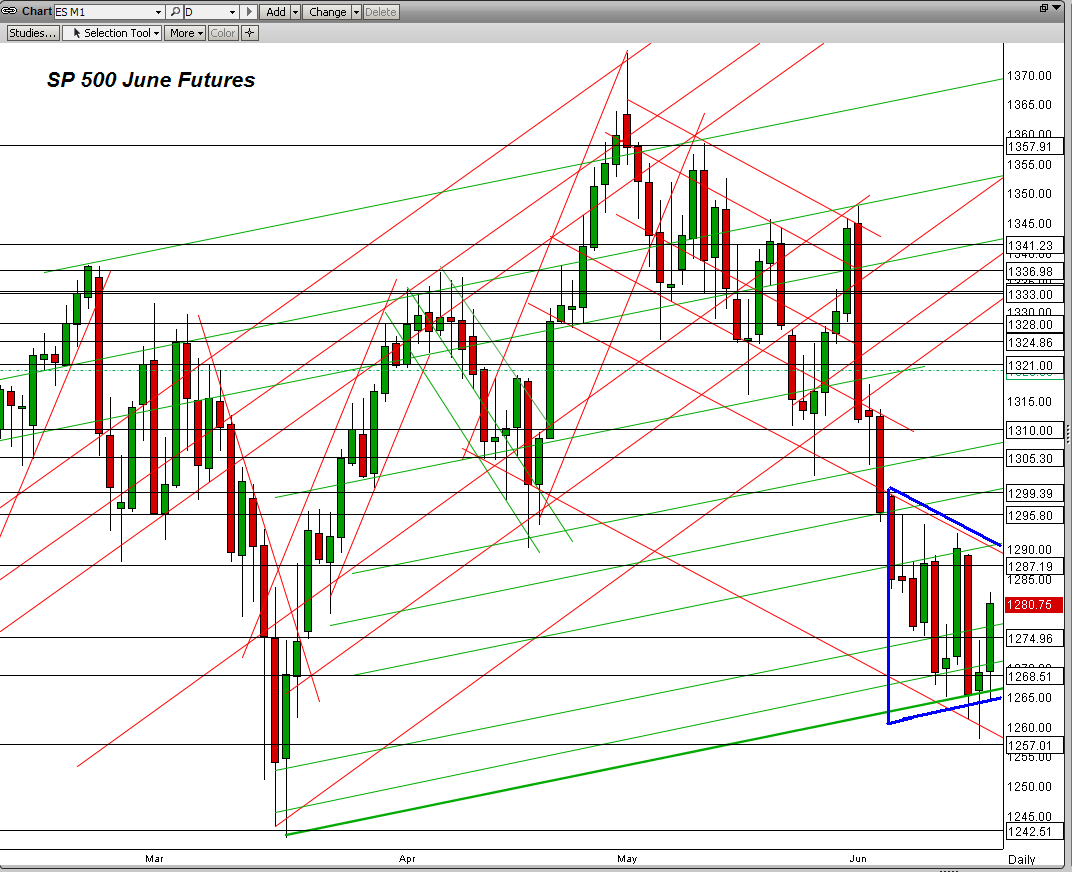
As can be seen on the chart, and I have marked it in blue for the non-technicians, the SP futures are in a tightening triangle.
The reflects the uncertainty in the market with regard to the Greek (and Irish etc.) default possibilities, as well as the upcoming FOMC decision next Wednesday the 22nd which is likely to reveal the nature of QE3, whatever the Fed may decide to call it.
I think it is more likely to involve a line in the sand promising action, rather than immediate new action itself. The Fed's balance sheet is quite large already. And the markets may test their resolve sooner rather than later.
Less remarked amongst Americans preoccupied with their Weiners is the semi-annual Russell 2000 rebalancing which will occur on Friday, and may drive volatility in individual stocks that are in and out of the club.
Whichever way the market breaks, it should have some impetus behind it since it has been winding up now for nine days.
These are short term things. All the Fed and the Europeans are doing is playing for time with a backdrop of a disordered, struggling economy.
Notice that the need for reform and rebalancing the system never really comes up in the discussion. This is old thinking, and its killing the economy.
As you know, I think both 'expansionary austerity' and 'stimulative easing' are missing the point and ineffective, because the economic, financial, and global trade system is broken, corrupted, and badly in need of reform and structuring.
What the Fed is doing is keeping the zombie banks upright at the expense of the long suffering middle class and savers. Michael Hudson has called it 'the endowing of a financial elite to rule in the 21st century.' The monied interests are gorging themselves on malinvestment, public policy failures, and a well financed campaign of economic propaganda such as that which led to the tragic lapses of regulation and the overturn of Glass-Steagall.
The effective tax rates of the super wealthy are less than 15 percent, because they draw a major portion of their annual increase in wealth from capital gains and dividends, and unrecognized entitlements. as well as a wide menu of tax avoiding schemes.
And while they moan about the nominal headline tax rates, paid only by the 'little people' even if they do not know they are little, corporations and the truly wealthy have not enjoyed just low effective tax rates in the post WW II era. And yet it is still not enough.
In light of the severe unemployment problems plaguing a large portion of families, austerity seems like a cruel joke, a coup de grâce delivered by the bankers to the income producing classes who depend on labor in the creation and delivery of real products, and not artificial arbitrage and gaming the system.
But on the other hand, stimulus seems just another excuse for the special interests to put on the feedbag once again to the detriment of the many of the next generation. There is no comparison between the Obama Administration and the New Deal in terms of real change and productive innovation.
There has been a very strong recovery in corporate profits in the non-financial sector, and the financiers barely missed a beat in distributing a healthy chunk of GDP to themselves in bonuses, while the ashes of the financial crises which they caused still glowing. And their behaviour in the mortgage and derivatives markets has been despicable. I am appalled that people put up with this sort of thing, much less defend it out of some mistaken belief in neoliberal 'free markets.'
The people should never have to bailout reckless banks who engaged in speculative self-interest, and particular when they did so with the intent to personally enrich themselves, come what may.
"The UK Chancellor of the Exchequer's guiding philosophy is refreshingly pro-market: 'All banks should be allowed to fail safely without affecting vital banking serviceswithout imposing costs on the taxpayer.'" George Osborne
The second chart gives some indication of the nature of the problem. The US enjoyed an extraordinary period of productivity and expansion, and the middle class was thrown under a bus. And now they are expected to pay to subsidize the unsustainable bonuses and lifestyles of the monied interests.
Sideways chop continues in bullion although the miners are on Mr. Toad's Wild Ride.
Tomorrow is option expiration. Let's see if the metals bulls can build a base here and take it up. Macro events are moving markets but volumes remain light and so the markets are easily batted around by the wiseguys.
The market action is weak and listless, and prone to short term manipulation by the bigger players.
The action next week could be fairly intense as we approach the QE3 event horizon.
NEW YORK, June 15 (Reuters) - Bill Gross said the Federal Reserve next week could signal that interest rates could be capped if warranted due to soft economic growth.
The world's largest bond fund manager said on Twitter late Tuesday: "QE3 likely to take form of 'extended period' language or interest rate caps on 2-3-year Treasuries."
Gross, the co-chief investment officer of PIMCO, the world's top bond manager, also said on Twitter: "Next week's Fed statement will likely stress 'extended period of time' language or even a period of interest rate caps."
The Fed will hold its next policy meeting on Tuesday and Wednesday, and will issue its policy statement after the close of the meeting.
The recent soft patch of economic data has increased speculation over whether U.S. policymakers will perform a third round of bond purchases, an unconventional monetary measure known as "quantitative easing," or QE2. The second round of QE2's $600 billion in purchases will conclude on June 30.
But Gross tweeted that the Fed could signal a cap on interest rates as a form of QE3.
Mark Porterfield, spokesman for PIMCO, confirmed to Reuters the content of the tweets. Pacific Investment Management Co. oversees more than $1.2 trillion in assets.
While the 10-year Treasury bond is one of the most widely watched securities as it sets the benchmark for almost every other interest rate in the U.S. economy, Fed Chairman Ben Bernanke has long considered the two-year Treasury note as an effective tool.
In a November 2002 speech, entitled "Deflation: Making Sure 'It' Doesn't Happen Here," Bernanke said: "Because long-term interest rates represent averages of current and expected future short-term rates, plus a term premium, a commitment to keep short-term rates at zero for some time--if it were credible--would induce a decline in longer-term rates."
Bernanke, who at the time was a Federal Reserve governor, went on to say that the two-year Treasury note is a long-term maturity and that 10-year notes are "longer" maturing securities.
Bernanke said: "A more direct method, which I personally prefer, would be for the Fed to begin announcing explicit ceilings for yields on longer-maturity Treasury debt (say, bonds maturing within the next two years).
"The Fed could enforce these interest-rate ceilings by committing to make unlimited purchases of securities up to two years from maturity at prices consistent with the targetedyields. If this program were successful, not only would yields on medium-term Treasury securities fall, but (because of links operating through expectations of future interest rates) yields on longer-term public and private debt (such as mortgages) would likely fall as well."
Stocks slid hard today on poor economic news from the US, more significant signs from Europe of a test of the European Union and a Greek default that might cause repercussions in the global banking industry.
There was a flight to safety into the US dollar and into gold and to a lesser extent silver. Gold looks to be making a move to break out of its consolidation range, but it has not done so yet.
Silver continues to struggle after the big smack down, but the inventories on the Comex are still in a very steady decline. Someone sent me a piece from Ted Butler in which he says that over the years he has not been able to correlate the price of silver and the Comex inventory levels.
Well, I think if there is plenty of available supply that makes sense. If the inventory gets low, then the dealers would just procure more.
However, when available supplies start to tighten beyond a certain level, especially after years of price manipulation causing distortions and underinvestment on the supply side, then a demand supply trade off comes into play and the correlations and the significance of the data can most decidedly change.
I was a little disappointed with his analysis since he has studied the Comex for the past twenty plus years, but offered no insight into Comex deliverable inventories from an historical perspective, and in particular, as a percentage of open interest. What was the prior low, and what else was going on in the industry at that time? How low was it?
I will make one prediction. The deliverable Comex inventory will not fall below zero. And that is exactly where is has been heading, slowly but surely, for the past three years, like a train wreck in slow motion. Should there be any sort of default incident, Obama should find a new head for the CFTC.
If you have seen the movie 'Super 8' you will understand it when I say that one can only wonder what ugly thing will be crawling out of a Comex train wreck, looking for payback after years of abuse.
VIX spiked over its 200 DMA today. Keep a close eye on where it goes next.
I shifted gears on my short positions late in the day, from triple short to the same units in an SP index short. Both sides of the paired trade were working for the account as gold spiked higher. I did take a few more profits. I own no miners now except for one special situation.
This is still option expiration and even with Greece overhanging the market, the wiseguys are more concerned with their bonuses than with anything else unless it hits them in the face.
Carlyle is doing a review of the investment banks to see who can claim the honor of handling their prospective IPO. I wonder how much of that resume will include managing the market in order to get that pig out in rough waters. If that's the case look for JPM and Goldman to have lead roles.
My first thought is that the Carlyle IPO would mark Land's End, and the cliffside boundary. Let's see what happens.
There were more large silver withdrawals from the Comex Deliverable Inventory with 773,018 ounces taken out of the Brinks depository. Additionally, there were withdrawals of 1,418,178 ounces of silver from the eligible (customer) inventory.
Comex will have to add to their deliverable inventory from some other sources in a tight market. Typically that implies higher prices.
Someone with credibility suggested to me yesterday that a panic liquidation in all assets may be in the cards in the minds of the Wall Street banks and the monied class. When you cannot win the game, you kick over the card table and turn out the lights.
Since they are sitting in large pools of cash, thanks to the Fed, this would allow the monied interests to buy good assets up on the cheap, to fill the holes in their balance sheet as they write off their remaining fraudulent assets. A reset for them, and a misery for the rest.
I remain a little skeptical that this is their intent, but it would 'work' to their benefit. After all, 'first by inflation, then by deflation...'
More likely is a longish period of stagflation and continued kicking the can down the road. And a gradual exposure of more fraud in the financial markets, with fake paper assets undermining the real economy and genuine wealth.
A bounce based on a less pessimistic view of global growth, from an oversold considition. We will have to wait and see what the rest of the week brings, and how we go into the Comex option expiration at the end of the month.
China raised its bank reserve requirements again, in the hope of slowing down the 15% YoY growth in money supply they are seeing, and a troublesome inflation situation they are still managing to keep under control by stifling domestic consumer demand through low median wages, also in support of their export policy and top down social structure.
I added short stock index positions into the close and took short term profits on the miners. I am now long gold and short stocks again, in anticipation of a backtest of this bounce. I will go with whatever way it breaks up or down.
Better than expected industrial production numbers out of China eased fears of a global slowdown in the BRICs, and less wretched than anticipated retail sales numbers in the US helped to spark a stock rally, as we had indicated might happen.
The next couple of days will tell us if this is a trend change or a dead cat bounce. Keep in mind this is an option expiration week.
I took a broad stock index short in the last hour of trade near the peak of the rally. I will use that to balance my remaining long position in gold, having taken the profits on the miners I picked up on the downtrend last week.
Here is a question from a reader which I found to be well stated and probably of a more general interest.
"I was thinking about your general forecast which you posted a while ago, and I wanted to see if my understanding of it was correct.
You had said that your forecast for the US was stagflation because the US is a net importer, unlike Japan which is a net exporter, despite both countries pursuing a policy of ZIRP + QE.
Is the reason for Japan's deflation that all the excess liquidity leaves Japan in search of a yield (due to ZIRP + QE), and not into tangible goods (due to Japan being a net exporter/net producer)? This would be in contrast with the US, where much of the excess liquidity from ZIRP + QE flies into tangible goods due to the imbalance caused by the US being a net importer/net consumer (though undoubtedly much of this excess liquidity leaves the US in search of a yield as well). Is this correct?"
This is a very nice summation of a portion the effects, but misattributes the causes. And like most summations it crushes many of the key points of a slightly more complex theory and overstates the importance of current trade balance.
In a fiat currency not constrained by external standards or other exogenous constraints, monetary inflation and deflation are always and everywhere a policy decision. As latitude on the monetary supply is constrained, so obviously the freedom to decide (choose if you will) is obviously constrained to a similar degree.
If you are Greece and under some contraints imposed by the ECB that controls your currency, you have fewer choices and greater prices to pay in making them. If one controls their own currency and is large and 'important' enough to make their decisions stick it is another matter altogether. The Wall Street banks understand this all too well.
The US is a democratic republic and a huge net debtor, in both current and future obligations. The choice of genuine deflation as such would therefore be a national economic and political suicide favoring foreign holders of its debt. I cannot think of a reasonable scenario for such a choice except for coercion such as war reparations and under heavy constraint. But it is a possible choice.
Further complicating the decision is the inescapable fact that the US holds what is still the world's reserve currency despite a movement to alternatives. A stronger dollar and monetary deflation would crush the world economy by destroying the interconnected global banking system as it is now constituted, in addition to devastating its own domestic economy. Deflation does favor the ends of a powerful few, however, so it cannot be said to be off the table.
Further complicating matters is that the people of the US are more independently minded, educated, and well armed than is normal around the world, despite a more recent program of cororatist propaganda that seems to have co-opted their news media. They are more like the Swiss in some regards. I know this comes as a surprise to most of them, but it is how it is. The US is a beacon of liberty to the world for good reasons, although that beacon occasionally flickers and suffers abuses, sometimes seemingly irrecoverable.
Their increasingly predatory financial system, together with the ownership of the world's reserve currency, probably dictated the accumulation of that large debt, significantly held by foreigners, if one subscribes to the theory of Triffin's Dilemma, which I do. The US had to print more than it consumed to supply currency for growth in the developing world, which was unfortunately engaged in currency manipulation and state mercantilism, and the financial system turned this into debt which it owned.
So the obvious choice is for a monetary inflation to soften the blow of what is going to be at least a de facto default on what is now a mathematically unpayable debt. Let's be clear about this. The US is facing a default and the bulk of the discussion now is about how to distribute the pain, and not fix the problems which caused the crisis in the first place.
The mercantilists who hold dollars, as a result of their gaming the global trade and fiat regimges, wish the US to suck it up and take it all. This is preferable to growing their own domestic economy and allowing their people to become more independently powerful, thereby threatening them. And the domestic monied interests wish the pain to fall largely on the weak and the many, the elderly and the poor. All of these actors are in a power position because they were the greatest beneficiaries of those structural distortions that have led the world to this crisis in the first place.
And yet the monetary inflation will not be able to have its usual effect, the magic that fiat has worked in the post WWII environment. This is because the economy is distorted, and organic growth of jobs and the median wage has been rendered untenable without significant reform in the domestic economy and global trade.
And the powers that be and the thought leaders are stuck in a credibility trap, through which they cannot effect the required reforms without indicting themselves, or at the least, dismantling the socioeconomic structure to which they own their ascendancy, whether it was through sheer luck and positioning in one of the bubbles, or in service to the monied interests by dismantling the regulations and promoting the frauds.
So the most likely course is an ineffective attempt to maintain the status quo, which cannot possibly become self-sustaining. And this is stagflation, which will continue until some crisis is large enough to change it.
It is tempting to use Japan as an experimental counterpoint to the US, but highly misleading and the cause of much misunderstanding.
Japan is most unlike the US, although the Yanks like to think of the rest of the world as little Americas, yearning to evolve into their image. The political structure is that of a one party government that was imposed on a military oligarchy which in turn had evolved from a relatively recent system of feudalism. There was no popular revolution in Japan that created their system of government. It was imposed. And the people have adopted it to suit their own preferences. There is nothing wrong with that. Nations should be able to have the type of society that suits their national character within some reasonable degrees of freedom of choice. One size does not necessarily fit all.
The Japanese economy is highly controlled and centrally planned, following an industrial policy formed by an entrench bureaucracy in MITI and the handful of kereitsus that essentially run the country like feudal lords of old.
It is a closed society, an island, with a largely homogeneous population and limited immigration. The oligarchy has a sense of national honor and responsibility. The social mores would not permit the type of personalities of the 'greed is good' world view, at least not explicitly.
Deflation suited them, and that is what they obtained. But it is important to realize that the people did not suffer deprivation because of the social contract between rulers and people, the lords and serfs. This social contract is essential to understanding the situation. And of course the fact that the people continue to have a decent, if somewhat constrained by western standards, style of living that has been consistently acceptable to them for many years.
Lower prices yes, but the losses and deprivations were not visited on the people, at least not yet. There is not the same cult of selfishness and greed, and denigration of obligation as there is in the states. Contrast CEO pay in Japan and the US. The losses were exported around the world and finessed by an increasing government debt, much of it wasted on the keiretsu's pet projects, despite the ongoing trade surpluses. But Japan appears to be heading for a change as the corruption and mismanagement of the oligarchy continues to peak through the studied facade.
So this is more the basis of my forecast, and I do not see a change in this until the US changes its financial system, and reforms its political system in a meaningful way, to diminish the influence of wealth and power and restore a balance with the voting public. There are no such things as free trade or free markets, just as there is no free lunch. All is subject to imperfection and abuse, and requires diligent effort, frank discussion, transparency, and conscious intentions. Opening your markets to slave labor makes everyone a slave.
The world economy is a very complex system, and those who think they understand it with slight effort are probably wrong and sometimes tragically so. Unfortunately they are also easily led, and in the pursuit of simple solutions may choose power over wisdom, to their own destruction.
I cautioned in yesterday's commentary, with the metals charts, that a short term bottom might be at hand. The sentiment was getting overdone and the usual book talking suspects were spreading gloom and doom with gusto.
Since the end of May the US equity market has been in a downtrend, and selling the rallies has 'worked.'
So, is it time to sell the rally again?
Keep an eye for a breakout attempt. A key level would be 1295 for conservative purposes, but they have to stick a close and follow through. It may take more than one step to do it, to allow for a fakeout to suck more of the bears into an offsides position for the setup.
Then again it could simply fail and go back to retest the low. It is hard to say what will happen when great events are in motion, and the house and a few big players are in collusion.
One can use a number of charts for confirmation of a move by the lead dog, the SP. The dollar has proven to be particularly effective lately in addition to the usual suspects like NDX.
The big TBTF and their funds are batting the US financial markets (and the public) around like their favorite chew toy. Failure to reform the financial system is Obama's single greatest fault, overshadowing even his military adventurism perhaps. I do not think he is 'bad,' but merely weak, lacking in character, and not rising to his call to greatness. A very modern man. He could have stood out well since he is surrounded by amoral puppets and stooges, some in his own house but particularly in the opposition. But he has a fatal attraction of trying to please everyone, and therefore no one, lacking principle and conviction, and therefore remarkable leadership.
I have to chuckle when people send me simple indicators available on public charts, or the comments from people who are obviously talking someone else's book in order to prove some assumption they hold without any underpinning or foundation. I take this a few times, since everyone is entitled to be wrong, and then invoke the spam filters if it become distracting. A small price to pay for the real gems that wash up on the shores from those who have learned to think for themselves, and the genuine souls who struggle on in this troubled world.
It is important when playing for money not to allow distractions to affect your play. You are responsible for what you read and where you spend your time. I learned this lesson some many years ago in a different, more exuberant phase of my gaming career, from Lyle Stuart.
"He names names because he knew everyone. And everyone knew him. In his stories, he relates the occasions when he won big but also admits when the cards were going against him and he left the table a loser. But he always left the table before he lost everything." John Patrick on Lyle Stuart
If you cannot maintain the discipline required to trade you should do something else. Most (close to 95%) are not equipped for this, and should ride the long trends as investors, and not worry so much about the daily noise. There is no school for this, you must learn by experience, so you can own your decisions with some understanding and conviction.
In the end the market will teach you humility, and this is a particularly instructive market, being artificially constructed and rife with information assymetry, manipulation of the rules, and deception.
But the trends are resilient, if one has the eyes and the grace to see them.
Precious metals were under pressure throughout the US trading session. The bear raids started early on Sunday evening but gained footing during the NY trading session.
I think the silver chart *might* be clarifying a bit here, but we will have to see where it finds its level in order to peg the new levels of resistance and support after the parabolic run up which very possibly was a calculated maneuver designed to break the bull market trend before it leads to a Comex default.
Gold was pressured by China weakness and the bears took the opportunity for another raid when SP downgraded Greece to CCC.
The gloom seems rather thick here, and the common sentiment is overwhelmingly bearish. It does seem overdone as we might see at a market turning point near the bottom of a resistance channel.
At the end we have to accept the verdict of the market, at it is deliberately given over time. Always.
But I have to note that those who are quite often wrong because of a fundamental lack of economic and market knowledge are becoming increasingly noisy and emboldened lately, trotting out old tired arguments and worn predictions, and this is sometimes a sign that the tide is turning.
It is option expiration week. Let's see what happens.
Slowdown fears for China and a downgrade of Greece's credit rating put some headwinds into the market that started out on the bullish side based on another 'merger Monday.'
What next? This is an option expiration week, and the bulls are looking for an excuse to rally. They have not been able to find a footing yet, and so the market continues to trend downward despite brief buying flurries with no sustained volume.
The trend will continue until it does not. Be on the defensive here. I am shifting to a more neutral posture until I see if stocks can break down further however.
Greece on Monday became the country with the lowest credit rating in the world after Standard & Poor's downgraded it by three notches, saying the agency would consider a likely debt restructuring as a default.
A restructuring of Greece's debt -- either with a bond swap or by extending maturities on existing bonds -- looks increasingly likely to be imposed by European policymakers as a means of sharing the burden of Greece's crisis with the private sector, S&P said in a statement.
"In our view, any such transactions would likely be on terms less favorable than the debt being refinanced, which we, in turn, would view as a de facto default according to Standard & Poor's published criteria," the agency said.
In such a case, S&P added, Greece's credit rating would be lowered to "selective default," or SD, while the ratings on the country's debt instruments would be cut to D.
S&P cut Greece's long-term sovereign credit ratings to CCC, just four steps away from default, from B. The short-term rating was affirmed at C and all the ratings were removed from credit watch.
The outlook on the long-term rating remains negative, however, in a sign that another downgrade is likely in the next 12 to 18 months.
The Court is corrupt,
The fields are overgrown with weeds,
The granaries are empty,
Yet there are those dressed in fineries,
With swords at their sides,
Filled with food and drink,
And possessed of much wealth.
This is taking the lead in robbery,
Far indeed is this from the Way.
Lao Tzu, Tao Te Ching
Harvey Organ's comment on the Kitco tax fraud story:
"It is also interesting that Kitco immediately filed for an interim receiver Richter Usher Vineberg as this will no doubt turn into an absolute mess. The gold at Kitco is unallocated and thus can be attacked by Revenue Canada. This would create the biggest run on a "bank" in history for Canada as depositors of gold at Kitco immediately seek redemption. Thus Kitco had to act immediately.The unallocated gold is surely a mess but when you add in the tax consequences, this will dwarf the Refco fraud."
More US economic data will be coming out next week, and it *might* help the bulls gather themselves together. But if the data comes in decidedly worse the downtrend might break support and gain momentum.
The stock market has just about reached the lower bound of a 'correction.'
Keep an eye on the VIX, especially in relation to its 200 DMA. This may suggest what the pros are thinking.
“Kitco Metals Inc. has never participated in any tax fraud, nor has it ever carried out any fictitious transactions. In all respects, Kitco vigorously contests all aspects of Revenu Québec’s investigation,” it said.
The company said it has asked Superior Court of Québec to appoint an interim receiver so that it may continue normal operations under the supervision of the accounting firm RSM Richter. The action was taken “to allow for the time required to vigorously contest Revenu Québec’s unfounded claims.”
It will be interesting to see if Kitco gets the receivership they have requested, and how this affects the settlements, if any, of their unallocated pools of gold and silver.
There may be more to this than appears on the surface based on the company's request for the court to appoint a receivership so that it may "continue normal operations."
June 9, 2011
Major Investigation by Revenue Quebec into two networks in the Gold sector
Revenue Quebec has a major investigation underway related to two networks of companies and individuals that would be designed to evade taxes in the gold sector. The transactions generated by these activities totaled $1.8-billion, which represents a fiscal loss for Quebec Sales Taxes of more than $150-million.
The operation involves the execution of 70 search warrants in Montréal, Westmount Mont-Royal, Laval, Pointe-Claire, Rosemère, Brossard, Dorval et Saint-Bernard-de-Lacolle. More than 175 investigators from Revenue Quebec were deployed to execute the warrants in places of business, residences, offices of accounting firms, and receivers.
The investigation targets the activities of two networks that would seem to have participated in a artificial commercial activity consisting of repetitive transactions and the use of phony invoices. Revenue Quebec has reasonable grounds to believe that besides Kitco Inc. and Carmen International Inc., more than 125 other companies were complicit in the scheme.
On top of this, Revenue Quebec also has reasonable grounds to believe that Messers Viken Gebenlian, Haroutioun Dakessian, Oskan Hazarabedian and Benjamin Bensimon, as well as Mrs. Shadia Khatib, participated in the creation of artificial tax declarations for certain companies involved by furnishing them with false invoices.
Revenue Quebec is also investigating similar infractions involving GST.
Revenue Quebec must be vigorous with those who violate tax rules and has the intention of pursuing penalties wherever found. As well, the companies and their managers who participated in the tax fraud scheme, and any other accomplice, if found guilty, must pay the evaded funds plus interest and face the applicable penal sanctions. Also, all offenders face fines amounting to 125% to 200% of the evaded taxes and a maximum prison sentence of 5 years.
The mission of Revenue Quebec is to assure that each of us pays his or her fair share to finance public services. Obviously, respect for tax rules is in all our of interests.
The Gold Sector Scheme
What is the gold scheme?
The gold industry scheme uses several companies that generate artificial transactions for the sole purpose of creating tax credits on inputs.
The scheme essentially consists in the transformation of pure gold into gold scrap, which can then be sent to a refiner and transformed anew into pure gold. The cycle can then be repeated.
How is it possible to demand tax credits on the inputs by using pure gold?
Participants in the scheme claimed tax refunds under The Quebec Sales Tax Act. Obviously, this particular scheme was based on the fact that pure gold, being a form of currency like ordinary bills or coins, is in an untaxable form.
However, by transforming the gold into scrap, it is rendered taxable, which permits a buyer to claim tax refunds on the inputs. As the seller of the scrap does not submit retail sales tax to Revenue Quebec, the tax authority finds itself refunding taxes that it had never received.
It’s important to note that the scheme is based on artificial transactions. There was no legitimate commercial activity. The sole purpose of the transactions was to create eligibility for tax refunds on the inputs.
How did the scheme work
1.The provider of the gold (A) sells the gold to the gold refiner (B). As pure gold isn’t taxed, there is no retail sales tax treatment.
2.The gold refiner (B) transforms the gold into gold scrap, rendering it taxable.
3.The gold refiner (B) sells the gold scrap to the gold provider (A). The gold scrap being taxable, the gold refiner collects retail sales tax from the gold provider.
4.The gold refiner (B) doesn’t remit retail sales tax collected from the provider (A) to Revenue Quebec (a situation of taxation realized but not submitted).
5. The gold provider (A) claims a tax refund from Revenue Quebec on the retail sales tax inputs that it had paid to the gold refiner (B).
6.The gold provider (A) sends the scrap gold to another refiner to transform the gold scrap into pure gold.
The same cycle of transactions repeats itself, and each time a new cycle begins, it increases the size of the fraudulent gains generated by the scheme and lost to the province.
What’s more, you generally find that one or several intermediaries gets added in between the provider (A) and the refiner (B) in order to obfuscate the structure and make it more difficult for the scheme to be detected.
Let us pray for those whose hearts are hardened against His grace and loving kindness by greed, fear, and pride, and the seductive illusion and crushing isolation of evil.
We pray that we all may experience the three great gifts of our Lord's suffering and triumph: repentance, forgiveness, and thankfulness. And in so doing, may we obtain abundant life, and with it the peace that surpasses all understanding.
It is available for your use at no cost, but with attribution and a link to the original posting.
I make every attempt to respect the rights of others. If you feel that something here has infringed your work please let me know and I will correct it immediately. It is not always easy to determine the status of material posted to the Internet with regard to fair use and public domain.