24 April 2012

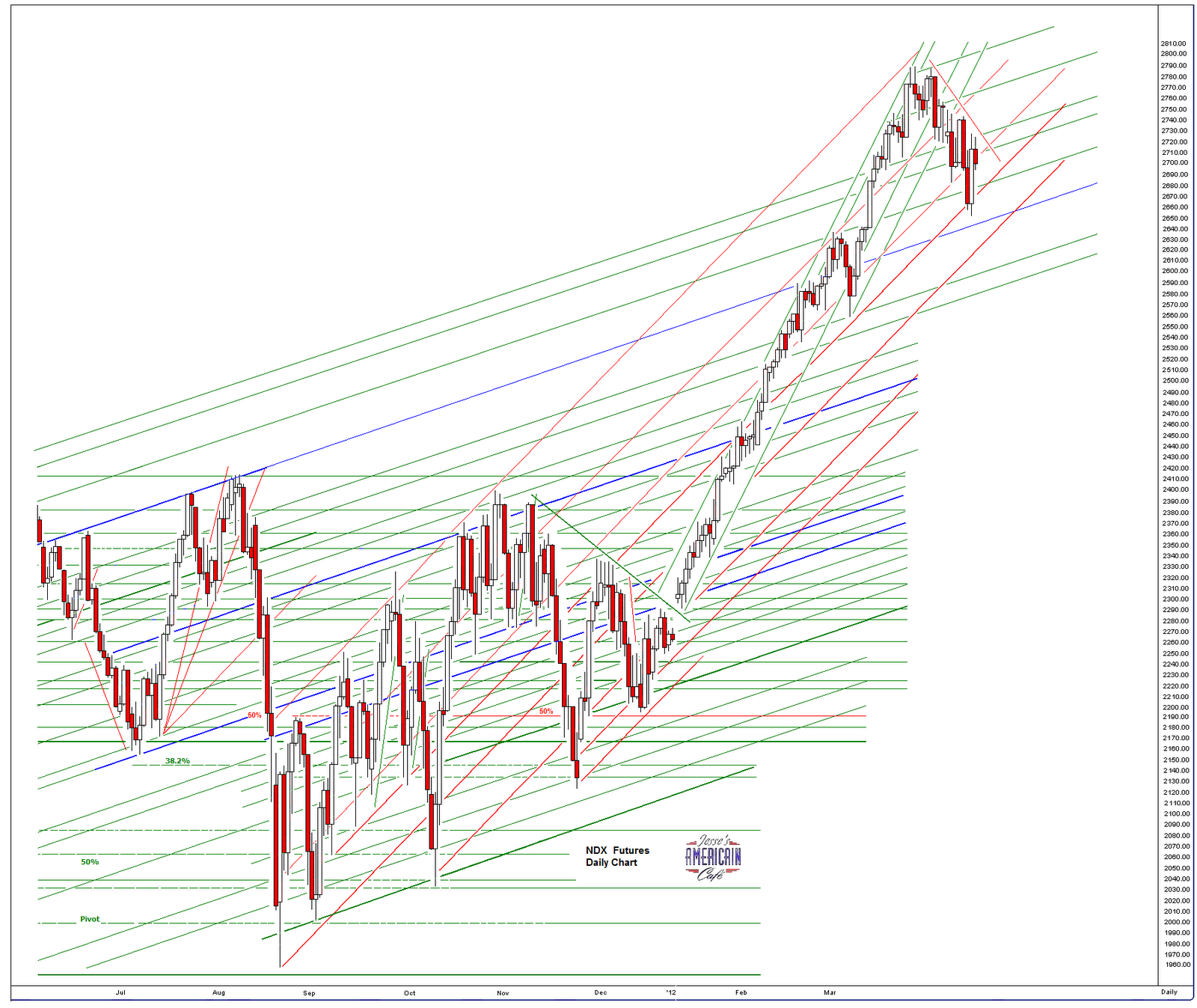
SP 500 and NDX Futures Daily Charts - All Eyes On AAPL


All eyes are on AAPL which reports earnings and revenues at 4:30 PM.

Tomorrow afternoon is the FOMC rate decision, and on Friday the advance GDP number from Q1.


US Leads Developed Nations In Percent of People In 'Low Wage Work'


This could be a good question on a quiz.

With regard to Victorian England I have seen estimates that show that almost 20 percent of workers were 'in service,' that is, were employed as domestic servants.

I see where they are already bringing back debtor prisons in the States.

And Australia and New Zealand are falling behind it appears.   Some stubborn fascination with equality no doubt, insufficient elitism.  

Research shows the US is a low wage country
By Mark Thoma
April 23, 2012

(MoneyWatch) - Recent research from John Schmitt of the Center for Economic Policy Research shows that the US leads developed countries in the share of workers earning low wages. The research also shows that increased wage polarization over the last several decades is one of the reasons for the large share of low wage-work in the US. The bars in this graph represent the share of workers in low wage work, where low wage work is defined as employees earning less than 2/3 of the median wage (approximately $10 per hour or $20,000 per year). In this category, the US leads among developed nations...

Research Shows that US is a 'low wage' country - Mark Thoma


23 April 2012

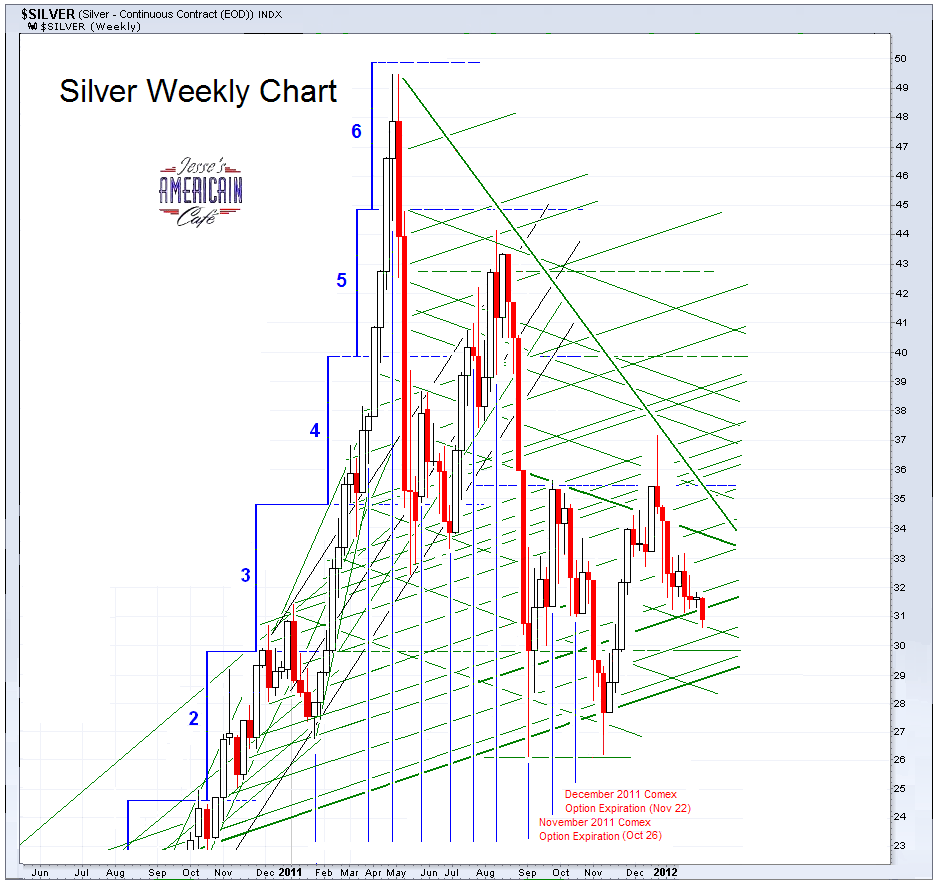
Gold Daily and Silver Weekly Charts - Two Day Fed Meeting Weighs on Metals


The money-printers will announce their latest decision on Wednesday around 2:15 PM, after their two FOMC meeting.

Gold and silver typically sell off into such meetings so today was no real surpise. The correlation with the equity markets allowed our short stock hedges to function well.

I put out the latest Net Asset Value premiums this afternoon, and PHYS produced a fairly surprising .94% premium to NAV. That, ladies and gentlemen, is not a euphoric number.


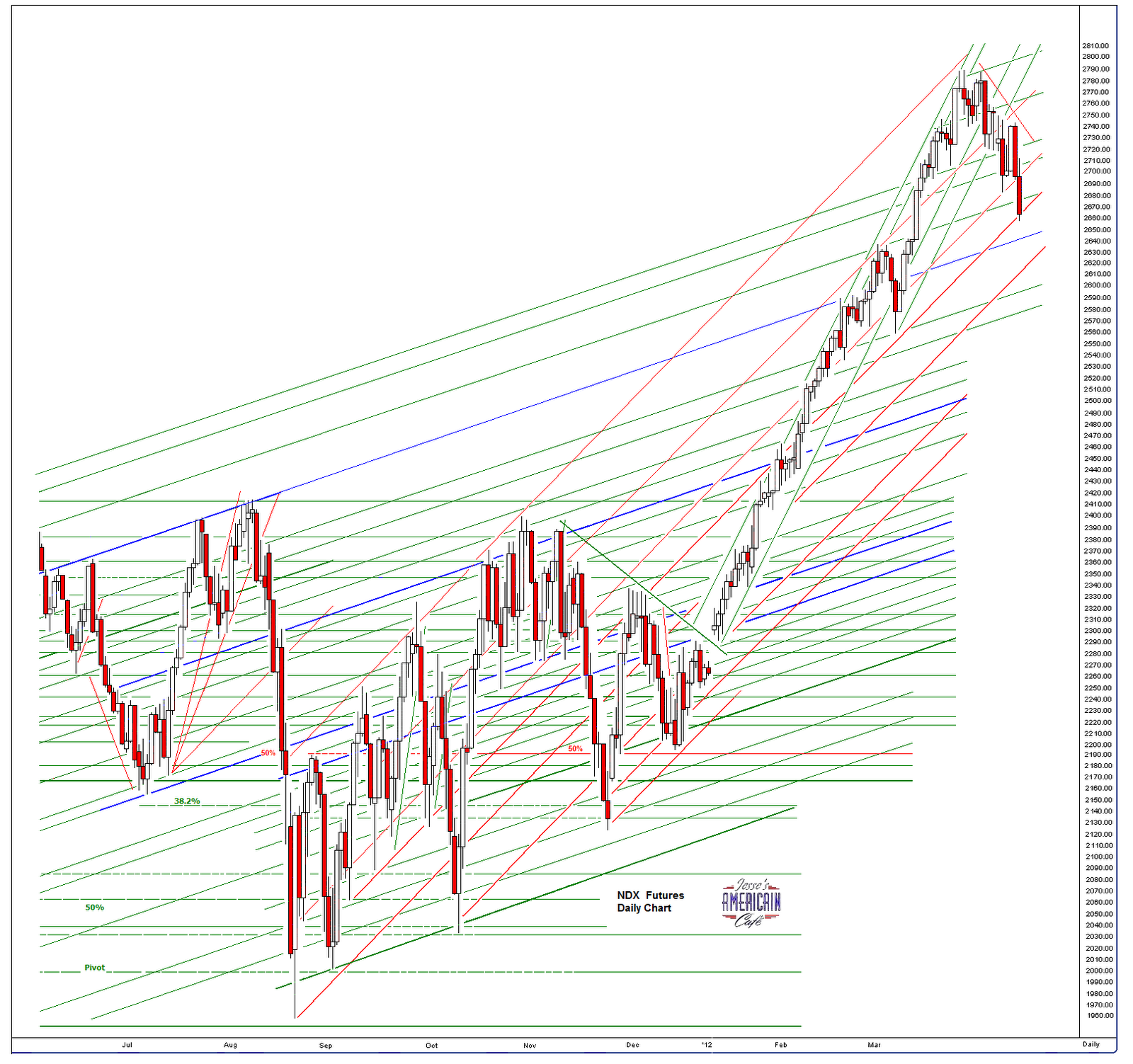
SP 500 and NDX Futures Daily Charts


700 million shares had traded on the NYSE at the bell, and that is light, and symptomatic of the lack of broad participation in this market. Shares are getting tossed around like hot potatoes among speculators and trading programs, with little conviction.

The two big pivot points of expected news will be on Wednesday when the Fed reports its FOMC decision and economic outlook, and on Friday when the advance number for US GDP Q1 comes out.

Europe continues to overhang the risk trade.


Net Asset Value Premium of Certain Precious Metal Trusts and Funds


The premium on PHYS is about as low as I can recall seeing.

It is so low that I checked for news of a secondary offering but found none.


Weekly US Economic Calendar


The Fed has a two day meeting and will report their decision and outlook on Wednesday.

The US will report the Advanced GDP number for Q1 on Friday.


Banking On Fear: Why the Policy of Stuffing the Banks With Money Does Not Help the Real Economy


"The big banks are buying up what they call fixed income instruments (bonds and other debt backed paper) and at the same time offering CDS insurance on the same. Just like they bought and sold protection on mortgages..."
This is a fairly good description of why the policies of Bush and Obama have failed to effect an economic recovery.

The policy of 'saving the banks' first and foremost, and of stuffing them with cheap money in the hopes that they will stimulate the real economy with loans, is a cruel hoax.

Cheap money is hot money and it seeks high beta returns. It does not seek investment with returns over long periods of time. And in an environment of lax regulation and little deterrence for abusive financial practices, one sets up a scenario ripe for fraud and another, more chilling, financial collapse.

And the problem is not in the US alone. Europe and the UK are following similar practices, of serving the financial elites first, and the people very little or not at all.

There will be no sustainable recovery until the banking system is reformed, and balance is restored to the economy. Growth, not austerity, is the way out of the wilderness.  But that growth is only achievable if the corruption that brought down the system in the first place is corrected and the real economy restored to some sort of natural order and sensible priority.

The hot money seeks out speculative returns, and when it cannot find them, it creates them.  And that is the well spring of fraud, and of many of the corrosive economic problems facing our world today.

The problem is complicated because most of the western political leaders are complicit, by action or acquiescence, in the financial corruption that holds their nations by the throat, and allows the very few to prosper enormously at the expense of the people in general.  The leadership is caught in a credibility trap.  They are unable and unwilling to reform the system, and promote a renewal and  change might bring them down with it as well as the corruption that feeds them with money and power.

"...The problem (one of them at least) is that while our leaders are banking on growth to save us, the banks are not. They are banking instead, on fear. Our leaders keep thinking if they ‘save’ the banks then the banks will help save us by investing in growth. They fail to understand that ‘invest’ is really not something high up on the global bank’s ‘to do’ list. I spoke at length recently to bankers in The City who deal in investing in raising money for Small and Medium businesses. They were unequivocal – it is getting harder not easier to raise money for such investment. The big banks and big funds are looking for short term speculative returns not slow investment returns.

When you have large and growing losses from bad debts you cannot and will not recoup and recover on the basis of wise but slow investment returns. The worse your previous debt mountain is, the greater the pressure to pursue exactly the sort of high-risk speculation that got you in trouble in the first place. If it is a choice between investing in Spanish factories or buying Spanish debt or selling CDS on that debt, the ‘smart’ bonus seeking money goes for the latter every time.

The brokerage Carmel whose study I have quoted is a good example. On page 9 of their study they say,
We began buying Spain CDS in Q4 2011…[with a coupon of] 3.5% of notional per annum –effectively an option premium on the default of Spain.

Should the Spanish crisis flare up in 2012 as we expect, we can generate a 300% return on the annual premium.
300%!   Investing in small and medium businesses or a potential 300% speculating on Spanish default. You choose.

Banks are banking on fear and the volatility fear causes. They are not banking on or helping to support growth. They will do the politically necessary minimum and no more. The big banks are buying up what they call fixed income instruments (bonds and other debt backed paper) and at the same time offering CDS insurance on the same. Just like they bought and sold protection on mortgages..."

Read the rest of this blog from 'Golem XIV' in the UK here.

Also see his essay "We Are All In This Together."

This may also be a good time to read or re-read this essay of mine, Currency Wars: The Anglo-American Century. What is happening in the western world is no accident, anymore that the rise of tyrants and the destruction of freedom are accidental.

The Case Against Lehman Brothers - The Credibility Trap


This documents the investigation into Repo 105 and the fraudulent transfers between New York and London, and when the accounting firm of Ernst & Young knew of them. The SEC and the Federal Reserve were there at the company, with access to the records, when all this happened.

And of course, there have been no indictments. And the reason may be that the SEC and the Fed, in their desire to maintain confidence in the system, knew about it and failed to disclose it. Or they could claim incompetence and a failure to do their jobs in protecting the public from financial fraud.

This is the credibility trap. When you are complicit in a fraud, in any number of ways, you cannot take effective, credible action against it, and deter other frauds from occurring.  And you cannot afford to even discuss the issues credibly, because your are too compromised in your own actions, or inaction.


21 April 2012

Max Keiser Interviews Gonzalo Lira On the European Crisis


Currency Wars: Rickards On Gold, QE, and the Economy


Jim Rickards is interviewed by FutureMoneyTrends.com.
Part 1 is focused on Gold manipulation and why gold plays such an important role in the world, even if conventional wisdom doesn't believe so, gold is not only being watched by central bankers, as Mr. Rickards put, "the gold price is being managed."

Part 2 expands into the economy and probability of more quantitative easing (QE). According to Mr. Rickards, QE will come in the next few months because it can't be done this fall since it will look political, and if the FED tries to wait until December, it will be too late.

20 April 2012

Gold Daily and Silver Weekly Charts - Winding Into the Apex, Slowly


SP 500 and NDX Futures Daily Charts - A Lazy Wind into the Weekend


Comex Silver Inventory Watch - Heading Into May-July Delivery Period


The long term decline in deliverable supply at this price level could become quite interesting.


The only ways to obtain more deliverable inventory to meet a bulge in demand is to game the rules on the ability to take physical delivery or let the price rise by buying on the open market.    

The push by the CFTC for position limits may tighten the ability to take delivery from 1,500 to 1,000 contracts, but hedgers will be exempt from position limits on the short side.  And the big silver short JPM claims to be a hedger.

I keep hearing stories of negotiated prices above the public quotes to buy off large delivery claims.  I would be interested to know if anyone has proof of this.  We know there are large agreements being conducted around the publicly quoted prices all the time. The FX pit traders walked out in protest over a recent occurrence.  It does not take an economist to understand what this does to price discovery and market efficiency.

The estimates I have seen of how much silver is real and how much is conflicting paper claims (leverage of unallocated claims) is up to 100:1.   Some of those claims are reported to be covered by 'inventory in the ground' which is not readily available for delivery.

One can only wonder how well confidence in the Comex would receive another 'stolen assets' scandal like the confiscation of gold and silver that happened to customers of MF Global.

The central banks have long ago dispersed their caches of silver to the market, so they are not available to supply ready inventory at leased rates.   One might look to SLV and wonder who audits its custodial integrity of unencumbered physical bars and how often.  

As I recall the sponsor of the ETF is Blackrock, but the custodian and keeper of the vault holding the physical silver backing the ETF is JP Morgan.  As you may recall, JPM is holding a massive short position on the silver futures, as best we can determine. 

JPM claims they are a hedge on behalf of other parties.   If they are using the SLV inventory as collateral in any way, then someone needs to be paid a visit by the SEC and CFTC because the owners of the shares have a superior claim to the metal.   That smells like 'hypothecation' in the manner of MF Global.  But I suspect that rather than blaming Edith O'Brien one might blame Bear Stearns.

I am not saying this is 'illegal' but it certainly warrants disclosure if it is occurring.  And if the CFTC knows this and is sitting on the information in their four year old and still unreleased silver manipulation report, then Gary Gensler needs to appear before the Congress and answer some very tough questions about conflicts of interest and withholding of key market information.

Of course the prudential time to ask those questions and obtain the answers is now, and not after the carnage of a commercial failure devastates investors, global industry, and market confidence.

Will anyone listen to this?   Did anyone listen to Harry Markopolos before Madoff's fund blew up?

These days it seems like the US financial markets are a train wreck happening in slow motion.  Or almost like watching a B horror movie.  You hear the music and you know what's coming, but there is no way to warn the campers.


'Our rivals are scared shitless of us.'   Blythe Masters

How Jason P. Morgan sees itself in the markets  lol

19 April 2012

Goldman Sachs Employee Facing Insider Trading Probe


And the fails just keep on coming.

They will toss the small fry while the big wheel keeps on turning.

Reuters
Goldman Sachs facing a new insider trading probe
By Emily Flitter

NEW YORK (Reuters) - Federal prosecutors in California are investigating a Goldman Sachs employee for insider trading, according to prosecutors and defense lawyers who attended a hearing in U.S. federal court in New York on Thursday.

The employee is suspected of giving inside information on two public companies to former Galleon Group co-founder Raj Rajaratnam, who was convicted last year in one of the largest insider trading cases in Wall Street history.

The investigation of the Goldman employee was divulged during a hearing involving the insider trading case against former Goldman board member Rajat Gupta.

Gary Naftalis, the lawyer for Gupta, commenting on the newly disclosed investigation, said that Assistant US Attorney Reed Brodsky asked him not divulge details of the matter.

"Per Mr. Brodsky's request, I am not going to name his name," Naftalis said.

In a hearing a month ago, Naftalis revealed that another Goldman Sachs employee had been caught on a wiretap leaking secrets about Intel Corp and Apple Inc.

"That's obviously an area we have been pursuing in terms of our preparation for our defense at trial in terms of his connection to all this," Naftalis said at Thursday's hearing.

A spokesman for the U.S. Attorney's Office for the Central District of California declined to comment.

The attorneys at the Thursday court hearing said the employee in the California investigation still works at Goldman.

A spokesman for Goldman Sachs declined to comment.

Double Barreled Blast of Max Keiser and Matt Taibbi (With Outtakes)


Wall Street as organized crime.  An excellent discussion with Matt and Max.


The entire show including the first half with Stacy Herbert discussing Goldman Sachs and their $22 million dollar fine for sharing unpublished info between analysts and traders is here.


Outtakes from this week's Max Keiser Show (with Matt Taibbi As Max's Samoan Attorney)


The businessman in a suit is a young Jamie Dimon.

Gold Daily and Silver Weekly Charts - Winding Up for a Move - Tomorrow Is Stock Option Expiry


The trick in trading is not to 'predict' in advance which way the metals will break in the short term, or any market for that matter. I have seen plenty of guys waste their trading accounts and their time trying to find 'the perfect system.' 

Believe me, if there was such a system, you would not find it.   And especially you would not find it on a publicly available site.

The best system is to sit as the house, and make money no matter which way the market goes, and have plenty of advantageous knowledge of the order flows to boot.  The US markets are all about the asymmetrical dispersion and control of knowledge.  And HFT has taken it to a literally inhuman degree.

Well, absent that exorbitant privilege of insiders, all we can do is trade to avoid the losses, and learn to recognize trends, and play them with some discipline.

Right now gold and silver are not trending, they are consolidating and winding up before they begin another move. I can argue the reasons for a move either way, and unless you are Ben Bernanke and ready to show your hand honestly I am not particularly interested in what you have to say, because you just don't know. And neither do I.  This is not a 'natural market.'

But we can hope to find the trend as it begins again, miss part of it, but be sure to hop on board and take it for a ride. For most people, they have neither the time nor the inclination to do this for the short term, and probably even for the intermediate term. They just feed the trading letters and system creators and of course the brokerage firms.

Chat boards are a nice way to spend the time you may have on your hands in socializing, if you have nothing more pressing, but they offer little in the way of constructive trading advice.    To paraphrase Dr. Greg House, traders lie.   And most amateurs become bitter with their losses.  Misery loves company.

Don't get me wrong.  Fundamentals still matter in the longer term, and in the lesser covered stocks one can always find the undercovered gem or two, if you have the stomach for the risk and can wade through all the price manipulation and naked short selling that is tolerated, especially north of the US border.

So for now I am long bullion and short stocks, in a pretty robust hedge. I have taken the profits out of miners but am still willing to flip a trade in the case of some unusual deviations from trend.  And they certainly happen.  Sometimes you just have to wonder.

I am waiting to see which way the market breaks and if stocks continue to move with the metals or if there is a divergence developing.  My 'bias' if I have one is to see the metals bounce and rally up to the top of the larger symmetrical triangles, but that is a 60-40 proposition at best.  I mean, the market is being rigged, or isn't it?  And if it is, probabilities are being written by other than 'the invisible hand' of supply and demand.

I am not trading nearly as frequently or aggressively as in the past because a) I am getting older b) these markets are almost ridiculous.  Its like playing cards with the little girls.

If I put in a order for a few thousand shares, the liquidity from a large offered set of multiple positions evaporates instantly and I close on maybe 100 shares.   If I offer to buy above market but below ask I get ten 'friends' appearing instantly along with my bid. 

There is little genuine liquidity in the equity market.  It is mostly a sham, a flash crash waiting to happen unless the ESF intervenes which I am sure they will.  At the first sign of real trouble it will collapse like a house of cards.

As for gold and silver, price discovery is buried under a mountain of paper and faux trades.  With 100:1 leverage and naked positions dominating the trade, its a bit of game in the short term at best, and not a particularly honest one at that. 

Don't exhaust yourself chasing rainbows here.  Sometimes the best trade is to stay out of the short term scrums, the wash and rinse cycles, and just ride the macro trends, ignoring the day to day noise.  And judging by the shrinking volumes and low open interest, quite a few people are fine with that decision.

The pit crawlers had best start studying origami and advanced airplane design to while away their empy hours, with only phony computer generated order flows and Fed buying programs to light up their screens.


SP 500 and NDX Futures Daily Charts - Coiling Ever Tighter Into the Apex


VIX remains above the 50 DMA but fairly low so the 'yellow flag' is out.

Hedges in place.

As a reminder tomorrow is stock option expiration.


A Message on the Need to Reform the Financial System -- From Herbert Hoover


This speech was given by Herbert Hoover as the country was caught in the depths of the Great Depression 6 December 1932, as he was leaving office, largely perceived as a failure.

I have sympathy for Hoover and rightfully so. For many years I saw his portrait every time I would visit the headquarters of the IEEE in New York City. I read about his magnificent acts of logistical organization and the relief of suffering in the European famines. He was an accomplished and talented person.

And yet he failed, or at least has been judged a failure as President, because of a timidity and unwillingness to act, boldly and in a timely manner.  He was constrained by bad advice, and an ideological bent that prevented common sense action from moving the country forward. Afterwards in his Memoirs he blamed the advice he received from his Treasury Secretary, Andrew Mellon, the great liquidationist, who had been appointed by Warren Harding in 1921, and who throughout the 1920's preached the gospel of tax cuts for the wealthy to stimulate growth.
"Liquidate labor, liquidate stocks, liquidate farmers, liquidate real estate… it will purge the rottenness out of the system. High costs of living and high living will come down. People will work harder, live a more moral life. Values will be adjusted, and enterprising people will pick up from less competent people."
This speech could be given with little alteration by Barack Obama today, although I am sure he would add quite a bit more flair.

The Too Big To Fail Banks are still with us, but even larger and more dangerous and powerful. Obama himself, despite pledges to the contrary, is taking large amounts of funds from the corrupt campaign process.

Instead of acting quickly to correct the causes of the financial collapse, he expended most of his early political capital on a healthcare plan that, despite some genuinely beneficial changes, serving to increase the control and reach of a few private healthcare monopolies by requiring all people to purchase insurance from them.

Fed policy still serves the few and is largely opaque in its dealings, becoming even more powerful as regulator.

And the markets are dominated by even fewer players, and tainted by a major scandal in which over a billion dollars was stolen from the customers.   

Corporate profits are excellent and the very wealthy few are making enormous strides in increasing their wealth. And yet the bulk of the nation suffers from fear and uncertainty.

The people's vehement objections to the bailout, marked by faxes, calls and emails in their millions, were ignored.

Yes, Obama faces a rigid and uncompromising opposition in the Congress, which achieved its House majority during his term I might add, but he still has broad Presidential powers, including the ability to direct the enforcement activities of the regulators and the Justice Department.

And not one major participant in the fraud has been indicted and prosecuted.  Instead, the perpetrators and beneficiaries of the fraud have crafted the words for the very reforms which they have opposed and weakened every step of the way.   And the regulatory agencies continue to hand out wristslap fines for egregious market frauds that continue to add to the deterioration of the confidence of average market participants.

If the US had a Parliamentarian system, Prime Minister Obama would have most likely already been ushered out the door.

Am I being too harsh? He promised much, and achieved little, and broke almost every major pledge he had made to his constituency in his zeal to curry favor with those who would have nothing to do with his mandate. In this he is more Chamberlain than Hoover, who at least acted on his principles that were unfortunately mistaken as he later admitted.

When he writes his memoirs I will be shocked if the current President does not paint a picture of magnificent accomplishments, and for the shortcomings, blame everyone but himself and his inability to execute on principle.

President Obama will undoubtedly provide a good case study for the failure in leadership in a crisis for future historians.

"There are three definite directions in which action by the government at once can contribute to strengthen further the forces of recovery by strengthening of confidence. They are the necessary foundations to any other action, and their accomplishment would at once promote employment and increase prices.

The first of these directions of action is the continuing reduction of all government expenditures, whether national, state, or local. The difficulties of the country demand undiminished efforts toward economy in government in every direction. Embraced in this problem is the unquestioned balancing of the Federal Budget. That is the first necessity of national stability and is the foundation of further recovery. It must be balanced in an absolutely safe and sure manner if full confidence is to be inspired...

The second direction for action is the complete reorganization at once of our banking system. The shocks to our economic life have undoubtedly been multiplied by the weakness of this system, and until they are remedied recovery will be greatly hampered.

The third direction for immediate action is vigorous and whole-souled cooperation with other governments in the economic field. That our major difficulties find their origins in the economic weakness of foreign nations requires no demonstration...

Banking Reform

The basis of every other and every further effort toward recovery is to reorganize at once our banking system. The shocks to our economic system have undoubtedly multiplied by the weakness of our financial system.

I first called attention of the Congress in 1929 to this condition, and I have unceasingly recommended remedy since that time. The subject has been exhaustively investigated both by the committees of the Congress and the officers of the Federal Reserve System.

The banking and financial system is presumed to serve in furnishing the essential lubricant to the wheels of industry, agriculture, and commerce, that is, credit.

Its diversion from proper use, its improper use, or its insufficiency instantly brings hardship and dislocation in economic life. As a system our banking has failed to meet this great emergency.

It can be said without question of doubt that our losses and distress have been greatly augmented by its wholly inadequate organization. Its inability as a system to respond to our needs is today a constant drain upon progress toward recovery. In this statement I am not referring to individual banks or bankers. Thousands of them have shown distinguished courage and ability.

On the contrary, I am referring to the system itself, which is so organized, or so lacking in organization, that in an emergency its very mechanism jeopardizes or paralyzes the action of sound banks and its instability is responsible for periodic dangers to our whole economic system."

Herbert Hoover, Annual Message to Congress, 6 December 1932

Frontline: Money, Power, and Wall Street


Coming April 24 and May 1, four hours in two parts.

There has been no genuine and effective reform, and no real recovery. And there is clear and present danger of another financial market collapse.

The truth of what really happened was led down a blind alley, and strangled. And no one saw or heard anything.

When it becomes available I will put up a link for those who would access it via the internet.


Watch Money, Power and Wall Street on PBS. See more from FRONTLINE.

A Study On Speculation in the OIl Market For Those Economists Who Have Apparently Not Seen It


Here is a study from the St. Louis Fed on Speculation in the Oil Market that indicates that speculation contributed about fifteen percent to the increase in prices in the oil market during a recent price increase.

Anyone who trades these markets and follows the real economy does not require such a study to tell them what is plainly visible to their own eyes, especially when the studies always seem to come out five years after the fact, in the manner of regulatory actions against market manipulation.

The markets have become deregulated to the point where hot money from big hands can push prices around at will, especially using large positional advantage and High Frequency Trading.    And even if traders are caught blatantly rigging the markets and painting the tape bringing in hundreds of millions in profits, they will only be chastised, make a hollow promise to do better, and endure a wristslap fine that is a very modest cost of doing business.

Granted, the larger markets cannot be moved for long against the primary trend, and the trend in oil has been higher for any number of long term fundamental reasons.    But traders feed on volatility, both up and down. And they introduce faux inefficiencies to take profits for themselves, adding no value, as a tax on the real economy.

And of course no financial engineer wants to discuss the effects of money printing on the price of real goods and services.

In the smaller commodity markets the scams can go on for longer periods of time creating more substantial damage to fundamentals of the related industry. I would love to show you the CFTC report on the effect of absurdly large positions in the silver market, but it has been sitting on that report for four years.

We have to ask ourselves, what are markets for? Are they fulfilling that function honestly and efficiently? What is the benefit of speculation and what are its limits?

Even Bernanke has seen the effects of speculation in the markets, and this from a man who ordinarily could not find a bubble with both hands as he expels it.

It is harder to get an answer to this now, because like some periods in history prior to this, the markets and the public are awash in hot money looking for an easy path to enormous returns as quickly as is possible. And that money flows through the avenues of Washington and Wall Street, and the media, and the universities and think tanks, distorting perception and public policy discussions.

And that is the danger of speculative excess, against which we have been warned time and time again.

Now the Fed will likely point to ETFs and blame investors who flocked to commodities to protect themselves from money printing. But that is only part of the story.

If you want to know who is benefiting from this, follow the profits. Look at the big trading desks who are gaming the system, and not at the small fry trying to find some investment haven in the storm of paper games.   And the reason they are so desperate is because of the reckless and irresponsible actions of the government in allowing the overturn of Glass-Steagall and the unbelievable growth in the unregulated derivatives market which even now poses a clear and present danger to the financial system.

And if you want to know who is to blame for that, skip the study, and go ask Brooksley Born.

"The increase in [oil] prices has not been driven by supply and demand." — Lord Browne, Group Chief Executive of British Petroleum (2006)

"The sharp increases and extreme volatility of oil prices have led observers to suggest that some part of the rise in prices re‡ects a speculative component arising from the activities of traders in the oil markets. " — Ben S. Bernanke (2004)


The run-up in oil prices since 2004 coincided with growing investment in commodity markets and increased price comovement among different commodities. We assess whether speculation in the oil market played a key role in driving this salient empirical pattern.

We identify oil shocks from a large dataset using a factor-augmented autoregressive (FAVAR) model. This method is motivated by the fact that the small scale VARs are not infomationally sufficient to identify the
shocks.

The main results are as follows:

i) While global demand shocks account for the largest share of oil price ‡uctuations, speculative shocks are the second most important driver.

(ii) The comovement between oil prices and the prices of other commodities is explained by global demand and speculative shocks.

(iii) The increase in oil prices over the last decade is mainly driven by the strength of global demand. However, speculation played a significant role in the oil price increase between 2004 and 2008 and its subsequent collapse.

Our results support the view that the financialization process of commodity markets explains part of the recent increase in oil prices.

Speculation in the Oil Market - St. Louis Federal Reserve, January 2012

And I have to offer a bit of an apology to Paul Krugman. As you may recall, I have taken issue with his absurdly incorrect description of the relationship between spot prices, inventories and the futures markets in the past when he stated emphatically that he saw no speculation in the oil markets.

Apparently he did see speculation and admitted it later on. He just didn't think it was a problem.

NYT
Oil speculation
By Paul Krugman
July 8, 2009

Oil speculation is back in the news. Last year I was skeptical about claims that speculation was central to the price rise, because what I considered the essential signature of a speculative price rise — physical withholding of oil from the market, in the form of high inventories — just wasn’t showing.

This time, however, oil inventories are bulging, with huge amounts held in offshore tankers as well as in conventional storage. So this time there’s no question: speculation has been driving prices up.

Now, “speculation” isn’t a synonym for “bad”. If the underlying assumptions that seem to have been driving oil markets were right — namely, that a vigorous recovery is just around the corner, and demand will shoot up soon — then it would be perfectly reasonable to accumulate oil inventories right now. But those assumptions are looking less reasonable by the day.

Anyway, the moral of this post is that the oil story this time looks very different: this time, the signature of large-scale speculation is clearly visible.

Paul Krugman saw no issue with it because he wanted to see a recovery in the economy at that time, to prove in the benefits of the financial engineering being done by the Treasury and the Fed. Alas, it was a phantom.

Hey Paul given this admission, that 'withholding' is a signature of speculation to the upside, would you consider creating 'phantom inventory' and 100:1 leverage of existing inventory to be evidence of speculation and manipulation to the downside?  And brazenly bombing quiet markets with enormous sell orders that crush price lower without even the appearance of legitimate price seeking?

If so, you may wish to talk with Bart Chilton about the silver market. That is, if you were interested in reform and not just proving some economic theory about stimulus.

Few care about genuine reform of the financial system and the markets, caught as we are in a credibility trap. But that is the only path to sustainable recovery. And therein lies a tragedy.

18 April 2012

Bill Moyers: It Pays To Be Rich - And a Tribute to Bernard Rapoport


It's all part of Obama's Raw Deal.

If he is Hoover, what is Mitt? More of the same, or something a little more edgy perhaps.

And as a counterpoint to mindless greed and the cult of self, a touching and moving tribute to Bernard Rapoport, who was fully human, greatly loved, and a great man, a pillar in the stream of a generation that has lost its way and its honor, and has forgotten the duty of talent and the obligation of fortune.
"Any beast can cry over the misfortunes of its own child. It takes a mensch to weep for others' children."

Sam Levenson


Gold Daily and Silver Weekly Chart


Intraday rant about market speculation and manipulation here.


SP 500 and NDX Futures Daily Charts


These markets are wound a bit tightly, and may break in either direction probably based on some stimulus or trigger event.

They are thirsty for liquidity and real investment and must have one or the other. Real investment is sidelined by fear of corruption and has been chased to the sidelines by rampant speculation by the HFT cowboys.


Bart Chilton of the CFTC Discusses Position Limits - Economists Remain Craven, Compromised, Blind


Bart Chilton discusses position limits and commodity price manipulation with Becky Quick and her assistant.

Silver is mentioned at about 5:35 on the tape.

'Speculators' might be confused with 'investors' if you come from the land of the privileged hedge and vulture funds.

Speculators look for market inefficiencies and exploit them, thereby contributing to price discovery in a healthy market. Investors take longer term positions and tend to be involved in fundamental production and distribution of goods and services.

The problem comes when speculation becomes too large and over-leveraged, and runs out of natural market inefficiencies, and starts to create its own market opportunities by cornering markets, naked short selling, and other forms of price manipulation.

The hot money tends to drive the investment money out of the market and price discovery fails. The distortions caused by malinvestment over periods of time can have significant effects on the real economy.

The Street knows this, and so do the economists and politicians and spokesmodels. They just pretend not to notice because the money is too good to stop, and the painful consequences too remote to care.

Still, 'progressive' economists like Thoma and Krugman continue to believe that speculation does not result in high commodity prices in this case oil. For an example read it here.

I think they are victims of their own lack of understanding of how real markets, versus their theoretical models of markets, work. They say they have never seen any evidence of speculation as a factor in the commodity markets. Have they ever spoken to a regulator like Bart Chilton? I think not. Why burden one's mindset that largely ignored the housing and credit bubble while it was forming under Greenspan? At the time Brad DeLong said that 'Greenspan had NEVER made a policy decision with which I disagreed' and censored my comments about the bubble because 'he knew that I was wrong.'

The abuse of the speculative element and its ability to move any paper markets, particularly in a hot money environment, is almost overwhelming in the available historical examples. I think their romance with paper money makes them blind to its corrosive effects on the real economy.

And it is easy to say that one has seen no proof if all one reads are papers, and do not go out and talk with those working to reform the markets and are closer to the action.  That is why they 'do not understand the passion.'  

More likely is it the inertia of thought that seems to plague the ivory towers. They seem to lag the current trends in finance and the economy by about ten to fifteen years.

I remember being in grad B-school in the late 1980's, and arguing with a few of my profs about 'the Japan miracle' and where it was likely heading. I had been doing business there, learned the language and business culture in particular, and they were tossing around theories and 'facts' that had little or no connection to the reality of what was going on there, with the rampant monetization of real estate and speculation in paper asset bubbles.

They were enthralled by the myths of 'Japan Inc.' that were so popular in their circles of the day, too often promulgated by grant-seeking, honorific econo-whores. By the time the rest of them figure it out the crisis is safely past and we're on to the next. I found an ally in my old macro prof who took me aside and said, "They're young, they'll learn. Money never lies, but you must learn its language, or chase illusions."

And this is why economics is a disgraced profession, and continues to be so.


The 'Raw Deal'


17 April 2012

Senate Banking Committee to Hold MF Global Hearing Next Week


"How can people trust the harvest, unless they see it sown?"

Mary Renault

Here is the cast of players for the next Senate Hearing on MF Global as reported by the NY Times.

The problem that this hearing will seek to address is the lack of confidence in the markets and how to restore it.

The appearance of Mr. Freeh is new, and the characterization of it by the Times is interesting.

I doubt anything new will come of this hearing, however. The link in this scandal is Edith O'Brien.

The CFTC is a shadowy reflection of the Congress and the government, which maintains a complaisant tolerance of fraud and corruption as a means of doing business in the markets by powerful finacial interests, despite what they might say or pretend to do when they are pressured by their outraged constituents.

The reform of the markets is not rocket science. But accepting huge sums of money and attempting to please the donors, while merely appearing to reform the markets and enforce the law and doing little of substance, is what is complicated.

NY Times
Senate Banking Committee to Hold MF Global Hearing
By AZAM AHMED and BEN PROTESS
April 17, 2012

A former director of the Federal Bureau of Investigation who has come under fire as the bankruptcy trustee for MF Global will appear next week before a Congressional panel examining the collapse of the brokerage firm.

Louis Freeh, who has the responsibility of returning assets to creditors of the commodities brokerage firm, is expected to testify alongside regulators as well as another trustee responsible for the return of missing customer funds. The two trustees, whose missions in some ways are at odds, have been facing off over the privacy of documents and the distribution of assets.

The hearing, slated for April 24 before the Senate Banking Committee, will be the sixth Congressional inquiry stemming from MF Global’s bankruptcy and the disappearance of customer money. Nearly six months later, farmers, hedge funds and other customers of MF Global are still owed an estimated $1.6 billion.

Unlike previous hearings, which focused on the wrongdoing that may have led to the firm’s collapse, the Senate Banking Committee’s hearing will focus on ways to better protect customer money and improve regulatory oversight.

“As investigators seek to recover MF Global customer funds and hold accountable those responsible for any wrongdoing, Congress needs to focus its attention on preventing future abuses and the other critical public policy issues raised by the collapse of MF Global,” Tim Johnson, a South Dakota Democrat who is chairman of the committee, said in a statement. “This hearing will help us identify ways to restore market confidence for farmers, ranchers and investors through improved regulatory oversight and strengthened protections for customer accounts.”

The hearing will be the first time that the public hears from Mr. Freeh, who has faced pressure over his handling of the bankruptcy process. He initially declined to share certain documents with regulators and his fellow trustee, James W. Giddens. In addition, a furor arose when it emerged that Mr. Freeh had been contemplating awarding bonuses to MF Global executives who remained at the firm, a common practice in bankruptcies.

Mr. Freeh’s fellow panelists are all experienced in MF Global hearings. Mr. Freeh and Mr. Giddens, the trustee responsible for recovering customer money, will be joined by regulators, including Robert Cook, director of trading and markets at the Securities and Exchange Commission; Richard Ketchum, head of the Financial Industry Regulatory Authority, and Terrence A. Duffy, chairman of the CME Group, MF Global’s front-line regulator.

Jill Sommers, a commissioner at the Commodity Futures Trading Commission, will also appear before the committee. The trading commission was MF Global’s federal regulator and is leading the investigation into wrongdoing at MF Global, along with federal prosecutors and the F.B.I....

Read the rest here.
Gold Daily and Silver Weekly Charts - Bear Raid Breaks Momentum


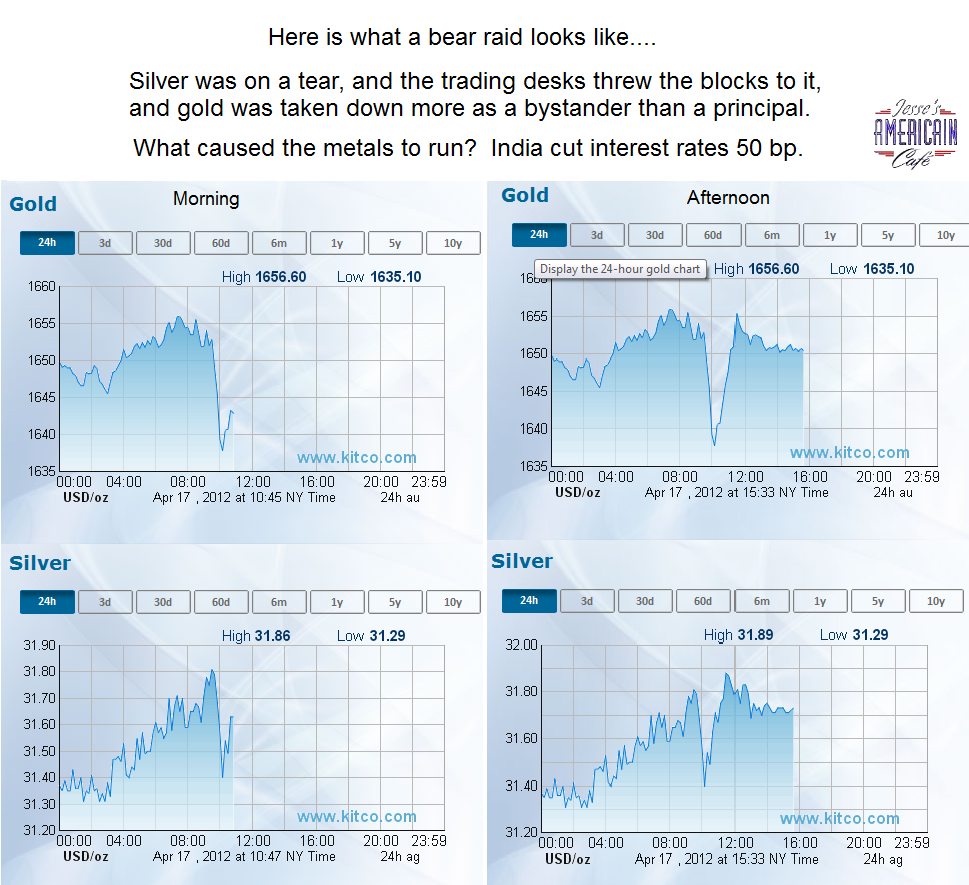
The paper money munchkins and metal bears are making their stand for gold at $1650 and silver at 32. That seems fairly obvious. They will hold it until they cannot, and then will fall back to defend a slightly higher price level. I like to think of it in American football terms. The bulls are going for a first down, and the bears are trying to hold them back.

Silver came in this morning with some serious momentum, and so we saw a fairly quick and sharp bear raid. See the first chart. Yes, the bear raid 'failed' but it broke the upward momentum which was the point.

Silver registed for delivery at the Comex is down to historically low levels again. They will have to be replenished before the next big delivery month.

Some of the commentators are remarking on the unusually low open interest in gold at Comex. While that could be a bullish or bearish indicator depending on how you wish to twist it, it could also very well indicate that the players are shunning the US futures market and so volume is down. Before these scandals work themselves out I expect it to fall much lower.

India cut its interest rate by 50 basis point, and this was most likely the fundamental reason for the rally in commodities and stocks.

It looks like the metals and stocks are moving together again, so one might put the long metal short stocks hedge back on again.


SP 500 and NDX Futures Daily Charts - Risorgimento della Gola


The IMF raised it's world growth projections from 3 to 3.5%. Since the only group that is worse than the IMF projecting growth rates is the Fed, I think we can write than one off to jawboning at best, but nothing of lasting substance.

The rally was in part a wash and rinse, a way to catch the bears off balance, and was triggered largely by India which cut interest rates by 50 basis points.

After the bell Intel beat estimates, for the 17th time in a row. IBM beat as well. Their accounting reports are as reliable and substantial as a politician's campaign promise, so the markets may not be overwhelmed by them.

And before you ask, that is not literal Italian in the title, but a rather loose double edged pun.


Net Asset Value Premiums of Certain Precious Metal Trusts and Funds


The premium in PSLV for silver remains historically low.

I thought the bear raid this morning was all about breaking the upward momentum in silver in order to keep gold under wraps at 1650.

More on that later in the gold and silver commentary.


The Quebec Students Strike


"But the most interesting resistance happening right now is going on in Quebec, Canada. There are, according to one representative report, over 165,000 students on strike from class out of a 495,000 student body.

Quebec is looking to increase their tuition 75% over the next several years; students responded by starting what is now the longest strike in the province's history. It's gone on even though the government has offered to make student loans a nicer, kinder form of debt, with income-contingent repayments while not budging on the tuition hikes...

The campus combines several issues into one - the privatization of public services, the dismembering of social insurance and its replacement with a regime of debt and risk-shifting, the dismantling of the primary means of social mobility with one designed to entrench inequality, which all builds towards a lack of freedom to fully develop ones talents and abilities and be full, productive citizens.

These students are right to fight this battle at the beginning, during the initials cuts. Privatization creates its own justification; the more public universities are defunded and reconceived as a private good, the less civic interest there is in defending them as a public good. And they are also fighting at the beginning of their lives, both for what kind of world they want to live in while resisting the constraints of indenture that we see when this process of privatization and debt reaches its ultimate conclusion - a path the United States is much further along."

The Quebec Students Strike - Rorty

At this time strikes and protests are more oddities, although the numbers are growing.

In time they will become a trend and will be met by even harsher repression, Mideast-style, in the US, the UK and Canada.

It sometimes seems as though the leaders of the great world powers have decided not to fight among themselves, except in controlled regional conflicts. Blood keeps the ledgers green.

Rather, they have learned to cooperate with each other, to enrich themselves and increase their personal power which has always been the goal of the predator class, by dominating and abusing their own people, engaging in financial pogroms, and preparing the way for a de facto global government and planned economy of the elite, by the elite, and for the elite.

And so we see once again the dreams of world domination, the rhetoric of privilege over law, and the perennial rise of the ubermensch. Even the victims of yesteryear seem to be getting on board, or at least their leaders are for it, hoping to get their own piece of the pie.

How soon we forget, forsaking what is lasting and important, becoming wilfully blind out of pride, fear and greed. There are those who would have a world in flames, as long as they might own the ashes, winning. And so history repeats.


16 April 2012

SEC Charges OptionsXpress with Naked Short Selling Scam


And the fails just keep on coming.

MF Global was check-kiting (in addition to outright theft) and OptionsXpress was 'stock kiting' in some targeted and fairly impressive volumes.

Their mistake was involving the retail side of the trade.   Naked short selling and price manipulation is only permitted for professionals of TBTF institutions and  campaign contributing hedge funds.

Bloomberg
OptionsXpress Accused by SEC of Naked Short-Sale Violations
By Joshua Gallu
Apr 16, 2012 5:15 PM ET

OptionsXpress Inc. (OXPS), the Chicago brokerage acquired by Charles Schwab Corp. (SCHW) last year, was accused by U.S. regulators of using sham “reset” transactions as part of an abusive naked short-selling scheme.

The company and four executives violated Securities and Exchange Commission rules in conducting trades from at least October 2008 to March 2010 designed to give the illusion of compliance with rules governing short sales, the SEC said in a statement today. An OptionsXpress customer was also accused by the SEC of participating in the alleged violations.

In a short sale, an investor borrows shares and sells them with the goal of profiting from a price decline by repurchasing at a lower price and repaying the loan. The SEC’s Regulation SHO requires brokers to close out clients’ short sales within three days and bars them from executing further bets against individual companies until previous sales have been settled.

OptionsXpress, its former chief financial officer Thomas Stern and the customer, Jonathan Feldman, are fighting the agency’s claims, which were filed in administrative court in Washington today...

OptionsXpress helped its customers buy shares while simultaneously selling call options that were essentially the economic equivalent of selling shares short, the SEC said. The purchase of shares created the illusion that the firm had satisfied the close-out obligation even though they were never actually delivered to the purchasers, according to the order.
Stock-Kiting Scheme

The transactions allowed OptionsXpress and its customers to engage in a “stock-kiting scheme” that deprived true stock purchasers of the benefits of ownership, the SEC said in its order. OptionsXpress had repeated failures to deliver stock in firms including Sears Holdings Corp. (SHLD), American International Group Inc. (AIG) and Chipotle Mexican Grill Inc. (CMG), according to the order.

In January 2010, customers involved in the OptionsExpress trades accounted for an average of 48 percent of daily trading volume in Sears, the SEC said. In 2009, six OptionsXpress accounts purchased about $5.7 billion worth of securities and sold short about $4 billion of options, according to the order.

The SEC settled related claims against three OptionsXpress employees: Peter Bottini, Phillip Hoeh and Kevin Strine, according to a separate administrative order filed today. Attorneys for Strine and Hoeh declined to comment. A phone call to Steven Biskupic, a lawyer for Bottini, wasn’t immediately returned.

In resolving the action, Bottini, Hoeh and Strine agreed to cooperate with the SEC’s investigation without admitting or denying wrongdoing or paying any financial penalties.

Charles Schwab, the San Francisco-based brokerage, agreed to buy OptionsXpress for about $1 billion in stock last year, adding the retail options brokerage founded in 2000 to its equity and mutual fund offerings. The acquisition was completed in September.

Gold Daily and Silver Weekly Charts


Gold closed about where it had opened on Sunday evening, and silver closed slightly higher.

And yet the miners took a minor beating as it were.


SP 500 and NDX Futures Daily Charts - No Resolution Yet


There was no clear breakout or breakdown on stocks.

There is also a strong possibility that we move to a sideways chop from here to the next big market move in May.


Why Has the American Economic System Failed, and What Are We Going To Do About It?


"We always want to keep in mind what the function, the purpose, of the economy is. The purpose of an economy is not producing GDP. It is increasing the welfare of citizens, and it is increasing the welfare of most citizens. And the American economic system has failed, and failed very badly. Most Americans today are worse off, most American households have lower real income adjusted for inflation than they had fifteen years ago."

Joe Stiglitz made an aside about half way through his talk about mercantilism at INET Berlin this month that is worth noting. I like the way he frames the problems and his fresh look on the situation but do not favor many of his suggested cures, especially the notion of something that sounds dangerously like central planning by a financial elite. I think that is something that needs much more work, but that is a discussion too often impeded by denial, misdirection, and diversion.

Although he initially addresses his talk to America, he goes on to include other countries, especially Germany. I would add the UK, among others including China, which is a disaster in the making.

I start the tape of his talk at 13:25, so you can hear the basic question and the simple truth that so many have overlooked. The American economic system has failed the public, and that failure has its roots in the 1990's, accelerating at the turn of the century into the financial collapse. It is a story of deceit, corruption, and betrayal.

And the majority of the people, who have suffered the most from this injustice, are being asked to suffer even more for a system that does not benefit them and actually works against them. And they are asking, 'is it worthy of our support?'

And history indicates that they will provide an answer that may be unpalatable for those who benefit the most from the current unsustainable arrangement, who are enriched by the misery of others.

I cannot say it more simply or more emphatically, that the gaming of the system by the monied interests, marked by but not wholly due to the repeal of Glass-Steagall, the trade agreement with China without a floating exchange rate, and the Bush tax cuts for the wealthy while initiating aggressive war on multiple fronts, have set the American economy on a spiral of demise and eventual self-destruction.

What has institutionalized this demise and made it pernicious is the corruption of American power and distortion of thought by big money, and the short term selfishness and self-interest of the status quo. That is what I call the credibility trap.

The point must be made, that the system did not fail because our economic models were no good, that our financial leaders were simply mistaken, that the political powers were pursuing the right path but that things went wrong in ways that no one could have foreseen, and that even now, the thought leaders and spokesmodels for the monied interests are hard at work concealing and deceiving and misleading, feeding the rotten system that has brought us to where we are today.

It was never a mistake. They knew, but it was easier to go along or do nothing, being either craven or compromised. It was always about easy money, and the fraud.

Giving even more money to the Banks, and asking the people to pay for it, in the hope that it will eventually trickle down to the people from whom it has been stolen is not a policy, and not even a policy failure. It is an obscenity.

I sense we are in the negotiation phase, in which the powerful monied interests want to be let off with a wrist slap, and no admission of guilt.  And of course for change to come slowly, maximizing their returns. 

The powerful think that they are the system, the economy and the government, and that it exists to serve them. And so any change must suit their needs, first and above all. But a prideful greed and will to power can never really contain itself, as it can never be truly satiated. It always craves just a little more.

The existing US dollar trade regime dominated by global corporations and banks, backed by widely deployed military power, is not sustainable. We are entering the next phase of this unfolding crisis, and some countries are already there, in which we will see growing domestic unrest and repression, and regional trade wars and alliances, in the evolution of the ongoing currency war.

Reform will come, one way or the other.   The writing is on the wall.

For in that universal call,
Few bankers will to heaven be mounters;
They'll cry, "Ye shops, upon us fall!
Conceal and cover us, ye counters!

When other hands the scales shall hold,
And they, in men's and angels' sight
Produced with all their bills and gold,
'Weigh'd in the balance and found light!'

Jonathan Swift, The Run on the Bankers


14 April 2012

Joseph Stiglitz: Is Mercantilism Doomed to Fail? And With It the US Dollar?


This is Joe Stiglitz' presentation at the INET conference in Berlin last week. He speaks about mercantilism, and I added the tagline about the dollar.

The one point I wish to make emphatically is that only under a fiat currency trade system can these large deficits and surpluses be created, in the same manner as the debt bubbles, and asset bubbles.

This is not a new idea, of the natural balance that hard currencies present in a global trading system. But it has been forgotten, put aside in recent years. My friend Hugo Salinas-Price has written a nice presentation of those ideas in his essay Gold Standard: Protector and Generator of Jobs.

I have written on the topic many times, most recent in The Great Flaw In Free Trade Theory and other Vain Beliefs, Hoaxes, and Follies.

Under a hard currency or asset system of trade, as one country draws down its stock of gold, for example, its gold-backed currency would automatically become devalued since there would be less gold underpinning it.

Conversely, as a country built up a trade surplus, over time so much gold would flow to that country so that its currency would appreciate relative to the currencies of the debtor nations.

These changes in valuation would tend to 'balance' the trade flows naturally, and unilateral mercantilism would fail long before it threatened the stability of the international monetary system.  That is not to say that exploitative trade might not exist, such as under the British Empire.  These took more of a form of colonialism, a kind of mercantilism among master and vassals.  But any trade imbalances between developed nations with their own currencies could only grow large with great difficulty.

A fiat currency regime allows huge imbalances not only to exist, but to grow to dangerous and unsustainable levels that threaten the very system itself.

Some of today's problems are indeed because the US is acting as the 'deficit of last resort' because it owns the world's reserve currency. This is known as Triffin's dilemma.

My thoughts about Triffin's Dilemma and the international trade structure  that as a businessman I was operating within during the 1990's, especially after Bill Clinton allowed China to obtain free trade status after a large currency devaluation and without a floating currency stipulation, was that ultimately the world would be plunged into a currency war that would likely either lead to a unified financial order, possibly a triumvirate of spheres of influence, or the failure of the dollar and a radical restructuring of the global financial power structure.

So far we seem to be on track.


Michael Hudson: Debt: The Politics and Economics of Restructuring


I have been watching the presentations from the New Economic Thinking's (INET) Paradigm Lost Conference in Berlin.

Here is Michael Hudson's talk on Debt and Restructuring from April 13, 2012


The Criminal Manipulation of Food and Commodity Prices


Michael Greenberger of the University of Maryland has been an outstanding spokesperson for financial reform.  I have carried his interviews before.

He served on the CFTC with Brooksley Born in the late 1990's. This is how I first became aware of his opinions about regulatory matters.

I had hoped he, among some notable others, might have found a place in the Obama Administration if it had been truly interested in financial reform. And we all know how that went, and how it still goes today.


h/t via Yves

See the entire story at the Real News Network here.


Since July 2001, Michael Greenberger has been a professor at the University of Maryland School of Law, where he teaches a course entitled "Futures, Options and Derivatives."

Professor Greenberger serves as the Technical Advisor to the United Nations Commission of Experts of the President of the UN General Assembly on Reforms of the International Monetary and Financial System. He has recently been named to the International Energy Forum’s Independent Expert Group that provided recommendations for reducing energy price volatility to the IEF’s 12th Ministerial Meeting in March 2010.

Professor Greenberger was a partner for more than 20 years in the Washington, D.C. law firm of Shea & Gardner, where he served as lead litigation counsel before courts of law nationwide, including the United
States Supreme Court.

In 1997, Professor Greenberger left private practice to become the Director of the Division of Trading and Markets at the Commodity Futures Trading Commission (CFTC) where he served under CFTC Chairperson Brooksley Born. In that capacity, he was responsible for supervising exchange traded futures and derivatives.

He also served on the Steering Committee of the President's Working Group on Financial Markets, and as a member of the International Organization of Securities Commissions' Hedge Fund Task Force. After service at the CFTC, Professor Greenberger served as Counselor to the United States Attorney General in 1999, and then became the Justice Department's Principal Deputy Associate Attorney General.