18 June 2010

Official Gold Reserves As of June 10, 2010, and Truths Yet to be Told


It is important to remember that these are the 'official' numbers. And it does not show how the reserves are 'encumbered' by leases and loans.

For example, there is circumstantial evidence that the Reserve Bank of Australia loans up to 100% of its gold reserves to the bullion banks who subsequently sell it, and then 'owe' it to the Bank and the people of Australia. The trick of course is the significant counterparty risk in the event of a serious short squeeze.

And they are not the only ones. Since this is an asset owned by the people, a timely and transparent accounting by the Treasuries and the Banks is something that the people of every nation obviously deserve. Whether the financial engineers, who enjoy experimenting with Other People's Money and doing favors for their private sector cronies, will ever willingly provide that information is another story altogether. It will almost certainly be under force of law, or an independent audit.

World Gold Council
Official sector gold reserves as at June 2010

European central banks sold virtually no gold over the past quarter, save a small amount for minting gold coins. Total sales by European central banks have amounted to just 1.8 tonnes since the third central bank gold agreement began in September of last year. The only sales of note made via CGBA3 have been by the IMF, which has sold 38.7 tonnes since mid-February. We expect the IMF to sell at a similar pace this quarter.

Outside of the agreement, the main purchases reported over the last quarter have been by Russia and the Philippines, both of which have long-standing gold buying programmes. The Central Bank of Russia bought another 26.6 tonnes of gold over the past quarter, taking its total gold holdings to 668.6 tonnes or 5.5% of its total reserves, and remains the 9th largest official sector gold holder. The Philippines central bank bought 9.5 tonnes of gold in March, taking its gold holdings to 164.7 tonnes or 13.7% of total reserves.

The Saudi Arabian Monetary Authority reported last quarter that “gold data have been modified from First Quarter 2008 as a result of the adjustment of the SAMA’s gold accounts”, meaning SAMA’s gold reserves are now reported to be 322.9 tonnes or 2.8% of reserves, from 143 tonnes or 1.2% previously....


What Have They Been Doing Since the Financial Crisis Began?


"China is considered a stealth buyer of gold, said Boris Schlossberg, director of currency research at Global Forex Trading. As the world's largest producer of the metal, China often buys gold from its own mines and doesn't report those sales publicly. But in April 2009, China did admit to having added 454 tonnes, or a 76% increase, to its reserves since 2003.

Analysts suspect the country is continuing to buy gold and could in fact, be the world's largest buyer consistently. It simply doesn't reveal it's pro-gold stance proudly, however, because China is also the world's largest holder of U.S. Treasurys.

Announcing an aggressive gold buying spree is not in China's best interest because, for one, it might push gold prices higher. Secondly, it could devalue the U.S. dollar, which would subsequently lessen the worth of the country's portfolio of U.S. government bonds, Schlossberg said."

Central Banks Join Gold Rush - CNN


Just as there are stealthy buyers, how can one refuse to acknowledge the body of evidence that there are also stealthy sellers, hiding behind official secrecy, derivatives arrangements, leases, and accounting frauds that will shock and anger the real owners of the assets when their hidden and conflicted dealings with their cronies in the private banking sector are revealed?

Anyone at this point who says that the Fed would never engage in such obviously compromised and conflicted transactions, and then go to great lengths to hide them, has either not been reading the real news, or is as compromised as the central bankers and their cronies in government and the mainstream media are, morally and intellectually.

And if they will allow the equity markets to be manipulated, as any even modestly sophisticated trader with decent access to tools must now recognize and admit, why would they hesitate to enable and encourage the manipulation of the sovereign bond markets, and those markets that affect them, which are by far the most important markets of all?

The world is not big enough for them to find a place to hide from justice after the truth is revealed. So they will lie and obstruct, extend and pretend, increasingly desperate for power, corrupting all that is corruptible, until the very end, and the final downfall and collapse. And then will come the crocodile tears, and the claims of ignorance, and finally weak apologies that they thought they were doing the right thing, but were honestly mistaken.

Such is the case in all control frauds, white collar crimes, official corruption, and Ponzi schemes.

The banks must be restrained, the financial system reformed, and the economy brought back into balance, before there can be any sustained recovery.

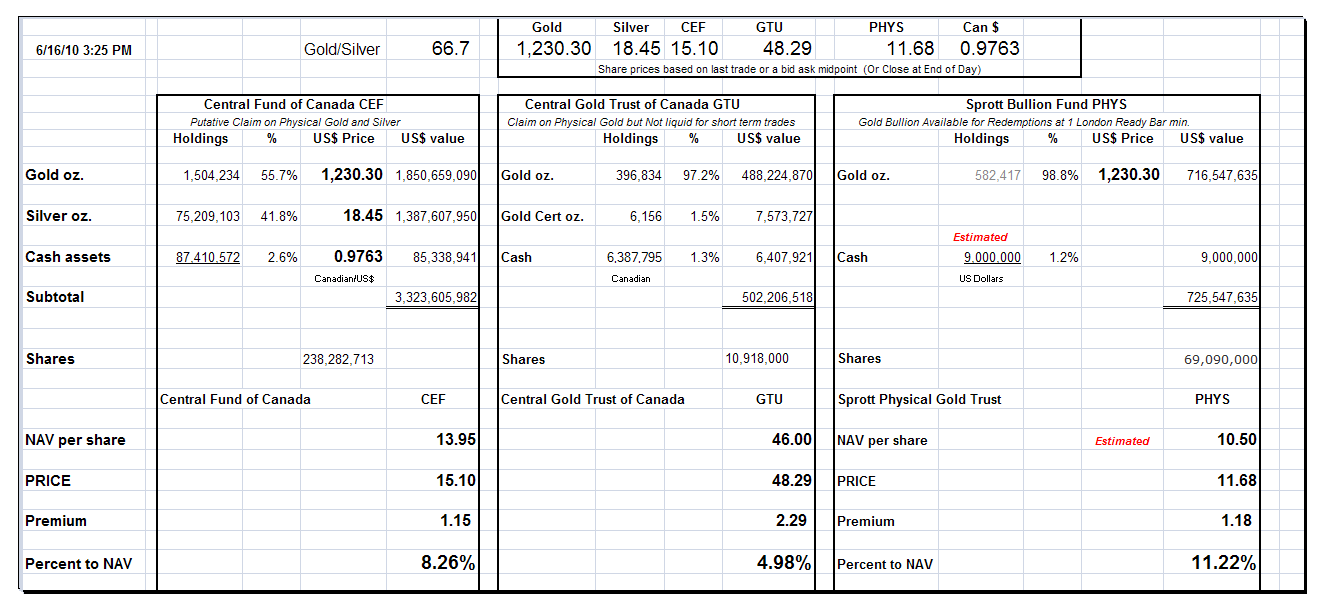
Net Asset Value of Certain Precious Metals Trusts and Funds


The Central Gold Trust shelf offering will complete next Wednesday, 23 June.


On fading Jeff Christian and Jonny Nadler


Stay thirsty my friends.

17 June 2010

SP 500 Futures Daily Chart and Gold Sets Handle and Moves Higher


Charts from 10:30 New York time this morning. As a reminder tomorrow is the stock options 'quad witching' expiration.

Stocks look overdue for a pullback, with 1100 providing a key support, and below that around 1090. We're back on the 'short stocks / long gold' trade as of yesterday, believing that the stock rally was artificial and support for the IPO's rolling out under the careful guidance of Mother Goldman.

"In today’s exchanges, strong programs prey on weak ones, humans are hard to find, and the SEC struggles to keep up."

Monsters in the Market, the Atlantic, July 2010


The 'handle' on the gold chart is very well defined, and gold is making a strong move higher this morning in an attempt to break out. I do not suspect it will be successful so easily, but once it does it may gap higher overnight and then say goodbye to these price levels. There are powerful interests which do not like to see gold move higher just yet, because it creates doubt in their financial engineering. Larry Summer's documented this effect in his paper on Gibson's Paradox. Greenspan was right so many years ago when he said that statists hate gold, because it provides a safe haven for the individual, and a stumbling block to the powerful.


Net Asset Values of Certain Precious Metal Funds and Trusts

The premium on GTU continues to be compresses because of the large secondary offering of units. That should be completed on June 23. We would expect the premium to revert to the mean, closer to 8%, once the shares are sorted out.


NAV Added later, as is indicated by the time stamp.

16 June 2010

US Dollar: The Last Bubble


A bubble is a significant increase in valuation supported by a set of artificial, inexplicable, and otherwise unsustainable conditions. The 'increase in valuation' can be nominal as in a price that goes 'higher' without a corresponding increase in value, or a decline in the value underlying the asset while the price remains nominally the same. (note 1)

True bubbles almost always involve some element of secrecy, a cover up, and some dispensation from common knowledge and experience. There are almost always dissenters, voices of warning, that are ignored and even ostracized. "It's different this time..." without there being an identifiable difference, only the self referential rationale.

Stocks are not a bubble because they are going higher and the market is infallible. Housing cannot be a bubble because the housing market is so geographically diverse. You get the point. Not all things that increase in price are a bubble, but this does not mean that bubbles cannot be identified. They can, but when they serve some greater end, the voices of dissent are overwhelmed. Almost all bubbles involve control frauds and the corruption of the media, the analysts, and the regulators, to some degree, through benefits and intimidation.

When the artificial conditions are removed the valuation of the bubble 'reverts to the mean, ' a more normal valuation based on the fundamentals, unadjusted and undistorted supply and demand. An asset bubble often involves a fraudulent design taking advantage of and even perpetuating a corresponding foolishness. In other words, the fraud is father to the folly.

The duration of a bubble does not make it valid or 'the new normal.' Like most chronic conditions it just means that the adjustment will be all the more difficult.

The US dollar as the world's reserve currency, and the unusual period of US prosperity, is an historical artifact of the post World War II era that will not continue indefinitely. When the reversion to the mean occurs, it is likely that the dollar will have to be reissued as 'the new dollar' similar to the rouble in the post-Soviet adjustment. I can think of few better examples of what the US faces than the collapse of the former Soviet Union. For the UK, it looks like Argentina, or Iceland writ large, but with the sharp edge of a police state.

This is my fundamental currency thesis that I have been following since 1997, and it appears to be valid so far. I do not see the resolution in hyperinflation per se, but I do think the new dollar will have a value of about 10% of the current dollar. I think a hyperinflation requires a loss of confidence against some external standard. So the object is to weaken any that might appear.

At some point they will merely knock a zero off the current dollar and demand their surrender for new dollars. That should play havoc with those holding large bundles of 'cash.' For example, if you have $100,000 in savings, and it will afterwards be worth 10,000 in new dollars.

Eliminating 90% of its foreign debt obligations will certainly help to repair the US Balance Sheet. It is possible that this is accomplished in inflation, rather than a more formal evaluation, and over a long period of time, say twenty years or so.

If this seems impossible to you, then you are not aware perhaps that the same thing was accomplished from 1933 to 2000, or 67 years, and should avoid looking at the last chart. The Fed was merely squandering the nation's wealth, without the advantages of modern financial engineering and deregulation. The next leg down will probably be about three times more efficient, under the leadership of Zimbabwe Ben.


Chart from the latest ScotiaCapital FX Presentation


"Facts do not cease to exist because they are ignored." Aldous Huxley
Wouldn't it be convenient for the oligarchs if their think tanks could somehow concoct a story, some plausible sounding theory, to persuade a portion of the world's population to hold dollars, expecting them to GAIN in value, even in the face of significant defaults and credit failures and a deteriorating return in GDP growth per marginal dollar debt? Or even better, getting them to remain fully invested in a series of artificially contrived dollar denominated financial assets that could be selectively 'pulled down' while keeping the overall scheme intact and running. Bernays would be proud.

But the trick is to convince the non-sleepwalking portion of the public to ignore the signs of a failing economy and an approaching currency collapse. This is the sort of black is white brainwashing exercise that occupied quite a few of the whiz kids for the latter part of the twentieth century.

It might take a lot of work, and some high level financial engineering, raw determination to play the long game, public relations professionals engaging invoking slogans and prejudices, and a suite of new financial instruments that would have to be protected even when it was suspected they were fraudulent, but it would be a useful tool for the Übermenschen to have in their toolbox. Nothing works better than to convince a free people to willingly enslave themselves.

Advice for far too many economic forecasters and precious metals analysts.


You know who you are.

Stay thirsty, my friends.

Note 1: The latter case is the most difficult phenomenon to understand, but is behind much of the financial crisis which we are experiencing today. Inflation can occur even if money supply is flat and declining, because it is the level of demand for the money that could be dropping even while supply is constant. A example of this would be Europe in the aftermath of the Black Death, in which case the 'wealth' remained constant but the number of people demanding it were reduced dramatically and precipitously. If the value, the productivity of a country is all that stands behind a fiat currency, if that productive capability is in decline, to be replaced by 'service,' then in fact an inflation can occur even while the nominal money supply is flat or decreasing. One has to consider what is 'backing' the money from an external perspective.

It might be easier to understand if you imagine that a country is on a gold standard, with a constant money supply, but covertly gives away all of its gold. That country will experience a significant inflation which will come upon it seemingly overnight once the confidence, the backing, in the currency is dissipated.

This argues strongly against the monetarists who are pure relativists. Their relativism lead inevitably to central planning and a command economy, ideally a one world government. The need for great and greater control is necessary of the continuation of their fraud. This is why Wall Street banks always seem to be entranced with fascism, or more properly, statism, and why the robber barons chose to build slums rather than vibrant cities. And why the Chinese government fears to stimulate domestic prosperity under market discipline. Its a matter of control. Their end is not an increase in general prosperity, but rather the maintenance and increase of the power of the few over the many, relatively speaking as a close ended system. Your weakness increases my strength.

I will leave the discussion of value for another time, but let it suffice to say that it involves the determination of efficient markets. An efficient market is one that is free of fraud, all information being available to all participants at the same time, with full transparency. Any limitation or even worse, monopolization of information detracts from market efficiency. Transactions are relatively frictionless, and there are strict limits on the use of size and leverage to distort the determination of value. Obviously there are no perfectly efficient markets in this world, but it is useful to have a measure to understand how imperfect that are, and whether a rule or a change makes them better or worse.

Net Asset Value of Certain Precious Metals Funds and Trusts


The Central Gold Trust was pressured today in response to its new unit offering from the existing shelf prospectus. The price declined 3.67% from yesterday's close with gold down $7.10. The total placement will be $285 million.

The premium is now low enough to make one an interested buyer, all things being equal, if there is an optimistic outlook for gold.

I have not quite calculated the 'greenshoe' on this offering as I am otherwise occupied today, but it might involve shortselling ahead of the offer as is customary and explained here.


Press Release
CENTRAL GOLD TRUST
For Immediate Release to Canada News Wire and U.S. Disclosure Circuit

TORONTO, Ontario (June 16, 2010) - Central GoldTrust of Ancaster, Ontario announced today that it has entered into an underwriting agreement with CIBC World Markets Inc., as lead underwriter, and Credit Suisse Securities (Canada), Inc. (the “Underwriters”), under which the Underwriters have agreed to buy and sell to the public in Canada (except Québec) and in the United States under the multijurisdictional disclosure system, 5,730,000 Units of Central GoldTrust.

The Underwriters have been granted the right to increase the size of the offering (the “Right”) by up to an additional 1,000,000 Units, exercisable in whole or in part, at any point prior to 4:00 p.m. (EST) on June 16, 2010. The offering will be made under an initial prospectus supplement to Central GoldTrust’s US$800,000,000 base shelf prospectus dated June 8, 2009.

The purchase price of U.S. $48.90 per Unit is expected to result in gross proceeds of approximately U.S.$ 280 million, prior to the exercise of the Right.

Substantially all the net proceeds of the offering have been committed to purchase gold bullion for settlement at closing, in keeping with the asset allocation provisions outlined in Central GoldTrust’s Declaration of Trust and the related policies established by its Board of Trustees. Any additional capital raised by the offering is expected to assist in reducing the annual expense ratio in favour of all Unitholders of Central GoldTrust.

Closing is expected to occur on or about June 23, 2010.

15 June 2010

Central Gold Trust Opens Its Entire $800 Million Base Shelf Prospectus in a Non-Dilutive Offering


Stefan Spicer is opening up his Central Gold Trust (GTU) for expansion in a very classy way, making it non-dilutive of NAV so as to not penalize the existing unit holders.

Well done indeed. An excellent response to surging market demand. The Spicers once again show the way to respond to their customers.

It will be interesting to see how quickly this offering sells. Since the Central Gold Trust holds its bullion in a strict allocation it represents a potentially large physical offtake in a tight bullion market as the move to hard assets continues.

And as an aside, it is so nice to be able to trade Canadian securities on the American exchanges. Anyone who trades the Canadian junior miners on the 'pink sheets' is all too familiar with the spread games and bid dodging the market makers are playing these days.

For Immediate Release toCanada News Wire and U.S. Disclosure Circuit
TSX SYMBOLS: GTU.UN (Cdn. $) and GTU.U (U.S. $)
NYSE AMEX EQUITIES SYMBOL: GTU (U.S. $)

CENTRAL GOLDTRUST ANNOUNCES PROPOSED OFFERING

TORONTO, Ontario (June 15, 2010) - Central GoldTrust of Ancaster, Ontario announced today that it plans to offer Units of Central GoldTrust to the public in Canada (except Québec) and in the United States under its existing U.S.$800,000,000 base shelf prospectus dated June 8, 2009 and filed with the securities commissions in each of the provinces and territories of Canada, except Québec, and under the multijurisdictional disclosuresystem in the United States pursuant to a proposed underwritten offering by CIBC.

Central GoldTrust will only proceed with the offering if it is non-dilutive to the net asset value of the Units owned by the existing Unitholders of Central GoldTrust.

The entire original amount of U.S.$800,000,000 provided for in the base shelf prospectus is available for this offering.

Substantially all of the net proceeds of the offering will be used for gold bullion purchases, in keeping with the asset allocation provisions outlined in Central GoldTrust’s Declaration of Trust and the related policies established by its Board of Trustees. Any additional capital raised by the offering is expected to assist in reducing the annual expense ratio in favour of all Unit holders of Central GoldTrust...

Read this entire news release here.

SP Daily Chart - Wall Street Pushes CBOE Out the Door to Double Digit Gains


As I cautioned, between the IPOs that were coming out, with Goldman in a key role, and the quad witch for June at the end of this week, the US financial markets would be Shenanigans Central, especially on these light volumes and happy talk from the government.

The manipulation, fraud, and corruption in the US financial markets is remarkable for its obviousness.


CBOE IPO shines, may prompt more IPOs
By The Associated Press (AP)

CBOE IPO SHINES: Shares of options exchange CBOE Holdings Inc. logged double-digit gains in their trading debut. It was a rare success in what has been a tough year for initial public offerings.

THE GOODS: CBOE's rapid growth, exclusive products and potential to be acquired made it attractive. The exchange created the VIX, or the Chicago Board Options Exchange Volatility Index. It is a closely watched gauge of market volatility also known as the "fear index."

CRACK IN MARKET: While demand for most IPOs remains tepid, CBOE's success may prompt high-profile companies in the pipeline to set a trading date.

The US dollar was severely overbought, remniscent of the eurodollar short squeeze that took it to about this level a couple of years ago. As the euro rallied today so the dollar fell. This *could* just be a normal correction in an amazingly sharp rally. I have marked the target lows for this correction if that is what it is.


Net Asset Value of Certain Precious Metal Funds and Trusts


14 June 2010

Gold, Silver, and the Mining Index with the SP 500 for the 'Quad Witch' This Week


This is one of the big four 'quad witch' weeks for US equities, and Goldman is bring out some IPO's including the CBOE. So as previously said, we'll look for shenanigans on light volumes as the trolley dodgers try to stay out of the way of intermittent headline risks and keep that perfect trading score going.

When frauds like the US financial markets become this obvious and blatant, it is frequently a sign that they are nearing the endgame, or perhaps more properly, an implosion. But never poke a cornered skunk, you have to smoke them out.

Gold


Silver Daily Chart


Silver Weekly Chart


HUI Mining Index - Weekly Chart

Some might notice a trend on this chart. That trend would not hold up in a general stock market crash.


US Long Bond

Big Daddy looks about read to take a dump.


SP 500 Sept Futures Hourly chart


SP 500 Longer Term Cash Chart


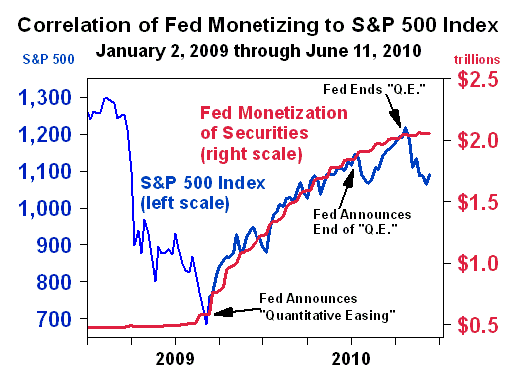
SP 500 Correlated to Bernanke's Quantitative Easing Program


Chart Courtesy of James Turk