15 October 2010

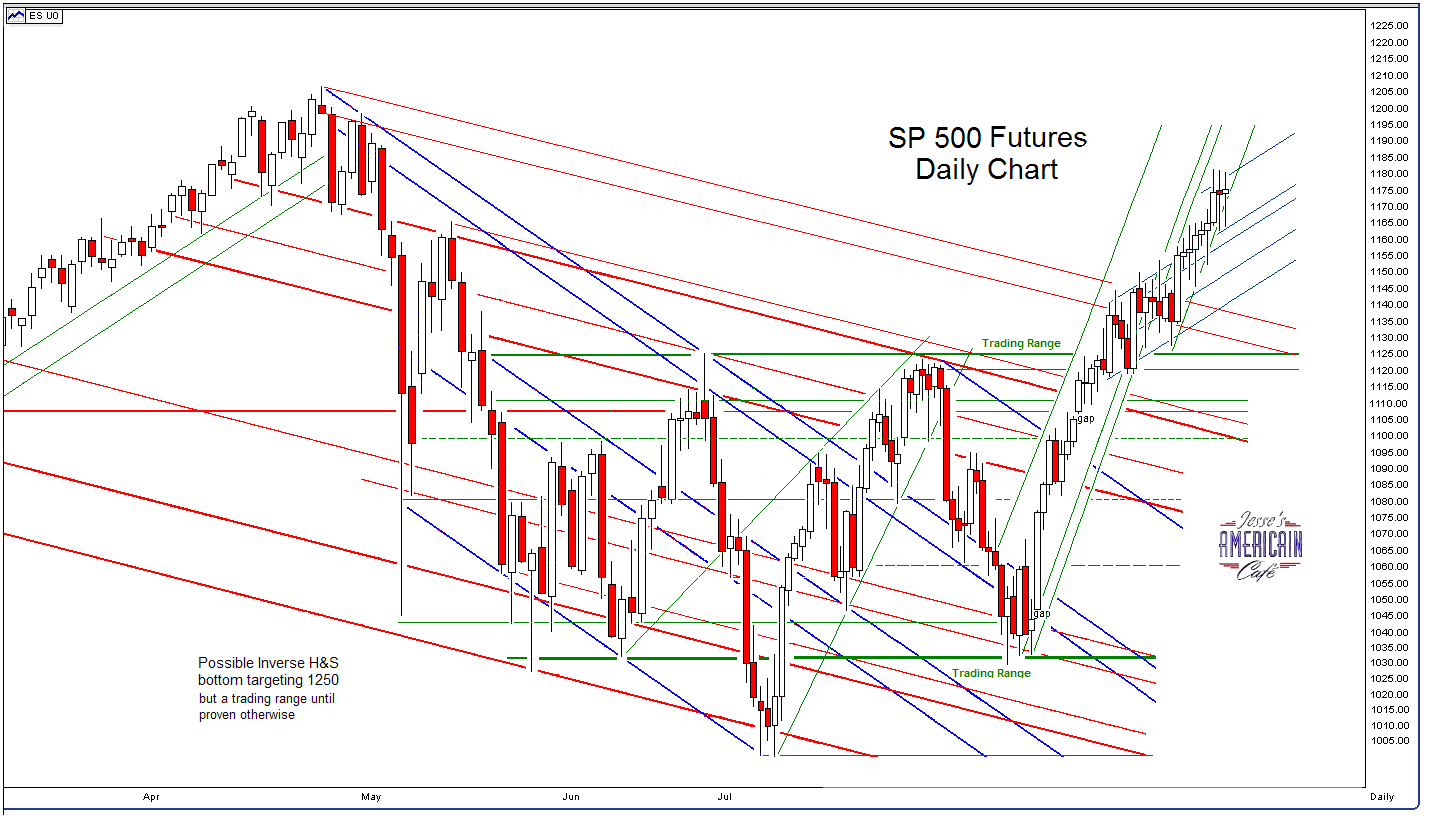
Gold and SP 500 and NDX December Futures Daily Charts


Climbing a trellis of support and resistance...


Richard Russell last night on gold…

"Today I am taking the same stand regarding the gold bull market. The gold bull market will not end with a fizzle and a whimper. It will end with intense speculation and widespread interest from the funds and the public. We haven't seen that kind of activity yet, but I'm convinced that a period of wild speculation in gold lies somewhere ahead.

This is why I continue to beg my subscribers to load up with gold. As I see it, we are nearing a period of intense speculation that will be beyond anything seen before by the last three generations of Americans. Ironically, more money made in the final explosion in gold than was made during the first two phases combined.

Great bull market are seen maybe once or twice in a lifetime. The current "stealth" gold bull market has sneaked up on most Americans. The very phrase, "gold bull market" is sneered at by most analysts today. In fact, most of the comments on gold today come in the form of warnings; "Gold is too high." "Gold is in a bubble." "Gold will sink back below 1000." "Gold is a fool's play."

Nonsense. Gold is moving ever-closer to it's climactic speculative third phase. The negative comments about gold will only serve to make the gold bull market that much stronger. In this business, there is nothing more powerful than a primary bull market that has been denigrated, spat at, and held back for years.

And that's the end of my "lecture" about the fabulous gold bull market…"


"...the world will soon wake up to the reality that everyone is broke and can collect nothing from the bankrupt, who are owed unlimited amounts by the insolvent, who are attempting to make late payment on a bank holiday in the wrong country, with an unacceptable currency, against defaulted collateral, of which nobody is sure who holds title."

Bill Dudley Administers QE II to Wall Street While Ben Advises (And Timmy Helps)


Pulp Fiction Adrenaline Shot

John Travolta ................ Bill Dudley, Governor, NY Fed
Eric Stoltz ..................... Ben S. Bernanke
Uma Thurman ................TBTF Wall Street Bank
Rosanna Arquette ............Timmy

Weekend Reading


If US based readers have spare time and four dollars it might be worth the effort to read this book. Its a fun read for the gold bugs, and is what I used to call 'airplane and waiting room' reading. Not strenuous but a good divert and an engaging story. Not to give it away, but I thought his gambit with the bags of silver coins was clever but somewhat implausible.

Full Faith and Credit by James R. Cook

If you are up for something more intellectually engaged and you can find them read When Money Dies by Adam Fergusson and Debt and Delusion by Peter Warburton.

I was in Moscow doing business when the rouble was dying after the collapse of the Soviet Empire. It made a lasting impression especially to see how the common person was reacting to it, each in their own way. A true vignette of human nature.

Option Expiration and A Few Dates and Facts Worth Noting


As a reminder today is stock option expiration in the States.

Precious metals options expiration for November will be next week.

The US 2010 elections will be held on the first Tuesday in November which is the 2nd.

The Federal Reserve will be meeting on Wednesday 3 November, and is widely expected to be announcing a new quantitative easing program, particularly after the preface which Mr. Bernanke delivered today.

As an aside October 2010 is unusual in that it contains five full weekends, a welcome rest before the great events to come.

This is among my favorite times of the year, as the heat of summer gives way to the pleasant warm days and cool nights of autumn, and expectations of the harvest holidays and family gatherings rise, culminating in Christmas week and the beginning of a new year. The cycle of nature cares little for the comings and goings of men.

And finally, an interesting graph showing the percentage of gold as an investment in global portfolios.


14 October 2010

Guest Post: Peak Oil - There Is No 'Plan B' By Chris Martenson


ChrisMartenson.com
Future Chaos: There Is No "Plan B"
By Chris Martenson
October 13, 2010

Note: This article builds on my recent report, Prediction: Things Will Unravel Faster Than You Think. It explores the coming energy crunch in more detail by looking at existing government planning and awareness, and the implications of what international recognition of Peak Oil as early as 2012 might mean.

The hard news is that there is no "Plan B." The future is likely to be more chaotic than you probably think. This was the primary conclusion that I came to after attending the most recent Association for the Study of Peak Oil & Gas (ASPO) in Washington, DC in October, 2010.

The impact of Peak Oil on markets, lifestyles, and even national solvency deserves our very highest attention - but, it turns out, some important players seem to be paying no attention at all.

ASPO conferences tend to start early, end late, and be packed with more data and information than should be consumed in one sitting. Despite all this, I was riveted to my seat. This year's usual constellation of excellent region-by-region analyses confirmed what past participants already knew: Peak Conventional Oil arrived a few years ago, and new fields, enhanced recovery techniques, and unconventional oil plays are barely going to keep up with demand over the next few years.

But there were two reports that really stood out for me. The first was given by Rear Admiral Lawrence Rice, who presented the findings of the 2010 Joint Operating Environment (a forward-looking document examining the trends, contexts, and implications for future joint force commanders in the US military), which spends 76 pages summarizing the key trends and threats of the world. "Energy" occupies six of those pages, and Peak Oil dominates the discussion. Among the conclusions (on page 29), we find this hidden gem, which uses numbers and timing that are eerily similar to those that I put forth in my April 2009 report, Oil - The Coming Supply Crunch:
By 2012, surplus oil production capacity could entirely disappear, and as early as 2015, the shortfall in output could reach nearly 10 MBD.

(Source)
While there are two "coulds" in that statement, the mere possibility that such an imminent arrival and massive shortfall could be true should give every prudent adult a few second thoughts about what the future may hold. If surplus production capacity disappears in just a couple of years, there is an entire world of planning that should take place beforehand at the international, national, community, and personal levels.

More on the JOE report in a minute. Next I want to turn to a presentation given by Rick Munroe, who did his best to discover where within the civilian governmental departments lie the plans for what to do in a liquid-fuel-starved future.

To cut to the chase, it turns out that virtually every department that he contacted in both the US and Canada denied having any such reports. In one humorous exchange by email, Natural Resources Canada stated two things in the same email:
• “At this time the Department has no views on [Peak Oil].
• "There is no imminent Peak Oil challenge…."
It will be interesting to see how NRCan words their emails once they do develop a point of view.

The main conclusion from Rick's presentation was that Peak Oil is being examined closely and taken seriously by military analysts, but not civilian authorities. The few plans that do exist on the civilian side are decades old.

The implications of this are that North America "remains highly vulnerable to a liquid fuel emergency disruption" and, since because there are only a few dusty plans lying around, there will be greater chaos than necessary.

Now back to the JOE report.
OPEC: To meet climbing global requirements, OPEC will have to increase its output from 30 MBD to at least 50 MBD. Significantly, no OPEC nation, except perhaps Saudi Arabia, is investing sufficient sums in new technologies and recovery methods to achieve such growth. Some, like Venezuela and Russia, are actually exhausting their fields to cash in on the bonanza created by rapidly rising oil prices. (p. 26)

A severe energy crunch is inevitable without a massive expansion of production and refining capacity. While it is difficult to predict precisely what economic, political, and strategic effects such a shortfall might produce, it surely would reduce the prospects for growth in both the developing and developed worlds. (p. 28)

Well, the amounts needed from OPEC are quite, shall we say, 'ambitious,' as they amount to an additional two Saudia Arabias coming on line in order to make up the shortfall. A massive crunch is not otherwise avoidable. Let's be honest; there are no more Saudia Arabias to be found. Perhaps we could cobble one together out of thousands of smaller, less productive fields, but the likelihood of a few massive fields waiting to be found 1,100 feet underground is extremely remote. People in the business of actually producing oil know that producing from smaller wells takes more time, equipment, and manpower.

Meanwhile, I also happen to agree with their assessment that the details of the effects are difficult to predict but that the general theme will be one of reduced growth, and that's under the best of circumstances. More likely we'll have to figure out how to operate on zero or even negative growth.

So I came away from the ASPO conference pondering two completely polar trends that combine to create lasting discomfort. On the one hand, we have more and more private and military organizations coming to the conclusion that Peak Oil is imminent and will change everything, possibly disruptively. On the other hand, there appear to be no plans within the civilian government to deal with a liquid fuels emergency.

While we can expect that such plans will be tossed together when necessary, I would hope that Katrina taught us a few lessons about developing plans on the fly after the disaster has already arrived. Sure, things got done, but they were certainly suboptimal and led to more confusion and more chaos than if they had been carefully developed, practiced, and debugged.

The way that I understand the lack of planning on the part of the civilian side is that Peak Oil does not present any easy political wins, if any at all. Given the two-year planning cycle in DC, it's never a good time to bring up such an unpleasant subject. Politics trump necessity.

What can be rather easily predicted here is that when the next fuel crisis arrives, there will be more chaos than necessary. Some areas will get completely stiffed on their fuel allotments, while other areas will be reasonably well supplied. The reason that this can be easily predicted is because it more or less already happened in Europe during a protest by French fishermen inspired by high fuel prices. They blockaded ports in late May of 2008, and by early June, the action had spread across Europe. Shelves were quickly stripped bare of essential goods, tensions mounted, and petrol stations ran dry in a hurry.

And these were just the effects of a port blockade and tanker truck strike. What would happen with a real and persistent shortage of fuel? Well, if it were perceived to be due to a structural and permanent inability of the global oil market to meet demand, prices would rise stratospherically until demand was cut off. The only problem is, letting prices determine which industries idle back may not be the best plan.

Consider the case of agriculture. If full 'pass-through pricing' is the mechanism of rationing, which it currently is, then less food will be grown. With world grain stocks at historic lows, this is one area where we might not want to let Mr. Market dictate the activities of farmers based on fuel price. To do otherwise would require a plan of some sort, and none appear to be in effect.

That's the source of my discomfort. It's not necessarily that large organizations are beginning to share my sense of timing and impact of Peak Oil, although that will hasten the tipping point of awareness. It's that somehow I always thought that because Admiral Hyman Rickover knew well that this day would come (in the 1950's!), 60 years would have been sufficient lead time to assemble some credible plans.

No plans = unnecessary chaos.

The lack of planning also betrays a very common attitude, which might be summarized as, “We’ll deal with that when we get there.” I detect this attitude in a wide range of individuals and market participants, so it’s not at all uncommon. However, I think it's a mistake to hold this view. When (not if, but when) full awareness of Peak Oil arrives on the international stock, bond, and commodity markets we will discover just how narrow the doorways really are. Only a few will manage to preserve their wealth by squeezing through the doorway early; most will not make it through. As mentioned frequently on this site, our What Should I Do? guide for developing personal resiliency against a Post-Peak future offers a valuable resource for those just getting started in their preparations.

This thinking is explored in greater depth in Part 2 of this report (enrollment required), in which I discuss strategies to fill the official vacuum by developing our own plans for what we should do in response.

Gold Daily and Silver Weekly; SP 500 and NDX December Futures Daily Charts


Gold and Silver are in a relentless rally as the US dollar continues to drop. US equity indices continue to climb as well. This has the look and feel of a monetary reliquification rally such as we had seen in 2003-2007.


13 October 2010

The Trends Are Extended, Start Thinking Consolidation and Reversals, But Wait For It


The trends are extended on quite a few charts. The action in the US markets is being artificially inflated and supported by monetization and liquidity so it *could* continue on for some time, even until the November election. It is being fueled by the expectation of a large quantitative easing by the Fed shortly thereafter. That QE, when it arrives, is likely to be sold if it is not significant enough to meet expectations.

I am more cautious on short term positions here, and have had some short hedges on in the overnight, but deftly. It is important not to exhaust yourself expecting a trend change before it is ready to happen, and one cannot anticipate exogenous events by definition. Still, the time is ripe for one to have a significant effect should it occur.

The long term trends are all intact, but we have reached a position where we might be looking for intermediate tops and consolidations.  The Fed is not infallible or omnipotent, but rather determined and capable within its limits.  The combination of government and the monied interests is powerful and ruthless.  Manage your money tightly and wait for the market to reveal its intentions if you are trading.


Gold and Silver, SP 500 and NDX December Futures Daily Charts


Gold met the intermediate measuring objective of 1375 today.  The slope of this rally is a bit strenuous and a consolidation of some sort, even a bit of a retracement, would not be out of order and might even be welcome for traders to catch their breath and square up positions. However, gold may not oblige as this breakout is particularly violent having built such a long and broad handle in its base formation. This bull market has a long way to go.

Silver is taking out $24 oz. in what is an extraordinary rally following JPM's closing of Blythe Master's proprietary trading group.


Financiers Offer Terms to the Rest of World in the Currency Wars


Anglo-American financiers to the Rest of World: We've a Gun to Our Heads, Better Surrender.
"To put it crudely, the US wants to inflate the rest of the world, while the latter is trying to deflate the US. The US must win, since it has infinite ammunition: there is no limit to the dollars the Federal Reserve can create. What needs to be discussed is the terms of the world’s surrender: the needed changes in nominal exchange rates and domestic policies around the world."
Destroy the world economy by trashing the global reserve currency? Yes we can.

I hate to make light of this because it does offer a useful vignette of the deployment of opposing lines and basic strategies in the currency war, at least from one perspective. Several years ago I forecast that the Bankers would make the world an 'offer they cannot refuse,' or at least that the Bankers think that they cannot refuse. Hank Paulson made such an offer to the US Congress, and now it appears that the financiers are extending a similar type of offer to the rest of the world.

And quiet flows the Don.

Financial Times
Why America is going to win the global currency battle
By Martin Wolf
October 12 2010 22:30

Currencies dominated this year’s annual meetings of the International Monetary Fund. More precisely, two currencies did: the dollar and the renminbi, the former because it was deemed too weak and the latter because it was deemed too inflexible. But, behind the squabbles, lies a huge challenge: how best to manage the global economic adjustment.

In his foreword to the new World Economic Outlook, Olivier Blanchard, the IMF’s economic counsellor, states: “Achieving a ‘strong, balanced and sustained world recovery’ – to quote from the goal set in Pittsburgh by the G20 – was never going to be easy ... It requires two fundamental and difficult economic rebalancing acts.”

The first is internal rebalancing – a return to reliance on private demand in advanced countries and retrenchment of the fiscal deficits that opened in the crisis. The second is external rebalancing – greater reliance on net exports by the US and some other advanced countries and on domestic demand by some emerging countries, notably China. Unfortunately, concludes, Professor Blanchard, “these two rebalancing acts are taking place too slowly”.

We can consider this rebalancing on two dimensions. First, the erstwhile high-spending, high-deficit advanced countries need to de-leverage their private sectors on the journey to what Mohamed El-Erian of Pimco, the investment company, called “the new normal”, in his Per Jacobsson lecture. Second, the real exchange rates of economies with robust external positions, strong investment opportunities, or both, need to appreciate, while expansion of domestic demand offsets the consequent drag from net exports.

Aggressive monetary policy by reserve-issuing advanced countries, particularly the US, is an element in both processes. The cries of pain now heard around the world, as markets push currencies up against the dollar, partly reflect the uneven impact of US policy. Still more, they reflect the stubborn unwillingness to accept the needed changes, with each capital recipient trying to deflect the unwanted adjustment elsewhere.

To put it crudely, the US wants to inflate the rest of the world, while the latter is trying to deflate the US. The US must win, since it has infinite ammunition: there is no limit to the dollars the Federal Reserve can create. What needs to be discussed is the terms of the world’s surrender: the needed changes in nominal exchange rates and domestic policies around the world.

If you wish to understand how aggressive US policy might become, read a recent speech by William Dudley, president of the Federal Reserve Bank of New York. He notes that “in recent quarters the pace of growth has been disappointing even relative to our modest expectations at the start of the year”. Behind this lies deleveraging by US households, in particular. So what can monetary policy do about it? His answer is that “very low interest rates can help smooth the adjustment process by supporting asset valuations, including making housing more affordable and by allowing some borrowers to reduce debt interest payments. Beyond this ... to the extent that monetary policy can ‘cut off the tail’ of the distribution of potential adverse economic outcomes ... it can help encourage those households and businesses with money to spend to do so”.

Above all, today’s low and falling inflation is potentially calamitous. At worst, the economy might succumb to debt-deflation. US yields and inflation are already following the path of Japan’s in the 1990s (see chart). The Fed wants to stop this trend. That is why another round of quantitative easing seems imminent.

In short, US policymakers will do whatever is required to avoid deflation. Indeed, the Fed will keep going until the US is satisfactorily reflated. What that effort does to the rest of the world is not its concern.

The global consequences are evident: the policy will raise prices of long-term assets and encourage capital to flow into countries with less expansionary monetary policies (such as Switzerland) or higher returns (such as emerging economies). This is what is happening. The Washington-based Institute for International Finance forecasts net inflows of capital from abroad into emerging economies of more than $800bn in 2010 and 2011. It also forecasts massive intervention by recipients of this capital, albeit at a falling rate (see chart).

Recipients of the capital inflow, be they advanced or emerging countries, face uncomfortable choices: let the exchange rate appreciate, so impairing external competitiveness; intervene in currency markets, so accumulating unwanted dollars, threatening domestic monetary stability and impairing external competitiveness; or curb the capital inflow, via taxes and controls. Historically, governments have chosen combinations of all three. That will be the case this time, too.

Naturally, one could imagine an opposite course. Indeed, China objects to the huge US fiscal deficits and unconventional monetary policies. China is also determined to keep inflation down at home and limit the appreciation of its currency. The implication of this policy is clear: adjustments in real exchange rates should occur via falling US domestic prices. China wants to impose a deflationary adjustment on the US, just as Germany is doing to Greece. This is not going to happen. Nor would it be in China’s interest if it did. As a creditor, it would enjoy an increase in the real value of its claims on the US. But US deflation would threaten a world slump.

Prof Blanchard is clearly right: the adjustments ahead are going to be very difficult; and they have also hardly begun. Instead of co-operation on adjustment of exchange rates and the external account, the US is seeking to impose its will, via the printing press. The US is going to win this war, one way or the other: it will either inflate the rest of the world or force their nominal exchange rates up against the dollar. Unfortunately, the impact will also be higgledy piggledy, with the less protected economies (such as Brazil or South Africa) forced to adjust and others, protected by exchange controls (such as China), able to manage the adjustment better.

It would be far better for everybody to seek a co-operative outcome. (Co-operative outomce is code for 'obey our will and give obesiance to the financiers' - Jesse).  Maybe the leaders of the group of 20 will even be able to use their “mutual assessment process” to achieve just that. Their November summit in Seoul is the opportunity. Of the need there can be no doubt. Of the will, the doubts are many. In the worst of the crisis, leaders hung together. Now, the Fed is about to hang them all separately....
The theme for the next ten years is self-sufficiency.