06 March 2013

SP 500 and NDX Futures Daily Charts


The SP March futures failed at their second attempt today to take out the intermediate measuring objective of 1540, as the tech NDX was a weight on the market.

The Fed Beige book today indicated that QE is failing to stimulate commercial activity and lending. Given that the hot money is being packed in the reserve of the biggest Banks, and used for speculation and bonuses, that is not surprising. Let's call that 'trickle down stimulus.'

Non-Farm Payrolls on Friday.


Classic Nor'easter Winter Storm 'Saturn' to Hit New York Area Tonight


It is certainly no Hurricane Sandy but it has dumped over a foot of heavy snow on parts of Virginia so far today.

It has achieved a nice circular rotation. The snowfalls will depend greatly on where the rain/snow lines are drawn by rising late winter temperatures. 

For now it looks like a rain event for most, with some heavy wet snow showing up overnight with the greater accumulations to the south and west of the City.   

We will have to see if it has any impact on NY trading tomorrow.

US National Weather Radar Map


The Week in Economic Data: Another Non Farm Payrolls Friday


It appears as though 'trickle down' stimulus is not having its desired effect according to today's Fed Beige Book.

Fed's Beige Book Fails To Stimulate More Lending - Forbes

Jobs Report on Friday.


Fiat Monetary Theory: The Gamblers


'The Gamblers'
"The historical behavior of interest rates and growth rates in U.S. data suggests that the government can, with a high probability, run temporary budget deficits and then roll over the resulting government debt forever.

The purpose of this paper is to document this finding and to examine its implications. Using a standard overlapping-generations model of capital accumulation, we show that whenever a perpetual rollover of debt succeeds, policy can make every generation better off.

This conclusion does not imply that deficits are good policy, for an attempt to roll over debt forever might fail. But the adverse effects of deficits, rather than being inevitable, occur with only a small probability."

Ball, Elmendorf, Mankiw, The Deficit Gamble

As with most Ponzi schemes, modern fiat currencies are a matter of degree, belief, and tipping points.

There are always limitations in any system, and in paper money systems the debt must be balanced by real growth and investment, an organic growth that makes the rolling debt burden, which is really the basis of the money itself, sustainable and productive.    That growth must be broadly based in order to support consumption from within the system itself, and this implies income commensurate with increasing productivity.

The failure of every fiat currency has been tied to the abuse of power, in the non-organic use of created money not to increase the productive growth of the economy, but to establish monopolies, cartels, speculation, and of course, aggressive war, all in pursuit of the outsized enrichment of a relative few who define themselves as an elite.

And human nature being what it is, all paper money systems have failed within a few hundred years.

There is a variation of  Fiat Monetary Theory, also known as fiat money, which seeks to distinguish itself by its name in addition to its penchant for sophistry, called Modern Monetary Theory.

This variant eliminates the debt problem by switching from a debt based currency to a pure fiat currency issued directly by the government. The longer term problem of currency revulsion, or the rejection by the people of the stated value of the currency, is resolved by greater use of government force.

The resort to force is a tell tale marker of all ideological cults which are unable to achieve a natural stability and an informed, willing acceptance.  That force may include psychological persuasion including propaganda and ridicule.

We are seeing something like this today in Europe, with the compulsion to enforce austerity as the technocrats and careerists refuse to admit that, that by its very design, the Eurozone is inherently unstable. 

And the reforms required to avert disaster are unthinkable, because they will diminish their wealth and power.   And so they become increasingly desperate and self-destructive.

Since the leaders are naturally superior, it is the people that have failed them, because they did not believe enough, work hard enough, sacrifice enough. And so they must be punished.

05 March 2013

The Market Price of Corruption: Real Rates, the Real Yield Curve, and the GDP Gap


"Gentlemen! I too have been a close observer of the doings of the Bank of the United States. I have had men watching you for a long time, and am convinced that you have used the funds of the bank to speculate in the breadstuffs of the country.

When you won, you divided the profits amongst you, and when you lost, you charged it to the bank...You are a den of vipers and thieves. I have determined to rout you out, and by the Eternal, (bringing his fist down on the table) I will rout you out."

Andrew Jackson, Andrew Jackson and the Bank of the United States (1928) by Stan V. Henkels

What is the market price of policy error, careerism, and corruption?

The charts are simple, but the implications are profound.


seign·ior·age  

/ˈsānyərij/
Noun
  1. Profit made by a government by issuing currency
  2. A thing claimed by a sovereign or feudal superior as a prerogative.

Hugo Chavez Is Dead


CARACAS (Reuters) - Venezuelan President Hugo Chavez has died after a two-year battle with cancer, ending the socialist leader's 14-year rule of the South American country, Vice President Nicolas Maduro said in a televised speech on Tuesday.

The flamboyant 58-year-old leader had undergone four operations in Cuba for a cancer that was first detected in his pelvic region in mid-2011. His last surgery was on December 11 and he had not been seen in public since.

"It's a moment of deep pain," Maduro, accompanied by senior ministers, said, his voice choking.

Chavez easily won a new six-year term at an election in October and his death will devastate millions of supporters who adored his charismatic style, anti-U.S. rhetoric and oil-financed policies that brought subsidized food and free health clinics to long-neglected slums.

Detractors, however, saw his one-man style, gleeful nationalizations and often harsh treatment of opponents as traits of an egotistical dictator whose misplaced statist economics wasted a historic bonanza of oil revenues.

Chavez's death opens the way for a new election that will test whether his socialist "revolution" can live on without his dominant personality at the helm...

Gold Daily and Silver Weekly Charts - We're In the Money - Trickle Down


The central banks have created a new era of permanent prosperity.

All you have to do is believe. And everyone can be rich. Your turn will be coming soon.

One might feel better about the corporate profits and new highs in stocks, and the abundance of bank reserves, most of which is driven by policy and the Fed, if it was not such a transparent attempt to once again approach severe economic problems by using a 'trickle down' approach.

This is going to fail, and the consequences may be quite severe.


SP 500 and NDX Futures Daily Charts - New High On Dow Industrials - Blue Skies


Hair of the dog.

No worries mate.

You can stick a fork in Europe, China may be in a bubble, your neighbors may all be unemployed, but Ben has your back.


04 March 2013

Chalmers Johnson: End of Empire, Signs of Decay


"History teaches us that the capacity of things to get worse is limitless. Roman history suggests that the short, happy life of the American republic may be coming to its end... [the US will probably] maintain a facade of constitutional government and drift along until financial bankruptcy overtakes it.

Of course, bankruptcy will not mean the literal end of the United States any more than it did for Germany in 1923, China in 1948, or Argentina in 2002-03.

It might, in fact, open the way for an unexpected restoration of the American system, or for military rule or simply for some development we cannot yet imagine. Certainly, such a bankruptcy would mean a drastic lowering of our standard of living, a loss of control over international affairs, a process of adjusting to the rise of other powers, including China and India..."

Chalmers Johnson, Nemesis: The Last Days of the American Republic, 2007


Gold Daily and Silver Weekly Charts - Risk On, and Miners Pounded


"We live in deeds, not years; in thoughts, not breaths;
In feelings, not in figures on a dial.
We should count time by heart-throbs. He most lives
Who thinks most, feels the noblest, acts the best.
And he whose heart beats quickest lives the longest:
Lives in one hour more than in years do some
Whose fat blood sleeps as it slips along their veins.
Life's but a means unto an end; that end,
Beginning, mean, and end to all things—God.
The dead have all the glory of the world.
Why will we live and not be glorious?
We never can be deathless till we die."

Philip James Bailey, Festus

Complacency reigns.

The pounding in some of the miners today was pretty impressive.

The relationship between stocks and the metals are fascinating.

I am still refining my list of mining stocks, but I am not buying here as my price targets are much lower than current prices. I could be wrong on them as I am quite pessimistic about stocks in general, and the miners are catching it from both sides, being metals related. But for now I see no reason to buy.

And I may not get those buys. But this ability to be 'picky' is one of the benefits of having a substantial long term position which one does not touch. You do not feel pressured to buy bottoms or sell tops, because your greater concentration is always on the long term prize.

You may trade around it if you will, but never, ever, give up your position entirely in a bull market.


SP 500 and NDX Futures Daily Charts - Complacency Returns


Today was a QE bet, risk on, as the market shook off any fears of Europe.

But this is an obsessive-compulsive rally, and the trends go with the winds, which are highly variable.


Net Asset Value Premiums of Certain Precious Metal Trusts and Funds


Thin with a slight edge to silver.


China's Extreme Real Estate Bubble: Globalization Is a Fraud, a Castle Built On Sand


Quite a few people know about this, but they really do not understand it.  It is a fraud that surpasses by far any in history, including the South Sea and Mississippi bubbles.

China is an extreme bubble fueled by artificially low wages and an autocratic industrial policy that is distorting the economy of the entire world.

The monied interests of the West have been riding the trend of deregulation and globalization to their personal enrichment and benefit.  But it is an empire of illusion, with a foundation of sand, held in place by the corrupting power of money.

There are some ways out of this that the Chinese leadership might take, but I suspect that their powerful oligarchs will be caught in the same credibility trap that has kept Western leaders from taking the appropriate policy actions for the good of their own people.

This is a story of betrayal, powers and principalities, of the rulers of darkness in this world, and evil in high places.   And the Anglo-American establishment has played a key part in it.

Sorry for the commercials, but the video is worth watching because it carries a visual impact that words alone do not quite capture.

China's richest woman says in a related interview not included on the aired program that the 'Chinese people are craving for democracy.'

So are the Arabic people, and the people of Europe and the Americas, who often have the illusion of choice, from amongst a series of choices allowed by technocrats acting for a ruling elite.


01 March 2013

Gold Daily and Silver Weekly Charts - Sequester Will Harm Effectiveness of the CFTC


CFTC Chairman Gensler noted on financial television that the sequester will make the enforcement efforts of his agency to police the markets harder, and it will be more difficult to 'stop the bad guys on Wall Street.'

Isn't he the one that just went to court and filed a brief in support of market manipulators to overturn the Federal Energy Commission's successful $30 million fine against an Amaranth natural gas trader because the FERC was doing 'his job?'

Chairman Gensler also noted today that LIBOR is useless for ensuring the integrity of commercial business interest rates.   Can't dispute that testimony.

Not to put too fine a point on the irony, but speaking of concocted numbers without genuine merit, and of little value in setting prices for the real economy, has the Chairman looked at the silver futures markets lately?  

Have a pleasant weekend. 


'Oh lawdy, this is grim.  My Grand Slam breakfast!'

SP 500 and NDX Futures Daily Charts - Sequester Cometh


Let's see how it goes next week.

VIX down and the market floating on a thin film of bravado.


Net Asset Value Premiums of Certain Precious Metal Funds - Thin Premiums, No Bubble


Premiums are rather thin again.

One of the reasons I track this series of prices and relationships, which can all be accessed in a series by clicking on the category title at the bottom, is that I use it to keep track of any 'frothiness' in the market.

And it is well known that a 'bubble' does not exhibit this lack of enthusiasm in what are largely retail instruments.

This is confirmed by the bellwether precious metal mining sector, which is not robustly priced to say the least. It looks more like gloom and depressed sentiment rather than overly enthusiastic buying.

A bubble is marked by wide public participation. And there just isn't any yet in this bull market.

Even at this stage of the bull, the 'wall of worry' is quite steep and troublesome. But this has marked every major consolidation before the next leg higher, as the metal passes from weaker to stronger hands, over and over. The paper onslaught works, until it does not.

And then the metal bears retreat to a higher level and repeat the process. It is a cynical game, and does not perform the functions of capital allocation and demand satisfaction that are the purpose of the markets with regard to the real economy. There is a great moral hazard in this that will be reconciled at some point.

What I do particularly resent is the use of the media and propaganda and obvious price manipulation to help that process along. The hedge funds and bullion banks go too far, and the regulators do far too little to uphold their responsibilities.

But for those who have been involved since the beginning of the great turn in valuations, this is nothing new, and it too will pass.

I could be wrong, but I do not think that I am. And at least I am thinking, and not merely mouthing nonsense, which is what passes for much commentary about the metals from even 'name' economists. Change is hard for the status quo.

And we are in a period of great historic change, and like most great change, it happens slowly at first, and over a long period of time. And then suddenly the greater mass of people become aware, as if that change just happened suddenly, and just fell from the sky. And it is a revelation to many who otherwise would not have given it a thought.


28 February 2013

Gold Daily and Silver Weekly Charts


Intraday commentary on gold and stocks here.

I like the 'risk on/risk off' chart cited there which comes from Barry Ritholtz.

I think it speaks to action in the gold and stock markets.

As for gold and silver, we seem to be getting the post-expiration test of the market which I had suggested we might see.

I am not sure how they will fare vis à vis the sequester. I do think that stocks and the metals may be inversely correlated once again in a risk off environment.

Today I started setting the criteria by which I might take positions in the badly beaten down precious metals mining sector. The funds have been having too much of their own way there, but it does not seem that we are done with that yet. But I have created a short list, and am refining some 'tough' target prices. Obviously that list is evolving with the market and economic outlook. But for now they are below this market.

Bullion is still my preferred vehicle, but I think once we get past whatever big bump in the road is coming, we may see smoother seas more amenable for a longer term chartist such as myself.

Sequestration Is Coming. Now What?


SP 500 and NDX Futures Daily Charts - Rally Sequestered


Stocks started cranking higher on a 'better than expected' Chicago PMI and Unemployment Claims, and a so-so first revision of 4Q GDP that went slightly positive, but below consensus, but with a big jump in the deflator.

The Dow Jones Industrial Averaga, aka the Rubes' Index, was hovering just below new all time highs.

Rally rally, until the afternoon when the impasse in the Congress made traders shaky, and took stocks into the red.

After the bell Groupon gave CEO Andrew Mason the boot.

Let's see how the sequester plays out and how they buy and sell around the news.

Intraday commentary and a 'crash warning' here.

FWIW, stocks are trading like commodities here, and thinly. So there are a range of non-reality based possibilities, until and unless the music stops. I am somewhat coyly skeptical in my trading here, with a more 'value-based bias' as much as one can in the fog of currency war and control fraud.

Sequestration Is Coming, Now What?


Chris Martenson: A Steep Stock Market Decline Is Coming - Ritholtz On Risk On/Risk Off


'Life is a school of probabilities.'

Walter Bagehot

...and the tuition is paid in their miscalculation, especially through unintended consequences.

I had this from Adam Taggart this morning.  This is in no way an endorsement of Chris' conclusion, since I am loathe to make predictions rather than forecasts.  But I respect his work, so I thought I would pass it along to see how it plays out.

Quite a bit of his analysis is correct and I cite him often.  I find this market to be 'thinly bought' with steady rises on fairly cynical buying, with declines that are steep and sharp.  

The fundamentals are very wobbly both in US but especially in Europe.  China is unstable and Japan is in transition.  Political leadership is bad to say the least.

So I would say that the right trigger event to a market correction is something that I can see playing out.  However I would add the caveat that the nature of the trigger event will shape that correction, especially in the inter-market relationships and actions.  This includes type of event and location.

Chris' scenario works well with a supply/price shock in energy, or a new sovereign financial failure in Europe.

It does not play out as well with a US based trigger event, a trade war, or some stronger erosion with confidence in the dollar reserve currency system, or a civil dislocation.  Odds-wise Europe and China are better bets for the locus of the next crisis than the US.

Will the next crisis spring from a private financial occurrence like a bank failure, or a sovereign failure?  Will the unholy Trinity of Fed-Banks-Government falter?  Or will it be more political than financial, although the two are remarkably intertwined in this corporatist world of ours.

Note the time frame which is reasonably broad enough to encompass any number of events.  I would add another month or two, although I would expect that the signs of trouble would be pretty apparent by August, even to the extent of a bubble like environment more obvious than today.

And of course we cannot dismiss the possibility that nothing dramatic will happen, and things will stumble along as they have been, from small crisis to ray of hope, and back.  But with increasing levels of background hysteria as I have said we would see.  This could get a bit ugly before it is over.

I do think the monied interests are looting, on a somewhat wider than normal scale, and some recent market action is the buying up of lifeboats at artificially low prices by given the appearance of normalcy. But really, who can say what will happen?  In a market where stocks trade on their own supply and demand like commodities, rather than their underying fundamentals, the very act of betting against such manipulation creates the opportunity for insiders to manipulate even more. And this applies to all financial paper assets, including highly leveraged paper commodities with serious real world consequences, as we had seen in Enron's egregious manipulation of the energy markets.

I am not faulting Chris' analysis in any way.  I am just loath to stick myself to a forecast of a less probable event, given the wide number of variables that can take the storm in this direction or that.   With regard to the intensity of the storm,  as the unknown aphorist once said:
"Great designs have linear consequences.  Bad designs have exponential consequences." 

Have I given you enough possibilities to effectively make no firm prediction, thereby stressing the need for portfolio diversity and flexibility? I hope so.  I would rather make money than be 'right,' except for the longest term wager of all, which too many neglect.

However I am on alert, and will try to get to know what to watch, and then watch it.

I have lost quite a bit of money underestimating the willingness of frightened men in positions of power to engage in financial shenanigans, outright fraud, and seemingly irrational support for the rationally unsustainable. And I hope never to forget that lesson.  Fiat is a powerful drug.

But there will be no sustained recovery until the financial system is reformed, and so we will continue on in a state of fragility, as so eloquently expounded upon by Taleb.

La voilà.

"Chris Martenson is issuing an official warning of a major stock market correction within the next few months. He's only done this once before in 2008.

He's seeing a convergence of both technical and fundamental data that are flashing oversized risks to the downside for asset prices, despite the Federal Reserve's money printing mania which is showing signs of hitting diminishing returns.

He expects the fall in equity prices to happen within the May-September window.

This downdraft will be characterized by lots of volatility, formed by market routs and Fed-inspired rescues, alternating until some form of bottom is reached. Along the way there will likely be a flight for "safety" into the dollar and Treasury paper, but only during the first stage of this crisis.

Once a bottom is reached -- he expects anywhere from 40% to 60% lower than the current ~1500 level on the S&P 500 -- the process will begin to be dominated by rising government borrowing which will cause interest rates to begin to rise.

When that happens, expect capital to flee the paper market for hard assets. In particular, that's when the upwards price revolution in the gold and silver markets will kick into high gear."

Warning: Stocks Likely to Crater From Here

In a related vein, Barry Ritholtz has posted this very illustrative 'risk-on, risk-off' chart. As the 'risk-on' phase continues, the pricing of risk becomes increasing divergent from reality.

I would like to add the obvious that gold tends to move inverse to this, except when 'risk on' is being fomented by a general increase in liquidity that is causing most asset prices to rise. Then we have that odd phenomenon when gold and stocks move in a correlated manner. And similarly, when there is a general liquidation gold falls with stocks.

Gold often moves most strongly higher in a 'risk off' trade not driven by panic selling of everything, and moves lower in a 'risk on' trade driven by a mispricing of risk. I know that this may seem like thin beer, but it is what it is, and it explains why gold acts as a safe haven, but sometimes does not. Bonds have exhibited similarly odd behaviour.

As for stocks, it depends on the character of the market and the nature of the trigger event, to say whether we might have a crash, or just one hell of a correction, within some longer term trend.

So in other words, not all selling, like risk, is of the same character. You have to know the market behind the price, especially when price is used to mislead. If markets were rational and efficient, Wall Street would not have to cheat so much to win so often. Much financial innovation is merely engaged in the increasingly elaborate mispricing of risk in the service of fraudulent outcomes.
“Financial operations do not lend themselves to innovation. What is recurrently so described and celebrated is, without exception, a small variation on an established design ... The world of finance hails the invention of the wheel over and over again, often in a slightly more unstable version.”

John Kenneth Galbraith
Politicians, like financiers, can make great personal progress towards power and wealth during new eras of innovation like supply side economics, privatization, globalization, and deregulation. What is particularly damaging is when the government, through monetary actions and/or regulatory inaction, extend and pretend if you will, supports this divergence between the promise, the risk, and the reality for its own ends.

The resulting reversion to the norm can have the impact of a thunderclap. So government becomes complicit in the control fraud which it abets, perhaps for certain policy ends, so that finally only those without conscience can abide it. And that is the genesis of the credibility trap, and the ascent of the careerists, and white collar sociopaths.
"All the truth of my position came flashing on me; and its disappointments, dangers, disgraces, consequences of all kinds, rushed in in such a multitude that I was borne down by them and had to struggle for every breath I drew."

Charles Dickens


27 February 2013

Here Is Something To Think About With Regard to Money


Here is something to think about as the Fed continues to expand its Balance Sheet by buying Treasury (and mortgage debt), with an emphasis on systemic limitations that become a little more apparent at the ZIRP boundary where organic money growth is stultified.

As you may recall, the Fed refunds all profit it makes, that is revenue in excess of expenses, back to the US Treasury. And that includes all the interest collected on the bonds its holds.

So as the Fed buys Treasury debt, and holds it to expiration, it refunds all of the interest payments back to the Treasury, less their expenses.

As long as there is at least one Primary Dealer available to make a market in Treasury debt, the Fed, which is technically prohibited from buying the bonds directly from the Treasury, there is a fairly strong measure of control over both the interest paid and the amount of debt which can be issued.

As a thought experiment, what would it be like if the Fed expressed a willingness to buy ALL outstanding Treasury debt at a set schedule of prices?  What are the limiting factors?  What happens to the debt payments of the Treasury?

Now what would happen if the Bank of England or the European Central Bank stated the same policy for all the relevant sovereign debt?  Would it be the same?  Or why would it be different? 

At the end of the day, the value of a fiat currency is intimately involved in confidence in the mature judgement and trustworthiness of the parties involved in its issuance. 

This is why, although it was superficially 'clever,'  the platinum coin was such a dodgy idea to resolve what was essentially a financing disagreement.

As I have said, at the end of the day, the only limiting factor on the Fed and the Treasury is the value at market of the currency, especially with regard to international transactions.

Isn't fiat currency grand?

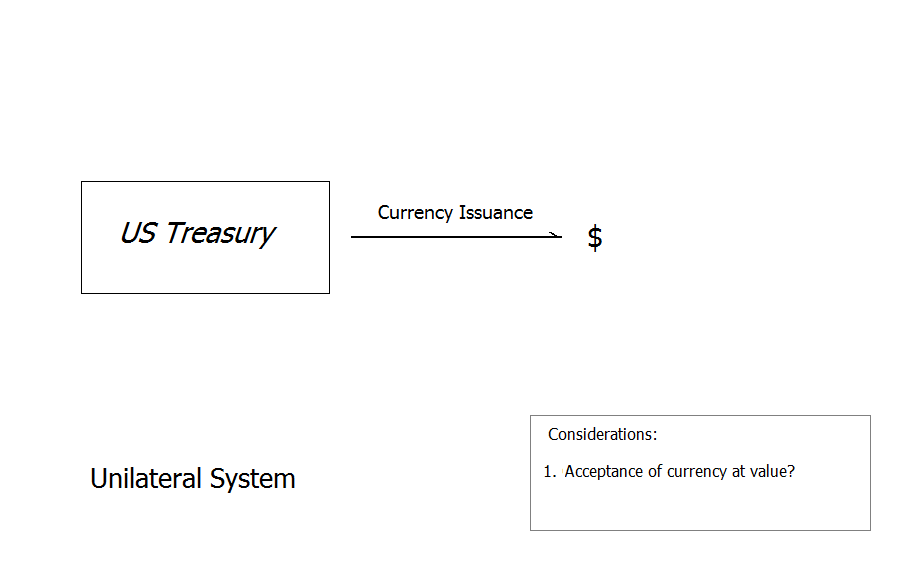
Here are two very simple models of currency supply 'management.' The 'considerations' could be thought of as degrees of freedom.

I could have added a significant amount of detail to both pictures, but I wanted to capture the 'essence' of the system in each.  

In the Tripartite Market System the level of debt issuance and its price takes the agreement of at least three parties:  the Treasury, the Fed, and the Debt Market as represented by the Primary Dealer.  In this system it is the level of debt issuance that is managed, and the prices paid for it.

In the Unilateral System the Treasury determines the level of dollar issuance according to its needs.

I *think* one can contrive a non-debt based system that involves more than one party, and does not necessarily require a non-governmental party to be directly involved.

Technically the existing arrangement between the Congress and the President is a two party system.  The Congress authorizes expenditures and the President ratifies, enacts, and adminsters them. 

The 'debt ceiling' arrangement in which Congress refuses to 'pay' by deferring to finance its own previously authorized expenditures is a bit of an anomaly and a symptom of dysfunction.