skip to main |
skip to sidebar
I thought this was a fairly nice thumbnail sketch of the problem facing the world's central banks vis à vis the US dollar as reserve currency and globalization. I have to add that this current impasse was not unforeseen.
I suggest you take a look at a very brief description of Triffin's Dilemma.
The Triffin dilemma is a theory that when a national currency also serves as an international reserve currency, there could be conflicts of interest between short-term domestic and long-term international economic objectives. This dilemma was first identified by Belgian-American economist Robert Triffin in the 1960s, who pointed out that the country whose currency foreign nations wish to hold (i.e. the global reserve currency) must be willing to supply the world with an extra supply of its currency to fulfil world demand for this 'reserve' currency (foreign exchange reserves) and thus cause a trade deficit.
The use of a national currency as global reserve currency leads to a tension between national monetary policy and global monetary policy. This is reflected in fundamental imbalances in the balance of payments, specifically the current account: some goals require an overall flow of dollars out of the United States, while others require an overall flow of dollars in to the United States. Currency inflows and outflows of equal magnitudes cannot both happen at once.
The Triffin dilemma is usually used to articulate the problems with the US dollar's role as the reserve currency under the Bretton Woods system, or more generally of using any national currency as an international reserve currency.
The problems with any domestic currency operating as the world's reserve currency are well known, and yet the United States decided to pursue this after Nixon closed the gold window. Perhaps that is because the risks to the many were outweighed by the benefits to a few.
I enjoyed the author's flat out statement that "it is undeniable that the world's central banks collectively have flooded world financial markets with liquidity by printing money."
If someone tells you that central banks, in a fiat regime, cannot create money out of nothing, then they simply do not know what they are talking about, no matter how many rhetorical flourishes and convoluted rationales they may produce. They can do it, they are doing it, and they will keep doing it until they reach what they consider to be a sustainable equilibrium, or they exhaust their ability to print based on the limits I have previously described.
The problem is that none of the equilibria they have produced in the last twenty years have been sustainable, except for a few years, and the half life of the monetary bubbles appears to be contracting.
The US dollar is at the end of its rope as the reserve currency for the world. Nothing could be more clear. What will be done about this is another matter. The Anglo-American banking cartel will enter the next phase of the evolution of money resisting change every step of the way. What they most desire is to maintain and extend their control of a worldwide fiat currency, not even in the interests of their own people, but for the benefit of a few.
Institutional Risk Analyst
What's a Central Bank to Do?
By Bob Eisenbeis, Cumberland Advisors
April 25, 2011
Faced with largely the same set of facts when it comes to their inflation outlook, some of the world's major central banks have come to markedly different conclusions about the appropriate policy.
The ECB began to exit from its accommodative policy by increasing its policy rate by 25 basis points to 1.25% on April 7. The ECB noted that growth was improving moderately, but inflation had increased to 2.6% and was up from 2.45% the previous month. The rise was largely due to increases in energy, food, and commodity prices. The concern was the potential second round effects and that these increases could become embedded in inflation expectations.
The same day, the Bank of England kept its policy rate at 0.5%, despite the fact that inflation had been running well above its target rate of 2% for more than a year and was likely to remain so through 2011. Again, the Committee noted that the near term path for inflation was higher due to energy, imported commodities and other goods. Concern was also expressed about inflation expectations having risen in the UK, the US and the euro area relative to what they had been before the financial crisis. Finally the UK real economy was softer than that of the EU generally with output having declined by 0.5% in the fourth quarter of 2010.
While the FOMC will meet this week, Fed Chairman Ben Bernanke and Vice-Chair Janet Yellen have already signaled that they view the recent increases in commodity, energy and food prices as transitory. Governor Yellen in particular provided an extremely thorough and detailed dissection of the inflation data and her views on the real economy and employment in her April 11th speech in New York. She indicated clearly that the causes of the run-up in food, energy and commodity prices were rooted in increases in global demand, combined with energy supply shocks and uncertainty about oil flow from the Middle East. Like the Chairman, she expressed the view that the increases were transitory.
Most notably she attempted to debunk the widely discussed view that accommodative policies in the US were the cause of the increase in global prices. She was very clear that the main concern was for the US expansion and employment situation, that the current stance of policy was appropriate, and that QE II would be completed as scheduled. So we don't expect any notable news coming from this week's FOMC meeting.
These three views on the appropriate stance of policy and how individual-country central banks may think about policy shows a growing disconnect between traditional approaches to monetary policy and globalization. For example, the US economy historically has been largely isolated from the rest of the world. International markets were not particularly significant (exports and imports were roughly balanced and accounted for less than 13% of GDP). Inflation was largely a domestic issue and could be directly affected by changes in US policy rates. From the 50s through 70s, the main channel for monetary policy was through housing: when interest rates exceeded the Reg Q ceilings that banks and thrifts could pay for funds, the supply of funding to housing was cut off. Then construction declined and the effects rippled through the rest of the economy. Most of the economic models have that structure and international isolation embedded within them. Yet this is not the world that policy makers are now dealing with, as the above descriptions of the causes of the current inflation aptly illustrate.
If the major causes of inflation are external to an economy, and policy makers have domestic tools and targets for inflation and local employment, either explicitly or implicitly, then how should they respond to externally generated causes of inflation? What is the link between the central bank's domestic policy interest rate tool and the external causes of price increases? These key questions are not currently addressed within contemporary policy frameworks employed by the FOMC, the ECB, or the Bank of England, as best one can determine.
In the current inflation environment, one can justify any one of three alternatives, and some of these are clearly being adopted. Furthermore, all can be mostly right or mostly wrong.
First, a policy maker could attempt, as the US did during the 1970s oil crisis, to insulate the real domestic economy from the contraction supply shock by keeping rates low. This policy seemed appropriate and was politically acceptable, especially since the price increases were viewed as temporary. But it clearly failed, and we paid the cost with higher inflation.
Second, if one believes that the energy, food and commodities price increases are transitory, then no response is called for; and this can justify focusing on domestic employment, as is currently being done in both the US and UK. Even if the increases are permanent, doing nothing may be the appropriate policy. Permanent increases in energy, commodity, and food prices will shift these prices relative to other goods and services and generate substitution and accommodative responses by business and consumers. We may, for example, drive less and adopt more hybrid transportation alternatives -- moves that are already beginning to take place -- than we would if the energy price increases were viewed as being temporary.
But doing nothing also has its own risks. Maintaining an accommodative policy too long risk overheating an economy and fueling both an increase in domestically-produced goods and services prices and passing along the increased prices of external goods and energy prices as second round effects. As always, timing is everything when it comes to exiting from an accommodative policy.
Third, a central bank can move to increase its policy rate to choke off inflation, as the ECB has begun to do. But this policy has certain risks associated with it. If the causes of the inflation are external to the economy, then one would not expect those prices to be responsive to a policy move by a domestic central bank. But the increase in rates will clearly impact those domestic and non-international activities that are affected by rising interest rates. Economic activity in those areas will contract, including production, employment, and prices. So the impact of responding to an external inflation source is to force a decline in an aggregate price index by contracting domestic economic activity. This seems a risky path indeed. Right now it may appear less so because policy, as ECB President Trichet stated, is still viewed as being extremely accommodative.
So what is a central bank to do, especially when policy is overly accommodative? While Vice-Chair Yellen may argue that the increase in world prices is not our fault, it is undeniable that the world's central banks collectively have flooded world financial markets with liquidity by printing money.
This situation is likely to become even worse in the near term if Japan resorts to inflation as a means to finance the cleanup and rebuilding necessitated by the recent earthquake, tsunami, and nuclear disasters. When domestic economies are no longer insulated from international markets and forces, individual central banks can no longer go-it-alone with their policy decisions. In such a world, perhaps the best policy is to remove the distortions cause by current policies, and then attempt to avoid extremes. Unfortunately, how to get from here to there in a non-disruptive way is not at all obvious, as the ECB may soon find out..
What this means for investors is that market uncertainty is likely to remain high for some time to come, and attempting to play in international markets carries with it huge foreign-exchange and real risks that need to be hedged.
Although I may say uncomplimentary things occasionally about Messrs. Bernanke and Greenspan and their colleagues on Wall Street and in government, I most definitely do not think they are fools, or naive, or uncomprehending of what they are doing. Therefore I find their actions difficult to square with a sincere fulfillment of their stated objectives, and the oaths of their offices, unless there is another dimension to their plans which has not been disclosed, and which I do not yet understand.
"And some of us who have already begun to break the silence of the night have found that the calling to speak is often a vocation of agony, but we must speak. We must speak with all the humility that is appropriate to our limited vision, but we must speak...Perhaps a new spirit is rising among us. If it is, let us trace its movements and pray that our own inner being may be sensitive to its guidance, for we are deeply in need of a new way beyond the darkness that seems so close around us."
Martin Luther King
The very obvious bear raid does not surprise me so much as the worthlessness of most commentary I have seen about it.
Silver has support down to about 42, maybe even 41, and still maintain its long term trend. I don't think it will go that far unless stocks sell off hard, or the JPMorganites pull out the stops. More likely is a snap back rally after the short term market rigging is done.
Who exactly would trade options on the Comex these days anyway? They are the distillation of all that is wrong in the futures markets.
Gold held like a champ today in the 1500-1520 range. I'll be curious to see if it can continue to hold 1500. If it does I consider that extremely bullish, setting up a move to 1590 unless there is a liquidity panic.
The FOMC is meeting and will announce their decision tomorrow. If they signal an end to QE it will likely be a red herring, but an excuse for more trading shenanigans.
The dollar continued to slump. It has not yet broken down in its steady decline, so I do not see the waterfall drop that so many have been predicting. It is possible but not probable unless something happens.
This metals action was market manipulation pure and simple, and a black mark on the regulators. See the intraday commentary here, especially the video from James Cramer about how trading desks manipulate markets.
On the other hand we have a flash of insight from Avery Goodman here, who suggests that silver (and gold) are rising because the suppression racket is falling apart.
The major export of the States these days is financial paper assets. And here are their production charts on the equity side.
I thought it was remarkable that stocks and bonds both rallied today, while the dollar continued to slump.
The FOMC is meeting, and will make their announcement tomorrow. Benny will be throwing a bone to the protesters, in the manner of Mubarak or Gadaffi, and holding a press conference in the spirit of transparency.
I wonder if he has the the nerve to fake an end to QE while continuing to blow an asset bubble in stocks and bonds? Well, not so much the nerve, as perhaps the luck.
I had reminded you repeatedly for the past few weeks that today would be an option expiration on the Comex.
While it is hard to know specifically beforehand which way it would go, I urged caution, and gave the example of going flat myself in my own trading account. I will never tell anyone what to do, as I am no advisor, and each person's situation is unique.
But the direction for most option expirations is down, and the momentum traders are playing it. If enough of them jump in short ahead of time, it could go up because manipulation has no friends, but normally it is a period of retracement.
That big run up on Sunday night seemed odd, like a setup. It is easier to run something up on thin volumes, and then smack it down hard, gaining momentum as it were as fellows lift their trailing stops. This is a very calucated bear raid. As I recall, Andrew Maguire purported to give the CFTC the details on how certain actors in the market were coordinating their moves. But this is nothing new, is it?
Jim Cramer on how hedge funds manipulate the market.
Some of the panicked messages and talk of a crash in the metals is a bit ironic. Did you expect silver to go up endlessly without a pullback? Some of the pieces coming out seem like shameless propaganda, but one must never ascribe to bad intentions what can be attributed to stupidity. But still the funds have many allies in the media, and one needs to take note of them and remember.
I have to admit the miners have been getting hit rather hard, but this is just another characteristic of the way in which the trading desks and hedge funds have a relatively free hand in the US to manipulate the market for their own benefit, naked shorting, whatever they wish to do with no uptick rule. If you wish to reform the markets, look to the regulators and their backgrounds, and the actions they have taken with investigations. If Obama replaced Gary Gensler with Eliot Spitzer then we might see something done, but the banks would not like that, and Obama is in the process of collecting a billion dollars in campaign funds.
I have come back into the market buying selectively and with hedges. They were throwing away some decent holdings in the first half hour for example. That is a bit hard to resist, and so I didn't. Could it go lower? Yes, it could. If enough calls are converted to futures positions then we might as well expect another hit on the metals to test those new hands tomorrow and later this week.
The Fed is also meeting, which is another negative to the metals. As even Paul Volcker is reported to have said, "Gold is the enemy." Yes it is, and the statists and financial engineers and one-worlders hate it. It restrains their will to power, because they cannot create anything real, substantial, only lies and illusions.
And the dollar continues to decline, following its trend lower.
"Therefore have I have set my face like flint..." Is 50:7
Gold and especially silver did moonshots in the overnight Asian trade, but ran into very determined and targeted selling on the New York open. London was closed today.
Tomorrow is the actual option expiration. The trade play between the bulls and bears seems to be in the 1500 to 1520 range.
Let's see what happens.
Thin volumes, drift higher.
Stocks must break up and out of these formations or face a tumble.
"God beholds you individually, whoever you are. He calls you by your name. He sees you and understands you, as He made you. He knows what is in you, all your own peculiar feelings and thoughts, your dispositions and likings, your strength, your weakness.
He views you in your day of rejoicing, and your day of sorrow. He sympathises in your hopes and your temptations. He interests Himself in all your anxieties and remembrances, all the rising and failings of your spirit. He has numbered the very hairs of your head and the height of your stature.
He compasses you round and bears you in His arms; He takes you up and sets you down. He notes your very countenance, whether smiling or in tears, whether healthful or sickly. He looks tenderly upon your hands and your feet; He hears your voice, the beating of your heart, and your very breathing.
You do not love yourself better than He loves you. You cannot shrink from pain more than He dislikes your bearing it; and if He puts it on you, it is as you would put it on yourself, if you would be wise, for a greater good afterwards....
God has created you to do Him some definite service; He has committed some work to you which He has not committed to another. You have your mission -- you may never know it in this life but you shall be told it in the next.
You are a link in a chain, a bond of connection between persons. He has not created you for naught. You shall do good, you shall do His work. You shall be an angel of peace, a preacher of truth in your own place while not intending it if you do but keep His commandments.
Therefore I will trust Him. Whatever I am, I can never be thrown away. If I am in sickness, my sickness may serve Him; in perplexity, my perplexity may serve Him. If I am in sorrow, my sorrow may serve Him. He does nothing in vain. He knows what He is about. He may take away my friends. He may throw me among strangers. He may make me feel desolate, make my spirits sink, hide my future from me -- still He knows what He is about."
John Henry Newman, The Heart of Newman
The DX Index I normally show is the continuous futures contract on the DX index. The front month is now June.
The Fed also publishes two other dollar indices: major currency index, and the broad currency index. The major currency index is essentially the basis for the Wall Street DX futures index.
I have included charts of both of these Fed dollar indices below.
“If those in charge of our society - politicians, corporate executives, and owners of press and television - can dominate our ideas, they will be secure in their power. They will not need soldiers patrolling the streets. We will control ourselves.”
Howard Zinn
Wow.
Silver is amazing. Its upward moves are iconic, a short squeeze that doesn't know when to quit. And the equity markets are no slouches either. Is that you blowing a bubble again Benny?
The miners are lagging and at some point soon they should catch up, especially the juniors. I think a lot of people do not believe the metals move is for real and so are playing paired trades and some assets become individually mispriced.
I feel like we are in the Jurassic Park movie, seeing the water glasses on the dashboard shaking, with the heavy footfalls of T-Rex and the sounds of its breathing moving around us in the night. We just do not know which direction it is coming from, and where it is going.
I took some paired positions into the weekend, I just could not resist. I have a weak spot for long holiday weekends in which Asia is open and the west is closed. Let's see if any of the China rumours with regard to the reminbi are valid.
Have a happy holiday weekend everyone, and see you at the late show Sunday night.
Metal's breaking out. Timmy's at the wheel, with Jamie and Blythe in the back seat. Ben is the goat.
There are some potentially monster bull formations on the index charts, with inverse head and shoulders abounding, targeting SP 1450 if we get the breakout and confirmation for example.
So, get long the market? My inner bear is growling. I can't really get long with conviction, so I'm back to playing pair trades and playing it on the edges until I get a better feel for which way things are going to break.
The real economy seems sluggish, but the presses are rolling. So we could see things break out nominally, or we at least have to allow for it.
Have a happy holiday weekend. See you Sunday night.
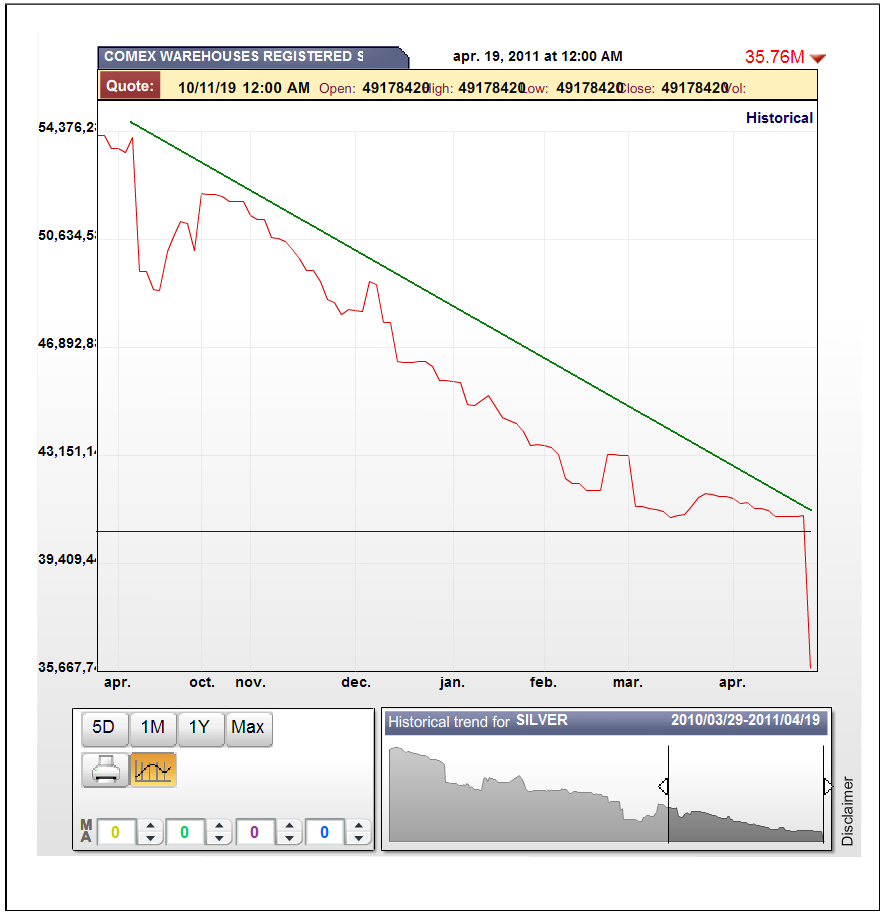
I am not talking about the specifics, about which individual holder of bullion changed the status of a very large portion of the remaining registered silver inventory at the Comex, and what their particular motivation might have been. I imagine that the details of that transaction and its short term intent will become known at some point. I am not even sure yet whether it is bullish or bearish. It could be part of a short term trading gambit tied in with the coming option expiration.
I wanted to step back and get the significance of this in the 'big picture.' So I looked at the interactive Comex silver inventory chart over at 24hourgold to see what the big withdrawal from the registered ounces looked like in context. The chart goes back to middle 2008.
Several things stand out for me. First, there are definitely big declines in the past, certainly on the order of the most recent decline this week.
There is one significant difference. Two of the biggest declines occurred at year end, and are indicated on this chart as circles.
There are another two large declines in inventory comparable to this week in April time frames, marked on the chart by rectangles.
So its just a normal thing, right?
Not really. The prior two declines in April occurred after significant builds in inventory from the first of the year. This year that simply did not happen. There was no bounce.
For me the most significant aspect of the chart is the steady decline in inventory over the past three years, stepwise at times, but getting dangerously low compared to the open interest in the futures market which that inventory supports which continues to increase. That is known in the trade as 'leverage.'
I am sure that the exchange principals will pass along rumours about a short squeeze and an attempted market corner, and try to paint this as some insidious anomaly. Yes there are speculators becoming involved, those who see what is happening. As the British government attempted to hold the pound to an artificial value, and was hammered down by traders, famously George Soros but primarily the faceless acting through the Swiss, so too the metals manipulation by the Anglo-American banking cartel is staggered, and is probably going to go down hard, capitulate with a revaluation and partial disclosure, and move on from there. I think the episode of cheap gold and silver is over, until a new cycle of money begins.
I prefer to view it as the natural outcome of a long term manipulated market, in which artificial shortages have been introduced by protracted interference. If you artificially depress the price of most things for a long enough period, in a market based system you will introduce underinvestment and systemic shortfalls that will only be corrected by either higher prices and investment in production, sometimes with long lead times, and/or with 'rationing' either overtly, or through public relations campaigns that seek to discourage demand from a group of the people while other segments take the remaining supply.
They keep warning about bubbles, and silver 'correcting.' Well, the establishment pundits have no credibility on noticing bubbles, that is for certain. Their hypocrisy knows no bounds.
And what this trend seems to be implying is that silver is already correcting, higher, back to its real long term trend after decades of under performance due to artificial constructions and leverage.
The Comex is headed for a default unless they can secure a large new supply of silver and increase their inventories. Or allow the price to climb higher until the market finally clears and existing supply re-enters the market. Where will that be? From the looks of things, higher, probably where the trend price with inflation would have been, barring sufficient new investment in production. When flagrantly betrayed, the market can be a harsh mistress.
And the same thing is happening, in relative slow motion, in the gold market which was the real point of this all along. But the difference is that in the gold market the bullion banks have been able to turn to the central banks for protection and supply over many years, drawing down their sovereign inventories and masking it at times with accounting tricks. That is, until that trend changed a few years ago, and the central banks became net buyers after twenty five years of selling, motivated primarily by the BRICs and the much abused and crumbling dollar reserve currency arrangement.
I wonder if the bankers can find a willing seller, a new source of silver. And at what price. And with what will they offer payment, what depreciating paper promise?
Someone asked me again today, have you ever seen a market go up like this without a correction? Well, of course not. Nothing ever goes straight up. They are asking the question to get the answer they want, ie. consolation for an existing opinion. The real questions to ask are WHY something is going higher, and to think about how much it might correct, and what it will do after that. Saying something will go down after it goes up is not an investment strategy, it is a sucker play. People go broke following these faux contrarian plays.
Yes, I am cautious on silver in the short term, and yesterday I did take all my trading positions off the table, without touching long term positions. Let that action speak for itself, within the context of my goals and needs. And I am especially cautious now in most US markets because of lax regulation. But I liked and respected the perspective Jim Rogers had to offer. And yet he will be the first to tell you he does not know the future, and neither do I. But I think it is going to take a liquidity panic sell off in broad assets to break the silver bull. I hope it does not go parabolic and at least consolidates here somewhere, to set up a more orderly appreciation such as is happening in gold.
But I am not assuming that these are normal market conditions. I think that the financial engineers and their bankers are becoming very concerned, and even afraid, for good reasons. What has been hidden will be revealed, what has been whispered will be shouted from the rooftops. They will spin stories to hide it, and probably engage in scapegoating, blaming Islam or China or high profile speculators like Soros, or some other group for what is in reality the direct result of their perfidy.
As we have seen in the past three years, the markets have been made a sham, riddled with fraud, puffed up but lacking substance. And in each case there is a violent correction that exposes the graft and corruption. And this is ongoing, because as William K. Black recently said, they have 'left the felons in charge of the system for the sake of stability.'
But at the end of the day, the result remains the same, no matter how they try to shift the blame and the pain.
As the Americans like to say, 'the jig is up.'
"They have sown the wind, and will reap the whirlwind. Their stalks of grain wither and produce nothing to eat. And even if there is any grain left, foreigners will consume it." Hosea 8:7
I try not to react to a single month's number, and instead keep an eye on the trend.
Still, the Philly Fed came in at 18.5 versus a consensus expectation 33, and that is enough of a miss to make me spill my coffee.
The taxes on the real economy from the unreformed financial sector and the gasoline spike are taking their toll. There were also supply chain disruptions associated with the Japan earthquake that may have played a part. The price paid section of the report showed rising prices.
The data are looking and quacking like stagflation to me. And I think stagflation is the result of an exogenous shock or egregious policy error. I'll take that second door, Alex, for a lower 90 percent of the public strangled by corrupt fiscal and monetary policy, and unfortunately, their own gullibility.
Let's see how the trends continue to develop.
Let's refresh our understanding of the difference between registered and eligible status at the Comex.
"Comex has two categories of silver in its warehouse.
The eligible category means that the silver is in a condition that conforms to the standards of delivery. Size and quality of the bar in other words. It is being stored at the Comex warehouse, but is not offered for delivery into contracts.
Registered means that the silver is available for delivery to those who demand bullion by being registered as such with a bullion dealer, in addition to being in a fit condition to satisfy the contract.
Eligible silver can become registered and deliverable if the owner of the silver declares it saleable at some price. And of course if it is there, and otherwise unemcumbered by senior obligations or conspicuous absence."
Registered Ounces Available for Delivery at the Comex
The eligible silver stocks and that of the daily metal warehouse statistics are limited to silver bars that meet the Exchange's criteria for delivery. This criteria specifies that a silver bar must weigh 1,000 troy ounces, plus or minus 10% and be on the Exchange's Official List of Approved Refiners and Brands for silver.
In order for eligible metal to become registered metal, the owner of the metal must have an Exchange Licensed Depository (like Scotia Mocatta) issue a Depository Receipt (Warrant) on those silver bars meeting Exchange standards comprising 5,000 troy ounces (plus or minus 6%) stored at its facility.
It is not a particularly difficult operation to change bars from eligible to registered status, and vice versa. It is a matter of the actual owner's intent. It is a little more difficult to have a new bar introduced to the warehouse and certified as eligible, meeting the criteria of the exchange as stated above.
Some traders use the term dealer to mean deliverable, and customer to signify eligible.
There may be other types of bullion in non-standard forms, such as coins or odd or smaller bars, stored for a fee at Comex, but these are not of interest to us here.
Here is Harvey Organ's take on the silver inventory at the Comex this evening.
"We have just received tonight's inventory changes and it is a dandy. First of all, there were no deposits of silver into the dealer and no deposits into the customer.
There was a rather large withdrawal of silver from one customer of 119,400 oz ( from Scotia). We had another 999 oz from the Delaware vault. Thus total withdrawal: 120,399 oz.
Now the fun begins: We had a massive 5,287,142 oz adjustment whereby the dealer repaid a customer for a prior commitment or a seller had cold feet and decided not to sell his silver and it returned to eligible silver (not for sale) or this is a settlement whereby silver is finally delivered to a patiently waiting long. Ladies and gentlemen..something is up!! The adjustment was in the Scotia vault. Let us see if this silver leaves the Scotia vault."
Turmoil in Silver and Gold at the Comex - Harvey Organ
I suspect the silver has been taken off the market for delivery into some obligation, for example, delivery to an outstanding purchase from a fund like the Central Fund of Canada, Sprott, or some other large customer, perhaps even a sovereign entity (hint here be rumours). But perhaps it is just a customer who has changed their mind about the prospects for silver.
This is what happened. It could be quite bullish depending on what happens to it, as Harvey indicated.
Here is Adrian Douglas' Marketforce Analysis summary of changes to the Comex Inventories.
SILVER
ZERO ozs withdrawn from the dealer’s (registered) inventory
120,399 ozs withdrawn from the customer (eligible) inventory
Total dealer inventory 35.76 Mozs
Total customer inventory 67.24 Mozs
Combined Total 103.00 Mozs
GOLD
139,996 ozs withdrawn from the dealers (registered) category
70,796 ozs deposited in the customer (eligible) category
Total dealer inventory 2.11 Mozs
Total customer inventory 8.90 Mozs
Combined Total 11.01 Mozs
Adrian's analysis appears each day after the market close in Bill Murphy's metals discussion at LeMetropole Cafe. This is where I first learned about the lesser known aspects of the metals markets in 2001 before gold and silver started to rally, and it remains a must read for me every day.
Remember we are entering a period of May option expiration at Comex, on Tuesday April 26th.
As I mentioned earlier today, something is obviously up. I am trying to get to some level of understanding of it, and am wading through rumours, innuendo, and speculation. But there is something happening behind the scenes, I am now sure of it. And it might be big, because the usual trading desk chatterers don't seem to know what it is. Or aren't talking.
But I am wondering, are the BRICs going to make their move? Or is it something else.
“Rise and rise again, until lambs become lions.”
The move in silver is remarkable, not only in its magnitude, but in the relatively small notice of it being taken outside of trading circles.
We understood the big move in silver back in the day, as a result of the Hunt brothers attempt to corner the market. But what exactly is driving it now? Where is this buying coming from, and what does it mean?
I think there is a an untold story here, and I will be spending a little more time trying to get my mind around it, sifting through the rumours and other stories, to try and get to the bottom of it.
Yeah yeah silver is overextended. There will likely be a correction at some point. And every nitwit in the peanut gallery is going to say "I told you so" even though they told us so when silver was $20.
I have to admit I am absolutely in awe of this move. I would have never expected it to go this far, this fast. I would really like it to take a break, or for some news to come out to explain what is driving this. Silver is even leaving AAPL behind in the dust. It seems to be inversely correlated to Obama's popularity, and the Congress' integrity. Hm, maybe something to that.
I am holding all long term positions and am flat on the short term for the holiday weekend. I could be persuaded to take a position or two for the weekend but only if I see something worthwhile.
Risk? We don't see no stinkin' risk. The dollar was taken to the woodshed.
Corporate profits are just peachy. Let me take most of my profits tax free, keep two sets of books, and I'll show you a good time too.
AAPL crushed its numbers after the bell.
In short, the answer is yes. That seems to be the case to some degree.
The reasons for this are roughly as follow.
From past analysis, the mining sector seems to be roughly correlated 50 percent to the underlying metal, and 50 percent to the SP 500. Obviously this varies over time because of related factors, lags and correlations, but it is not a bad rule of thumb.
Right now the SP 500 is underperforming the metals. I am showing the SP 500 compared to gold, because silver is in such a powerful short squeeze that almost everything is underperforming it.
In addition, the correlation of the miners to the SP 500 has been a little more variable of late because of the 'risk on, risk off' sector rotations. The miners seem to be affected greatly by this.
I have noticed in the past that the miners, particularly the juniors, tend to get their biggest moves near the end of tops in legs of the metals moves, playing a sort of 'catch up.' I have not done any rigorous analysis on that lately.
But it is important to note that the reason why the metals are moving is a significant factor on the miners. If it is a risk off flight to safety, chances seem to be good that the miners will underperform. If it is more of an inflation trade, the miners may catch up in relative valuations and their leverage seems to work in one's favor.
To make things even a little more complicated, various pair trades and arbitrages come in and out of fashion amongst the speculating crowd in the hedge funds, who swing a big stick on short term pricing these days. Long metals and short miners is a trade that temporarily distorts for example.
Someone just sent me this piece by my friend Dan Norcini and I think he makes some great points on the arb trades to which I allude above.
Again I have to caution that I have not done the kind of recent rigorous analysis on this that I have done in the past, because for my own purposes it is 'working' for me. Perhaps I shall have another look at it.
As a special note, I want to thank all the kind people who bring things to my attention by email. I cannot look at everything, and even if I may have seen it, I am always grateful, just a little less so perhaps if I have an active link to it on my site. lol.
I am busy making preparations for some special meals on the holiday and it has me on the run. Prime Rib, ham, turkey, fresh and smoked sausages, and all the sides, and even the children have been helping, learning along with the adults, with some special treats and cakes.
Try to remember the poor in these times, because many families are enduring their private hells and hardships, despite all the griping by those who imagine that the poor are lazy people living in luxury. I don't see many of them volunteering for that. If it were true, Goldman Sachs would be living in homeless shelters. People say, why doesn't God do something about this, why doesn't he help the poor and straighten these things out. Well, He did do something. He sent you.
Spring is in the air, and life is resilient. We are not in thrall to any morose doctrine, nor bound by hopeless despair. Let's remember that one of the early names for the Christians were 'the Easter people,' and hallelujah and our Father was their song. And this is our legacy, our life. Not the dried bones of those who are already dead, scuttling around in darkness, grasping for things and the lives of others, desperately trying to fill their emptiness. These are no great souls but the husks of men, destined to the trash, nameless, the leavings of Gehenna.
The tomb is empty and death is overthrown, and there is nothing for us there.
As a reminder, the Comex will have their gold and silver option expiration on Tuesday, April 26.
Due to a lax regulation of the markets by the CFTC, there are sometimes major price manipulation shenanigans associated with these events, and these sometimes during thinly traded periods of time.
Someone sent me this article. It makes a point about the calendar holidays which I had not noticed. Here is their follow up aricle.
Since much of the physical buying comes out of Asia, and most of the price manipulation seems to originate in London and New York, this could be interesting. Although the setup is there for a thin trade, it takes a look at the composition of the markets, and the actual details of the options and contracts held in balance to other things, in order to make any judgements.
I do know that quite a few specs are jiggy with their recent gains in silver. This makes a retracement possible if someone 'gets the ball rolling' as they say. On the other hand, I have seen fellows use option expiration to breakout metals and other instruments and beat the shorts mercilessly. It is hard to trade this sort of event reliably if one is not an insider.
I stopped trading on the Comex a few years ago, before I scaled back my general trading, out of sense of discouragement in the integrity of their markets. But it is hard to get away from it, since their trades feed into and affect so many other instruments like ETFs, etc. When one take a position in a short ETF like ZSL, for example, one is trading with the Comex by proxy I would imagine.
While I do not believe in 'hanging bankers' at all, I think some serious investigations, indictments, and prison terms for the guilty white collar criminals would do a great deal to stimulate the real economy by reining in the excessive fee-based taxes from the financial sector, and refreshing the price discovery and efficiency of the markets.
But the Obama Administration is reform adverse, especially while collecting its famous billion dollar campaign slush fund. You don't get that kind of money from the "Yes We Can" crowd. And most Republicans are unashamedly servants of the pigmen.
Here is a nice, concise analysis of the Obama Administration's policy from an interview with William K. Black:
Ryssdal: What about the argument, though, that the financial system is so fragile still, and these cases so complicated, that we can’t really tear things apart with substantive investigations and prosecutions because it will all fall apart again?
Black: Yeah, that’s an excellent point. We should leave felons in charge of our largest financial institutions as a means of achieving financial stability.
Ryssdal: See, that’s funny because I was expecting you to come back with — I don’t know, JPMorgan earned $5 billion last quarter. How shaky can they be?
I am now flat in my trading account, and am not sure about putting on trades for the holiday weekend.
I had quite a few questions on this topic of when to sell silver this evening, based on a comment I made with the normal gold and silver charts. I indicated we could see a pullback and consolidation, and it might be 'impressive.' I was thinking of support around 40, maybe 38.
Unless there is a liquidation panic as we saw in 2008 then I do not believe it will be much more profound than that.
Someone brought this interview on this very topic to my attention, and I include it here for your knowledge.
I have a lot of respect for Jimmy Rogers. He is an intelligent man and a real gentleman. I think there is wisdom and experience in what he says.
I own gold and silver in various forms, but have no plans to sell any bullion for the foreseeable future. I may hedge a little for short term trading corrections, but not actually sell it until the fundamentals change, because there is too much 'friction' is buying and selling bullion.
And even with non-bullion holdings, there is the bigger problem that once you have sold and lost your position in a bull market, it is often very hard psychologically to buy back in. It is natural to wish your decision to sell to have been 'right,' and sometimes so badly that your emotions will tend to distort your perception of the market, causing you to make mistakes.
Too often we see people who have sold their positions early making all sorts of foolish comments and dire predictions, trying to get other people to join them and sell, because misery loves company. I will listen to anyone's reasoned opinion, but too often these fellows just talk nonsense and are nothing more than a distraction.
There might be quite a bit more upside in silver, and that $100 is a respectable longer term target if the dollar does not 'turn into confetti' as Jimmy Rogers says.
Gold and silver are heavily tied to the fate of the dollar in some ways, and I do not yet see a clear path for the US to reform its financial house yet. The dollar denominated debt is the last of the great credit bubbles, and that means the bonds and the currency itself.
And yet the dollar is not the be all and the end all, and this is the sea change that so many are missing. Even without inflation the price of gold and silver would likely increase because of the growing demand in the developing world, which demands its own stores of value.
No, the US will not default per se. But they can sure engineer a de facto default through monetary inflation, which is what they are doing now. And they will never admit it, and take all sorts of pains to disguise it, because that is the whole point of it, to gracefully extinguish the debt without a formal devaluation or crashing the system.
I also think that gold and silver are making up for lost time, for the twenty year bear market during which their price was beaten down, held artificially low through central bank shenanigans.
Most institutions and individual investor are underweight precious metals, at a time when they are probably needed the most as insurance against currency and financial default risks.
I began trading stocks, bonds, and options in the stagflation of the latter 1970's in the aftermath of the great bear market, and vividly remember what it was like, and how people viewed inflation hedges like gold and silver, collectibles, coins, income averaging your tax returns for inflation effects. And this is not it, not even close yet.
When the inflation concerns catch some wind in their sails, there is nothing like it. The bulk of the people and unsophisticated investors are convinced that deflation is either here or imminent. So Bernanke has smooth sailing for some time yet.
Here is what Jimmy Rogers has to say.
- Eventually everybody's going to own gold, and then we'll have to sell our gold, but that's a long way from now.
- If triple digit silver happens this year then we'll have a parabolic move and we'll have to sell, and all parabolic moves end badly. I hope it doesn't happen, because I own silver and want to buy more.
- My hope for silver and gold and all commodities will go up for ten years in an orderly manner.
I sold the rest of my index short positions on the Goldman disappointment this morning, and flattened out the metals longs into the close.
Silver is a dreadnought and I would find it hard to bet against it even at this lofty level. Gold is running into stiff resistance here in the 1500 to 1510 level. It tagged the short term measuring objective on our chart today. Whether it will higher and break through before consolidating its gains I cannot say.
A word about objectives on the chart.
Someone wrote in taking me to task a bit for 'limiting my gold target to 1500' whereas some other fellow put it at 1520 based on a little inverse H&S and why don't I show that, the implication being that I was being stingy.
First of all, the objective on the chart is pretty clear, a range from 1500 to 1510. I drew both lines as a range, and labeled the lowest one as the 'minimum. It obviously depends on how you measure the head to the neckline. I was not sure so I showed the range as a 'slop' factor.
An objective from a classic chart formation is a MINIMUM measuring objective, not a limitation. This is basic charting. The minimum has been met. That does not mean I am saying that's it, pack it up, we're done.
Second, I even drew the line down from the neckline and to the head on the little inverse H&S that forms the right shoulder of the big inverse H&S that measures up to 1590. And then I drew the same line up from the neckline to 1510. So I show the work. The measure from the head to the neckline is roughly the objective for a clean breakout from the neckline. That is how these things work. I did not put H, R and L labels on it because then the chart gets too busy. And the biggest factor for me are the trendlines.
I added something that looks like a trendline on silver. Its going straight up here which makes even me edgy, but that's what is happening, a massive short squeeze. There is a lot of pain on that chart. Try not to add to it.
At some point silver will retrace and it could be fairly impressive. But rather than waste your money chasing it for bragging rights, and shorting ahead of the breakdown, why not just buy a lottery ticket and limit your risks on that kind of strategy?
I will most likely not sell any bullion, and at most hedge it in the event of a decline that breaks a key trendline by either shorting something or buying an inverse ETF.. But that is what seems to be appropriate for me. There is too much 'friction' in selling bullion to do it frequently. The problem with selling bullion is that it is very hard to make oneself buy back in.
Some guys make a career out of taking calls after big moves, saying down if it was up, and up if it was down. Some of them word their forecasts such that they take both sides. It's not that they make any money doing this, but odds are decent they will be right half the time, and most people will forget the times they were wrong, and they certainly won't remind you.
Most of the time it's an ego thing. Trying to recapture a golden moment when they were lucky and got it right. That's a tough addiction because you don't even see it; self-delusion is a powerful drug. But they talk down to everyone else, those other dumb sheeple, because that's how they get their kicks, on Route 66.
I was fortunate. I got really lucky once, selling out a huge long position around the top of the tech bubble, and then going short and riding it almost to the bottom. And I can definitely see where that might have gone to my head. But God in His tender mercy had the market just beat the living crap out of me for almost two years in the run up to the housing bubble, as I was incredulous that the Fed would keep such a obviously reckless behaviour going. And I was wrong. So my humility was assured.
And I learned from that, and am back ahead of the game. Every speculator has to go through this, the big hit, the bloody beating, and have their teeth handed to them, at some time or another, before they are well seasoned. The trick is to remain standing and not lose your entire stake, whether it be stocks or even cards. Life is a school of probabilities, and everyone must learn. Most traders lie and will never discuss their losses, but if they are any good, they are there.
But I know a lot of guys who made big bucks in the bubbles who fell in love with themselves, and have never shaken the need to succeed, the euphoria of winning, even yet. But most of them go broke one way or the other, either monetarily or morally. And when the going gets tough, they can get rather creepy. They are perfect, but they are not doing well, so someone must be out to get them, pulling them down. That never ends well.
Silver will let us know when it is done for the time being. That does not appear to be yet, but I wonder if we are not close.
Any wonder that the United States of Amnesia would slough off any concerns about its sovereign debt this quickly?
Intel beat after the bell, and IBM posted good numbers, so all is well.
I went fairly flat into the evening, having lost most of my short index positions last night, and shed the rest of them this morning.
I lightened up considerably on metals into the close.
Should one seek the most despised trade, the least loved asset, and buy it in the spirit of Contrarianism? Act ways uncommon in principle of simply not following the herd?
How about--
A nice parcel of land around Fukushima?
Units in Madoff's ponzi scheme?
Condos in Chernobyl or Love Canal?
Marrying the obviously wrong man or woman simply because they are available?
Founding a chapter of the Flat Earth Society?
Sometimes things are not so desirable as decisions or investments within the universe of possible choices because they really, truly, suck out loud, and it is going to take a serious effort to change them and their value equation.
Being a contrarian means seeing value through analysis where the crowd does not yet see it. It does not mean simply and somewhat randomly doing goofy things, self-nominating for the Darwin Awards and winning because there are so few other entrants.
The dollar trend seems pretty clear right now. Some day it will rally, and be a great investment, as most things never going straight down forever. But timing and risk management in investing is not the only thing, it is everything.
Any fool can sell a rising item because it is rising, or buy a falling one simply because it is falling, and they often do. And they may be right often enough to become addicted to being a clever one, better than the rest so they fancy, rather 'special.'
But they tend to go broke over time, reduced to heckling from the sidelines, making 'calls,' writing their wins in marble and their losses in sand, delusional to the end.
Bon mot du jour:
Q. What do they call a trader who constantly bets against the trend just to be different?
A. Waiter!
Most successful contrarians are operating on asymmetrical information, sometimes the legitimate result of hard work, but too often not these days, which makes the short term trade especially difficult for the rest.
God gave you a brain. Get to know it. It can be your best friend given time and circumstance. It seems to warn us when something looks dodgy, if we will but listen to it.
And then there is that other indispensable companion, your conscience...
I agree with David Lindorff in his excellent piece, An Oh Please Moment, that the timing of the SP downgrade of US debt is highly questionable.
"Either S&P has been pressured by powerful Republicans and/or Wall Street Bankers to issue this warning, in order to add to national hysteria about the national debt and win more drastic cuts in social programs, or S&P is simply blowing it again."
Since the Ratings Agencies quite obviously have been in the pocket of the Wall Street monied interests for some time now, generating ratings on command for pay, there is much less question in my mind about which of the two alternatives are correct.
The bankers, having obtained huge sums of personal wealth by buying the government and looting the Treasury, are engaged in an aggressive campaign to make sure they can keep their ill gotten gains, without indictment, and pigs that they are, without any of the pain to be obtained from gaming the US financial system in a massive fraud and causing its collapse. They seek to direct that pain quite squarely and unashamedly on the lower and middle classes, while increasing their wealth by promoting even greater tax benefits and indirect subsidies from the public. When one does not prosecute crimes, it emboldens the perpetrators to ever greater excesses.
But I find myself, as always it seems, in the middle again, not being quite comfortable with some of the counter-arguments being made about the SP downgrade and its dodgy motivations.
"As Galbraith explains it, “US debt consists of bonds issued in US dollars, which I assume the S&P analysts know. How can the US possibly default on its own currency? The obligation is in nominal dollars, which is to say when the bond retires, the US issues a check in dollars to cover it.”
Since the US prints its own currency (or actually just issues electronic payments to create new money) whenever it needs it, as Galbraith puts it, “As long as there is diesel fuel to power up the back-up generators that run the government’s computers, they will have the money to back their own bonds.”
This is technically correct, and underpins much of what is described of late as modern monetary theory.
Since the interest and bonds are denominated in dollars, the US has the ability to print dollars at will without an effective external constraint since it 'owns' its currency. The US is not answerable to some external standard like gold, or even a foreign central monetary authority with its own set of rules per se as in the case of Greece and the ECB. On paper at least the US is answerable to the Fed, which in theory is an independent constraint on limitless spending emulating a gold standard, in the words of that monetary whoremaster Greenspan.
And so the particular prognosis of SP not only smells of rank politics, pandering to the money class, but it is also patently absurd in what it says. The US is not risk of default. But it is at risk of a de facto default.
David Lindoff goes on to say quite insightfully:
"The problem will come when the dollar starts to seriously erode against other currencies because too much of the currency has been put into circulation. When that happens, there may be a shift away from the dollar as the world’s “reserve currency.” Looking further, one could then imagine the US being unable to issue debt to foreign investors, because they would no longer want to be left holding dollars, and the US would have to either drastically reduce its debt, or borrow in foreign-denominated debt--say Yen or Euros or Renminbi."
As I have said many times before, the limiting factor on the Fed's ability to create money is the value at exchange of its bonds, and the dollar which is merely a note of zero coupon and duration.
The debt will be discharged, whether through payment or default. And monetary inflation is most often the soft default method of choice. The debt will be discharged. The crux of the matter is how the discomfort if not outright pain will be allocated. So far it is all carrot and few sticks to the creditors.
Mark Thoma captured the essence of the entire situation brilliantly and in a few words, quite nicely here:
"I am not as worried about the ability of the political process to deal with our long-run debt problem as S.&P. appears to be. One way or the other, the process will resolve this, especially since the public is demanding action. (I have to admit I am not quite so confident that they will not just kick the can down the road even further given the opportunity. Political campaign reform is needed, and badly, and the Fourth Estate is in occupied territory. - Jess)
Don't let the downgrade allow those with wealth and power to push through the wrong solution. I am more worried about who will be asked to pay the costs of reducing the long-run debt to a more manageable level. Will we balance the books on the backs of those least able to pay and least able to defend themselves in the political process -- the sick, the poor, the elderly and children? Or will we ask those higher up on the income and wealth ladders to pay a significant part of the bill?"
What concerns me is that the focus of the discussion seems to be solely on allocating the pain, with the monied interest pressing their advantage, but few are talking anymore about the need to reform the system as the sine qua non.
We can pour stimulus and subsidy into this broken and distorted system until the cows come home and the US resembles postwar England. But on the other hand, we can engage in draconian austerity until we recreate Dickensian London, with scarecrows of children doing awful labor until they meet an early death, with heartbroken families living in the streets and debtors prisons, while the Scrooges of Wall Street glory in their superior intellectual and predestined moral fiber to have avoided such a fate, which they cleverly promoted themselves through their financially based criminal enterprises.
But it will not, ever, result in a sustainable economic recovery, and a stable society without significant government abuse of individual freedoms.
Most likely the result will be a protracted stagflation, similar to what Japan endured and continues to endure, but with inflation replacing deflation because the US is a net importer running a trade deficit. There will be endless war because besides financial fraud that is the US' other major industry. And behind it all will be a growing domestic unrest and official repression, provocation and reaction.
Reform is not being discussed because the status quo is already moving on, and the few real reformers have been artfully co-opted by the ultra-rich, with the result as Matt Taibbi, himself a star in the truth-telling firmament, so colloquially puts it here:
"My own personal view on this is not so much that Tea Partiers are racists, but more that they're tremendous pussies. They have no problem puffing out their chests and screaming bloody murder about Mexicans or single black Moms taking their tax money for emergency room care or school lunches. But when John and Christy Mack rob them to buy mansions on the Upper East side, you suddenly can't find a Tea Partier within a thousand miles -- can't find one with the Hubble space telescope. For all their bluster and aggressiveness, billionaires make them go weak in the knees."
I personally don't think they are cowards at all, having shown the guts to face a hard life and carve a living out of it. Rather, and I have cited this phenomenon several times in the past, it is the vulnerability of the dark side of human nature to temptation, and being badly used. When the going gets tough, it is a natural reaction among many to kick the guy below you in the face, and try and knock him off the ladder before he can knock you off, and curry favor with those above in the hopes that they will accept you.
That is why there are things like religion and education and societal values which try to help people outgrow their schoolyard mentalities, and baser impulses to cheat and steal and lie, and to mature as human beings. Or at the very least, why there are laws and regulations to restrain those who for one reason or another are broken people but still functional enough to do others harm. Anyone who believes in the natural goodness of people in crowds lives in a world of theory and delusion, and at the very least must have never driven on a modern freeway in rush hour.
I also think there is quite a bit of prejudice and unfairness directed at the Tea Partiers by the bi-coastal elite, who are not all that different from them except in taste and fashion, not so much as they might like to imagine anyway. People are indeed sinful creatures, and one can find something wrong with anything that is wrought by them. But there is a redeemable wonder in most people as well, if one will only seek for it, cultivate it, and not try and push them down and use them badly, and enslave them.
And perhaps the real cowards are those of the privileged and the educated class who had taken the oaths and accepted the stewardship, noblesse oblige, and were in the best position to actually speak out when the Fed and the government started creating serial asset bubbles, and allowing rampant fraud, and egregious government lies that took the country to unfunded wars, and maintained their silence either out of complicity or fear or a reflexive desire to defend the status quo which had kept them and sustained them, rewarded them. Greenspan was able to engage in monetary and regulatory abuses for a long time because the thought leaders and power brokers were beneficiaries of his actions and fearful of his increasingly powerful bureaucracy, almost in the manner of a latter day Herbert Hoover.
Where are these people now, except for a few brave and notable souls deserving of encouragement and support, with regard to the increasingly obvious and blatant manipulation of the markets and prices, the legal abuses of the foreclosure process, the excessive fees and dangers of the leviathan banking system, and the growing body of evidence to support it? Who is asking for the CFTC and SEC to do their proper job? The Tea Partiers are the class of the overlooked and the relatively powerless, who know something is wrong, but are not sure what to do about it. The apathetic timidity of those who know better allows a vacuum to be filled by the new Huey Longs of the Right whom they descry. Could the mainstream media be any more compliant or benign to corruption, when not performing the function of outright propaganda and cheerleading for it?
Although a fiat currency might give Americans the euphoric feeling of independent and limitless wealth on command, it just does not work that way. The US has been gifted a deep and resilient economy and culture, bought over many years by blood and sweat and sacrifice.
It will take a monumental effort to bring it down, but I think the crony capitalists and oligarchs are up for the job if the people allow it, through complicity and sheer mean-spirited foolishness, but most likely apathy. The problem with this sort of large, complex system is that it collapses so slowly and in stages that the participants don't seem to notice it happening, until some weight reaches a critical point, and the bough breaks, and the heavy burdens of the past all come down in a rush that none can withstand, or probably even understand, until they are standing in ruins.
A rather volatile day to say the least, particularly in silver.
If you are an intraday trader there were numerous opportunities to make money and take positions. As noted in the intraday metals commentary, I took positions at what I considered throwaway prices in the metals, while flipping out of some of the short stock positions I had carried into the weekend.
Now there might be a better case for a short term correction or consolidation, but its all contrived really. The trends are clear and intact, and the fundamentals are aligned for gold and silver to go much higher.
There is extended comments on what is happening in the gold and silver markets posted today here. I strongly suggest that you look at it.
As I noted last week, there was something on the tape, an indication of an approaching event. I think it was the SP downgrade, and that word had been quietly leaking out to insiders.