04 October 2012

Simon Johnson: Money, Power, and the Rule of Law


The dominant political parties in the US or the UK really 'get this,' because they do not want to. They are fine with collaborating with the status quo as long as it serves them.

They have become a brothel for the monied interests and nationless corporations.

They seem to have lost their sense of honor and civic duty. It has been choked by greed and selfishness, a lack of empathy and proportion. Their hypocrisy knows no bounds

NY Times
Money, Power and the Rule of Law
By Simon Johnson
October 4, 2012

Economic policy is always torn between helping the broader social interest – lots of ordinary people – and favoring particular special interests. Unfortunately, special interests typically win out in the kind of situation we have in America in 2012, when it’s all about spending money to win friends and influence people.

The most effective way to push back against powerful special interests is to have the same rules for everyone – and to enforce those rules fairly, even when they are broken by the richest and most politically connected people in the land. Attorney General Eric Schneiderman of New York took a major step toward restoring the rule of law this week, by bringing a case against JPMorgan Chase. But it will be an uphill battle; the forces against him are incredibly strong, including some within the Obama administration.

Special interests always want to take over and organize society for their own benefit. In the terminology of economics, there are always some “rents” to be had – meaning some form of extra compensation that you get from tilting the playing field in your favor. Powerful people are always “rent-seeking,” another way of saying that they would like to feather their own nests. And such activities impose costs on society, lowering incomes and limiting opportunities for everyone else.

When money is the primary source of power, the special interests win hands down. They can create advantages for themselves. One way is through the market mechanism – as monopolists did with railroads and industrial sectors at the end of the 19th century.

Or they can capture the government and use state policies to help themselves – for example, by deregulating the financial sector and allowing excessive risk-taking in big banks. The ability to take such risks hurts all consumers and taxpayers while helping the special interests who get this advantage...

Read the rest here.

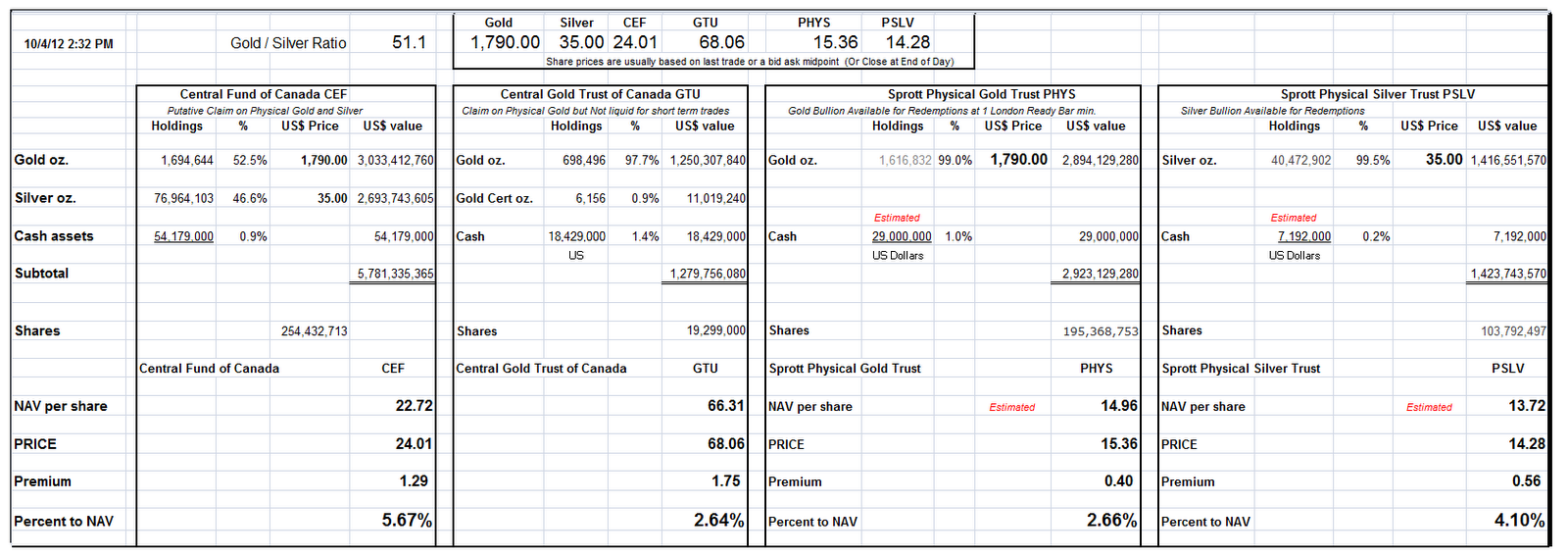
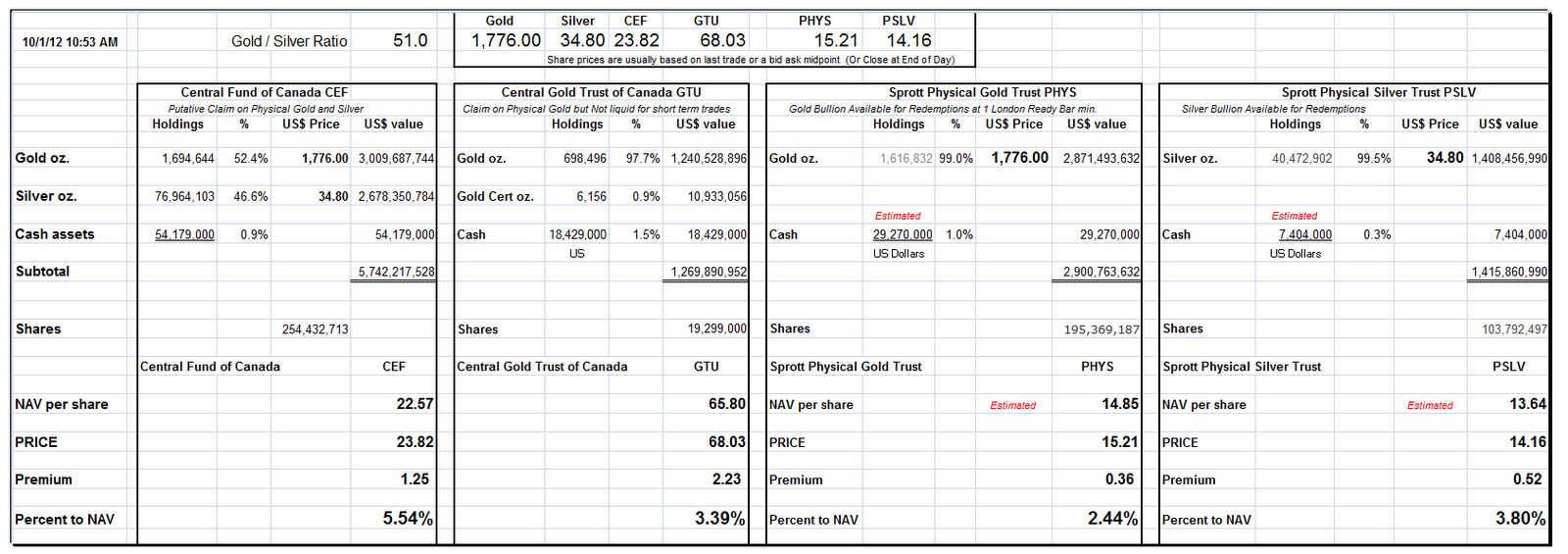
Net Asset Value Premiums of Certain Precious Metal Trusts and Funds


There was a small reduction in the units outstanding in the Sprott Physical Gold Trust, and a commensurate decline in cash. it looks like some shares were bought back.

The cash level in Sprott Silver Trust continues to decline to historically low levels. I expect they will be doing an expansion sometime in the next few months.


W. E. Pollock: Faux 2012 Debates In a Very Real World


A bit of a rant, but not misplaced.

I did not watch the US Presidential debate, but from what I hear of it, it does sound like the bread and circuses which I had anticipated that they would be. A real discussion of the real issues might accidently trip over the credibility trap that ensnares both parties.

I am also seeing some sentiment on the extremes, of both right and left, that would favor a continuing harder push in the current direction, that would bring about a social dislocation, and more radical change.

Those on the extremes think that they can ride that change into greater power by undermining democracy, or at least further limiting it. And so from their perspective, there can be no compromise. They do not want any, they would like to see a confrontation, an armageddon of sorts, because it would serve their interests. Or so they think.

Welcome to The Hunger Games.


Financial Fukushima: US Big Bank Derivative Bets Double in Six Years To $236 Trillion


Well, the derivatives market is like Fukushima Daiichi before it failed and melted down, when the utility company and the Japanese government were blithely assuring themselves and everyone else that nothing could go wrong. Just as Greenspan and other very important people said nothing could go wrong with the US housing market and the wholesale collateralization of debt. Nothing to see here, move along.

I was working on my own update, between the usual distractions, of the Sept 2012 BIS information, when Peter Miller sent this nice summary of the situation my way. A relatively small number of very large banks represent enormous counterparty risk to the world financial system because of the almost geometric growth of the largely unregulated and historically unprecedented derivatives market.

The distortions caused by such massive leverage ripple through the financial system, with both intended and unintended consequences, including the distortion of real markets and the transfer to and concentration of wealth in the money manipulation sector. And the marriage that the financial sector has made with politics is particularly dangerous to the average person.

This affects every country through the transmission power of the US Dollar and its pre-eminent role in decision making in our financialized world economy.

OurBroker
Big Bank Derivative Bets Nearly Double In Six Years
By Peter G. Miller
October 4th, 2012

America’s major banks now hold derivatives with a notational worth of $225 trillion – about a third of the world total. No kidding. Trillion.

And that’s up from a mere $120 trillion six years ago. Rather than being weened off derivatives, America’s big banks are more deeply entrenched then ever.

Hopefully Wall Street has it figured out just right and there won’t be any major losses, say a few billion here or there. After all, when has Wall Street ever been wrong about financial instruments?

“Derivatives are dangerous,” says Warren Buffett. “They have dramatically increased the leverage and risks in our financial system. They have made it almost impossible for investors to understand and analyze our largest commercial banks and investment banks.”

While many in Washington would like to limit derivatives trading, make such trades open to public scrutiny or both, Wall Street is vehemently against regulation.

In fact, there’s a simple way to resolve derivative worries. Allow unlimited derivatives trading — but only by individuals and partnerships willing to personally take the risk of profits and losses...

According to the Bank for International Settlements (BIS), the notational value of derivatives at the end of 2011 was $648 trillion.

The gross credit exposure from these securities was believed to be $3.912 trillion according to the BIS — that’s up from $3.5 trillion at the end of 2009.

But what if the estimates are wrong? For instance, let’s say losses are just one tenth of one percent bigger than expected. Not a big deal, except in the context of international derivative levels that’s more than $640 billion.

Do taxpayers have exposure? You bet. According to the FDIC, at the end of June 2012 all depository institutions held derivatives with a notational value of $224,998 trillion. However, such bets are not spread across the entire banking system. Banks with at least $10 billion in assets hold virtually all derivatives, securities with a notational value of $224.803 trillion. While the FDIC insures deposits in some 7,200 banks and savings associations, only 59 FDIC-insured institutions have deposits of more than $10 billion. Your little community bank, savings association or credit union likely has no derivatives department.

Derivatives are simply bets. They finance no factories, no research, no colleges, no homes and no cars. Any jobs they produce are incidental and inconsequential relative to the potential risk they represent, the risk that credit exposure has been incorrectly figured by hundreds of billions of dollars if not more. Since big banks hold virtually all derivatives, and since taxpayers can face massive costs if big banks fail, it follows that something should be done to limit taxpayer risk....

Read the entire story with an explanation of derivatives here.

Here is a glossary of terms which you might wish to keep.

03 October 2012

Déjà Vu All Over Again


Gold Daily and Silver Weekly Charts


The bears are holding the line.

Nothing in my outlook has has changed.

I expect gold and silver will run if stocks run, and will move lower if stocks sell off. What exactly might cause either thing to happen is not yet known of course, but we roughly know what to look for.

The Presidential debates are tonight. I will be enjoying a good book.

I have finished all the 'Berlin Noir' books by Philip Kerr (the trilogy, and then all the additional), and will now read his lesser known novel about Sir Isaac Newton,  involving the great thinker as a detective of all things. I suppose it will be in the manner of all these faux Sherlock Holmes stories that are now becoming popular, no doubt encouraged by the Robert Downey Jr. variant movies, although Mr. Holmes has been an established and enduring genre of its own.

There is a new TV show as well, Elementary, with Lucy Liu as Watson. It was all right, but rather thin compared to the UK show 'Sherlock' now coming out with its third series starring Benedict Cumberbatch and a wonderful Watson played by Martin Freeman, probably one of my favorites  I have been a 'Baker Street Irregular' since the age of 9 when I received the two volume annotated edition of the canon by William S. Baring-Gould.  I still have it kicking around somewhere I think.  I am afraid I have lost control of my library again.

Thank you for your patronage. Have a pleasant evening.


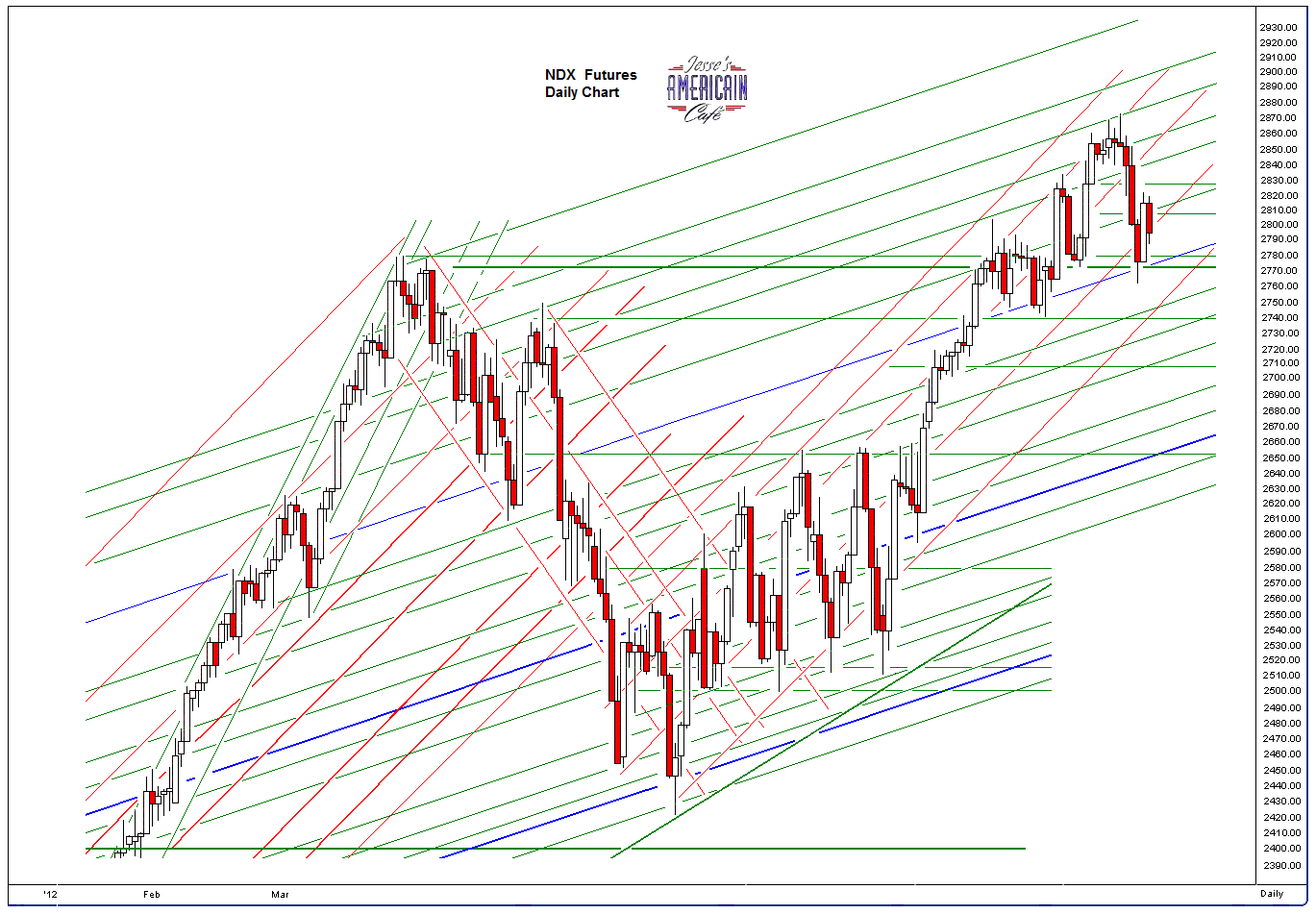
SP 500 and NDX Futures Daily Charts - Jobs and QE


The US produced two good economic numbers this morning that exceeded consensus, in the ADP employment report and the ISM Services index.

The markets popped on that good news, but then the rally faded and could not break out of the symmetrical triangle on the SP 500 futures.

The news from China overnight was not good, and Europe continues to weigh heavily. And of course Europe, especially Spain and Greece among others, remains highly unsettled.

Most daytraders still do not understand that the world has changed a bit, and some of the usual things that would goose stocks in the States are intermingled with this little thing called 'the rest of the world.'

The US Presidential debates are tonight and the Unemployment claims are tomorrow. We will also get some news on European interest rates. We will get the latest FOMC minutes on Thursday afternoon.

The Non-Farm Payrolls on Friday is expecting an add of 120,000 jobs and a slight tick higher in the unemployment percentage to 8.2%. Some fellow on financial TV was saying that expectations for jobs on Friday were 60,000 to 100,000 which did not seem right so I looked expectations up on Briefing.com. For 'private sector' jobs ex gov expectations are for an add of 130,000.


The Secret Deal Between the Democrats and Republicans To Control the Presidential Debates


"The only way to forestall the work of criticism (critical thought) is through censorship, which has the same relation to criticism that lynching has to justice."

Northrop Frye

Would you be surprised to learn that secret deals between the two major US political parties and the major news media control access to the Presidential debates, thereby controlling the discussion, turning them into show pieces and beauty contests obsessed with the trivial and the technicalities of performance art, rather than substantive discussions of the issues?

Did you wonder why third party messages and non-corporately sponsored ideas are completely ignored in the discussions, debates, and for the most part in the 'free press?'

It appears that for at least once the Democrats and Republicans were able to agree on something. They agreed to monopolize access to the presidential debate, with the help of a compliant and greedy corporate media, in a way that would almost certainly violate the antitrust laws, assuming these politicians were subject to any laws but their own.

This is not a serious and original discussion of the issues. This is bread and circuses. Bread for the media and the politicians, and circuses for the people.


Economic Roundtable Discussion: L. Randall Wray, Michael Hudson, and William K. Black


This is a radio show with the formidable title, 'Post Keynesian Economics' that is a very interesting discussion amongst Randy Wray, Mike Hudson, and Bill Black of the University of Kansas City, a bright light of thought in the economics profession.
Find out why the dynamics of private sector are essential to understanding the economy. Plus, we’ll discuss government transparency and accountability. If you're just little rusty on your economic theory and policy, join us at the table for the perfect refresher course.
The moderator, Jabulani Leffall, does a remarkably good job keeping the discussion on track, and managing the flow of questions from callers in to the radio show. I was astonished at how informative and listern friendly it was.

It discusses many current issues in the economy without getting too preoccupied with the economic school of thought and models beauty contests that seem to occupy so much economic discussion, turning them into snoratoriums for non-specialists.

It is a little wonkish at the beginning, but it broadens out quickly to a practical discussion of real, current things. I credit the moderator for this, as well as the three professors who are known as 'economic mavericks,' e.g. not on the corporate financial payrolls, which is a problem with other economic departments as illustrated in the documentary Inside Job.

Economics Roundtable - Post Keynesian Economics

You don't see these three economists on the mainstream media very often, which is a shame. But they aren't representing any corporate interests, so that is probably why they are not so popular on the corporate controlled media.

I enjoyed listening to it over a cup of coffee. It was remarkably pertinent to the real world, which is refreshing amongst economic discussions amongst three professors of economics.

02 October 2012

Gold Daily and Silver Weekly Charts


As you have probably read the effort to impose position limits on the markets was struck down by a court in Washington DC.

I continue to suspect that meaningful market reform in the near term is a fantasy, given the realities of the credibility trap and corruption that maintains a hold on the financial and political systems in the US and the UK.

There will be some watershed event first, if there is to be any serious reform. What that might be, I do not know.  But I am certain that it is coming, and change is coming with it.

The thought that these manipulated speculative markets in the US are effectively setting the world prices for critical commodities like food and energy is almost incomprehensible, especially if you understand what is really going on.  It makes the LIBOR scandal seem like an uncontrolled burp at a Sunday school picnic, and LIBOR was a conspiracy of the first order. 

The abusive rigging of LIBOR was known and tolerated by the regulators and the governments of the US and the UK, and was therefore an outrageous breach of trust that exemplifies the corrosive power of the credibility trap on the integrity of the entire system.  And as I said at the time, LIBOR is the tip of the iceberg.


SP 500 and NDX Futures Daily Charts


Largely another nothing day as the markets hold their ground ahead of the bigger events of the latter part of the week.

I have posted an intraday comment on the symmetrical triangle pattern on the SP 500 which is certainly worth a look.

King World News has a couple of charts from The Sentiment Trader that shows that the commercial hedgers are rather net short the stock indices.    I do not know that I find them particularly 'frightening' but they do seem to have a rather bearish bent to them.  Timing is everything.

I do think that if Obama is elected in the US there will be selling pressure into year end as some rush to take profits in order to hedge any potential changes in the tax structure in 2013.  I am not sure if advantageous buying will not come back in at some point, because there are many ways to take a profit for taxes without going net short or flat amongst the sophisticates. 

But they could provoke the specs, which seems to be a favored game. 

I am much more concerned about the madness in Europe and England, and the nutty ideas floating around the US than I am of these couple of charts.  The stock market is a joke.  But it is still overly important. 


Aktion T4 - In the Garden of Beasts


"The perpetrators were scholars, doctors, nurses, justice officials, the police and the health and workers’ administration.

The victims were poor, desperate, rebellious or in need of help. They came from psychiatric clinics and children's hospitals, from old age homes and welfare institutions, from military hospitals and internment camps.

The number of victims is huge, the number of offenders who were sentenced, small."

Commemorative Tablet at Tiergartenstraße 4, Berlin

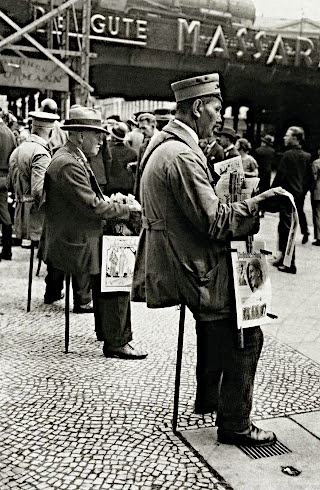
Most people are unaware or simply overlook the actions of the German government that began in 1939, in which the State, with the active cooperation of the medical and legal professions, began the systematic murder of people who were physically and mentally inferior, at least according to the judgement of the State.

It was this decision, and its willing acceptance by the thought leaders and intellectuals of the day, in defining who had the right to live based on their ability to serve the State according to its own needs, that laid the groundwork for the death of compassion, and the murder of over ten million people in the name of unnatural selection.

Once the State has the power to say who is a worthwhile human being and who is not, no one is safe.

We do not often hear about Aktion T4, the euthanasia program, because the weakest have little or no constituency, and are sometimes overlooked because others think that their own causes, or their own pain, is more significant.

What good is it to fight for the right of a child to be born, and then to promote a policy of social Darwinism, a survival of the fittest as if people were animals, forcing them to compete with slave labor in foreign lands in the name of The Market?   Or to embrace a healthcare system that holds parents hostage, as they bankrupt themselves while frantically trying to care for their sick child or their loved one, in the name of The Market?

Despite a lucky few inhuman policies and a system of privilege virtually condemn the unfortunate child to a lifetime of desperation and poverty, to be caught in the infamous 47% of the country that struggles to live and to merely survive, and to raise their children, often from hand to mouth. 

These are the working poor, the elderly, the disabled, who are sanctimoniously condemned and caricatured for not being able to outwit the abuses of the law and resist the perversions of the powerful that allow the select few to cheat and rob them at every step of the way. This is no deep economic mystery; it is a crime.

It was the professional class, the doctors and the lawyers, who willingly sanctioned the murder of the innocents in Germany. And for that great crime against God and Man, which almost no one protested against, the country was brought low and laid to ruin.  

And it is a terrible trap to think that we today are so different, so exceptional, that we are not capable of permitting the same thing to happen all over again.  After all, we are only doing what is necessary, what is required, because The Market says.

In their desire to escape the pain and complexity of being human, men can make themselves into beasts, one step at a time. And then there is hell on earth.

Aktion T4 was the name used for Germany's "Euthanasia programme" during which physicians killed thousands of people who were "judged incurably sick, by critical medical examination".

The programme officially ran from September 1939 until August 1941, but continued unofficially until the end of the Nazi regime in 1945.

During the official stage of Action T4, 70,273 people were killed, but the Nuremberg Trials found evidence that German and Austrian physicians continued the murder of patients after October 1941 and that about 275,000 people were killed under T4.

More recent research based on files recovered after 1990 gives a figure of at least 200,000 physically or mentally handicapped people killed by medication, starvation, or in the gas chambers between 1939 and 1945.

The name T4 was an abbreviation of "Tiergartenstraße 4", the address of a villa in the Berlin borough of Tiergarten which was the headquarters of the Gemeinnützige Stiftung für Heil- und Anstaltspflege, bearing the euphemistic name literally translating into English as Charitable Foundation for Curative and Institutional Care.

This body operated under the direction of Reichsleiter Philipp Bouhler, the head of Hitler's private chancellery, and Dr. Karl Brandt, Hitler's personal physician. This villa no longer exists, but a plaque set in the pavement on Tiergartenstraße marks its location.


"The inability to identify with others was unquestionably the most important psychological condition for the fact that something like Auschwitz could have occurred in the midst of more or less civilized and innocent people.

What is called 'fellow traveling' (collaboration) was primarily business interest: one pursues one’s own advantage before all else and, simply not to endanger oneself, does not talk too much. That is a general law of the status quo."

Theodor Adorno


“Then shall He say also unto them on the left hand, ‘Depart from Me, ye cursed, into the eternal desolation prepared for Satan and his angels. For I hungered, and ye gave Me no meat; I was thirsty, and ye gave Me no drink; I was a stranger, and ye took Me not in; naked, and ye clothed Me not; sick and in prison, and ye visited Me not.’

Then shall they also answer Him, saying, ‘Lord, when did we see Thee hungering or thirsting or a stranger, or naked or sick or in prison, and did not minister unto Thee?’ Then shall He answer them, saying, ‘Verily I say unto you, inasmuch as you did it not to one of the least of these, ye did it not to Me.’

Look in the mirror, Narcissus, and see what you are becoming.


SP 500 Dec Futures Shorter Term Chart - Symmetrical Triangle


The SP 500 December Futures contract is in a fairly obvious symmetrical triangle as noted on the chart below in blue. The triangle is part of an uptrending channel.

Symmetrical triangles are generally continuation patterns, which means that the probability favors the contract breaking to the upside, and continuing to follow the upward trend.

There is a possibility that the price will break down and out of this triangle, and that would be a trend reversal. That possibility is a greater now than it was back in September when we last had a correction within the trend channel because of the shape of the correction now as a triangle. In September it was a fairly well defined bull flag continuation pattern.

I put the odds of continuation at roughly 65-35. For the flag it was 75-25 at least, maybe more like 80-20. I tend to be conservative because of this thin markets and the permissive attitude towards short term price manipulations. The regulatory environment in the US and the UK in particular is a disgrace.

We may likely see a resolution of this on Friday with the Non-Farm Payrolls report, but it may take another full weekend and a few more days to work out. The results of the economic data and interest rate statements before Friday from Europe and the tenor of the US presidential debate will affect this, potentially quite a bit.

I am planning for either outcome.


01 October 2012

John Ralston Saul: It's Broke, How Can We Fix It?


This is a video of a talk given on 26 August 2012 at the Sydney Opera House.

The reference to the 'empty chair' on the stage during the opening remarks is in recognition of Chinese author Liu Xiaobo who remains incarcerated by the Chinese government for voicing a desire for political reform.

John Ralston Saul is president of PEN International, which is a global association of writers, and one of the world's oldest human rights organizations.

In his talk Saul refers to NGO's. A non-governmental organization (NGO) is a legally constituted organization created by natural or legal persons that operates independently from any form of government.

The talk gets rather 'conceptual' at times, so do not be too concerned if you struggle with it. I did as well. About the time he said, "you probably think that I am being rather vague and romantic" the engineering and managerial side of my brain was saying, 'that's an affirmative.'

But I think a few times he was trying to demonstrate our ability to make choices and 'think out of the box,' and that sort of thing does not always mix or segway well in a public lecture where hard issues and potential solutions are intermingled with abstractions.

But overall his talk is brilliantly insightful, and worth listening.


John Ralston Saul, CC (born June 19, 1947) is a Canadian author, essayist, and President of PEN International.

As an essayist, Saul is particularly known for his commentaries on the nature of individualism, citizenship and the public good; the failures of manager-led, or more precisely technocrat-led, societies; the confusion between leadership and managerialism; military strategy, in particular irregular warfare; the role of freedom of speech and culture; and his critique of contemporary economic arguments.

As an author he is best known for the 'philosophical trilogy' Voltaire's Bastards: The Dictatorship of Reason in the West, The Doubter's Companion: A Dictionary of Aggressive Common Sense, and The Unconscious Civilization.

Gold Daily and Silver Weekly Charts - There and Back Again


Gold and silver had an early pop into tougher resistance, but then got hit hard later on in the morning almost to unchanged, and then managed to recover a little into the close. An intraday chart showing the sharp early morning rally is shown below.

I had expected a much stiffer gut check on the longs, and we may still get it. I do not expect any breakout through resistance here to be easy.

But if we get the breakout and stick it, and the bears panic, look for a swift run to the next line of defense where the big shorts will once again attempt to make a stand.

 Looking at the chart it seems pretty straightforward.  There have been three major attempts to break through it, with this being the most recent, after the big blow off top. 

I think this resistance will be broken, but I cannot say if it is this time or not.  This is why I am holding off on drawing a broader trend curve to the gold chart in particular.  Coming off the long basing we saw at support surely helps on this attempt. If it is enough, who can say except in retrospect?

Someone seems very keen on stopping out any rallies below 1800, and the markets being what they are, with little regard to position limits and the integrity of the play, it could be quite a challenge at each major step of the way higher. 

Here are a few events this week that may affect the markets.

On Wednesday we will get the US Non-Manufacturing ISM number, and the ADP employment report.

On Thursday the Banks of England and the ECB may have something to say about interest rates, and very early on Friday there will be the release of Eurozone GDP.

The event of the week may be the Non-Farm Payrolls Report on Friday before the stock market open in NY.

The action in the metals markets will probably be more of a war of attrition than a blitzkrieg.  But I have an abiding feeling that at some point the status quo will break down, and that may be, as the kids say, epic.

Have a pleasant evening.


SP 500 and NDX Futures Daily Charts - Indecisive Day


A typically phony trading day that started out gangbusters but then quickly faded away to close nearly unchanged.

The Manufacturing PMI came in 'better than expected' which provided a little sugar rush.

Bloomberg TV is in panic mode, promoting the candidacy of Mitt Romney and his economic cause in the last month before the election as well they might given his self-inflicted slump at the polls.

I am still long bullion and short stocks. I did not tinker with that position today but I can see a question of balance coming as the new quarter grows a little older perhaps.

Let's see what happens.


Empire of the Exceptional: The Age of Narcissism


As a reminder, it is not possible to reliably diagnose someone from a distance. Why?  Because our view of them is by its nature self-selective: we see and emphasize things that support our hypothetical view of them and dismiss or minimize other things that do not. This is a recurrent weakness in social sciences to be avoided. I cannot stress this enough.  Extremes are sometimes easier to see, but most individuals are a rather complex mix. 

As the psychologist in the video below points out, most people do not fit into neat categories of anything, but are rather an amalgam of various tendencies that overlap and vary greatly in intensity and influence. Most people tend to be diffused in their interests.   We can find traces of almost everything in our selves, as it is the nature of being human.  The degree of that trait is what matters, and the other traits in our mix, and how we react to them, and use them in our daily lives.

And we might also keep in mind that we go through phases, and try out different aspects of our personality in different settings and situations, especially when we are growing  What our parents or society might approve of or not helps to shape the final person which we may become as an adult. And some people may arrive at self-actualization rather late, or in some sad cases never reach that point, locked in a perpetual adolescence because of some trauma or lack of appropriate growth opportunities at key developmental junctures.

Even though it is difficult to discern in the individual, certain trends can appear on the macro level, whether it be in an historical era or even a broader culture.   They can possess distinctive personalities.  As an example, the Japanese tend to be self-effacing and socially oriented with a heavy set of personal obligations to their family and to groups.

And yet I have met some Japanese businessmen who could pass easily for Donald Trump in terms of egoism and personal preoccupation. But on the whole the trend applies, or had applied when I last looked at it carefully and at first hand.  These things on the macro level do change as well, but slowly, generationally.  And the cultural self-image may significantly lag the actual change.   Look in the mirror and see what you have become, for it may not be as you imagine.

In the past thirty years it seems that Anglo-American culture has grown increasingly narcissistic. I do not know if there are more narcissistic individuals in society now, and perhaps there are not.

But I do think that narcissism is much more widely tolerated, rewarded, and even admired now than it would have been in the period of 1930 to 1950 for example. And that is what makes all the difference. More people feel free to indulge their selfish and egotistical tendencies, and to cultivate them, in order to be fashionable and competitive.

As an aside, I think this also tends to explain the decline of literature and poetry in American culture, and the rise of reality shows and the preoccupation with extravagance. Literature calls us out of ourselves, ex stasis, in order to fill us with knowledge and the creative impulse, while spectacle merely panders, and flows in to fill the empty and undeveloped voids in our being."

This video below uses a fictional Mark Zuckerberg from a recent movie as an example of the narcissist personality. I do not know the real Mark Zuckerberg at all so I cannot say if it is valid. But I do think that the fictional Zuckerberg in the movie is an artistic representation of the modern CEO or Wall Street fund manager, based on those that I have known or read about closely.

This narcissistic tendency in modern business occurred to me last night as I read Super Rich Irony in The New Yorker. Obama is, by historical standards, a moderate Republican who has accepted the pro-Wall Street and corporate money bias created in the Democratic Party by the Clintons.   And yet he is reviled by the modern super rich as if he were a Franklin Delano Roosevelt or Andrew Jackson.

Don't get me wrong, most politicians are by the nature of their calling a bit of a narcissist, some more than others. It takes a big ego to fill a big room, and to stand up and say, I can lead. But some are more than others, given the variability of human psychology and character traits.

Some of these super rich describe Obama as arrogant and narcissistic. I think what many of them really mean is 'uppity.'  Most everyone else is their inferior, especially a mixed race man of a lower class background.   To me he seems more a careerist  and professional (aka cynical) deal maker as politicians go, rather than an active reformer.  He is the typical modern manager ruled by expediency.  

But one of the common traits of the narcissist is projecting their faults on to others.  Since this person does not serve and love me, and I am without fault, perfect, they must have something wrong with them, or be out to get me.

Everyone has an ego.  It certainly takes an ego to write a blog for that matter, although again, some are more obviously so than others. How can one stand up and say, 'this is what I think?' Well, at least blogs are self-selecting; people have to come an read them, as opposed to people who endlessly spam other people with emails of dubious origin.  Do you get that too?  Where do these things come from?  Thank God for Snopes and Google search. 

But I point this out to emphasize that this narcissistic tendency is not something particular to the wealthy, but is a cultural trait, expressed in many ways including an increase in self-absorption and incivility.  Power expresses itself in the assertion of the will over others, and the cultivation of unrestrained personal power, the triumph of their will,  is the lifeblood of the narcissist.  And this is also why they tend to be rather antithetical to democracy.

But it does seem that what marks today's super rich more than anything is their preoccupation with their own natural superiority or chosenness as more than justifying if not dictating their good fortune, and almost demanding displays of their grandiose wealth and power, even if that wealth has been gained by cheating, stealing, and depriving others of their own deserved rights and property.  Certainly Hitler saw himself chosen by history, and he  often sought confirmation of it.  

For those with money, the growth process might be subject to the same warping so often experienced by an exceptionally beautiful woman or an enormously talented athlete.  How can one learn to form genuine friendships and loving relationships when they are constantly viewed through the prism of wealth or good looks or success on the field,  when there are so many willing to indulge your worst impulses?   There is some obvious merit to suffering and adversity, as it is the salt that can preserve the best in us if properly applied, destroying the worst.

It is the excess of the age, probably due to the circumstances of fortunate birth and an early childhood in which the young learned that greed is good, screwing everyone is acceptable business practice, that there is no law but their desires, and that most people are inferiors intended to be used by them.  Often parental approval, acceptance, the most basic love, is made contingent on the buy-in. 

I know people like this. I am sure we all do. A very successful acquaintance from school shared with me the lessons taught to him by his father, which he innocently repeated. He learned them both verbally and contextually.  And most of them were exactly as I described them in the above paragraph.  And so that is what he believed.  Can this explain why some sons of wealth turn out badly?   Life lacks real adversity and the normalizing experiences that make us whole?

I have a sense that the super wealthy as a class are reaching their self-destructive apogee, which as you may recall I suggested would happen in my longer term economic forecast of 2005.  It has quite a bit of historical precedent.  When their hatred of FDR was unsatisfied, they attempted to foment a coup d'etat, which was subsequently covered up.  That was a mistake made in the name of preserving the system, as so many similar errors incurring moral hazard have been made more recently.

Each success emboldens them to do more, ask for more, expect more as their due.  And eventually they go too far, and fall.  That in itself might not be so bad on the individual level, as in the case of Bernie Madoff who certainly deserves his time in jail, but they invariably inflict collateral damage on many good and innocent people in the process.

And that is when their own failing, and if you will, sin, can become ours if we do nothing to stop it and to repair it. Especially in an age in which narcissists and sociopaths,including their enablers, are actively assaulting the public interest and public trust in order to serve their own short term, selfish ends, no matter what the longer term consequences to society as a whole might be.

Enjoy the read and the video as something to think about.

Narcissistic Personality Disorder
By Mayo Clinic staff

Narcissistic personality disorder is a mental disorder in which people have an inflated sense of their own importance and a deep need for admiration. Those with narcissistic personality disorder believe that they're superior to others and have little regard for other people's feelings. But behind this mask of ultra-confidence lies a fragile self-esteem, vulnerable to the slightest criticism.

Narcissistic personality disorder is one of several types of personality disorders. Personality disorders are conditions in which people have traits that cause them to feel and behave in socially distressing ways, limiting their ability to function in relationships and in other areas of their life, such as work or school.

Narcissistic personality disorder is characterized by dramatic, emotional behavior, which is in the same category as antisocial and borderline personality disorders.

Narcissistic personality disorder symptoms may include:
Believing that you're better than others
Fantasizing about power, success and attractiveness
Exaggerating your achievements or talents
Expecting constant praise and admiration
Believing that you're special and acting accordingly
Failing to recognize other people's emotions and feelings
Expecting others to go along with your ideas and plans
Taking advantage of others
Expressing disdain for those you feel are inferior
Being jealous of others
Believing that others are jealous of you
Trouble keeping healthy relationships
Setting unrealistic goals
Being easily hurt and rejected
Having a fragile self-esteem
Appearing as tough-minded or unemotional
Although some features of narcissistic personality disorder may seem like having confidence or strong self-esteem, it's not the same. Narcissistic personality disorder crosses the border of healthy confidence and self-esteem into thinking so highly of yourself that you put yourself on a pedestal. In contrast, people who have healthy confidence and self-esteem don't value themselves more than they value others.

When you have narcissistic personality disorder, you may come across as conceited, boastful or pretentious. You often monopolize conversations. You may belittle or look down on people you perceive as inferior. You may have a sense of entitlement. And when you don't receive the special treatment to which you feel entitled, you may become very impatient or angry. You may insist on having "the best" of everything — the best car, athletic club, medical care or social circles, for instance.

But underneath all this behavior often lies a fragile self-esteem. You have trouble handling anything that may be perceived as criticism. You may have a sense of secret shame and humiliation. And in order to make yourself feel better, you may react with rage or contempt and efforts to belittle the other person to make yourself appear better.

The Mayo Clinic 


Net Asset Value Premiums of Precious Metal Funds


Gold popped up this morning and pushed up to 1790, nearer to the top of the resistance band, but was then smacked down hard back to 1770.

Let's see what happens.


30 September 2012

Sunday Evening - Litanies in Times of Plague


"The lamps are going out all over Europe, and I doubt we shall see them lit again in our lifetime."

Edward Grey, British Foreign Secretary, Whitehall, 3 August 1914

September 1, 1939
by W. H. Auden, NYC, Oct 1939

I sit in one of the dives
On Fifty-second Street
Uncertain and afraid
As the clever hopes expire
Of a low dishonest decade:
Waves of anger and fear
Circulate over the bright
And darkened lands of the earth,
Obsessing our private lives;
The unmentionable odour of death
Offends the September night.

Accurate scholarship can
Unearth the whole offence
From Luther until now
That has driven a culture mad,
Find what occurred at Linz,
What huge image made
A psychopathic god:
I and the public know
What all schoolchildren learn,
Those to whom evil is done
Do evil in return...

From the conservative dark
Into the ethical life
The dense commuters come,
Repeating their morning vow;
"I will be true to the wife,
I'll concentrate more on my work,"
And helpless governors wake
To resume their compulsory game:
Who can release them now,
Who can reach the deaf,
Who can speak for the dumb?

All I have is a voice
To undo the folded lie,
The romantic lie in the brain
Of the sensual man-in-the-street
And the lie of Authority
Whose buildings grope the sky:
There is no such thing as the State
And no one exists alone;
Hunger allows no choice
To the citizen or the police;
We must love one another or die.

Defenceless under the night
Our world in stupor lies;
Yet, dotted everywhere,
Ironic points of light
Flash out wherever the Just
Exchange their messages:
May I, composed like them
Of Eros and of dust,
Beleaguered by the same
Negation and despair,
Show an affirming flame.


A Litany in Time of Plague
by Thomas Nashe, London, 1593

Beauty is but a flower,
Which wrinkles will devour,
Brightness falls from the air,
Queens have died, young and fair,
Dust hath closed Helen's eye.
I am sick, I must die--
Lord have mercy on us.


"To know and to serve God, of course, is why we're here, a clear truth, that, like the nose on your face, is near at hand and easily discernible but can make you dizzy if you try to focus on it hard. But a little faith will see you through.

What else will do except faith in such a cynical, corrupt time? When the country goes temporarily to the dogs, cats must learn to be circumspect, walk on fences, sleep in trees, and have faith that all this woofing is not the last word. What is the last word, then?

Gentleness is everywhere in daily life, a sign that faith rules through ordinary things: through cooking and small talk, through storytelling, making love, fishing, tending animals and sweet corn and flowers, through sports, music and books, raising kids — all the places where the gravy soaks in and grace shines through.

Even in a time of elephantine vanity and greed, one never has to look far to see the campfires of gentle people."

Garrison Keillor

29 September 2012

Bill Moyers: ALEC, the Secretive Corporate-Legislative Body Writing US Laws


ALEC in the US Congress

State Legislators with Ties to ALEC By State


International ALEC 'Delegates'

Senator Cory Bernardi – Australia

MEP Philip Claeys – Belgium

Hon Iris Evans (PC - Minister of International and Intergovernmental Relations) - Canada

MEP Ivo Strejcek – Czech Republic

MP David Darchiashvili – Georgia

Assemblywoman Ayesha Javed – Pakistan

MEP Adam Bielan – Poland
MEP Michal Kaminski – Poland
MEP Miroslaw Piotrowski – Poland
MEP Konrad Szymanski – Poland

MEP Cristofer Fjellner – Sweden

MEP Richard Ashworth – United Kingdom
MEP Martin Callanan – United Kingdom
MEP Niranjan Deva – United Kingdom
MEP Daniel Hannan – United Kingdom
MP Chris Heaton-Harris – United Kingdom
MEP Roger Helmer – United Kingdom
MEP Syed Kamall – United Kingdom
MEP Robert Sturdy – United Kingdom

Weekend Reading: The Significance of the Individual


What we do, and what do not do, matters greatly, if not so much in the greater world, but to those around us, and to the resolution of our souls, the essence of our being.

We are free to believe what we will, but we will be held accountable for what we believe and what we do, and the consequences of our beliefs and our unbelief.
There is a simple belief in the Lord, and an equally simple unbelief.   One does not follow the will of God and His love by despoiling His creatures and His creation for their own selfishly destructive ends.  If there is no love in your actions, then you have lost your way.  Where there is no love, there is no living faith.  It is that simple.  No love, no life.
"Not everyone who calls out to me, 'Lord! Lord!' will enter the Kingdom of Heaven, but only those who actually do the will of my Father in heaven." Matt 7:21
And if you think that the Lord whom you serve calls you to self-righteous hatred, jealousy, intolerance, anger and envy, then you may serve that lord indeed, forever.  So do not bee deceived, and know well whom it is you serve.  It is worth some thought— for the time grows short, and the shadows lengthen.
"God has created me to do Him some definite service; He has committed some work to me which He has not committed to another. I have my mission—I never may know it in this life, but I shall be told it in the next. Somehow I am necessary for His purposes, as necessary in my place as an Archangel in his—if, indeed, I fail, He can raise another, as He could make the stones children of Abraham.

Yet I have a part in this great work; I am a link in a chain, a bond of connexion between persons. He has not created me for naught. I shall do good, I shall do His work; I shall be an angel of peace, a preacher of truth in my own place, while not intending it, if I do but keep His commandments and serve Him in my calling.

Therefore I will trust Him. Whatever, wherever I am, I can never be thrown away. If I am in sickness, my sickness may serve Him; in perplexity, my perplexity may serve Him; if I am in sorrow, my sorrow may serve Him. My sickness, or perplexity, or sorrow may be necessary causes of some great end, which is quite beyond us.

He does nothing in vain; He may prolong my life, He may shorten it; He knows what He is about. He may take away my friends, He may throw me among strangers, He may make me feel desolate, make my spirits sink, hide the future from me—still He knows what He is about."

John Henry Newman, Meditations and Devotions

28 September 2012

Bill Black Financial Report - How London Aspired to Be Fraud Capital of the World


Apparently since Blair the FSA has been soliciting financial business by advertising the loosest regulatoary morals on either side of the Atlantic.

Not that the US is any paragon of virtue. Timmy is known as the go-to head boy for the biggest banks.

But this is no surprise, because as Kansas City Fed governor Hoenig said, for the past twenty five years the selection of the US Treasury Secretary has been done by a de facto private auction to the biggest banks.


Gold Daily and Silver Weekly Charts - Not Much of a Pullback Yet


Not much of a pullback but still stuck at resistance.

It appears that September has come and gone without the CFTC saying 'peep' about the manipulation in the silver markets.

Let's see how next week goes.

Have a pleasant weekend.


SP 500 and NDX Futures Daily Charts - HFT Is Strangling the Markets


I was a bit surprised to see the paint slipping off the tape today, in the face of slack domestic US economic news. People cannot spend what they do not have.

High Frequency Trading, as it now stands, is institutionalized corruption of the markets, and it is killing them. The SEC is looking at it, but it is hard to imagine that they will do anything meaningful in the way of reform.

Those who 'own' the exchanges are operating them as their personal casinos, front running and skimming customers at every turn, and they generally get their way with these regulators in the States.

The market was sluggish today. Let's see if the bulls can whistle up a rally next week on these light volumes.


A Financial Coup d'Etat and a Credibility Trap - What Must Be Done


These two statements on the credibility trap and reform are from the bottom of my blog, and a permanent fixture to the layout of the site.

I wanted to take a moment to remind you of them, because they can be so easily overlooked. And they often are.

What I say in quite a few words, Chris Hedges says in a fairly pithy manner in the video below. And I think he is right. And this applies as much to Europe and the UK and the Mideast, including Israel, as it does to the US and the rest of the Americas.  Of course one could name many other countries, such as Russia and China, but unfortunately they cannot fall from freedom, because despite the changes in names and slogans and the self-serving advertising campaigns of nationless corporate predators, they already have little or none.

The progressive movement lacks a spine for the moment, and is badly divided over a number of difficult issues which diffuse them, instilling hatred and fear in their hearts, driving out love, and leaving room only for a destructive pride and selfishness.  And the timid thinkers, the so-called intelligentsia, hide in their studies and in their cellars, and in their work, waiting for someone else to do something.

Eventually progressive people will come together or, as Edmund Burke observed, "...they will fall, one by one, an unpitied sacrifice in a contemptible struggle."

To those who say to hell with it, to hell with thinking, to hell with complexity, to hell with others, I say, be careful of the madness which you seek to unleash, because it will come back to consume you and your children, as it has done so many times before, and will do so inevitably again.

This is what I believe is happening now based on a careful reading of history. 

This is not a prediction.  This is a warning for a generation that is being prepared to accept the unthinkable on a much wider scale than they might imagine in their worst nightmares: torture, murder, ethnic cleansing, and repression.  And what is most frightening of all is that they think they are immune to it, because they are so different, so special, so exceptional.  And so they become willfully blind, and in their blindness, may become beasts.

A credibility trap is when the regulatory, political and/or informational functions of a society have been compromised by a corrupting influence and a fraud, so that they cannot address the situation without implicating, at least incidentally, a broad swath of the power structure including themselves.

The status quo has at least tolerated the corruption and the fraud, if not profited directly from it, and most likely continues to do so. The power brokers have become susceptible to various forms of blackmail. And so a failed policy can become almost self-sustaining long after it is seen to have failed, and even become counterproductive, because admitting failure is not an option for those in power.

The Banks must be restrained, and the financial system reformed, with balance restored to the economy, before there can be any sustained growth and recovery.


27 September 2012

Gold Daily and Silver Weekly Charts - Negative Returns on Money Market Funds


Gold and silver had sharp rallies today as the selling going in to the end of quarter and the gold option expiry dissipated and a sharp short squeeze ensued.

Gold hit a new high in euros today on the back of fresh uncertainties in Europe, particularly in Spain.

As you know money market funds are savings vehicles with a fixed unit price that pay dividends, like a savings account. They arose as alternatives to bank deposit accounts because they were able to present higher returns than the regulated banks.

The Banks, and their regulatory friends who have been mostly among the Republicans want the money markets to have a floating price like a stock, opening the possibility for negative returns on savings. Turbo Timmy G. came out today calling for reforms in the money market funds, and a 'floating price' for the money market fund.

Et tu Timmy? All day long. The young man is getting ready to leave Washington after the election and take a lucrative trip through the crony capitalist revolving door, and probably into the banking sector.

The increased uncertainty, the chance of negative returns on your savings if the funds are allowed to fluctuate below one dollar per unit, is sure to drive quite a bit of risk adverse money out of the money market funds. And it opens the door to price manipulation and fraud, doing nothing to help promote transparency and confidence.

The Banks have always hated the money market funds, and are hoping capital will move out of the funds to them in the form of cheap, insured deposits.

I think quite a bit will go into gold and silver as people sicken of the financial repression of the Banks and their friends.


SP 500 and NDX Futures Daily Charts - The Paint Stays Mainly On the Tape


The several days of selling did dry up yesterday as we had suspected and today we had the end of quarter paint job.

We will probably see this continue into the weekend barring something unforeseen.

Let's see what happens.


Updated Gold Shadow Chart - Gold Hitting New Highs In Euros


Gold is now jammed up against resistance as many of the weak hands have been shaken out and the shorts are getting squeezed by fresh jitters in Europe. 

But is it enough to support a breakout? We will have to wait and see.

Gold is hitting new highs in terms of the Euro. 

I will be a little surprised if we get the breakout cleanly now without a serious 'gut check' after the gold option expiration, in which the in-the-money call holders now find themselves with shiny new futures positions.  But this might just be my inherent distrust of the trading environment on the CME.


Net Asset Value Premiums of Certain Precious Metal Trusts and Funds


26 September 2012

Gold Daily and Silver Weekly Charts - Silver Turns It Around - Gold Options Expiration - Ted Butler


As noted in the intraday commentary this is a week with a few key events on the Comex for gold, and so we continued to see the metals under pressure, although silver turned it around quite impressively and reached back up for the 34 handle.

Let's see how we go into gold option expiration and first notice.

Sept. 26 Comex October miNY gold futures last trading day
Sept. 26 Comex September silver futures last trading day
Sept. 27 Comex October gold options expiry
Sept. 28 Comex September gold futures last trading day
Sept. 28 Comex October E-mini gold futures last trading day
Sept. 28 Comex October gold futures first notice day

Ted Butler on J.P.Morgan and silver:
"My allegations in silver are incredibly specific. I believe that JPMorgan, by virtue of a massive concentrated short position in COMEX silver futures, is manipulating the price of silver lower than it would be otherwise. If JPMorgan’s concentrated short position did not exist, the price of silver would be substantially higher. It does not matter if the bank is hedging or engaged in market-making; the mere existence of such an unprecedented large and concentrated short position proves manipulation. That’s a key feature of commodity law and is why the CFTC monitors concentration closely.

For some reason, however, the Commission treats silver differently than other commodities. In addition to ignoring the concentrated short position, it glosses over the results of the concentration on price. Silver witnessed, among other large and uneconomic sell-offs, two distinct sell-offs in 2011, in which the price fell 30% and 35% within a few days. Not one word was heard from the Commission on the two most pronounced sell-offs in modern commodity history. Yet, this week Commissioner O’Malia promised that the Commission was looking into the 4% price decline in oil. A decline in oil of 4% gets same day comment; 35% down in silver is not worthy of any comment. This amounts to a level of discrimination that is not tolerated in society or in regulatory matters.

In addition to being specific, my allegations around JPMorgan manipulating the silver market are consistent and continuous. Four years ago, instead of responding directly to public complaints about JPMorgan’s concentrated short position, the Commission chose to investigate as a way of kicking the can down the road. After four years, the issue remains because JPMorgan’s concentrated short position remains. No one in authority wants to make the issues around this short concentration more transparent; not the CFTC, not the CME, not JPMorgan itself. Transparency is good in principle and for the other guy; but when it comes to silver, not so much..."

Ted Butler, 25 September 2012

As you know I think the CFTC may be caught in a credibility trap with respect to the silver and gold markets. And if so, at some point this is going to break, as a scandal of major proportions.

All the CFTC has to do is to release its findings, and satisfy analysts like Ted Butler with proof that the big short in silver is a genuine hedge. That is their responsibility as the representatives of the public in overseeing the markets.

That they will not do so, that they will not even speak to the issue but continue to be evasive, makes one wonder just what sort of people these are, and what they have to hide.

I read with some cheerfulness today that Europe is using the US markets as a model of what NOT to do, in crafting their new regulations about high frequency trading. The types of 'Dr. Evil' market manipulation practiced in the states is already illegal in Europe, and more importantly, enforced on occasion.

And for New York and London and their contempt for the people, shame.


SP 500 and NDX Futures Daily Charts - Slouching In To Quarter Close


A quiet day all things considered, with more housecleaning going on in the fundish portfolios as the markets lumber on into the quarter end close.

Let's see if the selling does dry up now, and the paint sprayers switch on and begin to hit the tape.

If 'something happens' all bets are off of course. This is a flimsy market to say the least, about as cynical as it gets.


Robert Johnson: Economists As Marketeers for the Monied Interests


Economics is a disgraced profession because of the actions of a few that were tolerated by many, too often for the sake of grants, appointments, and academic timidity. Careerism.

I would not give many of the Wall Street friendly economists too much credit for an obsession with abstract thinking and even dogmatic blindness, but much moreso a willingly cynical preoccupation with temporal honors, prestige, power, and money handed out by the financial interests in a bubble economy of their own creation.

And there is a fitting emblem for this hubris, the cult of the self, with the long tenure of Alan Greenspan at the Federal Reserve. 

A bureaucrat who is in a position of power for far too long can become a debilitating influence not only on their particular area or department, but on a profession as a whole.  One might think of it as the J. Edgar Hoover syndrome.


Robert Johnson serves as the Executive Director of the Institute for New Economic Thinking (INET) and a Senior Fellow and Director of the Global Finance Project for the Franklin and Eleanor Roosevelt Institute in New York.

Johnson is an international investor and consultant to investment funds on issues of portfolio strategy. He recently served on the United Nations Commission of Experts on International Monetary Reform under the Chairmanship of Joseph Stiglitz.

Previously, Johnson was a Managing Director at Soros Fund Management where he managed a global currency, bond and equity portfolio specializing in emerging markets. Prior to working at Soros Fund Management, he was a Managing Director of Bankers Trust Company managing a global currency fund.

Johnson served as Chief Economist of the US Senate Banking Committee under the leadership of Chairman William Proxmire (D. Wisconsin). Before this, he was Senior Economist of the US Senate Budget Committee under the leadership of Chairman Pete Domenici (R. New Mexico).

Johnson was an Executive Producer of the Oscar winning documentary, Taxi to the Dark Side, directed by Alex Gibney, and is the former President of the National Scholastic Chess Foundation. He currently sits on the Board of Directors of both the Economic Policy Institute and the Campaign for America’s Future.

Johnson received a Ph.D. and M.A. in Economics from Princeton University and a B.S. in both Electrical Engineering and Economics from the Massachusetts Institute of Technology.