12 February 2013

State of the Union Message: Tonight Was the Wish List


Tonight's State of the Union was the 'wish list.'

And there were some very fine and workable ideas contained in that avalanche of possibilities.

Tomorrow begins the hard work of coming up with a 'prioritized list.' 

And the shame is that many of the good ideas are not constrained so much by budget,  or capability, but by special interests and ideologies, and petty jealousies and in-fighting.  

And I hate to say, a growing mindset amongst the powerfully fortunate that if something does not directly benefit them in the short term by increasing their wealth and power, then it must be stopped no matter what, and the rest be damned.

And that, ladies and gentlemen, is the essence of politics, at its worst in dysfunctional organizations, companies and countries that are set against themselves, in all its inglorious ugliness. And it is a deadly entangling embrace, given the fallen state of the human condition, and the pure damned cussedness of people.

Let the games begin.


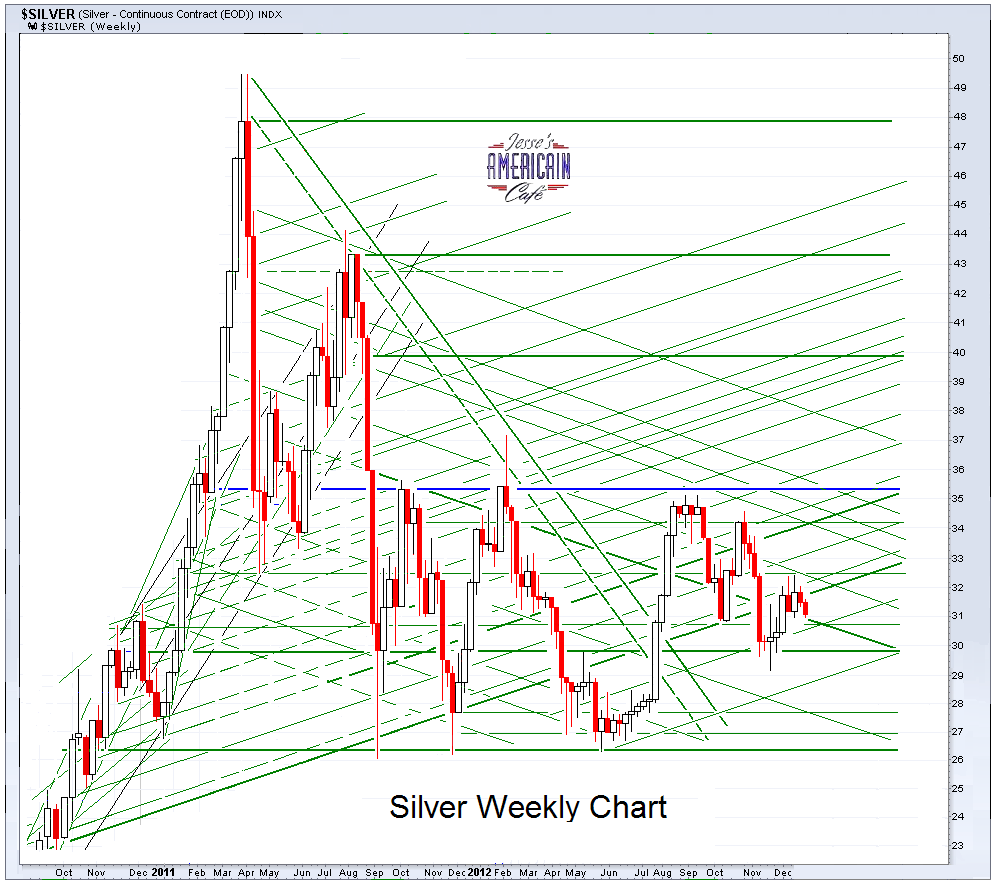
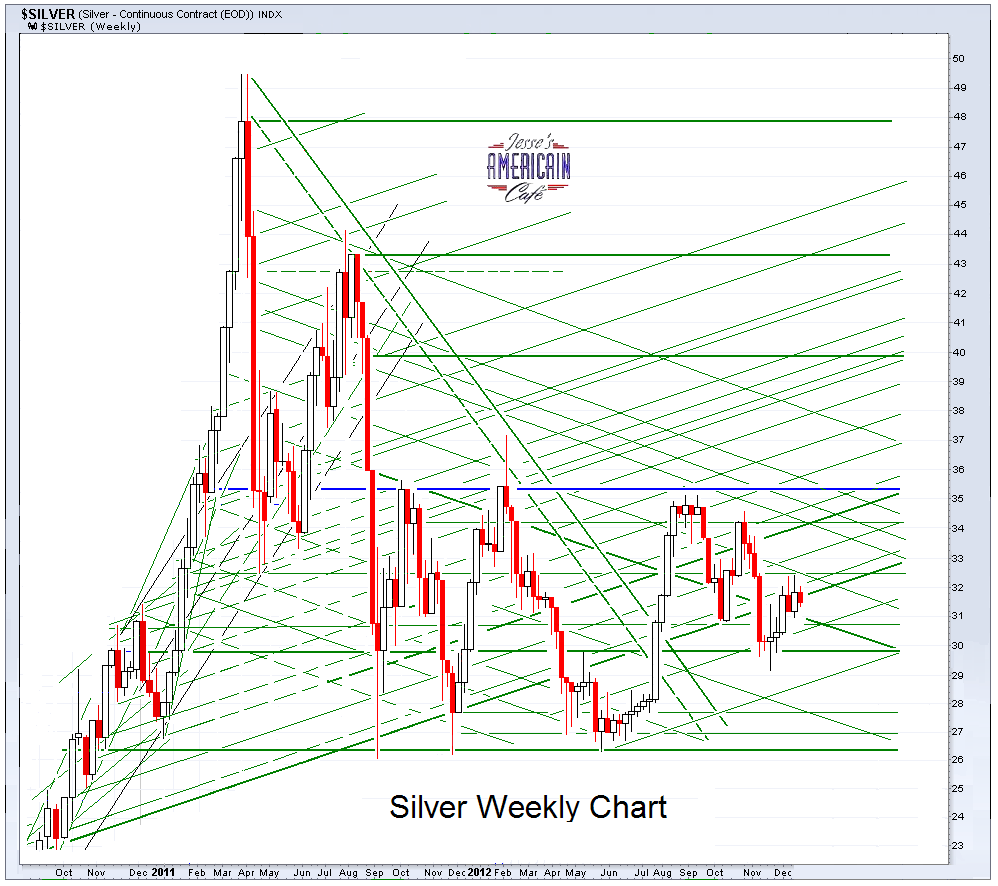
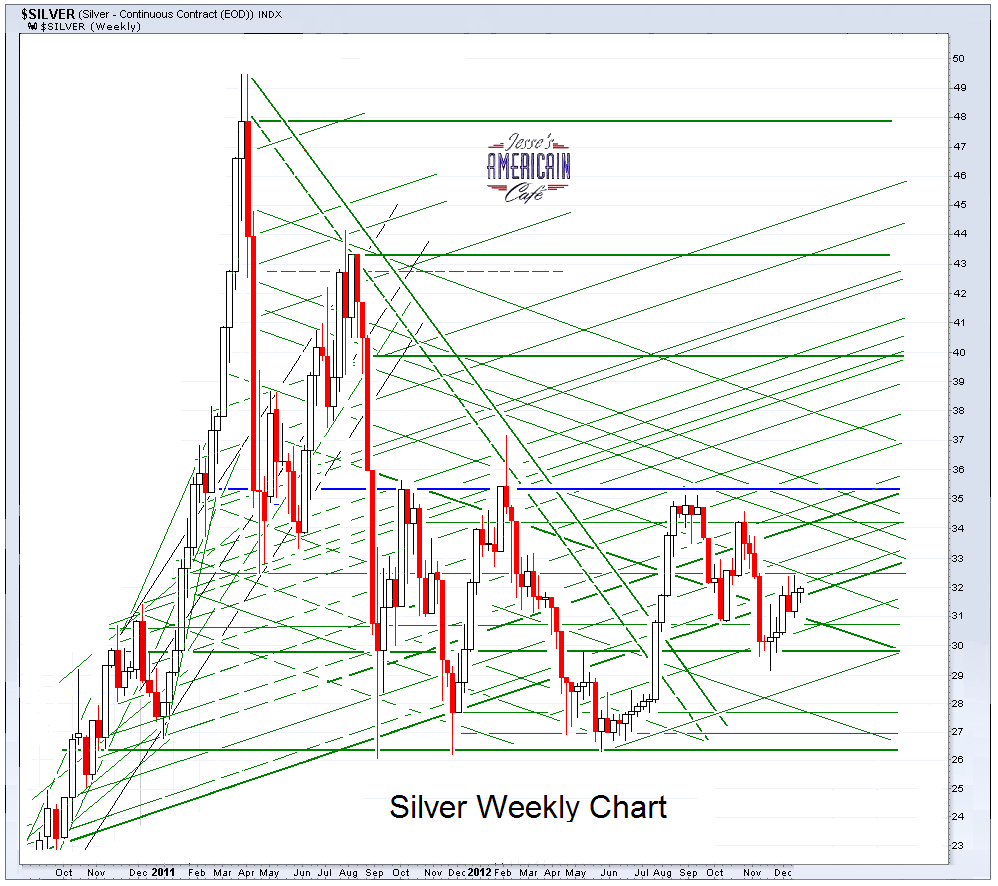
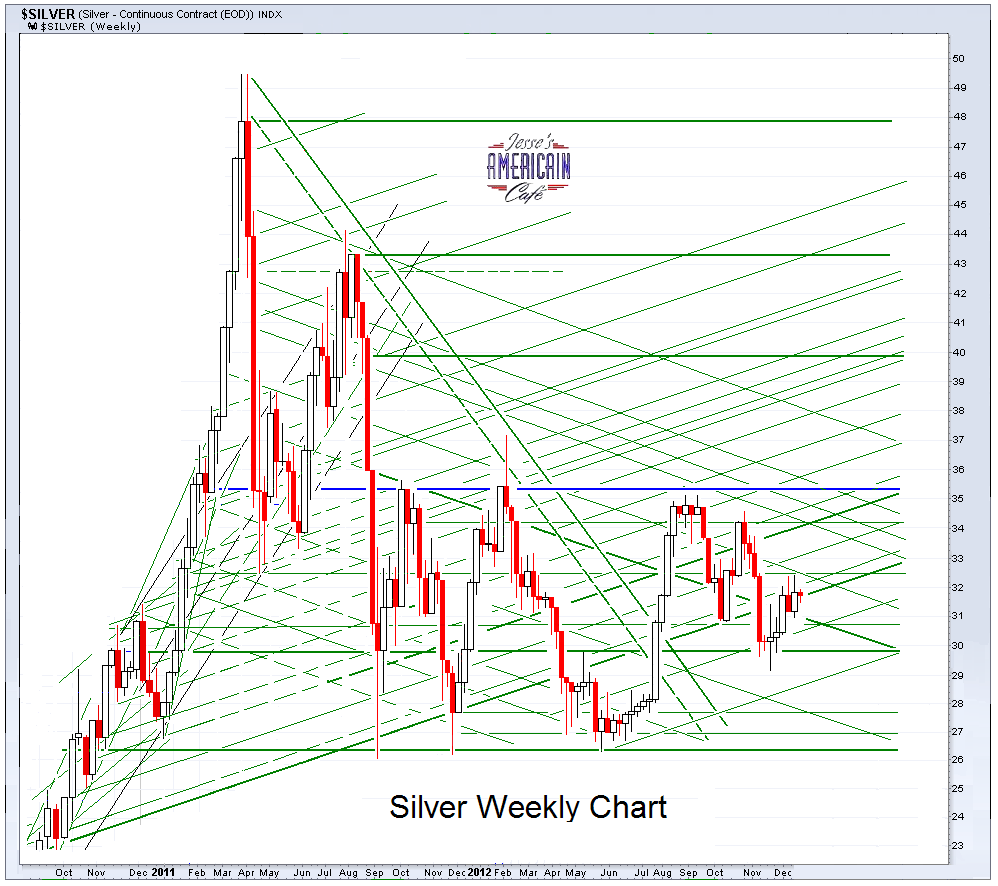
Gold Daily and Silver Weekly Charts - Plus Ca Change...


"The greatest triumph of the banking industry wasn’t ATMs or even depositing a check via the camera of your mobile phone. It was convincing Treasury and Justice Department officials that prosecuting bankers for their crimes would destabilize the global economy.”

Barry Ritholtz

As a reminder, this is a stock option expiration week.

Obama's State of the Union message this evening. Regards to the staffers watching their bosses at Bullfeathers.

There was a hit on the metals but they clawed their way back.

I include the VIX here just to show the complacency and the likely cause for the divergence between stocks and the metals. Its a 'risk on' thing and its has been going on since the Republicans blinked on the fiscal cliff.


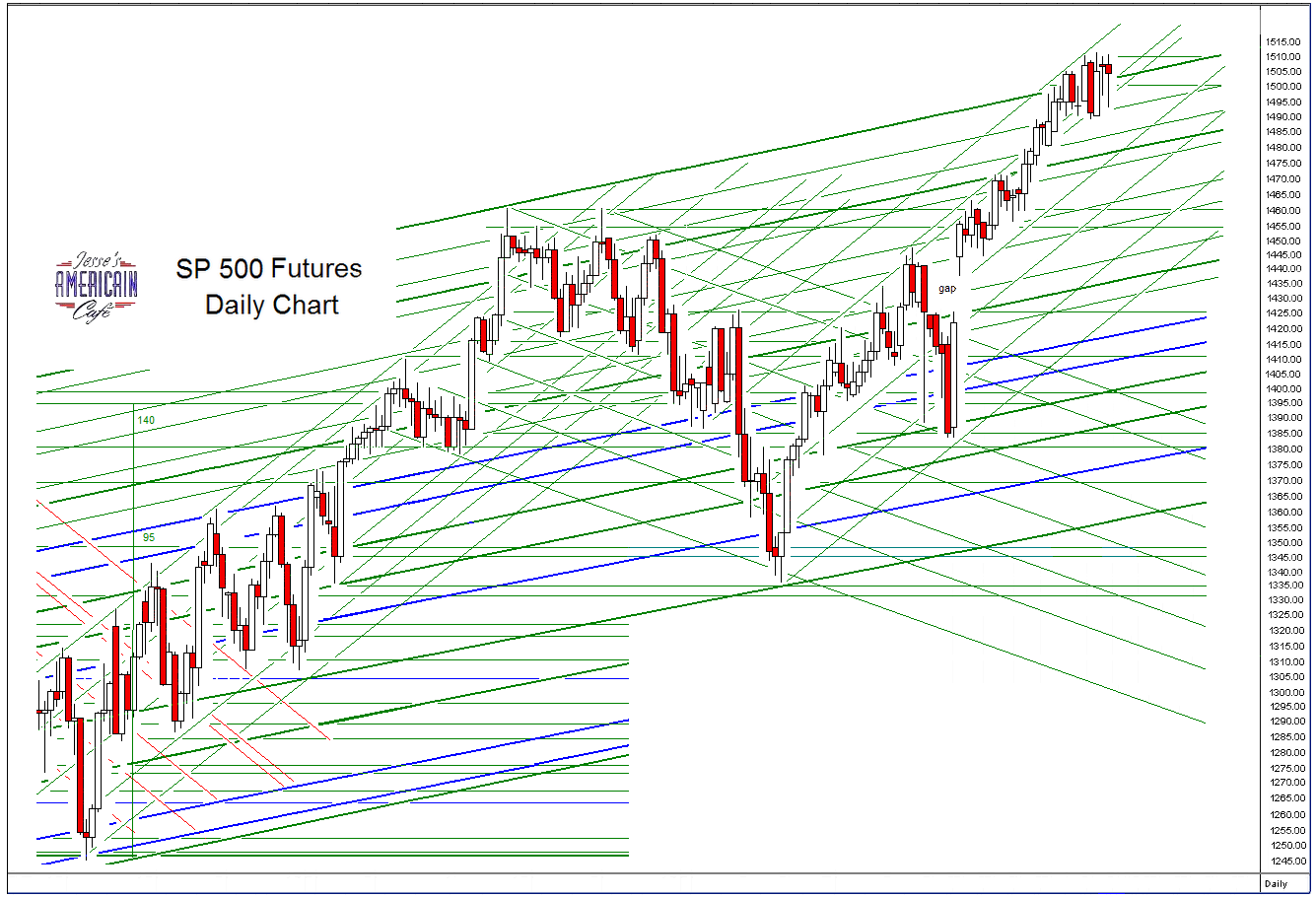
SP 500 and NDX Futures Daily Charts - Complacency By the VIX


"The man who knows the truth and has the opportunity to tell it, but who nonetheless refuses to, is among the most shameful of all creatures."

Theodore Roosevelt

VIX is back to the lows, and SP back to new highs, although the NDX remains a big 'non-confirm.'

Japan's Finance Minister says he would like to see a 17% rally on the Nikkei by the end of March.

I suspect that Bernanke is already doing his thing and inflating another asset bubble. The only question is how long can it last, and ignore the lack of recovery.

State of the Union tonight. Set your expectations low.

As a reminder this is a stock option expiration week.


11 February 2013

Gold Daily and Silver Weekly Charts - G7 'All Is Well' - Raid in Honor of Chinese New Year


Obama will deliver the State of the Union address tomorrow.

This week is a stock market expiration week.

Eric Sprott sees the gold scrap market drying up, and a default coming on the COMEX.

The G7 issued a statement ahead of their meeting in Moscow saying that there would be no escalation in the currency war.

To paraphrase Orwell, economic language 'is designed to make lies sound truthful and to give an appearance of solidity to pure wind.'

When the G7 show us a workable, sustainable solution to the reserve currency crisis, that is acceptable to the world at large including the BRICs, perhaps one might tend to take their diplomatic dispatches more seriously.

Meanwhile, the currency war continues as the Anglo-American economic empire, its multinational companies, and its client states resist change and reform at every opportunity in order to support a broken and corrupt financial system.


SP 500 and NDX Futures Daily Charts - Complacency and Options Expiration


Tomorrow is the State of the Union.

This week is stock options expiration.


Expecting the Unexpected: A Litany In Times of Plague - Diogenes the Dog


Caroline Baum has an interesting interview with economist Edmund Phelps titled, Expecting the Unexpected.

I have linked to it, but given the dismal sounding nature of the topic I suspect many would bypass it.

It is one of the better pieces by Caroline Baum which I have seen. Perhaps it is because she allows Phelps to speak in his own words at such length, and asks her questions well and in deference to the knowledge of the speaker, probingly.

I find it a bit discouraging that there is no mention of the tremendous effort that is made to hide information and to distort it wilfully, to manage perception, and to circumvent the rules through fraudulent behaviour.   And as we have seen,

That seems a little worse than naive, given that we live in the shadow of a pandemic of fraud and manipulation in the markets, from CDO to LIBOR.  I think it is a mistake to assume good faith and an excess of virtue when very large sums of money are involved, especially in a relativistic culture where greed speaks lies to deceit.

This trend to faux arithmetic determinism by making reality crushing assumptions in economics has been cited by many including Nassim Taleb of course, and mathematician Benoit Mandelbrot in The Misbehaviour of Markets. which pretty well takes some of the pretensions of the Chicago School apart, piece by piece.

Here are a few interesting excerpts.

Expecting the Unexpected: An Interview With Edmund Phelps
By Caroline Baum
Feb 11, 2013

In 2006, the Royal Swedish Academy of Sciences awarded the Nobel Memorial Prize in Economic Sciences to Edmund Phelps "for his analysis of intertemporal tradeoffs in macroeconomic policy." Phelps showed that, contrary to the original Phillips curve, there is no long-run trade-off between inflation and unemployment, only a short-term one. Translated into lay speech: You can fool some of the people some of the time and reduce unemployment by paying workers what looks like a higher wage. Eventually, they wise up to the fact that their higher nominal wage is a function of higher inflation, not a higher real wage. Unemployment reverts to its so-called natural rate.

Phelps is the director of Columbia University's Center on Capitalism and Society. I talked with him over the phone on Jan. 25 and Feb. 4 about his views on rational expectations: the notion that people’s expectations of economic outcomes are generally right and policy makers can’t outsmart the public....

Q: So how did adaptive expectations morph into rational expectations?

A: The "scientists" from Chicago and MIT came along to say, we have a well-established theory of how prices and wages work. Before, we used a rule of thumb to explain or predict expectations: Such a rule is picked out of the air. They said, let's be scientific. In their mind, the scientific way is to suppose price and wage setters form their expectations with every bit as much understanding of markets as the expert economist seeking to model, or predict, their behavior. The rational expectations approach is to suppose that the people in the market form their expectations in the very same way that the economist studying their behavior forms her expectations: on the basis of her theoretical model.

Q: And what's the consequence of this putsch?

A: Craziness for one thing. You’re not supposed to ask what to do if one economist has one model of the market and another economist a different model. The people in the market cannot follow both economists at the same time. One, if not both, of the economists must be wrong. Another thing: It’s an important feature of capitalist economies that they permit speculation by people who have idiosyncratic views and an important feature of a modern capitalist economy that innovators conceive their new products and methods with little knowledge of whether the new things will be adopted -- thus innovations. Speculators and innovators have to roll their own expectations. They can’t ring up the local professor to learn how. The professors should be ringing up the speculators and aspiring innovators. In short, expectations are causal variables in the sense that they are the drivers. They are not effects to be explained in terms of some trumped-up causes.

Q: So rather than live with variability, write a formula in stone!

A: What led to rational expectations was a fear of the uncertainty and, worse, the lack of understanding of how modern economies work. The rational expectationists wanted to bottle all that up and replace it with deterministic models of prices, wages, even share prices, so that the math looked like the math in rocket science. The rocket’s course can be modeled while a living modern economy’s course cannot be modeled to such an extreme. It yields up a formula for expectations that looks scientific because it has all our incomplete and not altogether correct understanding of how economies work inside of it, but it cannot have the incorrect and incomplete understanding of economies that the speculators and would-be innovators have...

Q: One of the issues I have with rational expectations is the assumption that we have perfect information, that there is no cost in acquiring that information. Yet the economics profession, including Federal Reserve policy makers, appears to have been hijacked by Robert Lucas.

A: You’re right that people are grossly uninformed, which is a far cry from what the rational expectations models suppose. Why are they misinformed? I think they don’t pay much attention to the vast information out there because they wouldn’t know what to do what to do with it if they had it. The fundamental fallacy on which rational expectations models are based is that everyone knows how to process the information they receive according to the one and only right theory of the world. The problem is that we don't have a "right" model that could be certified as such by the National Academy of Sciences. And as long as we operate in a modern economy, there can never be such a model...

Q: In the world envisioned by rational expectations, there would be no hyperinflation, no panics, no asset bubbles? Is that right?

A: When I was getting into economics in the 1950s, we understood there could be times when a craze would drive stock prices very high. Or the reverse: An economy in the grip of weak business confidence, weak investment, would lead to loss of jobs in the capital-goods sector. But now that way of thinking is regarded by the rational expectations advocates as unscientific.

By the early 2000s, Chicago and MIT were saying we've licked inflation and put an end to unhealthy fluctuations –- only the healthy “vibrations” in rational expectations models remained. Prices are scientifically determined, they said. Expectations are right and therefore can't cause any mischief.

At a celebration in Boston for Paul Samuelson in 2004 or so, I had to listen to Ben Bernanke and Oliver Blanchard, now chief economist at the IMF, crowing that they had conquered the business cycle of old by introducing predictability in monetary policy making, which made it possible for the public to stop generating baseless swings in their expectations and adopt rational expectations. My work on how wage expectations could depress employment and how asset price expectations could cause an asset boom and bust had been disqualified and had to be cleansed for use in the rational expectations models.

Read the entire interview here.

The Tale of Alexander and Diogenes

There is a famous and almost certainly apocryphal story about the cynic philosopher, Diogenes, which was related to us by Plutarch.

As you know, Diogenes believed in the mastery of the self.  He was considered to be eccentric and did outlandish things such as walking about Athens in the daytime with a lit lamp, 'looking for an honest man.'
"According to one story, Diogenes went to the Oracle at Delphi to ask for its advice and was told that he should 'deface the currency.' Following the debacle in Sinope, Diogenes decided that the oracle meant that he should deface the political currency rather than actual coins.

He traveled to Athens and made it his life's goal to challenge established customs and values. He argued that instead of being troubled about the true nature of evil, people merely rely on customary interpretations."
He was said to have lived simply, 'like a dog,' and that this is how the Cynic school of philosophy received its name.
The name Cynic derives from ancient Greek κυνικός (kynikos), meaning "dog-like", and κύων (kyôn), meaning "dog."
In his later life Diogenes was visited in Corinth by Alexander the Great, the king of Macedonia, who would go on to conquer Egypt and India.

Diogenes had been sitting in the sunshine, when Alexander walked up to him and asked what he might do for him, given his deprived state, because he owned only his cloak, having discarded his bowl when he saw a child drinking from cupped hands.

Diogenes looked up at Alexander and said, "You can stand aside, so as not to rob me of the light by your shadow."

Alexander's guards and followers were scandalized at such blatant disrespect for a king.

 And Diogenes asked them, 'Is your lord a good man or a bad man?'   'Good!' they said. 'Then my request is reasonable,' said Diogenes.

And the guards were ready to deal with him harshly, because the implication was that Alexander stood between the people and their natural lives by his own willful pursuit of wealth and power, which was a favorite theme of Diogenes.

But Alexander intervened on the philosopher's behalf, saying, 'If I were not Alexander, I would be Diogenes,'  to which Diogenes replied,  'If I were not Diogenes, I should also wish to be Diogenes.'

Diogenes died at age 89, owning little more than his cloak and his reputation.

After leaving Greece, Alexander went on to conquer most of the known world, and took the Persian title, King of Kings.  Alexander died of an unknown illness, perhaps caused by drinking too much, or poison, or his recurrent malaria, in the palace of Nebuchadrezzar II of Babylon, a few months short of age 33.

There is another version of the meeting between Alexander and Diogenes.  In it, Diogenes was staring at a pile of human bones when Alexander approached, and asked him what he was doing.  "I am searching for the bones of your father," said Diogenes, "but cannot distinguish them from those of a slave.”

The Corinthians built a pillar in Diogenes memory, on the top of which was a dog made of Parian marble.

And so passed the glory of Greece, and the grandeur of Rome.


09 February 2013

Neil Barofsky: Extended Interview On the Daily Show


And as an extra here is Neil Barofsky's Bloomberg interview on S&P's Corrupt Business Model.

And below the Extended Two Part interview on the Daily Show.


08 February 2013

Gold Daily and Silver Weekly Charts - Risk On


As they were saying on financial television today, stocks are the great play for the hot money, risk-eating crowd. And There Is No Alternative (TINA) so you have to be a big money playah and an aspiring rentier in this economy.

It's blue skies for the one percent.

Have a pleasant weekend.


SP 500 and NDX Futures Daily Charts


Risk on day as VIX slumps lower.


07 February 2013

Gold Daily and Silver Weekly Charts - CFTC Finally Does Something About Market Manipulation


Intraday commentary about that very clumsy Dr. Evil style hit on the open of the gold market here.

Speaking of the CFTC, it appears that those fine fellows have finally done something about the obvious and blatant manipulation that all too often plagues the futures markets in commodities.

That's right, the CFTC is joining a defense motion to dimiss the $30 million fine levied against the Amaranth trader who was caught manipulating the natural gas market. Why?

Because the CFTC and the trader's defense attorneys contend that the Federal Energy Regulatory Commission should not be investigating market manipulation in futures, because not doing anything about it is within the jurisidction of the CFTC.

Hey, nobody can touch our crooks but us, and we're too busy and understaffed to do it. Now that's industry friendly!

Ex-Amaranth Trader, CFTC Unite to Ask Court to Toss Fine
By Tom Schoenberg & Brian Wingfield
Feb 7, 2013

A former natural-gas trader at Amaranth Advisors LLC, backed by the U.S. Commodity Futures Trading Commission, asked a federal appeals court to overturn a $30 million fine imposed by another regulator over alleged manipulation of the gas-futures market.

In a case that could determine the limits of the Federal Energy Regulatory Commission’s power to punish market manipulation, a lawyer for Brian Hunter told a three-judge panel in Washington today that the CFTC has sole jurisdiction over futures trading on the New York Mercantile Exchange. The CFTC, which filed papers supporting Hunter, also argued today.

“There was no notice, much less fair notice, to Brian Hunter that his conduct was being regulated by FERC,” Hunter’s lawyer, Michael Kim of Kobre & Kim LLP, said during the 40- minute argument.

The dispute highlights FERC’s growing role as a regulatory enforcer. Congress beefed up the agency’s powers in 2005 to ensure order in the energy trading markets after Enron Corp. traders triggered California blackouts earlier in the decade. Since January 2011, the commission has publicly disclosed 13 investigations it has conducted of alleged market manipulation....

Read the rest here.


SP 500 and NDX Futures Daily Charts - Holding Up the Market


Maybe they can prop this pig up until option expiration next week, or even go for another bubble until Sequestration Come.


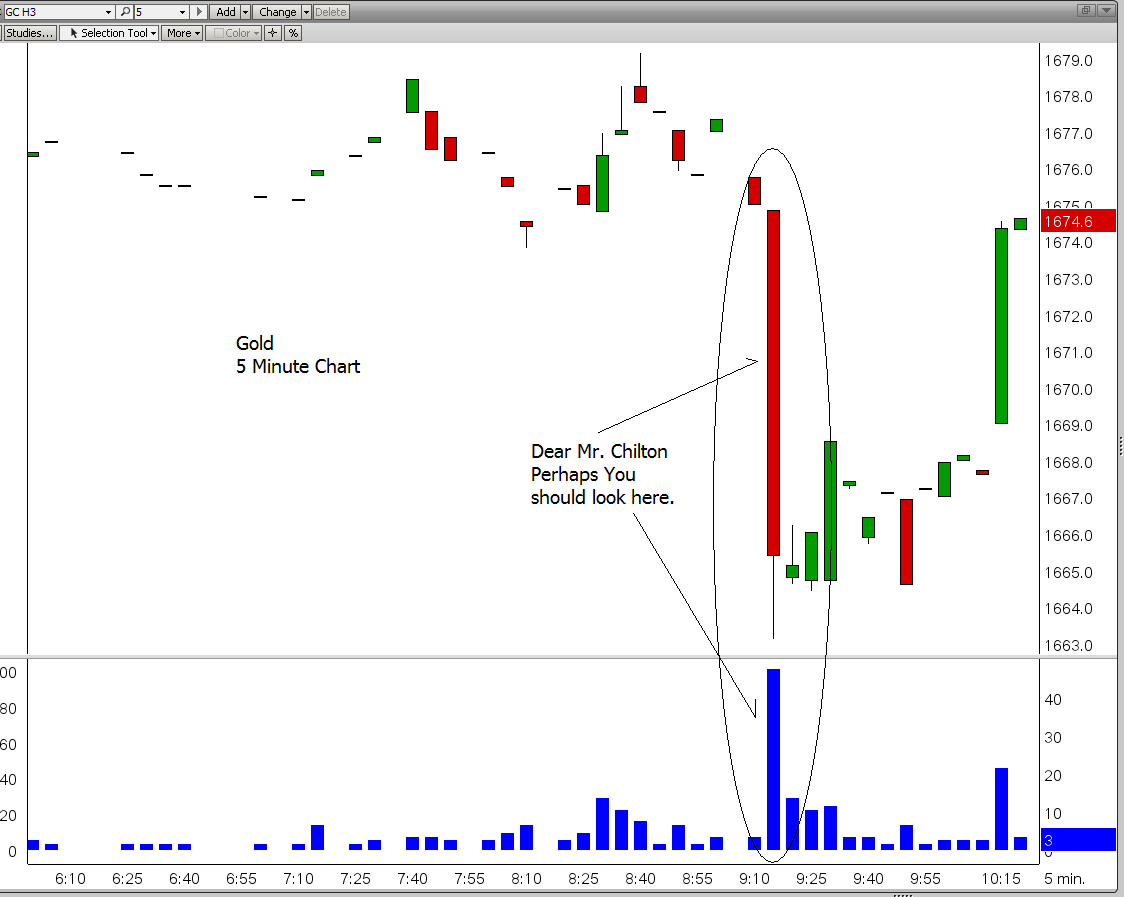
Dear Mr. Chilton, RE the Gold Market In NY This Morning


"If you follow issues like Too-Big-To-Fail or Wall Street corruption long enough, you realize that the reason things don't get done about them by our government has very little to do with ideology or even politics, in the way most of us understand politics.

Instead, it's a bizarre, almost tribal mentality that rules our capital city – a kind of groupthink that makes extreme myopia and a willingness to ignore the tribe's ostensible connection to the people who elected them a condition for social advancement within."

Matt Taibbi, Neil Barofsky's Adventure in Groupthink
Personally I think this is the corrosive influence of the credibility trap, the amorality of careerism, and of course, an ambivalence towards white collar corruption as the inherent entitlement of privilege.  There seems to have been a shift in perspective amongst the new ruling class from noblesse oblige to droit du seigneur.   This is what Robert Johnson calls 'the audacious oligarchy.'

While it is recovering much of this sudden, five minute loss even now, with spot back to 1680 already, the hit on the gold market in the New York trade this morning was fairly blatant.

Perhaps it was just some innocent who had the desire to drop a boatload of contracts into a quiet market, and knock the price down while maximizing their selling loss.  Or another 'fat finger' mishap, which seem to happen quite a bit around option expiration for example.

Or perhaps it was some wiseguy trader who looked at the market, having some advantageous insight into the order books, and decided to 'run the stops.'

Thank God the US has the CFTC, whose job it is to look at this sort of thing and to tell us whether it was legitimate, or not.

And we should hear back about this, perhaps as early as January, 2017. And maybe even sooner on this one: 24 Tonnes of Paper Gold Dumped at Market

But it is nice to see that the CFTC is doing something. They are asking the court to overturn the $30 million fine on the Amaranth trader who was caught manipulating the natural gas market, because another regulator did their job for them.

And how is that MF Global investigation going by the way?


06 February 2013

Gold Daily and Silver Weekly Charts


There is some serious coiling going on in these markets, and sentiment seems very discouraged.

As it stands now, I find the gold chart to be exceptionally interesting.  I think we might see something for the technical analysis books developing here.

Here is what Louise Yamada has to say about gold and silver.


SP 500 and NDX Futures Daily Charts


There was quite a push to get the SP futures to finish flat to green, with another significance divergence as big tech lagged.

Earnings guidance is trending negative, with tech the worst and banks the best.

This is indicative of the policy error of the Fed and the Treasury which addresses the big banks and the management of perceptions in certain key market pricing, while neglecting the growth of the real economy.

This is how the financial engineers create zombie economies. 


Net Asset Value Premiums Of Certain Precious Metal Trusts and Funds


I compare the Net Asset Value Premium table of today to that of Monday, with a snapshot of them taken at a time when the spot prices of both gold and silver are almost identical.

I just thought the thinness of the premiums was interesting.

There is a lot of discouragement in the metals out there.

Wednesday 6 February


Monday 4 February


Is All Stimulus Equally Effective?


I think we can understand the principle of government spending as a spur to aggregate demand, which can be useful in certain circumstances where the economy has been caught in a 'feedback loop' of stagnancy.

I won't go into it in detail now, but if the government buys things in the real economy, or provides money for other people to buy things in the real economy, the demand for real goods increases.  Simple enough. One can argue about aftereffects, but the demand increase remains the same. And the principle is that this temporary stimulus will help the real economy break out of a crisis induced feedback loop of stagnation. And I would add a serious caveat, IF other changes have been made to those problems and policies which have caused the crisis in the first place.

This is called 'stimulus' in economics.

There are other instances of stimulus being applied to an otherwise healthy but sub-optimal economy, and again, I will leave that to some other discussion. But there is the obvious caution about using artificial stimulants inappropriately to hide deficiencies in healthy organic growth, especially when caused by policy errors.

Here I speak only about stimulus in the aftermath of a crisis, an economy which is marked by endemically slack demand and investment. And I do think the principle of liquidity trap has been mistaken to the extent that the symptoms are treated rather than causes. I call this cargo cult economics. And Geithner and Bernanke are its high priests of a plummeting velocity of money supply.

But even in the case of post crisis slump, I wonder about this principle of stimulus in application. If the government wishes to add $1 Trillion in stimulus to a slack economy, would it be the same thing to just give $1 Billion each to the top 1000 richest people in the nation, or $10,000 each to 100 million randomly selected people, to be paid out over the period of a year.

I am sure that in the long run, there are equations and rationales that 'prove' that the effect of both actions are the same.  And I would imagine that some of the neo-liberal economists will likely argue that the one percent will put the funds to work as productive investments, and the hoi polloi will merely waste their money on drugs, alcohol, and video games.  This probably says less about reality and more about the inherently skewed perspective of the elite who consider the 47% to be sub-human. But there is merit in thinking that simple one time payments with no work attached are not as effective as something more substantial. 

What is the government gave 10 million people a job that paid them a living wage which, together will spending on capital assets, allowed them to repair bridges, improve parks, enhance the electrical system, build up safeguards against flooding and storms,  clean up the streets, and remove and replace dangerously dilapidated buildings.

But I think common sense and a bit of more granular thinking will show that in terms of stimulus to the real economy, if measured in a reasonably confined time horizon (ie. less than five years) one can see how the broader distribution of stimulus directly to those most inclined to spend it on real goods, rather than the accumulation of more productive assets in the face of slack aggregate demand, would have a demonstrably more effective result on stimulating demand in the real economy.

In a period of slack aggregate demand, wealth tends to accumulate. The wealthy buy more resources, and assets 'on the cheap,' and economic power and resources tend to concentrate, further dampening aggregate demand as measured not nominally but against a basket of real goods.

And this was the genius of Franklin Roosevelt, not an economist, but a practical, problem-solving leader. He reformed the banks, rather than stuffing them full of money, and hoping they would make more loans. And through a series of programs he sought to apply stimulus directly to where it was needed, in the relief of privation of course, but also in jobs which performed necessary functions and also built up the infrastructure of the nation.

Granted, there was trial and error in his method.  And he made some errors in judgement for certain, including some of his actions regarding the gold standard and the method of refunding the banks.  But we should note that he did this all under a duress that was more real and compelling and visceral than the singular crisis that caused the Congress to pass TARP.

And providing funds directly to the people without passing them through the hands of the one percent angered the elite of his day to the point of considering an actual coup d'etat, in addition to every form of political obstructionism one can imagine. And he did fail to stay the course, and allowed the money supply to contract prematurely after he thought the worst was over.  And the oligarchs still hate him, and seek to distort his record and his legacy.

 But all in all, he was a real leader at a time when most of the developed world was turning to the malady of fascism, militarism, and destruction.  He took the somewhat effete theories of Keynes, and put real substance into those principles, while engaging in sweepingly effective reforms that served his country for over sixty years, until a new generation forgot the lessons of the past.

And compared to the faceless bureaucrats and economists at the Federal Reserve and the Treasury, and their own series of failed financial asset bubbles, he was a natural genius.

05 February 2013

Gold Daily and Silver Weekly Charts - A 'Risk On' Day


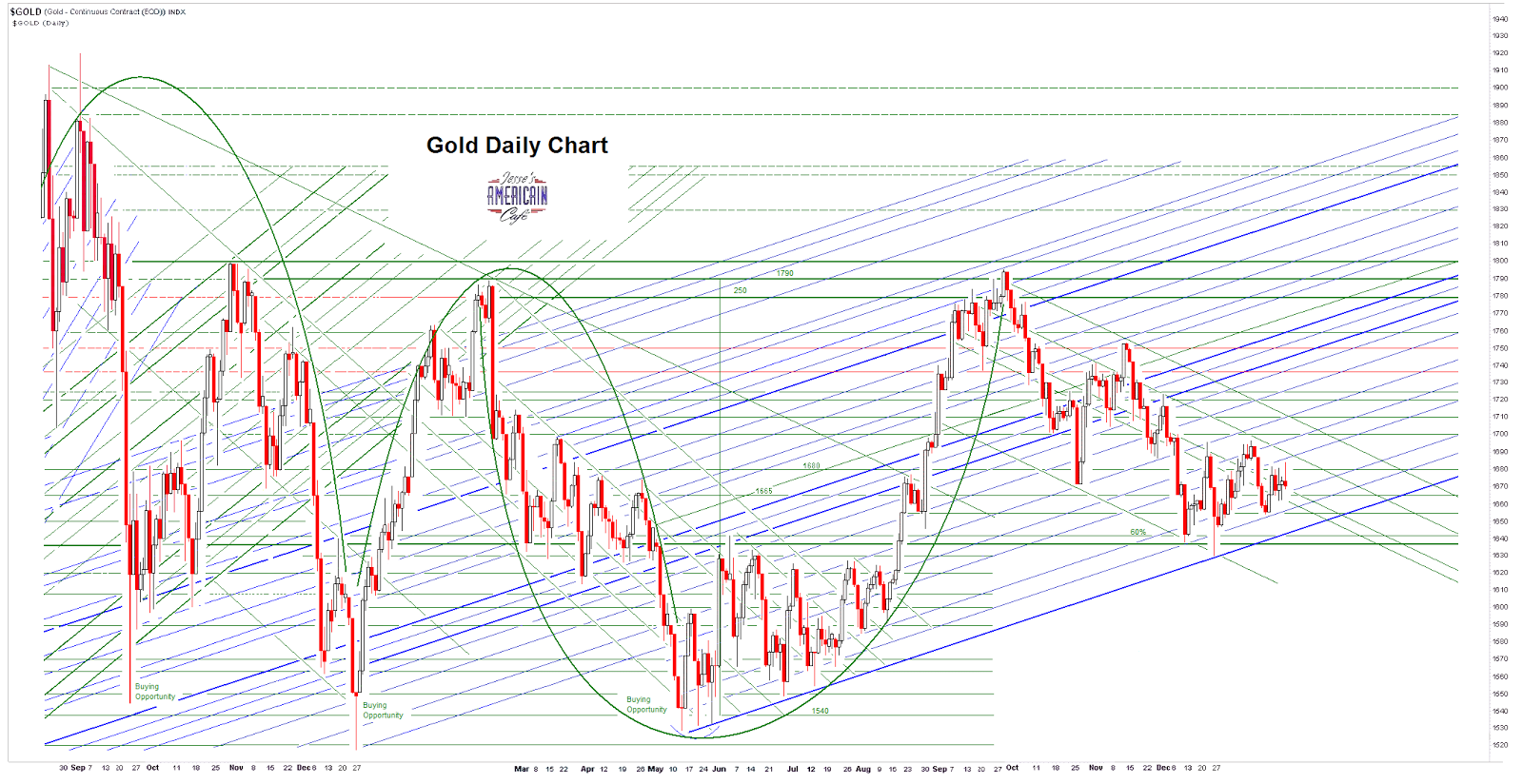
Gold was pushed back hard from its attempt to break out above its 50 DMA which is around 1684.

Silver held its ground a little better.

Cap, cap, cap.

C'est la guerre monétaire.

I found this comment from a reader on the equity markets to be resonant with my own thoughts.
"High frequency trading software that focuses on feedback loops is a useful diversion to hide front-running, short squeezing, and other parasitic activities. The current BS about rotation out of bonds is merely an attempt to attract retail because they’ve run out of shorts to squeeze to take the markets higher.

If you can put aside your moral outrage, this strategy is a thing of beauty – disgusting, evil, and fraudulent but beautiful in its execution."

Frauds R' Us.   Its the major growth industry, and the dominant export of the US and UK.


SP 500 and NDX Futures Daily Charts - The Dell Computer Market


It was rally mode today as traders celebrated the great economy in Europe, which is allowing their banks to pay back the ECB as they get 'healthy.'

Huh? Well, that's what the spokesmodels said. Its a 'better-than-expected' world, at least for the one percent.

This is the Dell Market, with lots of money flowing around the plate, but little value being added, just a further concentration of money and power.


Is that Mr. Megaphone Talking on the SP 500 Futures Chart? Or Yet Another Headfake?


Is that a megaphone top forming up on the SP 500 March futures chart?  Or is the Fed just glad to keep fueling this glorious rally for freedom?

Formations like this are fun to watch as potential indicators, but they really do not work until they 'work.'

That is, they are not active until activated by a clean trend break in one direction or the other.  This is true of all chart formations that represent a possibility that can become more or less probable over time, depending on which way things develop.

Charts don't do anything.  They merely reflect the underlying reality in an easier to grasp representation, for those with that sort of visual inclination.  They are a roadmap, not the road.

Right now 'the market wants to go up,' meaning lots of market participants want it to go up, want to take it up and keep squeezing the bears who piled on ahead of the fiscal cliff and sequestration.

My interpretation of this 'megaphone' is that the market is undecided about the viability of the rally continuing given the impasse in Washington and the impending battle of the budget over sequestration which should happen in about four or five weeks.  And despite the recent happy talk, the European situation remains volatile, and the currency war continues.

If you want to play a formation like this, thenwait for it, and give up bragging rights and save yourself a loss from being 'too early' or just plain wrong.

There is a word for those who bet against the market on the if-come.  They are called 'broke,' and spend most of their time badgering people on chat boards.  They are often wrong, but rarely in doubt.


Why Bears Should Tread Carefully

Enter the Credibility Trap: A Prediction About the S&P Ratings Lawsuit


No, I do not predict that there will be no criminal indictments and convictions to follow the suit, or even serious personal penalties from the civil action beyond something that is tax deductible as a cost of doing business. That is like predicting that a heavy rain will make puddles.

I predict that the primary defense that will be offered by S&P will be based on 'the credibility trap' itself.

The usual defense in cases like this is the First Amendment, that S&P was merely voicing an opinion. In this particular case, after having combed through over 20 million documents, the Department of Justice will attempt to prove that S&P was not merely voicing an opinion, but lying for gain, which is not 'protected speech.'

And most of them obviously cannot use the CEO defense of non-involvement and general ignorance of the entire situation, since they were being paid to write professionally informed judgements based on a factual due diligence.  It would be like a surgeon arguing against malpractice because he was watching porn while performing surgery, and was so distracted he did not really notice what he was doing and was therefore merely a hapless bystander.  Don't laugh.  It seems to be working for MF Global, and several national governments.

Having these usual avenues thwarted, I suggest that S&P will point to all the other credible voices of the economists and politicians, 'very serious people,' who said either absolutely nothing, or voiced similarly misplaced opinions and 'mistakes in judgement' about the true nature of the unfolding financial frauds.  How can you blame us, when no one of consequence said anything differently, forcefully.

So rather than key actors in a massive control fraud, they will portray themselves as hapless victims of the same mass delusion that affected most of the New York-London-Washington establishment, with many top universities in their supporting cast. 

Will Alan Greenspan offer to be an expert witness on the perils of mistakes made while blinded by a sincerely held ideological delusion?  Poor fellow, just a good chap making an honest error in judgement.  He used a bad model.  Who can blame him.

The defense will be 'the credibility trap' itself.  You cannot convict us, without indicting yourself.  

And if they are as I think they are, the S&P team will bring some credible implications of their case for the sacrosanct TBTF crowd to the plea bargaining process, and make its objective the best terms in a settlement while admitting no wrongdoing.   We chose to settle because it was cheaper.  We are victims of big government.   The usual suspects will run with that.

It is a corollary to the credibility trap that no one who knows 'where the bodies are buried' will be personally inconvenienced beyond mere appearances.

It will be interesting to see how this plays out.  It might set the tone for the 'investigations' of the coming collapse and scandal in the paper silver market.   How could we have done anything wrong when the CFTC investigated us for five years, and sat next to our people almost every day?

What Time Is the Next Crisis? - An Historic Warning From John Hussman


"The enemy of the conventional wisdom is not ideas but the march of events."

John Kenneth Galbraith

This is from John Hussman's latest weekly observations which you can read here.

In every instance he cites with which I am familiar, any concerns about the gross mispricing of risk were lightly dismissed, because 'the market says that everything is all right.'   As if the financial markets were some prescient, infallible instrument, and not overtaken by the manipulation of insiders and the monied interests. 

The 'rising market' kept most criticism of the policy errors in the growth of the credit bubble cowed and quiet, until the inevitable market break and crisis. That the financiers have not yet completely destroyed the global economy is not particularly reassuring, while they are still working at inscribing their arrogance, writ large on the pages of history, chapter by dreadful chapter.

Or more cynically one can conclude that yes, things are getting out of control, but we must keep dancing while the music is playing, and say nothing while the money is flowing in order to 'save the system,' while disabling the smoke alarms and stuffing one's pockets.

As long as the Fed can keep printing money and delivering it to the Banks and the one percent, and not to the real economy, through its purchases of their (fraudulently) mispriced financial assets, this could keep going, while maximizing the damage.  While it does give the financial engineers some feeling of control, it really does nothing constructive except to delay the essential reforms.

The combination of constructively applied stimulus and sweeping financial reform was the genius of Roosevelt, and the lack of it is the failure of Obama.

And the big correction might not even show up all that readily, in nominal terms at least, in the equity markets for some time, being papered over by a blizzard of new money.  And so that implies a crash in the bond markets, as we saw a few years after the Great Crash of 1929.  But they are getting better at the cover ups, so who can say.

The tail of financialization and leverage is still 'wagging the dog' of the real economy.   After reading the current thoughts in mainstream economics, and Modern Monetary Theory, it seems quite likely that history is about to deal out another hard lesson in real wealth and value.

I am ambivalent to the exact timing since I cannot know it.    And so if another year passes and 'nothing happens' I may not be cheered by it while the fundamentals like median wage continue to deteriorate.  This is the mechanism in which bubbles develop, and we have seen more of them than most, and with increasingly intensity.

But I am more confident that the punchline to this comedy, if it continues unabated, will be the devaluation of the currency and at least a de facto default on the debt which can take several forms. And the usual yahoos will rise up and seek power, promising an hysterical people to take away their pain, while inflicting it on 'the others.'

"Present market conditions now match 6 other instances in history: August 1929 (followed by the 85% market decline of the Great Depression), November 1972 (followed by a market plunge in excess of 50%), August 1987 (followed by a market crash in excess of 30%), March 2000 (followed by a market plunge in excess of 50%), May 2007 (followed by a market plunge in excess of 50%), and January 2011 (followed by a market decline limited to just under 20% as a result of central bank intervention). These conditions represent a syndrome of overvalued, overbought, overbullish, rising yield conditions that has emerged near the most significant market peaks – and preceded the most severe market declines – in history:
  1. S&P 500 Index overvalued, with the Shiller P/E (S&P 500 divided by the 10-year average of inflation-adjusted earnings) greater than 18. The present multiple is actually 22.6.
  2. S&P 500 Index overbought, with the index more than 7% above its 52-week smoothing, at least 50% above its 4-year low, and within 3% of its upper Bollinger bands (2 standard deviations above the 20-period moving average) at daily, weekly, and monthly resolutions. Presently, the S&P 500 is either at or slightly through each of those bands.
  3. Investor sentiment overbullish (Investors Intelligence), with the 2-week average of advisory bulls greater than 52% and bearishness below 28%. The most recent weekly figures were 54.3% vs. 22.3%. The sentiment figures we use for 1929 are imputed using the extent and volatility of prior market movements, which explains a significant amount of variation in investor sentiment over time.
  4. Yields rising, with the 10-year Treasury yield higher than 6 months earlier.

The blue bars in the chart below identify historical points since 1970 corresponding to these conditions.

MIchael Lewis and the Heart of the US Economic Policy Failure and Crisis


"Corruption is a tree, whose branches are
of an immeasurable length: they spread
Everywhere; and the dew that drops from thence
Hath infected some chairs and stools of authority."

Beaumont and Fletcher, The Honest Man's Fortune

Michael Lewis has written an excellent pocket analysis of the financial crisis in The New Republic, in his review of Greg Smith's book about why he left Goldman Sachs.  I have to admit some prejudice, because he says all of the things which I have been saying, and says them very well.

Crony capitalism has always been with us, but it took wing in the 1990's, and has brought us to this place where we would not wish to be.

Michael Lewis does an excellent job of distilling the problem and its solution to the basics, without necessarily touching on the need to reform the political campaign process, and the revolving door that enriches the politicians and regulators through betraying the spirit, if not the technical word, of their oaths of office.

Is a policy error still an 'error' if it is done purposefully? 

I had hoped that Obama might have risen above that as an 'outsider' with a mandate for change, but that notion was quickly dispelled in his first 100 days in office.  He has pursued a policy of subsidy and appeasement and failed leadership that is killing the legacy and effectiveness of his administration, but enriching many participants in the process. And it works, because the US has become a culture of personal greed. 

One can speculate on motives endlessly, but we'll leave that one to history.  The end result remains the same.  And the pity is that the 'opposition party' is even worse, even more servile to special interests.

And the oddest thing is that this is almost a general phenomenon throughout the developed world, and not some anomaly of the US. And the culture of greed and economic repression was spread by highly placed political appointments affiliated in many cases with the same handful of US-UK banks.

In the aftermath of the first Great Depression there was a general spread of militant fascism, and a great world war.  So why not a rise of oligarchies employing financial repression this time, with a global currency war?  There appears to be some precedent of corruptible, power mad people rising to the occasion.

The Western governments have come to resemble competing crime families, more than an open democratic process of policy formulation for the good of the entire nation through constructive give and take.  It's mostly take, with the common people being taken, while the media and the pundits weave an alternative reality for them with words and emotion.

So, here we are.

What do you want to do tonight, Marty?

"Stop and think once more about what has just happened on Wall Street: its most admired firm conspired to flood the financial system with worthless securities, then set itself up to profit from betting against those very same securities, and in the bargain helped to precipitate a world historic financial crisis that cost millions of people their jobs and convulsed our political system.

In other places, or at other times, the firm would be put out of business, and its leaders shamed and jailed and strung from lampposts. (I am not advocating the latter.) Instead Goldman Sachs, like the other too-big-to-fail firms, has been handed tens of billions in government subsidies, on the theory that we cannot live without them. They were then permitted to pay politicians to prevent laws being passed to change their business, and bribe public officials (with the implicit promise of future employment) to neuter the laws that were passed—so that they might continue to behave in more or less the same way that brought ruin on us all.

And after all this has been done, a Goldman Sachs employee steps forward to say that the people at the top of his former firm need to see the error of their ways, and become more decent, socially responsible human beings. Right. How exactly is that going to happen?

If Goldman Sachs is going to change, it will be only if change is imposed upon it from the outside—either by the market's decision that it is no longer viable in its current form or by the government's decision that we can no longer afford it. There is a bizarre but lingering aroma in the air that the government is now seeking to prevent the free market from working its magic in the financial sector-another reason that the Dodd-Frank legislation is still being watered down, and argued over, and failing to meet its self-imposed deadlines for implementation.

But the financial sector is already so gummed up by government subsidies that market forces no longer operate within it. Could Goldman Sachs fail, even if it tried? If someone invented a cheaper way to finance productive enterprise, would they stand a chance against the big guys?

Along with the other too-big-to-fail firms, Goldman needs to be busted up into smaller pieces. The ultimate goal should be to create institutions so dull and easy to understand that, when a young man who works for one of them walks into a publisher's office and offers to write up his experiences, the publisher looks at him blankly and asks, 'Why would anyone want to read that?'"

Michael Lewis, The Trouble With Wall Street


04 February 2013

Gold Daily and Silver Weekly Charts


There was some top calling after the big run up last week, especially given the ebullient cover of Barron's over the weekend.

Let's see if we get a trend break before the bears come out of the woods to pile on.

The capping on gold and silver is determined. When they break free, then we will see this market wiggle out of the grip of the pigmen, who are using it as their personal ATM.