09 June 2010

Gold Daily Chart: Update of the Cup, and the Long Term Golden Bowl

Gold did a 50% retracement in its most recent leg up with an intraday drop to 1222. 


Now we can see if the backing and filling is over, and a base can be built for another try at the breakout.

A reader from Strasbourg sent this chart of inflation-adjusted gold, and suggested I take a look at it for a longer term 'cup and handle.' So I did some basic charting and calculation that are shown below.


That's not a cup, its a golden bowl!

Who knows if this is valid. Let's just call it gold bull porn, and leave it at that.

Here is a short clip from one of my favorite Russian films Дневной дозор, Dnevnoi Dozor, or in English Day Watch. It is the sequel to Night Watch, both under the direction of the Russian director Timur Bekmambetov who went on to create Wanted starring Angelina Jolie and James McAvoy.

I don't know why, but it seems appropriate to a discussion of the long term gold trend.


Rumour: BP To Cut Its Dividend Next Week, and Yet Another Goldman Sachs Stock Scandal


This is making the rounds as a rumour, but it has some credibility, and I have been expecting it as they need to set aside serious reserves for litigation and for the clean up of damages caused.

The company is in deep trouble, and the CEO is making all the classic errors we learned not to do in the crisis management courses in business school. Its shocking really at how badly he has performed.

The rumour is so widespread that I am sure it will make the wires in some form, if only a denial, and I will look for it. I do not expect BP to declare bankruptcy as this other story suggests, although it would be an interestingly foul gambit to try and avoid its liabilities.

British Petroleum had been at the heart of darkness many years ago, as in the example of the Iranian coup d'etat of 1953 and imprisonment of Iran's democratically elected leader Mohammad Mosaddegh, followed by over twenty years of tyranny and torture. Some think this is what had inspired Eisenhower's parting words about the Anglo-American military-industrial complex.

Although through aggressive use of public relations had improved their image, BP have long been noted by investigative reporters and environmentalists as a bad boy among the corporate multinationals, preferring to spend money on PR, politicians, and regulators rather than planning and safety. BP: Slick Operator and BP's Other Spill by Greg Palast for example, and those radicals at the Seattle Times: BP's Trail of Accidents and Scandals Lead to Alaska. When Sarah Palin, former governor of Alaska winks and says "I'm your gal," she just might not be winking at you, chump change.

And let us not forget the BP Texas City Refinery Explosion of 2005 and the urgent calls for more oversight and attention to safety.

I thought it was interesting that BP bought the search term "oil spill" from Google to better direct the flow of information from the public.

And then of course there is the issue of insider selling that occurred prior to the more complete release of the extent of the Gulf oil leak disaster involving BP executives and former executives, and of course Goldman Sachs. Gulf Oil Spill to Drag Goldman Sachs into Trading Scandal?

This is not to say that all corporations are corrupt all the time, not at all. But neither are they naturally good, all the time. It underscores the need for regulation, and investigations into the type of corruption which was apparently widespread in the agencies that regulated the banks, the oil drilling industry, and the stock markets. Maintaining a system of justice, the rule of law, is not something you do once and then sit back and then trust to the natural goodness of men and women to limit their profits and do the right thing when no one is watching. Especially when you permit corruption to create enormous temptations and opportunities in the spirit of 'greed is good.'

"How are the mighty fallen, and the weapons of their warfare perished." Slowly but surely.

And I see that the utterly discredited econo-propagandist Art Laffer is now on Bloomberg television being prompted with softballs from the corporatist spokesmodels Matt Miller and Carol Massar.

"O Rose thou art sick.
The invisible worm,
That flies in the night
In the howling storm:

Has found out thy bed
Of crimson joy:
And his dark secret love
Does thy life destroy."

William Blake, Songs of Experience
Postscript: In case you are interested here is a brief, simple, but decent analysis of Blake's poem, The Sick Rose. The first twenty or so analyses that Google recommended would set my old teachers turning in their graves.

Net Asset Value of Certain Precious Metals Trusts and Funds


Interestingly, the Sprott premium has been driven down to near parity with that of GTU, which has no meaningful redemption policy for its gold.

I suspect this is the result of the ham-handed way in which Sprott managed its recent sale of additional units, and the munificence with which it delivered shares to the underwriters at prices well below the market. If I had done it that way, I would have been ashamed.

TORONTO, June 1 /CNW/ - Sprott Physical Gold Trust (the "Trust") (NYSE: PHYS / TSX: PHY.U), a trust created to invest and hold substantially all of its assets in physical gold bullion and managed by Sprott Asset Management LP, today announced that it has completed its follow-on offering of 24,840,000 Units at US$11.25 per Unit for gross proceeds of US$279,450,000 (the "Offering"). This includes the exercise in full by the underwriters of their over-allotment option.
I do expect the PHYS premium to get back closer to long term trend after the excess shares are sold into the market and the profits of the underwriters are booked. The redemption feature is attractive, but the method in which Eric Sprott treated his shareholders may dampen future enthusiasm for his products.

This just serves to remind one that no trust or fund is a long term substitute for owning the real thing.


Gold Bulls Are In Their Cups and the Bull Market in Confidence Games and Voodoo Economics


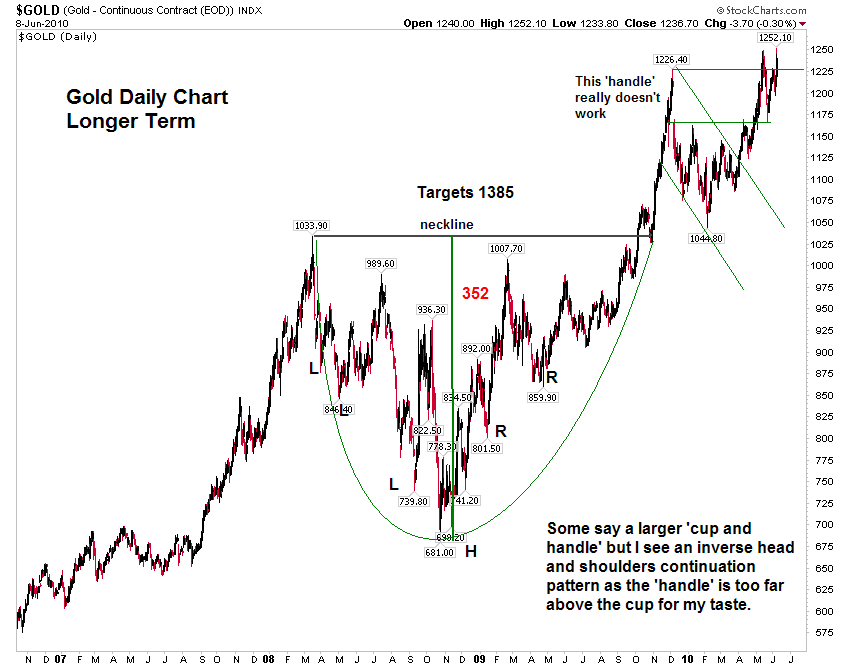
A friend and correspondent over at BullionVault reminded me the other day that some have been watching what they consider to be a larger cup and handle on the gold daily chart going back to 2008.

My depiction of that longer term chart formation is below.


I had carefully considered that interpretation last year but the handle formed much higher relative to the cup than I would prefer. Further, it did not form like a classic handle on the retracements. Instead I considered it to be a simple inverse Head and Shoulders continuation pattern in this bull market, from the extreme selling in the liquidity crisis.

The patterns have similar pricing objectives, unless you draw the lines as diagonals and attempt to measure off the top of the handle. Either way, each is a chart formation that is active and working with objectives north of where the cash price is today.

There are two reasons to use a cup and handle versus an inverse H&S. The first is that the breakout action on the handle is more easily charted and evaluated. A breakout through the neckline of any H&S is merely a binary event, whereas a handle permits more gradation. Head and Shoulder patterns are simple creatures. The second reason is that some people do not believe that an inverse H&S is an appropriate continuation pattern, and can only be used for a clear 'bottom' of a downtrend. I obviously do not agree with the latter. They can often act as continuation patterns after a severe selloff in a bull market trend that remains intact.

And there is of course, with the advent of modern computerized charting tools, the temptation to overcomplicate a chart and fill the page with far too many lines and circles and diagonal relationships to the point of obscurity, as though a Euclid of Alexandria had thrown up a lifetime of drawing on a basic price chart.

As an aside, sometimes readers will say things like 'So and So is a respected chart authority and he says...' And this is provided without justification, on the basis of authority. Well, one must always listen respectfully to learned opinions, but then look carefully at the empirical evidence, in a scientific manner, which in my book trumps theory and the 'rules' made by men.

When I was working at Bell Labs a very learned and internationally respected authority (and my boss' boss which was the ultimate power of that bureaucracy) told me that I "obviously did not understand information theory" when I presented the case for developing higher speed modems (> 9600 bps) , Digital Subscriber Line technology, and high speed local area transmission over unshielded twisted pairs, well in advance of their formative discussions on the CCITT and US IEEE committees. In other words, I have made my career in not accepting the conventional wisdom and authority of the day. Sometimes what you think you know prepares you for a world that no longer exists, because it was an illusion.

And that goes double for macroeconomics, which seems now more like marketing than mathematics, more astrology than physics. The US financial system is largely a confidence game, or more appropriately a racket dominated by rival white collar crime gangs.

Far too many economists tell people what they wish to hear, or what their masters are promoting, and attempt to give it the trappings of respectability with professional jargon, self-referential theories and elaborate faux proofs, with the trappings of equations based on falsified assumptions. If you want to measure a contemporary economist, see what they are saying, if anything, about reforming and restructuring the financial system.

A government needs to decide first what sort of nation it wishes to be, and then use economics as one means of sorting out more granular choices among policy decisions. To treat economics as a primary determinant of social policy is to perpetuate the hoax of the efficient markets hypothesis and the inherent goodness of 'free trade.' But it does helps economists to gain funding from the plutocrats, and serves to divert the public from the discussion of meaningful reforms.

Finally, at this point in my third career, I AM a 'chart authority' of sorts in my little circle, and it is my money on the line when I am investing, so I think I have some say, at least in my own kitchen, as long as she-who-must-be-considered is out front. lol.

Here is a picture of the pullback on the cup and handle we have been watching for the past few weeks. So far it is as expected.


08 June 2010

Gold Sets a New All Time High


Gold spot price briefly spiked over 1250 before pulling back as speculators took profits, and metals bears put on fresh shorts in the hope of an overreach and a double top.

The breakout needs to take out the 1250 area and hold it, put a nail in it. It will likely back and fill before making its move. I have added the new short term fibonacci retracement levels to the chart.

There is something profound going on in the background of this market, making it well worth watching even if you do not have an investment interest in it specifically.


There is nothing wrong with selling strength and buying weakness to round out a trading position. But you never wish to lose your entire position in a bull market, because it becomes a formidable task to buy back in, a real effort of will and emotion to get back on the train once it has left your standing at the station. Rather than admit they were wrong, most amateur investors will instead become bystanders and spectators, jeering and cajoling the passengers to get off as well, so they do not feel so foolish and lonely as the bull market passes them by.

"For instance, I had been bullish from the very start of a bull market, and I had backed my opinion by buying stocks. An advance followed, as I had clearly foreseen. So far, all very well. But what else did I do? Why, I listened to the elder statesmen and curbed my youthful impetuousness. I made up my mind to be wise carefully, conservatively. Everybody knew that the way to do that was to take profits and buy back your stocks on reactions. And that is precisely what I did, or rather what I tried to do; for I often took profits and waited for a reaction that never came. And I saw my stock go kitting up ten points more and I sitting there with my four-point profit safe in my conservative pocket. They say you never go broke taking profits. No, you don’t. But neither do you grow rich taking a four-point profit in a bull market." Jesse Livermore

Net Asset Value of Certain Precious Metal Funds and Trusts


07 June 2010

SP June Futures Daily Chart


The SP futures were selling off after the close of cash trade and went out on the low of the day around 1047.50.

That is some big support down at the prior lows, and if it does not stand up to a meaningful test the 990-1000 level beckons.

The performance of gold today, moving sharply highly in terms of dollars while US equities were falling was interesting, but the sharp rally in silver was stunning. This tends to lend some credence to the stories of a developing short squeeze in bullion that we keep hearing about. With the right catalyst we might see something pretty spectacular. But as always, play the probabilities if you want to remain standing in this game. The way to take advantage of the unexpected is by having core positions in a bull market trend and never touching them while the trend remains intact.

The June futures will be rolling over to the September contract soon enough, so we will be changing this chart. The basic shape of the formations will remain the same, but the support and resistance levels will change because the later month carries a different premium to the cash market.

SP futures drop again into the fourth circle of hell.


Gold Attempting To Break Out to New Highs


Gold is attempting to break out and confirm its cup and handle formation. It moved sharply higher on increasing volume right after the PM fix ($1,215) at the LBMA in London. If it can surmount resistance just above it may do a breakaway gap higher some evening and keep going. I will be a little surprised if it can break out quickly and in one move. Backing and filling the breakout is more likely, unless there is some sort of default in progress, or a heightened risk of a failure in the paper markets somewhere. I thought it was interesting that the rally was triggered off the PM fix in London, the 'fractional reserve' bullion market.

Some accuse me of being too conservative in my gold forecasts. Or at least they do when it rallies. Others think I am far too optimistic, but from economic theory most appropriately described as faith-based, but profanely so.

Let the charts speak for themselves. But however it develops, I will say that what we are witnessing is a generational monetary phenomenon, at least for those who have the eyes to see it. This is one of the few things of which I have been certain, and looked for it starting in 1999 when it became obvious that the dollar could not sustain its role as a gold substitute with the stability that is required of the world's reserve currency.

I am getting more anecdotal information of panic buying of physical bullion especially from substantial holders of 'old money' and amongst some of the average investors in Europe and Asia. I do not think that the public by and large has even started to buy bullion in the States. When they do the Comex will be overwhelmed and simply default, and then the situation will intensify as even more financial frauds and semi-official corruption begins to be revealed across many markets and institutions that have been operating in secrecy.

"Every thing secret degenerates, even the administration of justice; nothing is safe that does not show how it can bear discussion and publicity." John Emerich Lord Acton
For the most part Americans, and perhaps it would be fair to say even most of the English speaking peoples, are still moving through life blissfully and largely unaware of the global currency crisis and its implications for them, with a few notable exceptions. The trust they have placed in their politicians and institutions is being badly abused, and they will be shocked if the extent of its breadth and depth, the secret dealings and corruption, are ever exposed.


The details of each chart are unique, as is every breakout. So far the gold action suits the overall framework, but it would be a mistake to look for a perfect duplication, particularly in markets that are tainted with paper manipulation and semi-official fraud.


The Great Recession


Employment figures clearly show that this is much more than a cyclical recession. It is the breaking of an historic credit bubble, made worse by the Fed's policy responses and recommendations on banking regulation since 1994.

If you look closely at the chart below, you will see that if you subtract the temporary government hiring for the Census, there is no recovery in employment. It is flat. With all the trillions spent so far, why is there such a weak response?

You cannot kick start something with a quick blast of stimulus if it is still broken. So any stimulus to the economy or subsidies to the banks that are being applied are essentially wasted, until the system is significantly reformed and restructured. That is the problem.

Worse than wasted really, because it robs future governments of the ability to engage in constructive action. Like a third world country, the pigmen were the first to the trucks, with the help of corrupt politicians, and are stealing the aid intended for the public and have been hoarding it.

Stimulus. Reform. What we have seen so far from the Congress, the Fed, and Wall Street is simply white collar looting, and ironically in a crisis which they created.

And when the investigations and trials come later, which they will, watch how the pigmen claim complete ignorance of any wrongdoing even in their own companies or at most a few sincere errors in judgement, just like the CEO's and bankers and the financiers have been doing already in front of the Congress and the FCIC.

Hyprocrites and liars playing the public, whom they secretly despise as their inferiors, for fools. This is the prevailing attitude in Washington, the mainstream media, and on Wall Street.


This excellent chart is from Calculated Risk.

And as an aside regarding purported sources of our troubles, an Economic Chupacabra sighting in the People's Republic...

"Many people believe Goldman Sachs, which goes around the Chinese market slurping gold and sucking silver, may have, using all kinds of deals, created even bigger losses for Chinese companies and investors than it did with its fraudulent actions in the US.” China Youth Daily

06 June 2010

Silver Charts and a Look at the SP 500 Long Term Cash Chart


Several readers have asked for thoughts on the silver charts.

Silver normally functions as both a monetary and an industrial metal. This provides it with a higher beta (risk variation both on the upside and downside) than gold, and a stronger correlation to the SP 500.

So if one is looking at silver, one first has to ask, what do we think the SP 500 will do next, and then, what will gold do next?

SP 500 Long Term Cash Chart

The SP 500 is at a point where it will either find a footing and break back high according to its longer term bull trend, undoubtedly with serious assistance from the monetary authorities and their banking cohorts, or it will break down further and activate a more serious decline and a H&S topping pattern.

My bias now is for further weakness to the downside, possibly even a false breakdown, and then we will look for the turnaround to gain traction IF volumes remain light and there is no panic selling.

If there is a further decline, let's see if it can hold the 1000 area where there is a long term bottom of the bull trend channel.


Silver Daily Chart

In the short term silver appears to have further downside. How much is a very open question.

If and only if the SP 500 falls out of bed and there is a general liquidation of assets, silver may trigger a short term H&S top and fall down to the target area in green. There it is likely to be a singularly attractive trading buy, but we would have to look at the overall market landscape and the Fed's monetary actions.


Silver Weekly Chart

The weekly chart appears much stronger than the daily chart, suggesting that if there is a breakdown it might be short term, and look much worse on the daily chart, an intra-week spike down on the longer term chart. Again it is hard to say because the SP 500 is such an important variable in this.


I doubt very much that silver and the SP 500 will diverge. Gold however is more likely to diverge from stocks if it comes to that.

I have some confidence in Ben's and Timmy's willingness to sacrifice the dollar and the bond for stocks in the short term, and the US bond appears to be topping. The dollar DX index is looking toppy, but as I have repeatedly said this index is badly out of date, being so heavily weighted to the euro and the yen.

The way I will play this is in the obvious paired trades with little leverage and a short term bias until the situation clarifies. There is a distinct possibility that stocks, gold and silver all go up from here. These market are being driven by artificial liquidity, largely based on thin volumes, carry trades, and technical gambits by the big hedge funds and trading desks.

When you are playing in a rigged casino, don't be all that surprised if your 'systems' and indicators do not produce the usual, or even normalized, results in the short term. The intelligent individual response is to stick with the primary trends, based on fundamentals and the longer term charts, and tighten your leverage and lengthen your investment timeframes.

Or even better, stay out of trading altogether. It is a con game these days, especially in the English speaking countries.

Here is a news piece from the City that is worth reading: Why Rothschilds Is Piling Into Gold

This tracks closely with some information I had from some big private money people in the States, particularly in the old money northeast US.

04 June 2010

US Total Government Debt Reaches 130% of GDP


Here's a postcard from off-balance-sheet country.

This includes only current debt and not future unfunded obligations.

I like to call this US debt chart "The Last Bubble," but it could equally apply to a chart showing the representation of this debt - the US bonds, notes, bills and of course dollars, which are really nothing more than Federal Reserve Notes of zero duration in the modern fiatopia.

It all adds up, eventually, and must be reconciled. It is easier to print money and accumulate debt when you own the world's reserve currency. For a while the dollar might even flourish, despite the printing, as the international savers flee ahead of the economic hitmen, from country to country, and crisis to crisis.


Chart compliments of the Contrary Investor.

Gold Daily Chart Bounces Back on a Flight to Safety


Gold often functions as a safe haven because it is a remarkably universal currency, both temporally and geographically, that is not subject to the liabilities of other parties or even national balance sheets, except potentially to the upside because of fractional reserve holdings and leveraged selling. The most significant downside to gold is the animosity that is felt by those that perceive it as a threat to the status quo, in this case the US dollar as the global reserve currency.

Silver is less constructive because it acts as both an industrial metal and a currency but with a high beta. Longer term is has significant potential, but in a crisis it will not perform as well as gold.

A reader informs us that 'investment gold' is exempt from the 15 to 20% VAT in Europe, whereas silver is not. This represents the thinking in Europe that gold is money, an alternative form of money or currency. So therefore as the Europeans seek safe havens in the event of a euro decline or devaluation, they are flocking primarily into gold and dollars, for which there is no VAT, and secondarily into other investments like silver, diamonds, etc.

The miners are a stockpicker's vehicle even in good times, but especially so in a bear market, since they are correlated to the SP 500 as well as the metal, often with significant leverage correlated to their cash flow and financing requirements.


SP Daily Chart: Looking Ugly as Baghdad Barrack Declares Economic Victory


By now you will have heard about the shocking miss on the US Payrolls Number, made even more shocking by the cheerleading that preceded it by the likes of Goldman Sachs(who were probably on the other end of that trade> and by Barack Obama himself.

The administration had nothing constructive to say this morning except for mindless sloganeering by the likes of Christina Romer, Obama's chief on the Council of Economic Advisor, who is unlikely to inspire confidence when delivering even good news, much less a clear sign of economic policy errors and a double dip in the making.

With Romer, Summers, and Geithner, the President has managed to put together the economic scream team. Even Volcker is starting to look tired and ineffective. His recent proposal of a VAT, the most regressive of taxes, sounded less like a democratic reform and more like something from the Bilderberg playbook. One has to wonder how long will it be until they start recommending the sale of key sovereign assets to corporate oligarchs.

And then there was Baghdad Barrack, talking up the economy and the jobs numbers this morning at a Maryland truck garage. He seems to be trying to run a bluff, talking his way past his team's economic policy errors and corruption, a reflexive strategy that may have served him better when he had no real responsibilities or quantifiable results.

One might feel better if the other party had not already proven itself to be the party of the elite and the wealthy special interests, without vision or ability, creating many of the problems that are sinking the US today. Things do indeed seem bleak when the reform government fails.

It appears that the SP futures may be forming a bear flag, with another big step down to follow. That would be 'bad news' because below the support at 1040 is a disturbing possibility of a triple digit SP 500.

Chart Updated at 3:30 EDT


03 June 2010

Gold Daily Chart: A Typical Fibonacci Retracement Pattern So Far


The key support levels in the pullback from the handle resistance are 1205, 1198, and 1190. These are the three key fibonacci retracement levels, although it would not be completely unusual to see a pullback to 1166. I don't think it will happen, but the market will have the final say and we must listen.

This has the look of a bear raid by the funds and banks. They were hitting the mining stocks hard first, and then the metals. The planting of negative articles and comments by funds with friendly authors was also apparent, to the point at times of silliness.

And there are plenty of investors who have missed the rally, or with a certain ideological bias, who want to see prices fall. Misery loves company. The irony is that most will never bring themselves to buy back in, because they are always looking for THE bottom, and a lower price. They will more likely buy closer in the second leg higher, when fear overcomes their greed.

This is how bull markets operate, and the reasoning behind chart formations. Charts attempt to capture typical market behaviour, and nothing more than this. They influence some trading if enough people follow them, but by and large they cannot change the primary trend. And so far this looks like a typical bull market climbing a wall of worry. Let's see if anything changes.

The 1206.80 price on the chart is as of 2:45 PM EDT.


Here is a chart comparing the Gold Bull Market compared to the famous Dow Jones Industrial Bull Market, courtesy of Mark J. Lundeen who posted it at LeMetropoleCafe.


And finally, h/t to Tarlton Long, here is an example of some of the 'rubes' who are holding gold in their portfolio and its percentage of their Assets Under Management.


And finally Harvey Organ's June 2 Gold and Silver Commentary is worth reading.

02 June 2010

Obama Gives Us a Hint: Look for a Hot Jobs Number on Friday - Mission Accomplished


Since he is the commander-in-chief of the Washington bureaucracy that churns out government statistics, it is a good bet that the boss' expectations will be met by those who serve him. So watch those short positions into this Friday's Non-Farm Payrolls report. The President has declared that an economic recovery is at hand.

Obama gave a longish speech at Carnegie Mellon University in Pittsburgh today blaming most of the problems in the US on the Republicans and a few greedy Banks, extolling the reforms in healthcare and the financial system that he has been able to push through despite the minority opposition, and recalcitrant leftish supporters, after he saved the country by the unfortunate but unavoidably necessary bank bailouts.

His speech sounded good. And if you do not look too closely at what is going on, and how things are being run, and the lack of actual reform, you might have had a feel good moment. It was about as effectively staged as the case that George W made to the American people for the invasion of Iraq. And it was probably just as phony and self-serving.

I come away feeling that Lincoln had it exactly right. There will be a die hard group who will never lose faith in their party, or any of their chosen leaders, and will find desperate comfort in partisan blindness.

"If you once forfeit the confidence of your fellow citizens, you can never regain their respect and esteem. It is true that you may fool all of the people some of the time; you can even fool some of the people all of the time; but you can't fool all of the people all of the time." Abraham Lincoln
But the great majority of the American people are waking up, and that spells trouble in the November elections for most incumbent politicians. So the pace and velocity of the spin will have to be adjusted. Hence the speech today. And the outlook for the tortured American economic system, and the official descriptions of it.

For a refresher, here is Matt Taibbi's caustic expose of the financial reform process. Wall Street's War

Dow Jones Newswire
Obama Says He Expects Strong US Jobs Report Friday
By Jared A. Favole

WASHINGTON -(Dow Jones)- President Barack Obama, speaking Wednesday at Carnegie Mellon University on the economy, said he expects strong job growth to be reported Friday.

The Labor Department is scheduled to report May's employment statistics Friday. Economists expect the unemployment rate to slide to 9.7% from 9.9% in April and for the report to show the U.S. added as many as 515,000 jobs last month after non farm payrolls rose by 290,000 in April.

Obama said an economy that was "once shrinking at an alarming rate" has now grown for three consecutive quarters and is moving in the right direction.

I watched this speech live on Bloomberg television. It is no exaggeration. Obama was declaring mission accomplished, for the record. So if something beyond his control should happen to derail the recovery, well, that could not be his fault.

Bank of Canada Becomes First of G7 to Raise Interest Rates


Interesting move by the Bank of Canada to raise, albeit cautiously, its key interest rate by 25 basis points to .50%.

The reason for the increase is the obvious 6.1% growth in 1st quarter GDP led largely by housing and consumer spending, counterbalanced by slack inflation and wage growth.

So, Banque du Canada wishes to take a little off the top of its own housing bubble, and please its friends in the US by strengthening its currency against the dollar, so as to not further imbalance the significant exporting activity between the two trading partners.

I doubt very much that Canada will raise again in July, especially as the non-recovery in the US becomes more apparent. As I recall Canada fared much better in the last Great Depression because their more conservative banking sector required less reform, and offered less damage to the real economy. It appears that this will work in their favor again, despite some looming problems perhaps in housing.

Still, it is interesting to see the commodity strong countries like Australia and Canada raising rates even while Europe and the US economies remain wobbly.

Bank of Canada Press Release
Bank of Canada increases overnight rate target to 1/2 per cent and re-establishes normal functioning of the overnight market

OTTAWA – The Bank of Canada today announced that it is raising its target for the overnight rate by one-quarter of one percentage point to 1/2 per cent. The Bank Rate is correspondingly raised to 3/4 per cent and the deposit rate is kept at 1/4 per cent, thus re-establishing the normal operating band of 50 basis points for the overnight rate.

The global economic recovery is proceeding but is increasingly uneven across countries, with strong momentum in emerging market economies, some consolidation of the recovery in the United States, Japan and other industrialized economies, and the possibility of renewed weakness in Europe. The required rebalancing of global growth has not yet materialized.

In most advanced economies, the recovery remains heavily dependent on monetary and fiscal stimulus. In general, broad forces of household, bank, and sovereign deleveraging will add to the variability, and temper the pace, of global growth. Recent tensions in Europe are likely to result in higher borrowing costs and more rapid tightening of fiscal policy in some countries – an important downside risk identified in the April Monetary Policy Report (MPR).

Thus far, the spillover into Canada from events in Europe has been limited to a modest fall in commodity prices and some tightening of financial conditions.

Activity in Canada is unfolding largely as expected. The economy grew by a robust 6.1 per cent in the first quarter, led by housing and consumer spending. Employment growth has resumed. Going forward, household spending is expected to decelerate to a pace more consistent with income growth. The anticipated pickup in business investment will be important for a more balanced recovery.

CPI inflation has been in line with the Bank’s April projections. The outlook for inflation reflects the combined influences of strong domestic demand, slowing wage growth, and overall excess supply.

In this context, the Bank has decided to raise the target for the overnight rate to 1/2 per cent and to re-establish the normal functioning of the overnight market.

This decision still leaves considerable monetary stimulus in place, consistent with achieving the 2 per cent inflation target in light of the significant excess supply in Canada, the strength of domestic spending, and the uneven global recovery.

Given the considerable uncertainty surrounding the outlook, any further reduction of monetary stimulus would have to be weighed carefully against domestic and global economic developments.

Information note:
The next scheduled date for announcing the overnight rate target is 20 July 2010. A full update of the Bank’s outlook for the economy and inflation, including risks to the projection, will be published in the MPR on 22 July 2010.


Net Asset Value of Certain Precious Metal Funds and Trusts


Sprott completed its premium-busting unit offering and is now using the cash proceeds to procure bullion for the fund at an aggressive pace that suggests that it had made arrangements beforehand.


SP June Futures Daily chart


This market seems to be all technical play, lacking genuine investment interest as opposed to short term speculation.

If the 1070 level cannot hold into the open we will problem go down to retest that low around 1035.

Non-farm Payrolls report at the end of this week. Watch out for more games, wash and rinse. But a 'bad number' could be the spike in the rally hopes for those of the bullish persuasion. Since I do not view this market as 'real' and engaged in price discovery it is hard to operate in it with conviction.


01 June 2010

31 May 2010

Remember


"Judge of the Nations, spare us yet.
Lest we forget—lest we forget."


"The Revolution was effected before the War commenced. The Revolution was in the minds and hearts of the people; a change in their religious sentiments of their duties and obligations ... This radical change in the principles, opinions, sentiments, and affections of the people was the real American Revolution." John Adams