12 August 2011

Gold, and Platinum, and Money, Oh My!


Traders have recently been remarking about a highly unusual event in the metals markets.

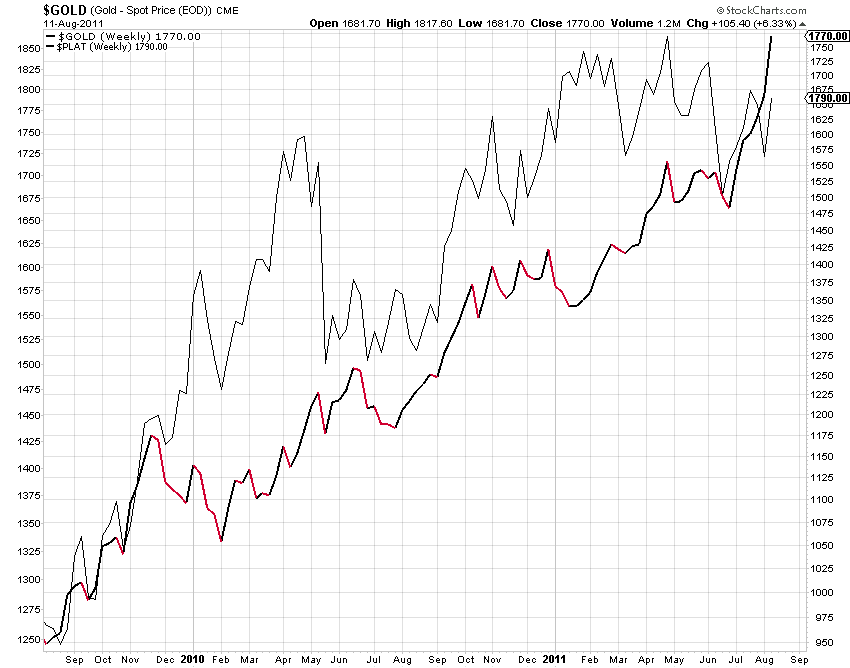
For the first time in quite a while, the price of gold per ounce has exceed the price of platinum per ounce. This is shown in the first chart.

There is even a paired trade being touted, short gold and long platinum. The caveat is that this is said to be a profitable trade IF there is a global recovery. Personally I think one must also assume that the recovery is not due to money printing.

Platinum is largely an industrial and consumer metal, even moreso than silver. Platinum has wide industrial uses in jewelry, catalytic converters, fuel cells, and hard drives among other things. similar to copper, platinum is an indicator of industrial manufacturing activity.

The use of platinum as money a store of value has relatively little traction except among collectors. The big price drive is its very useful properties for industrial use. I am not aware that it has ever been used as a national currency except for a brief period of time in 19th century Russia.

There is some secular effect on platinum, with substitution in some applications being achieved by palladium. But the two metals are tracking one another in price, as show in the chart below. So that seems to be a minor influence.

Some are confused because of the relative rarity of platinum, which is produced in fairly small quantities each year. But to look only at supply without considering demand is a basic fallacy of pricing. There is a definite shortage of honest politicians in Washington, but the ones that are there do not seem to be commanding very high prices amongst lobbyists, for example, as demand for honesty is also relatively low.

It does serve to look at a few more items as we see in the chart comparing price performance, rather than price, in the mix of gold, the SP500, the Commodity Index, and platinum. The Commodity Index is used as a broad reference and includes much more than metals.

Clearly industrial activity would seem to be lagging, while the money components of things like gold are increasing for some reason unrelated to commodity demand. That ought not to surprise anyone following the markets. The supply of paper money is increasing beyond demand of organic growth in the real economy, while demand for commodities used in production is slumping.

I would therefore not think the gold platinum pair to be particularly useful. I would consider something else if I believed that there would be an imminent industrial recovery.

Notice that I did not include copper or silver in these charts. That is because their performance tends to crush the meaning out of the others. Silver is responding to a massive break in a long term price suppression caused by artificial shorting activity. And copper is a more speculative market than most commodities.

I also did not include crude oil because, as nine out of ten Americans will remember, it is not a metal. And it sometimes has a speculative life of its own, especially as a reaction to certain regional conflicts. However being the indulgent sort I have included it in a final chart. It is a commodity.


11 August 2011

Mitt Romney to Iowa Voters: "Corporations Are People"


I think he was caught off guard.

I think he intended to say, 'Corporations are my best friends' instead of 'Corporations are people, my friend.'

Well at least now we understand when he says that he is 'a man of the people.'

It could have been worse. He could have said that 'Soylent Green is people.'

I can see that my comedic talent is going to have fertile input during the upcoming American presidential election.

This is the 'sane one.'


Mitt Romney: Corporations Are People - Salon


Gold Daily and Silver Weekly Charts - Bear Raid With Comex Margin Increases, Right on Cue


Machine gunning the life boats, strafing the refugees.

But it's hard to stop a rising tide.

Change is coming.


SP 500 and NDX Futures Daily Charts - Abandon Ship


I hear today that a number of the Congressional participants named to the Super Committee to Balance the Budget have signed pledges never to contemplate any tax increases. Perhaps the Democrats should sign a pledge to cut no entitlements, and the first meeting they can ask, 'So what do you want to talk about tonight Marty?'

So once again the Great Compromiser appears to be a hapless diddler attempting to organize a herd of squirrels.

This US equity market action reminded me today of a description I read about the equity markets during the summer of 1929. The American Experience series used one of the books which I read to formulate their wonderful documentary, The Crash of 1929.

It was an exceptionally hot summer, and the market had ups and downs that left investors shaken as if they had ridden on a roller coaster.  Leverage was high, and the markets were rife with speculation driven by newly created money and paper profits.

Of course there are profound differences as well.  The markets are hardly optimistic, and we have already seen a strong correction.  This is not to say that I expect the equity market to crash.  They can always crash something else, like the dollar or the bonds, or the system of governance.  Or perhaps the financial engineers will muddle through once again for a few more years.

Still it does not hurt to review an example of markets that were swinging widely because of serious problems in the economy, laissez faire politics, easy money policies, and the structure of the markets and their leverage themselves.  Perhaps this time Benny does not tighten, but perhaps the government will.


The Great Flaw in the Free Trade Theory And Other Vain Beliefs, Hoaxes, and Follies


There are several economic models and political memes that rely on an underlying belief in the natural efficiency and goodness of 'free trade' and 'efficient markets.' One can question whether these ideas promoted certain behaviours, or if certain parties promoted these theories to serve as justification for their policy objectives.

Whatever the case may be, let's take a look at the theories that seem to underpin the virtue of 'free trade,' meaning international commerce with very light national regulations and a centralized semi-autonomous authority as arbiter.

One of the theories in favor of free trade is the idea of comparative advantage, that is, that one country might have a natural advantage which they can exploit for their own benefit and the general benefit of the world. I am sure we all learned this in business school. I myself was quite a fan of Michael Porter in my day.

This theory is a universalisation of the idea that the naturally gifted pottery maker, for example, has an inherent talent that can be exploited, and can create and exchange pots for food, let's say, from a farmer who has the advantage of owning suitable farm land and has the talent and tools to exploit it.

Makes common sense does it?   Everyone does what they do best, and through the free exchange of  products the aggregate good is increased.  A nice simplistic maxim that underpins a broad economic and social philosophy, such as 'from each according to their abilities and to each according to their needs.'

The fallacy that is repeated over and over by the non-scientific thinker (like too many economists and politicians for example) who use these simple examples and sayings is that one can extend things that might make sense anecdotally into general, almost universal principles writ large on the face real world, or more properly OVER the face of the real world, that at the end have little real fundamental connection with reality and the expected outcomes.

This was Mandelbrot's great criticism of the neo-liberal school of economics, notably the Chicago School, for example. Their broad assumptions crushed the reality out of the math, and the application of their theory made the markets inherently unstable by miscalculating the risks which were allowed to grow to enormous levels, and then crash at the under-expected event, colloquially known as 'a black swan.'

There is some validity to this. Some nations, for example, are blessed with great natural resources such as coal and oil, and they can sell these items to other countries and regions in exchange for items like food, for example.

But like most efficiency arguments, most notably the efficient market hypothesis, these ripples in distribution or market anomalies are quickly exhausted, and in the classic impetus and peril of successful capitalism, the player start to create monopolies and other artificial advantages, such as frauds, which they can exploit more fully.

So for example, a nation such as China can devalue its currency substantially in the 1990's against the world's reserve currency, and thereby set up a set of artificial import barriers and export subsidies, simply by manipulating their currency.

By the way, this is basic math. There are plenty of people who were denying it, and most of them stood to benefit from this charade. But it is true. Anyone who travels internationally and changes money understands it.

The underlying basis of the currency wars is the ability to artificially manipulate one's currency, or even establish a pseudo-monopoly, for the advantage of one to the disadvantage of the others.

There are other methods to accomplish this and they are usually lumped under the title of industrial policy or mercantilism. A country has a set of laws and regulations that foster a certain stance towards issues such as worker's rights, environmentalism, savings and consumption, wealth distribution and even human rights.

The more trade becomes independent of public policy and regulation, the greater the movement of all countries to the least common denominator of the broader policy stances of the mercantilist nations.

In a very real sense, if you control the issuance and terms of money, you care not who makes the laws locally. And the exchange of trade mechanism is a subset of the control of a medium of exchange, which is the trade system, both international and domestic, the who and how people can buy or sell.

This principle seems to be the basis of the inclusion of gold and silver in the money system series of essays written by my friend Hugo Salinas-Price, and the age old understanding of the balancing mechanism of a harder and higher standard of exchange to manage the tendencies of various participants manipulate the rules, and to 'cheat.'

Anyone who believes that believes that markets and society do not require clear laws and impartial referees because people are naturally inclined to know and do the 'right thing' has obviously never driven on a modern American freeway.

If, for example, we were in a gold standard system for international trade, and the governance had allowed China and its multinational capitalist friends to game the system as they are doing now, eventually the flow of gold from the US to China would compel the US to devalue its currency against the Yuan, and thereby persuade China to release more of its reserves as gold back into the system by purchasing other things. If they used it to buy US debt for example, the dollar would continue to devalue in a cycle which would hamper and ultimately defeat the currency mercantilism.

It would have also restrained the US from manipulating the world by 'owning' the world's reserve currency and the 'exorbitant privilege' therein. It would have curtailed unfunded wars, and the exporting of jobs and production in favor of a 'service economy' that consists largely of pushing the reserve currency around the plate, and skimming the greatest portion for an elite group of policy leaders.  No standard is perfect, and there are ways to subvert some external standard like gold, but it is more difficult to do, and it is more easily seen and exposed if the standard is resolute and robust.

We see a similar principle in action in the theory supporting efficient markets. On paper they sound good, but they are deeply flawed because of the nature of the assumptions they make about people and their rationality and selflessness.

As most gardeners can tell you, there is rarely such a thing as a naturally beautiful and weed free garden, especially the ones that look 'natural.' It takes a great deal of forethought, adjustment, and continual work to make anything sustainable in this world of ours. And so it is with markets, both local and international.

There are those, like former Fed Chairman Greenspan, who argue that the fiat regime of the Federal Reserve works if the Fed 'acts like a gold standard,' that is, with an unapproachable virtue.  A similar theory underpins the World Trade Organization's function in international trade.  But like all human systems, they tend to fall to the great truth observed by Lord Action some years ago, that "where you have the concentration of power in a few hands, all too frequently men with the mentality of gangsters get control. History has proven that."

I am not promoting a gold standard per se and understand the problems inherent with it, and do not wish to discuss that here.

But what I am attempting to do is expose some of the fallacies of the zombie economic theories that have led the world to the place where it is today, with too much discretionary power concentrated in too few hands, with a propensity to act in secret and with an excess of latitude behind the cover of those artificial constructs known as 'corporations.'

This notion that government and regulation is the problem is true only to the extent that government has become weakened and corrupted by gross abuses. Effective government takes planning, continual hard work, and the adjustment of renewal and reform.

Human constructs, if not continually managed and repaired and occasionally renewed, tend inevitably into disruption, dysfunctionality, and corruption.

To say, let's just get rid of it and things will somehow become naturally good is to attempt to build a castle in the clouds. It will not and has never worked to promote a harmonious and productive society on a large scale, ever, in all of human history. It is the law of the jungle. But it has its continual appeal to sociopaths, misfits, the naive, the frustrated, and psychopaths. 

It is a tool of the false dialectic of extremes, that argues that the choice is between no government and bad government, and that if government is not perfect it is inherently evil.  Because they are driven to extremes, those who argue this cannot see the great middle ground, of an imperfect government that nevertheless is capable of maintaining justice and order within the context of freedom.   Failure is only certain at the extremes, of authoritarianism and anarchy, when by two different paths one turns society over to the wolves.

The longer this artificial construct of natural goodness and perfect rationality is maintained, the greater the forces against it will build, until countries and nations explode into revolution and wars, as a consequence of folly. 

The model in my forecast says that meaningful reform to the status quo will not be readily accepted by the power elite  They will promote a 'new normal' which will span a leisurely 'five to ten years' for economic recovery, while they are comfortably standing above it all on other people's necks.  The ability to set oneself aside and apart, as separate and above, from the rest of humanity is served in many ways and by many things. It is a dangerous delusion to feel naturally privileged for whatever reason. It can only be maintained through power, and power is a deadly narcotic.

We can be thankful that other crackpot theories have not become mainstream, such as eugenics, or the marginalizing and then disposal of the weak, the disabled, and the different to serve the economic advancement of the state. Or groupthink, and profound belief in national or racial exceptionalism that tends to lead groups to quick utilitarian solutions and Pyrrhic ends. So there is some room for optimism.

Change may not come until the powerful are standing in ashes, and therein lies a tragedy yet to unfold. Let us work on with hope that reform comes well before then.


Financial Times
Swiss central bank considers euro peg
By Peter Garnham

The Swiss National Bank, which has been waging battle to rein in the strength of the currency, has left open the possibility of pegging the Swiss franc to the beleaguered euro.

Thomas Jordan, vice-president of the SNB, said a temporary franc peg with the euro was within the range of options that policymakers might use to stem the Swiss franc’s strength. “Any temporary measures to influence the exchange rate are permissible under our mandate as long as these are consistent with long-term price stability,” he said.

Mr Jordan added that the central bank could employ other tactics, however, raising speculation that the central bank could impose penalty rates on non-resident franc deposits for the first time since the 1970s.

“We still have, at the moment, possibilities to make monetary policy more expansive without intervening in the Swiss franc,” he said.

The comments came after the SNB launched a fresh assault on what it has described as a “massively overvalued” franc on Wednesday by flooding the Swiss money market with liquidity to meet demand for the currency. The Swiss franc pulled back from record highs on Thursday after the bank’s latest action.

The Swiss franc has been driven higher in recent weeks as investors have sought a haven from concerns over eurozone and US government debt and worries over global growth...

10 August 2011

CME Raises Margin Requirements on Gold and Treasuries and Energy and Swiss Francs


...and Pesos, Rubles, etc. etc.

CME Boosts Margins - CME Site Bulletin

WSJ - CME Boosts Margins on Forex, Treasuries

Ok gold I understand, kind of. I just wondered if CME was going to raise margins and signal a bear raid in my gold chart commentary this afternoon.

But Treasuries?

Why be subtle? Why not just machine gun the lifeboats?

Git some. Git some. Get back in them big caps, tech, and bank stocks you wussies.

I wonder if this applies to Shanghai's SME and London's LBMA. lol.


h/t to Lee at Wall Street Examiner for the heads up.

Gold Daily and Silver Weekly Charts - Gold Shorts Were Being Carried Out on Stretchers


Gold has had a remarkable run higher. It has reached the point now where an additional rally without at least a consolidation starts to approach a breakaway run, something with a bigger correction in its future. So I would welcome a pause for the market to at least catch its breath and attract some stability.

Silver needs to go much further to catch up. Even though it has rallied it is still a bit weaker after having gone parabolic and then corrected so violently.

I suspect that at some point the equity markets will find their footing. Typically this happens after a day of deep selling and capitulation, maybe even 1000 points down on the DJIA intraday. Or some announcement by the government that changes the playing field.

Dangerous markets.

From London Trader - Read the Full Commentary at King World News:
“These guys in London woke up with their asses handed to them and I don’t think some of these guys will ever be short again, if they are still in business. So some of these perennial shorts that have always joined in the party got screwed, I mean literally lost everything. For the ones that didn’t lose everything, they certainly lost an awful lot.

Gold just gapped up and didn’t come back and these guys were heavily short. I believe there is still enough momentum to push gold into the $1,800’s. We are moving into season now and things are happening in China that will impact the markets in due course. Because we have been seeing that point of capitulation, we have been witnessing some dramatic moves as the shorts have been mauled, and as I mentioned, in some cases to the point of ending careers.”

I am wondering if the CME and their crew aren't going to pull another margin increase operation at some point on gold when the time is ripe, as they did after allowing silver to run up higher. JPM's 2500 gold call is making me edgy. I took profits today.

Be careful.


SP 500 and NDX Futures Daily Charts


It is going to take a selling capitulation with the DJIA down over 1000 points intraday, or some sort of government announcement or action to turn this market around.

It does seem to be trying to find some footing on the chart here, but lately that just means a pause before we see another downdraft.

Markets like this are deadly for bottom-pickers. Be careful. Rough waters, matey.


Lessons Forgotten


I do not and can not condone violence, ever, except in the most dire and extreme circumstances in defense of home and family. The resort to violence in the case of a powerful oppressor is to give them what they desire, the intention of their provocations: the excuse to repression, murder, and genocide.

But non-violence, as Gandhi so eloquently observed, is the weapon of the strong, of the clear-headed, of the disciplined and devoted, and of the exceptionally brave whose courage is deeply grounded in something other than themselves. Without exceptional leadership, it rarely occurs naturally.
"There is no bravery greater than a resolute refusal to bend the knee to an earthly power, no matter how great, and that without bitterness of spirit, and in the fullness of faith that the spirit alone lives, nothing else does."
So as a response to prolonged injustice, violence often occurs, sparking mindlessly. To try and understand it, where its roots lie, is not to condone it, but to determine what it is and why it might be happening.  This is the path to a lasting remedy.

Is this some excess of youth fueled by drink and wild spirits, as in the aftermath of a sporting event, or is it something more profound than the wildness of men in groups? 

There is little doubt in my mind about the nature of what we are seeing today. I forecast the progress of these events years ago, as far back as 2002.

I am appalled to see that things are following that course.   I even forecast the burning of cities in Britain.  People at the time were incredulous at this. And yet here we are.

When you suppress discussion and choice, and abuse reason and justice over a period of years, you will ultimately bring forth the madness. And those who would use such a crisis, who imagine that it will serve their purpose, they will find that the will to power serves none but itself.

"Our government teaches the whole people by its example. If the government becomes the lawbreaker, it breeds contempt for law; it invites every man to become a law unto himself; it invites anarchy...If we desire respect for the law, we must first make the law respectable."

Louis D. Brandeis


"Men naturally rebel against the injustice of which they are victims. Thus, when plunder is organized by law for the profit of those who make the law, all the plundered classes try somehow to enter, by peaceful or revolutionary means, into the making of laws. According to their degree of enlightenment, these plundered classes may propose one of two entirely different purposes when they attempt to attain political power: Either they may wish to stop lawful plunder, or they may wish to share in it."

Frederic Bastiat


"And remember, where you have the concentration of power in a few hands, all too frequently men with the mentality of gangsters get control. History has proven that."

Lord Acton


"Those who make peaceful revolution impossible will make violent revolution inevitable."

John F. Kennedy

When the governance of a society refuses to listen to the calls for justice and reform over a long period of time, when it acts to ignore, co-opt, diffuse, and then suppress the voice of the reformers, when it uses the law as a means of legal plunder, that government and society will eventually answer not to reasoned dissent, not to principled calls for reforms, but to the rage of the mob.

And then that society may call for the strong man to come forward and bring these unruly other ones to heel, operating on his own and beyond the law, using whatever means he wishes, even to suspending of the law for the sake of expediency, and ultimately engaging in crimes against humanity for the sake of justice.

And that is always a Faustian bargain, a path of self-destruction. But in a people gripped by frustration, anger and fear, it is a powerful temptation.

Violence and expediency invites dark powers to rise and insinuate themselves among you. And then begins the downfall, an almost inevitable descent, and perilous journey, into a hell on earth.


"One may dislike Hitler's system and yet admire his patriotic achievement. If our country were defeated, I hope we should find a champion as indomitable to restore our courage and lead us back to our place among the nations."

Winston Churchill, The Times, November 7, 1938


Tsar Nicholas II: I know what will make them happy. They're children, and they need a Tsar! They need tradition. Not this! They're the victims of agitators. A Duma would make them bewildered and discontented. And don't tell me about London and Berlin. God save us from the mess they're in!

Count Witte: I see. So they talk, pray, march, plead, petition and what do they get? Cossacks, prison, flogging, police, spies, and now, after today, they will be shot. Is this God's will? Are these His methods? Make war on your own people? How long do you think they're going to stand there and let you shoot them? YOU ask ME who's responsible? YOU ask?

Tsar Nicholas II: The English have a parliament. Our British cousins gave their rights away. The Hapsburgs, and the Hoehenzollerns too. The Romanovs will not. What I was given, I will give my son.

For his obsession with power and privilege Nicholas gave his son, his wife, and his daughters a hard death in a dark cellar. But their dresses were sewn with jewels.

09 August 2011

Gold Daily and Silver Weekly Charts - La Douleur du Monde


You have to choose between trusting to the natural stability of gold and the natural stability of the honesty and intelligence of the members of the Government. And, with due respect for these gentlemen, I advise you, as long as the Capitalist system lasts, to vote for gold.

George Bernard Shaw

Very volatile day in the markets, with gold leading the way higher and silver lagging a bit here in the short term.

Gold appears to be rising strongly, but not so much parabolic as some might imagine. It is certainly short term extended to the upside, calling for some type of correction or consolidation. But the fundamentals remain compelling.

These are dangerous markets, especially the equity markets. Please be very careful with your trading.

Stocks are now trading like commodities, largely on the technicals, and with High Frequency Trading still dominating the trade, they are only loosely associated with reality. This is what has been driving people to look for something solid, reliable.

Alas, it is hard to find. Even in gold, the paper trade has distorted markets for years as a result of the failure of the CFTC and SEC to maintain honest and efficient markets. So the rest of the world starts to create its own markets, and the decline of the American Empire begins to accelerate.


SP 500 and NDX Futures Daily Charts


Any excuse will serve a tyrant.

Aesop

The Fed threw the market a bone, stating that they would maintain easing through the upcoming Presidential election if the economic conditions called for it.

And so a powerful relief rally ensued. Whether it will be maintained is another question and answer, heavily influenced by the upcoming economic reports, especially with regard to employment, median wage, and spending. And of course the sovereign debt situations and wobbly governments around the world.


Federal Open Market Committee Pledges Monetary Easing Through 2013 If Required


About what one might have expected.

No specific action at this time, but reassurances that the Fed recognizes the downturn in the economy, with fresh evidence of this since their last meeting in June, and higher risks to recovery through lack of confidence in financial assets, and slack employment and spending by consumers.

In a very real sense the Fed is attempting to bridge the gap between fiscal and monetary policy, given the inadequate response from the federal government to the financial crisis. 
The Fed changed the wording from 'extended period' to 'through 2013.'   I had expected them to say 2012 but since this is not a binding limit it is of little consequence, except to signal that the upcoming presidential election will not deter them from taking what they believe to be the necessary steps to maintain the financial system.  Default may be all right with some, but the Fed apparently does not concur.

There were three dissenting votes, from Plosser (Phila), Kocherlakota (Minn), and Fisher (Dallas), based according to reports primarily on this statement regarding longer term easing based on economic conditions.
"...are likely to warrant exceptionally low levels for the federal funds rate at least through mid-2013."
I tend to think that their dissent, if based solely on this, represented some sort of intellectual stand, as the statement clearly represents no firm commitment to rate policy, but is intended to put some meat in the reassurance.   There is recent precedent for this approach in other central banks.  It is intended to convey intent to reassure the longer term horizon of business decision, but is clearly not a commitment.

And if the dissent was based on a desire to RAISE rates, which I highly doubt, I would think that those governors might be operating in some alternate universe with different relationships and conditions. I am open to contrary arguments, but it is most likely that a desire to raise rates would be based on some ideological persuasion or first principle rather than on sound economic theory.  

The dissenting votes may feed into the 'no confidence' in the governance of the country based on ideological differences and zombie economic theories that continue to hinder real recovery. 

But at the end of the day it is official acknowledgement of the weakness of the economy, and easy money as needed through 2013. The markets will most likely recover from these extreme short term trends, barring new difficulties, especially from Europe.   How robust that recovery will be is another matter.  The inability to reform is a significant impediment to growth and a return to normalcy.

Whether any sort of a sustained rally of more than a few days ensues is another matter.  The system appears to be broken, corrupt, and dysfunctional.  The solution may not appear until the suffering becomes more widespread, shaking the fortunate out of their comfortable complacency.

I should add here that if the equity market does not respond sufficiently on the announcement, we may see the entry of the Exchange Stabilization Fund and its house banks, either into the close or tomorrow. They tend to do this to reinforce some Fed action if the market does not respond on its own.  This is view as benign, similar to jawboning, the 'management of perception.'


Federal Open Market Committee
Release Date: August 9, 2011

Information received since the Federal Open Market Committee met in June indicates that economic growth so far this year has been considerably slower than the Committee had expected. Indicators suggest a deterioration in overall labor market conditions in recent months, and the unemployment rate has moved up. Household spending has flattened out, investment in nonresidential structures is still weak, and the housing sector remains depressed. However, business investment in equipment and software continues to expand. Temporary factors, including the damping effect of higher food and energy prices on consumer purchasing power and spending as well as supply chain disruptions associated with the tragic events in Japan, appear to account for only some of the recent weakness in economic activity. Inflation picked up earlier in the year, mainly reflecting higher prices for some commodities and imported goods, as well as the supply chain disruptions. More recently, inflation has moderated as prices of energy and some commodities have declined from their earlier peaks. Longer-term inflation expectations have remained stable.

Consistent with its statutory mandate, the Committee seeks to foster maximum employment and price stability. The Committee now expects a somewhat slower pace of recovery over coming quarters than it did at the time of the previous meeting and anticipates that the unemployment rate will decline only gradually toward levels that the Committee judges to be consistent with its dual mandate. Moreover, downside risks to the economic outlook have increased. The Committee also anticipates that inflation will settle, over coming quarters, at levels at or below those consistent with the Committee's dual mandate as the effects of past energy and other commodity price increases dissipate further. However, the Committee will continue to pay close attention to the evolution of inflation and inflation expectations.

To promote the ongoing economic recovery and to help ensure that inflation, over time, is at levels consistent with its mandate, the Committee decided today to keep the target range for the federal funds rate at 0 to 1/4 percent. The Committee currently anticipates that economic conditions--including low rates of resource utilization and a subdued outlook for inflation over the medium run--are likely to warrant exceptionally low levels for the federal funds rate at least through mid-2013. The Committee also will maintain its existing policy of reinvesting principal payments from its securities holdings. The Committee will regularly review the size and composition of its securities holdings and is prepared to adjust those holdings as appropriate.

The Committee discussed the range of policy tools available to promote a stronger economic recovery in a context of price stability. It will continue to assess the economic outlook in light of incoming information and is prepared to employ these tools as appropriate.

Voting for the FOMC monetary policy action were: Ben S. Bernanke, Chairman; William C. Dudley, Vice Chairman; Elizabeth A. Duke; Charles L. Evans; Sarah Bloom Raskin; Daniel K. Tarullo; and Janet L. Yellen.

Voting against the action were: Richard W. Fisher, Narayana Kocherlakota, and Charles I. Plosser, who would have preferred to continue to describe economic conditions as likely to warrant exceptionally low levels for the federal funds rate for an extended period.

08 August 2011

Gold Daily and Silver Weekly Charts - A Vote of 'No Confidence' In US Governance


Investors do not need a ratings agency to tell them what to think about the US sovereign debt status. The Treasury market is broad and deep, and the facts about the US financial situation are reasonably available, although sometimes hard to retrieve through the fog of rhetoric and deception.

Specialist agencies like S&P are needed to rate more obscure financial instruments and entities without a wide following or deep and liquid markets. And the US ratings agencies have shown themselves perfectly willing to produce 'ratings on demand for pay' over the last ten years for their large financial customers. And nothing appears to have changed.

So today we saw Treasuries rally sharply even on the longer end of the curve where the downgrade occurred. How about that! But it was perfectly understandable.

Why? Because the message was not about the quality of the Treasuries, which the market already knows much better than the bureaucratic paper pushers at S&P. Rather, the implications were about the outlook for the US economy. And that outlook is becoming increasingly dire. So Treasuries and gold were bought for safe haven status, and stocks and assets dependent on economic growth were sold off sharply in search of liquidity.

The reasons for this weakening economy should be obvious by now, and it is not because of the long term debt situation. Here is a review of some of the changes in the past twelve years that have taken the US from surplus to disaster.

We saw a remarkable flight to the safety of gold, but much less in the more industrially popular silver, and a serious sell off in the commodities. That was the clear sign that this market action was a comment on the economy, with its slack demand and stagnant wages, the dire condition of the average American family, and the dysfunctional nature of the economy.

And for the first time in a while, there was a feeling that the US government has lost its bearings and its ability to respond effectively even in the face of a common cause and emergency, and it was expressed dramatically.

Obama came on television to speak. And after he said his piece, the losses in the equity markets doubled. Why is this?

Because the President may be many good things, and have many good qualities, but he is most surely not a leader, and does not seem to possess an overweening moral principle or vision which he can communicate and achieve, even in the face of opposition and adversity. What does he stand for, and who or what does he really support with any passion, not because it is convenient, not as a means to some other end, but because it is the right thing to do? The best way to be thrown under the bus is to be one of his supporters and constituents, who is not a major lobbyist and campaign contributor. He is hardly a radical and he is certainly no reformer; he is a chameleon, who goes along to get along.

He is the very profile of a modern corporate manager, heavily laced with the moral timidity of a professional bureaucrat. He could not carry Franklin Roosevelt's leg braces. I would not hold him to this higher standard if he had not chosen to pursue the leadership of the Presidency in times of crisis. But he did.  And he sold out faster than a hooker when the fleet comes in. He pandered to the monied interests with his key appointments and choices of advisors from the very first days of his administration.

The President's response to this latest crisis is familiar, to have the Congress choose yet another bipartisan commission, similar to the ones that have failed to reach any practical consensus so far, and delegate the problem to them, hoping for the best.

And what makes this situation even worse is that as bad as this President may be, his opposition are largely created from the same mold, the same lobbyist infested cesspool, and are unprincipled servants to power,  beholden to creeps, crooks, and sociopaths who pay them and reward them with power, to the detriment of the American republic.

There are wide expectations that the Fed will 'do something' tomorrow. I doubt they will do anything, but they may say something.  This is what Wall Street wants.  If they do not get it, and the markets begin to move downward with some momentum, look for yet another hastily tossed together crisis response to come out later in the week.  Hostage-taking pays in this unprincipled environment. 

The downgrade was a vote of no confidence in the leadership of the US, across the board:  Democrats and Republicans, the Banks and Wall Street, the Regulators and the Fed, and their partners in the corporations, the mainstream media, the economists, and big business.  The power elite, the best and the brightest, the fortunate sons, whatever one wishes to call the governance of the country, have utterly lost their moral bearings.  Confidence in the government is at shocking lows, with some polls showing confidence in the Congress is down to 18%.   Why Are Banks Getting Off Scot Free? - Greenwald.

In a parliamentary government, the leadership of the US would have fallen this week.  This is what the market is saying. 

And governments are beginning to fall around the world, as the tide of history advances.  The pampered princes and princesses of privilege are blind to what is happening

The pity will be if the Fed does announce QE3, and the market rallies, and it is quickly forgotten, business as usual. For then it is just a reckoning delayed.

The Banks must be restrained, and the financial system reformed, with balance restored to the economy, before there can be any sustained recovery.


SP 500 and NDX Futures Daily Charts - VIX - Deeply Oversold at Must Hold Support


In the gold silver commentary tonight I will explain what happened today and why the markets reacted as they did. I thought the message was loud and clear.

US equity levels are down to the 'rally or die' level, and are completely and utterly oversold short term from a purely technical standpoint. However, this is the point where confidence could break, and stocks could move sharply lower if the situation is mishandled tomorrow, or later this week.

Say what you will about him, but Obama is certainly no leader, all show and no go, a profile in diffidence. But the polticial opposition for the most part are either self-preserving clones, or even worse, short sighted, reckless idiots on the payroll of sociopaths.

So it is a tough situation. lol.

The markets are looking for any excuse to rally. I would not bet the if-come yet, but would be aware of it.


This Week's US Economic Calendar


The short term trends are very over-extended, with stocks down and Treasuries higher. Gold has unjoyed a spectacular rally. The financial sector has been crushed.

I am looking for some thing that will reverse this process, and perhaps with some gusto. But that is what might happen ordinarily. How ordinary is this?

So for now the trend is the trend, and it would not be wise to get in front of it. But I have trimmed some profits, and opened the way for new opportunities if they come.


Net Asset Value Premiums on Certain Precious Metal Trusts and Funds


Gold is soaring. Silver is up, but lagging a bit here.

FOMC meeting tomorrow. It is a one day affair this time.

Sprott's Physical Gold Trust continues to be the weakest of a good bunch, as an after effect of the share expansion deal and how it was written with the underwriters Morgan Stanley and RBC Capital Markets apparently.


07 August 2011

It's the Unfunded Wars and the Financial Fraud, and the Unwillingness to Reform


Yes, the US has some very real long term issues with Social Security and Medicare.

Social Security is being strangled by the refusal to raise the income limit on the Social Security withholding tax in response to the gradual creep of inflation. If this limit was raised periodically the Social Security 'problem' would be resolved.

Medicare and in particular the drug portions of the program added by the Bush II administration are driving costs much higher. And this is more of a problem because of the structural cost problems in US healthcare system. Big Pharma in the US is a powerful lobbying force, and Americans pay MUCH higher costs per benefit for their health care services.  This is inhibiting the steps that are needed to restructure the US healthcare system.

But Social Security and Medicare, without the drug program, have not substantially changed since the 1990's, when the US was running a budget surplus, and then Fed Chairman Greenspan was reassuring the public that the Fed had a plan to deal with the lack of debt.

So what changed?

The repeal of Glass-Steagall and the growth of unregulated financial products, the co-opting of the regulatory agencies, the growth of corporate influence in Washington, and two unfunded and very costly wars of long duration, founded largely on lies and distortions following a despicable terror attack by a small group of people, coupled with tax cuts for the wealthy.

There is relatively little discussion, much less investigation, indictments and convictions, from one of the largest financial frauds in history.

And within twelve months of the crisis breaking, Wall Street bonuses were back to record levels, even as the rest of the country began its long downward spiral into debt, downgrade, and despair.

That is the long and short of it. And it bodes ill that these issues are so infrequently mentioned in the political and economic discussions circling Washington and New York today.

Rational discussion and factual analysis has been overwhelmed by a well funded program of propaganda and sloganeering, and bought and paid for politicians and media which serve to direct the discussions according to the program of the monied interests.

And this is why the outlook for the US is so negative. Governance has failed, the system has been thoroughly corrupted or co-opted, and the planning and discussions cannot gain traction. Some have recently referred to Obama's clarity gap because it is so unclear what he stands for, what principles he is willing to fight for.

The politicians of both parties, the media, and the business leadership are caught in a credibility trap in which the root causes cannot even be discussed, must less addressed, because they have all been involved in or benefited from a massive injustice in the financial frauds. They are complicit, and cannot act openly and honestly for fear of losing control of the debate, and of subsequent discovery.
"Every thing secret degenerates, even the administration of justice; nothing is safe that does not show how it can bear discussion and publicity."

Lord Acton
And who do we see on American television this morning, providing economic advice and promoting the Wall Street prescription for a cure through a return to more bank deregulation? The angel of economic death, Alan Greenspan, a man without shame or honor as one of the great authors of the misrepresentations and mismanagement that led US into the financial crisis which rewarded the few at the expense of the many.
"The liberties of a people never were, nor ever will be, secure, when the transactions of their rulers may be concealed from them."

Patrick Henry
The real issue at the end of the day is reform. The US has been led down a dark alley and strangled in what history may recognize as a financial coup d'etat, and a campaign of economic war against the common people.

The Banks must be restrained, and the financial system reformed, with balance restored to the economy, before there can be any sustained recovery.


05 August 2011

Standard and Poor's Downgrades US Long Term Sovereign Debt From AAA to AA+


"And remember, where you have a concentration of power in a few hands, all too frequently men with the mentality of gangsters get control. History has proven that."

Lord Acton

It appears that my suspicions about a hidden agenda and undercurrent in today's trade were correct. There were prints of something significant but undisclosed all over the tape, yesterday and today.

The official line will try to downplay this next week, and they may attempt to tinker with the market to support that story line. They have positioned Treasuries and the metals to help them do this. They did not quite succeed with gold.

It appears that this information known earlier on by at least some market participants, as the "government prepared for the downgrade" as reported to ABC news. S&P delayed the release this afternoon as the Treasury found 'a 2 trillion mathematical error' in S&P's figures.

Are you kidding me?

The US rating remains unchanged at Fitch and Moody's. This may ameliorate the effects of the downgrade.

There are no coincidences in politics, and international financial ratings. Watch and see how they never 'waste a crisis.'

The Governance of Money - MacroBusiness

There are some ways in which this crisis could be seen not so much as a financial crisis, but as a prelude a much deeper conflict of governance. This time it is not North versus South, but along the borders of wealth and power. Still, the lines of conflict are drawn along ideology once again, and what it means to be a human being with equal rights and obligations.

The currency and class wars will intensify.

United States of America Long-Term Rating Lowered To 'AA+' On Political Risks And Rising Debt Burden; Outlook Negative

· We have lowered our long-term sovereign credit rating on the United States of America to 'AA+' from 'AAA' and affirmed the 'A-1+' short-term rating.

· We have also removed both the short- and long-term ratings from CreditWatch negative.

· The downgrade reflects our opinion that the fiscal consolidation plan that Congress and the Administration recently agreed to falls short of what, in our view, would be necessary to stabilize the government's medium-term debt dynamics.

· More broadly, the downgrade reflects our view that the effectiveness, stability, and predictability of American policymaking and political institutions have weakened at a time of ongoing fiscal and economic challenges to a degree more than we envisioned when we assigned a negative outlook to the rating on April 18, 2011.

· Since then, we have changed our view of the difficulties in bridging the gulf between the political parties over fiscal policy, which makes us pessimistic about the capacity of Congress and the Administration to be able to leverage their agreement this week into a broader fiscal consolidation plan that stabilizes the government's debt dynamics anytime soon.

· The outlook on the long-term rating is negative. We could lower the long-term rating to 'AA' within the next two years if we see that less reduction in spending than agreed to, higher interest rates, or new fiscal pressures during the period result in a higher general government debt trajectory than we currently assume in our base case.

Read the full report here.

Gold Daily and Silver Weekly Charts - US Government Preparing for Debt Downgrade


After the bell, a Reuters story quotes an ABC News report that the US is preparing for a downgrade of its sovereign debt, according to an unnamed government source.
(Reuters) - The U.S. government expects its debt to be downgraded by credit ratings agency Standard & Poor's from its current triple-A rating and is preparing for the event, ABC News said on Friday.

ABC cited an unnamed government official as its source and said it was uncertain whether the rating would drop from triple-A to AA+ or to AA.

The report said the main reasons likely to be cited for a U.S. downgrade by S&P included political confusion surrounding the process of hiking the debt limit and doubt that agreement would be reached on more deficit reductions..."

It should be noted that there is not a consensus on this. Forbes says that S&P will not downgrade the debt.

This contributed to the remarkable volatility in US markets today, despite a better than expected Non-Farm Payrolls number.

The initial response was what one might have expected, but it was quickly met with selling that provoked more volatility and selling that reached a crescendo around mid-day at some key technical support areas in stocks.

This market is good for Wall Street and traders, and very bad for the real economy. It adds to the sense of uncertainty and riskiness in business and investment planning. It is a gambler's market, and not even a particularly honest gambling environment, with a noxious mix of asymmetrical information flows, front running, deception, ponzi schemes, and con men. 

I am now even more suspicious that there is a strong artificial element to thhe trading in these markets, and a 'setup' for either the re-introduction of Quantitative Easing,  and softer bailouts and subsidies for the corporate sector in the name of recovery and 'jobs,'  or a credit downgrade event in which the economic hitmen make the US an offer which they think that they cannot refuse.

I also wonder if the threats from S&P were a pre-emptive warning on QE3.  Make no mistake, there is a currency and class war underway, and things are not as they may seem to be on the surface.

The debt issues in Europe and the FOMC meeting on Tuesday will likely contribute to the market swings based on trading algorithms and the 'technicals.'

Gold showed remarkable resilience, and a safe haven aspect even with the obvious bear raids that hit the metals, especially silver.

Here is an interesting 2009 Bloomberg Radio interview with Jim Sinclair. It is well worth listening to with the benefit of hindsight.


SP 500 and NDX Futures Daily Charts - US Debt Downgrade Looming?


Since the end of QE2 the stock market is down about ten percent.

Do not think that this is lost on Bernanke and the FOMC which meets next week.

After the bell there were stories that the US government is preparing for a sovereign debt downgrade by S&P.  See the blog entry above for details.

I am not so sure that they will formally announce a QE3 on Tuesday, but I think that it is a good bet that between the Congress and the Fed there will be even more subsidies and supports for the banks and the corporations that surround them. 

And these will be paid for the bottom 85 percent of the American people.


Here Comes the 'Freedom to Invest Act'


As a general rule of thumb, any law in America that contains the word 'Freedom' or 'Patriot' in its title is brazenly promoting a crime, or a fraud, or some self serving corruption of the common good.

I suppose that this indirect level of freedom will just have to do until a bipartisan committee can come up with a plan to more directly 'free up' your IRA and 401k for the use of corporate America.

At least you are still free to vote, although the corporations get to pick the candidates and count the votes.

Some animals are more equal than others.

Rolling Stone
Evil Corporate Tax Holiday Deal Still Alive
By Matt Taibbi
August 4, 9:29 AM ET

There was some talk that a corporate tax holiday might be rolled up somehow into the debt-ceiling deal. I heard that from a few quarters in DC in the weeks leading up to Obama’s Bighornesque debt/supercommittee massacre.

However, the tax holiday turned out to not be part of that deal. That does not mean, however, that the proposal is dead. In fact, calling around in the last few days, I’m hearing that it is very much alive.

The action revolves around a bill sponsored in May by Texas Republican Kevin Brady (and co-sponsored by Utah Democrat Jim Matheson) called the Freedom To Invest Act, which would “temporarily” lower the effective corporate tax rate to 5.25 percent for all profits being repatriated.

Essentially, this is a one-time tax holiday rewarding companies for systematically offshoring their profits since 2004 – the last time they did this “one-time” deal...


04 August 2011

J P Morgan Says "We Love Gold"


JPM loves gold, and recommends buying the miners to play it with gusto no less.

I know, it's kind of creepy at first blush, isn't it?  Do Bankers blush?   Do their algos dream of electronic sheep?

Curiouser and curiouser.

What's next, will Jonny Nads turn bullish on what his people have been selling for years, and many times over it appears? Perhaps that would be just too much, and contrarian indeed.

It must make that other craven crow, Jeffery boy, just flip his wig a hundredfold to hear such heresy from the princes of the metal bashing set.

Well, it could be a nicer look for Blythe.  Gold flatters the face, whereas silver makes one pale.

Perhaps it is just a distraction from silver, which their central bank cronies cannot lend to them, having little or none anymore. Or perhaps a central bank chum whispered some words of hidden wisdom into their ear.  I have heard faint whisperings as well.
"I have heard the mermaids singing, each to each...
I have seen them riding seaward on the waves
Combing the white hair of the waves blown back
When the wind blows the water white and black.
We have lingered in the chambers of the sea
By sea-girls wreathed with seaweed red and brown
Till human voices wake us, and we drown."
Well perhaps not so much human, as dismal voices, the mumblings from the bearded men of the financial demimonde.

Was that a bear hug they gave it today?  Or were they just clearing the decks for their own trades.  Hard to tell in all this excitement, who is zooming whom.

But what goes around apparently comes around, and this has been a long time coming. As the founder of their bank, James Pierpont Morgan himself, once said:
"Gold is money. Everything else is credit."
Mirabile dictu. Barbarous is Back.

WSJ
Gold: J.P. Morgan ‘Loves’ It Big Time
By Dave Kansas
August 4, 2011, 9:49 AM ET

As Old Yeller races higher, J.P. Morgan comes out today with a report banging the drum for the barbarous relic.

“We love gold,” J.P. Morgan says. They add: “Many investors may look at the gold price chart with disappointment and assert it’s too late for them to buy. We disagree.”

The bank says that Western governments need to either raise taxes or cut spending or both, and nobody in authority seems ready to take those kinds of tough decisions. As long as everyone’s punting, J.P. Morgan believes gold will keep rising.

J.P. Morgan also points out that South Korea’s central bank recently snapped up 25 tons of gold, joining Mexico, Russia and Thailand as big buyers of the yellow stuff.

In a twist, JPM says gold stocks, which have lagged the surge in gold prices, might be a good vehicle to get into the gold game. They like Goldcorp, Kinross, Newmont and Barrick.

Gold Daily and Silver Weekly Charts - La Douleur - FOMC Next Week - QE3


The overnight and early morning rally in the metals was met with heavy liquidation selling around noon in New York. Gold finished down only 14 dollars from yesterday's close, but it was a much larger intraday reversal.

I think the Street and the monied interests are prepping the markets for QE3. The Fed meets next Tuesday.

I took a little time from my 'vacation' today to put some money to work in the market in the latter half of the New York trading day.


SP 500 and NDX Futures Daily Charts - VIX - SELLOFF! - Fresh Calls for QE3


There was a major selloff in Europe and the US today as fears of slowing economies and a sovereign debt crisis intensified.

There was a flight to safety in the dollar and Treasuries, and early on in gold. But the price rise in gold and silver was cut short as selling increased and it turned into a general liquidation.

Non-Farm Payrolls will be released tomorrow morning.

The Federal Open Market Committee will be meeting next Tuesday. The cynical part of me suggests that this week is a setup for QE3.